
#On the Order That Burned Its Own Bridge
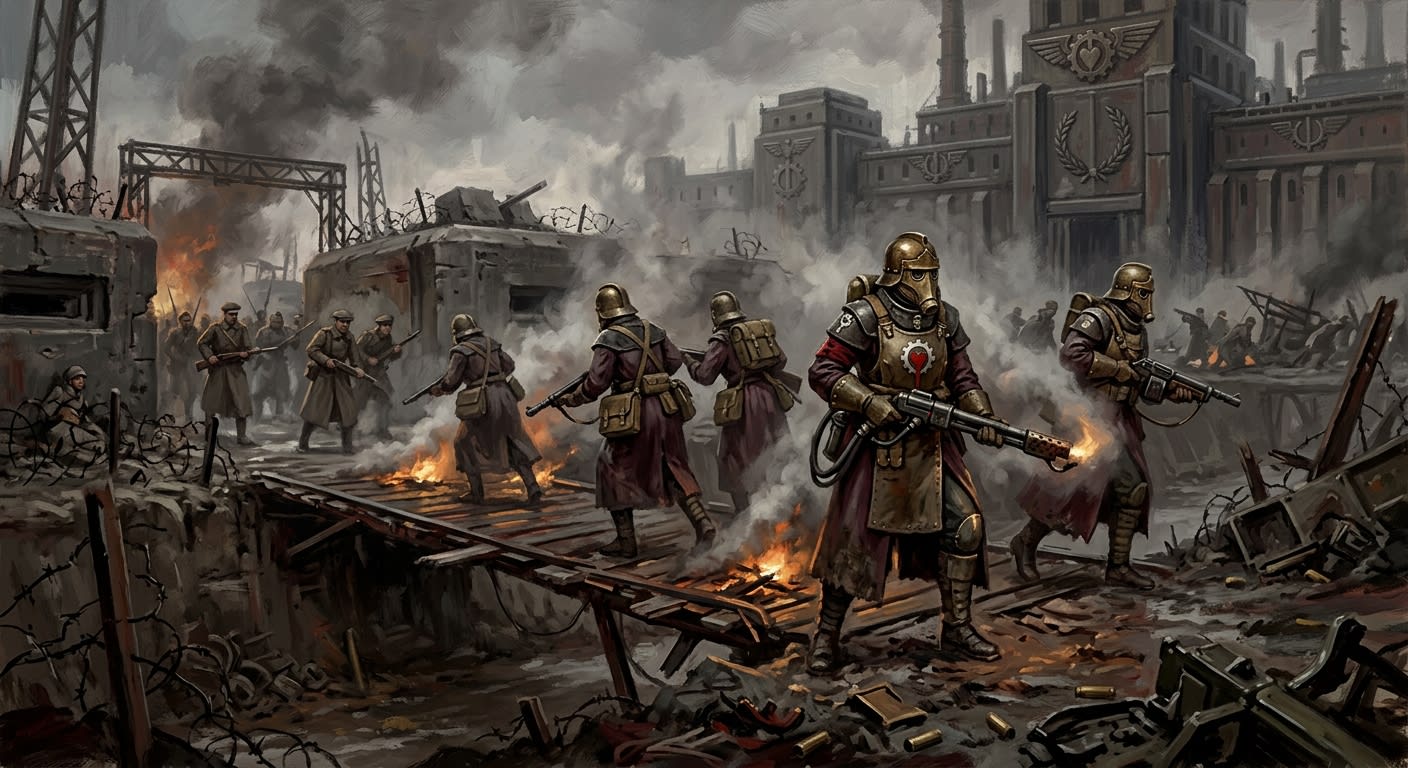
The Sisters of the Martyrdom were a wartime order of women active during the middle years of the Atheist Wars, remembered in songs, denied in ledgers, invoked in sermons, avoided in canon law, and used by the Bureau whenever a schoolroom requires a clean example of zeal without the inconvenience of clean evidence. They stood upon bridges before advancing Republican Guard columns, soaked their garments in consecrated oil, and set themselves alight.
The bridge burned. The column halted. The woman died.
Repeat this sentence across enough rivers and one has, by the Bureau's arithmetic, a military doctrine.
They took vows of destruction. This fact troubles devotional writers, who prefer women in hagiography to bind wounds, carry relics, hide infants, endure lashes, or sing beautifully while being murdered by men with bad Latin. The Sisters did some of these things, no doubt. Women in wartime rarely enjoy the luxury of a single task. Their defining vow was sterner: to destroy the passage by which the enemy advanced, and to offer their own flesh as the wick.
No founding charter survives. No abbess's rule has been authenticated. No list of members can be ratified beyond fragments: baptismal names, bridge names, execution notices, and three oil accounts in a merchant's ledger from the Rhône valley marked for lamps, which the Bureau of Shadows has underlined in a hand I recognise and dislike.
#On Their Origin After Saint-Malo
The Sisters did not arise from peace. Nothing useful does. The Massacre at Saint-Malo in A.S. 10 supplied the first blood, the first broadsheets, the first dead nun whose face could be printed cheaply enough for every parish cellar to own one. Sister Margaux became the grandmother of the war: small, elderly, unarmed, murdered on cobblestones by men who had mistaken a writ for a conscience.
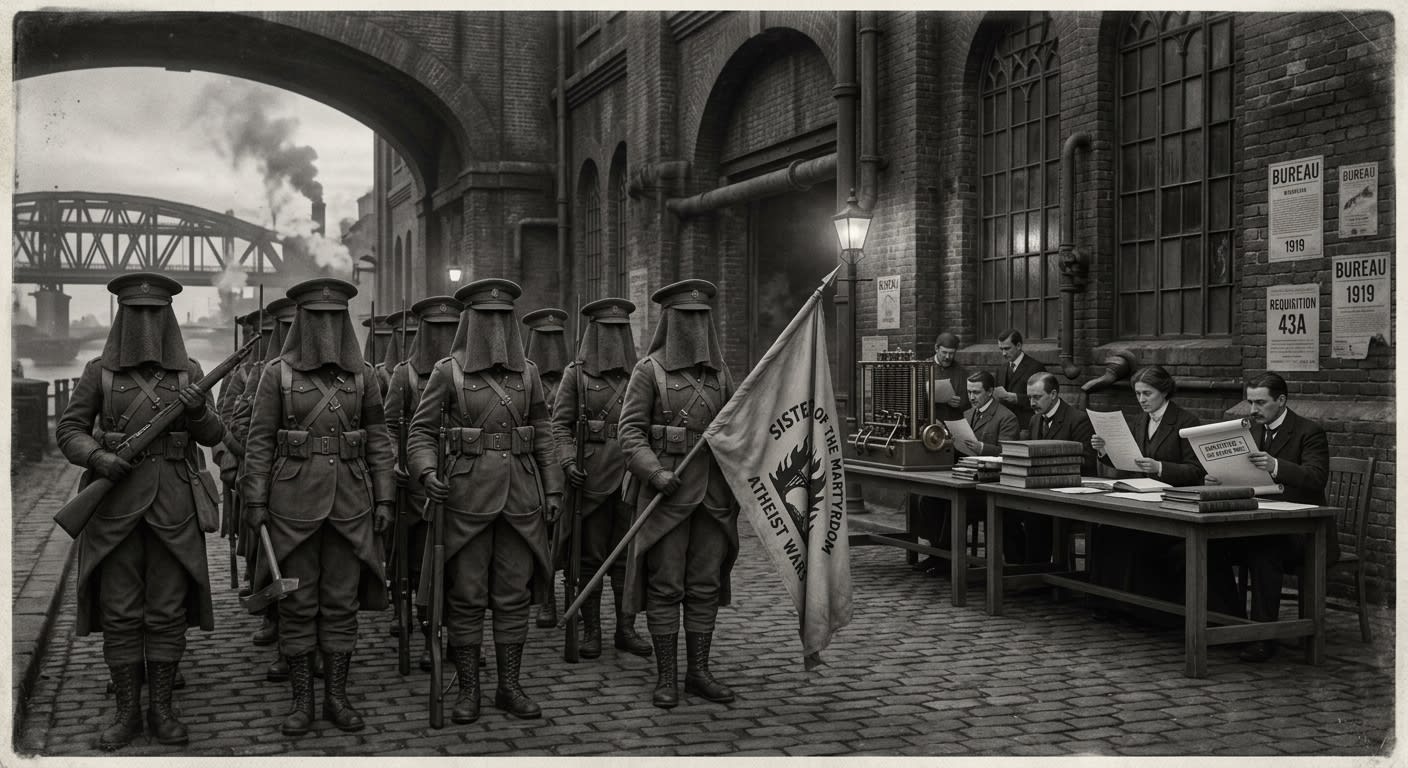
By A.S. 14, Margaux had been canonised. By A.S. 15, her image travelled faster than grain. A woman in Picardy saw it and hid powder beneath a bridge plank. A widow near Lyon saw it and refused to leave a ferry chain. A novice outside Angers saw it and wrote, in the margin of a psalter, I shall be the lock. These three records are filed separately. The Bureau has not joined them into one origin story, because joining records requires a committee and a committee requires chairs, minutes, tea, envy, and five unnecessary objections from men who have never burned anything more serious than toast.
The faithful needed time. The Rationalists had columns, artillery, prefectural maps, and men willing to march across old stone bridges into cities whose cathedral bells had been wrapped in sacking to avoid attracting shellfire. The faithful had barricades, relics, kitchen knives, bad powder, sermons, and bridges. Bridges mattered. A bridge is a piece of geography forced to make a promise. It says: here the army shall pass. The Sisters answered: no.
Their earliest confirmed action occurred in the Montreval approaches, A.S. 15, where Cardinal-Marshal Severin of Avignon was trying to hold starving garrisons against Lucien Artois and his clockwork guns. The Rationalist column reached the Pont des Tanneurs at second bell. Three women in grey habits stood at midspan. The column halted, assuming parley. The women knelt, touched tapers to their sleeves, and became a wall of flame. The bridge timbers, already soaked through the previous night, caught from beneath. Artois lost six hours, two spring guns, and the habit of assuming that nuns wished to negotiate.
Songs say Severin blessed them from the tower. Field notes say he was vomiting from fever in a tannery cellar. Both may be true. Blessings travel.
#On the Vow and the Habit
The Sisters' habit was grey wool, easily obtained and worse to burn than linen. This matters. Linen flashes and vanishes. Wool catches, smokes, clings, stinks, and remains on the body long enough for the body to walk. The Bureau of Doctrine prefers to describe their final actions as instantaneous sacrifice. The Bureau of Medicine, which has read the depositions and lacks poetry's cowardice, records that most Sisters lived between ninety seconds and six minutes after ignition.
Their vow, reconstructed from seven fragments and one hostile interrogation transcript, contained three promises:
To stand where passage must be denied.
To spend the body before the bridge is taken.
To leave no retreat for fear.
This is not charity. This is not contemplation. This is a demolition manual wearing a veil.
Earlier devotional pamphlets described the Sisters as “an auxiliary nursing order whose martyrdoms occurred during medical evacuation.”
Withdrawn. The error arose from cowardice, not confusion. A nursing order preserves bodies. The Sisters expended them. The distinction is morally uncomfortable and historically necessary.
They carried three objects: a taper in a tin case, an oil ampoule, and a small blade for cutting dress ties, mule traces, or the throat of any comrade who attempted rescue after the vow was spoken. The last object does not appear in the children's catechism edition. Children are spared many things in print. They are spared fewer things in history.
Consecrated oil was scarce. Lamp oil was cheaper. Animal fat was cheaper still. The Sisters used whatever burned. An A.S. 16 report from the Meuse corridor records an argument between a chaplain and a Sister named Maud of Saint-Riquier over whether axle grease could be blessed in emergency. The chaplain refused. Maud used it anyway. The bridge fell. The chaplain later submitted a doctrinal query. The query remains unanswered, which is the Bureau's tacit form of apology.
#On the Bridges
The Sisters' war was a map of crossings: Montreval, Tanneurs, Saint-Riquier, Châlons, the lower Meuse, the mill bridge at Avesnes, three unnamed spans outside Liège, and the western approach to Aachen in A.S. 25. At Aachen, the women protected evacuation and delayed Rationalist pursuit before the bridge's demolition. Later parish accounts assign two reliquaries and thirty-seven children to the escape; that tally remains unverified. Adèle was a former Sister. Klara rejected the title, and her later fate is unresolved.
The Sisters understood a bridge with theological clarity. A bridge is a permission. It is a straight answer to a difficult river. It is engineering's little act of optimism. The Rationalists loved bridges because their armies loved geometry: road, span, gate, square, lecture hall, decree. The faithful learned to love the broken bridge, the drowned ford, the ferry chain cut at midnight, the pontoon loosed under artillery fire and sent downstream carrying three Republican officers still arguing about jurisdiction.
At Châlons, a Sister called Bérénice waited beneath the central arch rather than on the deck. When the column reached midspan, she cut the oil bladders tied along the underside, lit the taper with her teeth, and made the whole bridge breathe fire from below. The deck collapsed inward. The Rationalists blamed faulty masonry. The masons, who had built the span in their fathers' time and resented secular criticism more than death, later testified that the masonry had performed admirably once asked to become a furnace.
At Saint-Riquier, two Sisters failed. Rain soaked the wick. The column crossed. The town fell. Their bodies were found at dawn beneath the parapet, unburned, hands still cupped around a dead taper. The Bureau's first instinct was to omit them from the cycle because failed martyrdom embarrasses liturgy. Their names survive because an old sacristan wrote them on the back of a bread account and hid the scrap in a chalice stem. I record them here: Ysabeau and Clémence. Failure does not void witness. It merely offends tidy people.
#On Kratz's Obsidian File
Now the matter grows dark, which is to say it enters administration.
The public story says the Sisters formed spontaneously: women of faith, inflamed by Saint-Malo, taking the war into their own hands when commanders lacked powder and bishops lacked courage. The public story has use. It teaches zeal. It flatters grief. It asks no procurement questions.
The Bureau of Shadows maintains another story under Seal Obsidian. Its later summary assigns early organization and funding to Cardinal Hieronymus Kratz. His age and known assignment at the time do not support this as a production fact. Procurement lists and household transfers in the dossier require independent provenance; they do not erase the women's agency or establish a single hidden organizer.
SEAL OBSIDIAN — EXCERPT, LINEAGE STATUS WITHHELD Subject █████ of █████, age ███, removed from household following debt adjudication by ecclesiastical agent attached to K████ correspondence cell. Later appears as “Sister █████ of the Martyrdom” in Pont █████ action, A.S. 16. Volunteer status: █████████████. Witness phrase: “She asked where the bridge was after they gave her the oil.”
The Bureau of Doctrine does not acknowledge Seal Obsidian. That makes discussion simple. What does not exist cannot contradict what has been preached.
Defenders of the later Kratz dossier argue that a secret apparatus would not invalidate public sanctity. The premise is disputed for the early actions; consent and coercion must be judged from evidence about each woman, not inferred from a later attribution. This is an uncomfortable legal question. Legal questions have their uses. So do tongs.
A.S. 92 instructional materials stated that “all Sisters of the Martyrdom were free volunteers, moved solely by divine inspiration.”
Corrected for internal editions only. Public editions retain the sentence pending pastoral review, which has continued for one hundred and nine years and shows every sign of outliving the reviewers.
Misunderstanding would be convenient. Some Sisters ran toward the bridges. Some begged for the taper. Some wrote farewell letters so fierce that the paper seems to scorch the hand. Some were saints in every sense the Bureau can bear to recognise. Others were cornered by war, debt, obedience, orphanhood, rhetoric, and men with plans. The same flame consumed both categories. The bridge did not ask which biography burned.
#On the Bureau's Refusal to Canonise
The Sisters have never been formally recognised as an order. This surprises the faithful, who have sung their names for one hundred and eighty-six years. It does not surprise anyone who has read canon law without a confessor nearby.
Self-immolation without authorisation violates six standing disciplines, three older episcopal norms, and one post-Concordat prohibition against unsupervised combustion by vowed persons. Sabotage of civic infrastructure, even enemy-held infrastructure, requires warrant from War or Engineering. Formation of a military religious order requires ratification. Use of consecrated oil for tactical burning requires inventory adjustment. The Sisters did everything the Synod later learned to admire and almost nothing the Synod could later afford to approve.
The compromise is exquisite. Individual Sisters may be commemorated locally as Witnesses of Transit Denial, a phrase so ugly it deserves its own small gallows. Chapels may display votive bridge-charms. Hymns may be sung if the third verse, which praises “the holy right to choose the flame,” is replaced by the approved line, “the holy duty to obey command.” Reliquaries containing ash attributed to the Sisters may be venerated under provisional status, provided no claim is made regarding the ash's original consent.
In Strasbourg, the Bureau of Doctrine keeps a locked drawer labelled MARTYRDOM, SISTERS OF — DO NOT RATIFY WITHOUT SHADOWS CLEARANCE. Shadows has never cleared it. Doctrine has never pressed. The drawer remains locked, and the faithful continue lighting little bridge-shaped candles, and the Bureau continues accepting the candle tax.
#On Their Memory
The Sisters survive where the Bureau cannot quite reach: in work songs, bridge tolls, ferry curses, widows' prayers, and the little black ribbons tied to parapets in towns that claim one of them. Their names vary. Their bridges move. Their number swells or shrinks according to parish pride. The official count recognises eleven probable Sister-actions between A.S. 15 and A.S. 18. Popular devotion claims forty-seven. The truth is somewhere between ledger and smoke, which is the usual province of history.
Their image has been softened. Icons show serene women standing in clean flame, faces calm, hands folded, veils rising in decorative tongues of gold. This is devotional fraud. A burning human being is not serene. Flame makes no room for composure. The Sisters screamed, ran, fell, clawed, prayed, cursed, and in at least two cases had to be held in position by comrades until the bridge caught. If this offends the icon painter, let him set fire to his sleeve and discover theology firsthand.
Their memory is useful to the Bureau and dangerous for the same reason: it proves that Faith can act before authorisation. The Synod prefers obedience dressed as zeal. Later Kratzian administrators used the Sisters' memory; that does not prove he organized their early acts.
The Rationalists learned from them too. After Montreval, advance orders required bridge sweeps, female detainee screens, and oil inspections at every crossing. Lucien Artois issued a field note: “No religious woman within torch distance of load-bearing timber.” The sentence has survived in Rationalist archives. It is the nearest that man ever came to prayer.
#The Ratification
The Sisters of the Martyrdom were brave. The Sisters of the Martyrdom were used. These truths do not cancel each other; they sit together like two witnesses refusing to leave the same bench.
Their bodies bought hours. Hours saved reliquaries, children, garrisons, manuscripts, and priests who later preached more beautifully than they behaved. Their fires also supplied men like Kratz with the raw material from which holy government is made: dead women, clean slogans, sealed procurement trails.
The bridge burns. The column halts. The Ledger opens.