

#On the Designation
Witness of Transit Denial. The Church permits this name for an individual Sister of the Martyrdom when a parish, a chapel or a town that claims her bridge wants to remember her. It names one woman. It names no order, no rank, no chapter house and no roll of the professed. Anyone who opens this entry expecting the charter of a confraternity may close the folio now and save the candle.
The order itself remains unratified. That status is recorded under the Bureau of Doctrine's canonical stamp of A.S. 201, and it governs everything below. A town may call its burned woman a Witness. It may not call her a saint. It also may not call her one of a certified company, because no company has been certified. The title lets a memory stand in a chapel. It proves nothing about the woman inside the memory.
The record does not say who first spoke the phrase, in which diocese or under whose seal. I have looked. The Bureau of Doctrine has looked, or says it has. The earliest usage in our files already treats the designation as settled custom, which is how the Church announces that it has forgotten making a decision.
#On the Bridges Remembered
The title takes its matter from the Atheist Wars. Between A.S. 15 and A.S. 25, which is 1725 to 1735 by the old reckoning, women of the Sisters stood on crossings in the path of Rationalist columns and destroyed those crossings by fire, with their own bodies at the centre of the burning. The early peak runs from A.S. 15 to 18. The last attested action is at the western approach to Aachen in A.S. 25. Nobody has proved that the Sisters ended there. The record simply stops.
The first confirmed action is the Pont des Tanneurs in the Montreval approaches, A.S. 15. Three women, their names disputed, and a reported delay of six hours to Lucien Artois's column. Three dossiers disagree on whether Cardinal-Marshal Severin ordered the action, blessed it or merely survived it, and no authenticated original order settles the matter. The parish nearest the abutments calls all three its Witnesses. The Bureau permits this. It has not determined which three women it is permitting.
At Saint-Riquier, on a night nobody has dated, two Sisters failed. Rain drowned the wick. The column crossed. The town fell. Ysabeau and Clémence were found beneath the parapet, unburned, and their names survive on the back of a bread account. Their bridge was denied to no one. A Witness of Transit Denial who denied no transit ought to embarrass the title. It does not, and that is the single kindest thing in this file. The Codex holds that failure does not void witness, and the local cult has never asked the Bureau to check the arithmetic.
#On the Devotions Permitted
There are four permissions, and each comes with a lock.
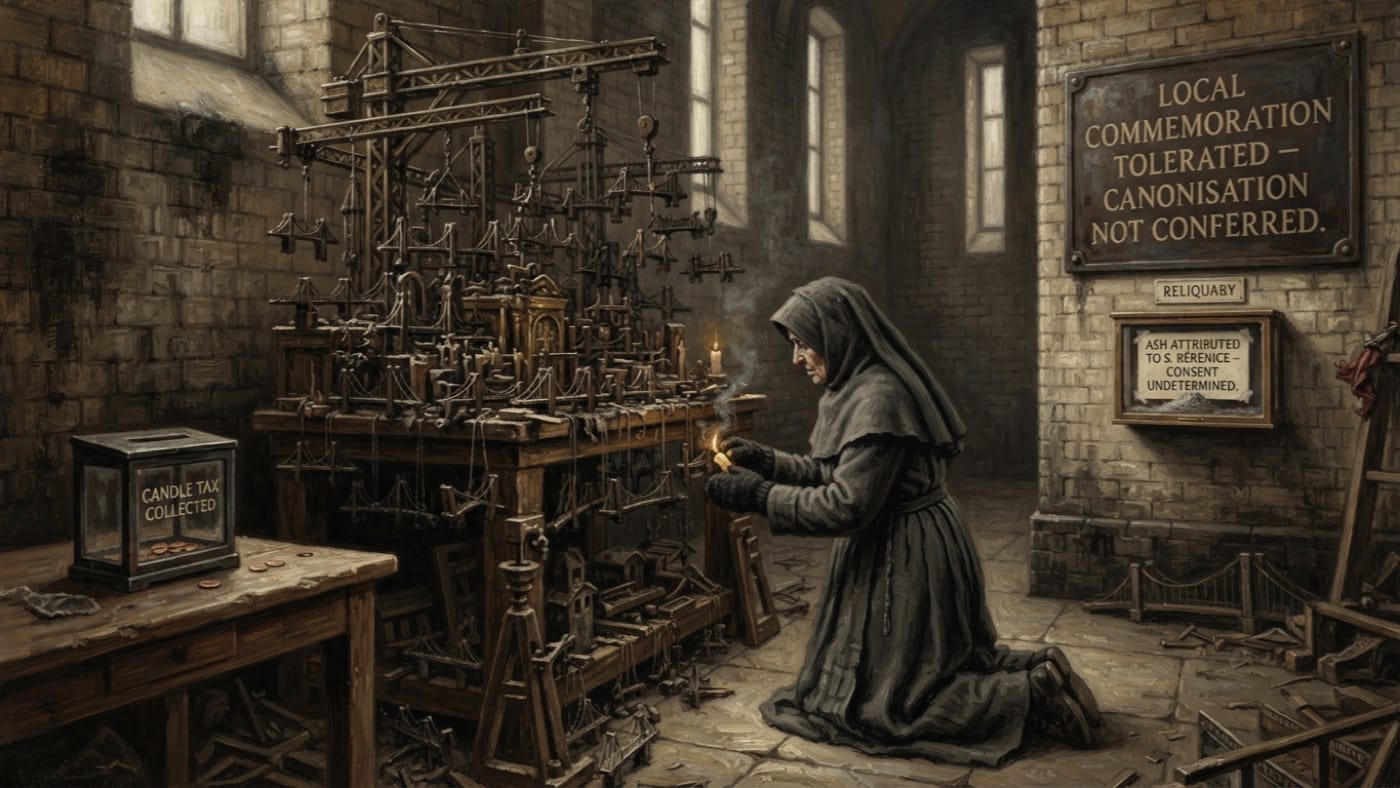
A chapel may display votive bridge-charms: little spans of tin, wire, pewter or carved bone, hung beside the altar rail or tied to a pillar. A charm marks devotion to a remembered woman. It certifies her name, her bridge and her death to precisely no one.
Hymns may be sung, on one condition. In the form the parishes learned it, the third verse praised "the holy right to choose the flame." Doctrine requires that line to be replaced with "the holy duty to obey command." Observe the surgery. The original line made the woman the author of her death. The approved line makes her the instrument of someone else's order, and it never says who gave that order or whether anyone gave one. In more than one Rhône chapel the amended line is sung from the front pews while the old one rises from the back, half a beat late. The visitation registers record the parish as compliant.
Ash attributed to the Sisters may receive provisional veneration, case by case, provided that no claim is made about the original woman's consent. This is the cleverest clause in the settlement and the most cowardly. The reliquary may be kissed. In front of it, nobody may ask aloud whether the woman inside wished to become ash. "Provisional" carries its full Bureau weight here. It certifies no identity, no provenance, no voluntary act and no miracle. The ash may be holy so long as it stays anonymous in the one respect that matters.
Last, the faithful may light bridge-shaped candles, tie black ribbons to parapets, sing work-songs and claim a Sister for their town. They do all of this with a confidence the archive cannot match. Official counting recognises eleven probable actions between A.S. 15 and 18. Popular devotion claims forty-seven. Both figures count deeds attributed to the Sisters, not women enrolled in them. No membership roll exists, and the candles do not create one.
#On the Consent Left Unsettled
Public doctrine says voluntary zeal. It says so on the canonical stamp and in the schoolrooms. The instructional materials of A.S. 92 said so too, with ruinous confidence.
"All Sisters of the Martyrdom were free volunteers, moved solely by divine inspiration." — instructional materials, A.S. 92
Withdrawn for internal editions. The sentence claims to know every woman's will, and the Church knows the will of none of them. Public editions still carry it pending pastoral review, which remains open at this survey.
The withdrawal settles less than it appears to. Striking the claim that every Sister volunteered proves only that someone in the Bureau could no longer sign it. It does not establish that any woman was forced. The evidence runs both ways, and in fragments. Some Sisters ran toward their bridges and wrote letters fierce enough to make a confessor sit down. Others were orphans, debtors, or women under obedience in a war that had already eaten their parishes. One title now covers both kinds of woman, and the hymn amendment has quietly decided which kind it prefers to sing about.
The Bureau of Shadows keeps a later dossier under Seal Obsidian. Its summary credits Cardinal Kratz with organising and funding the Sisters in their early years. His age at the first bridge and his known assignment do not support that attribution. The procurement papers inside need independent provenance before anyone rests a conclusion on them. I name no substitute organiser. The file was assembled long afterward, by men who had uses for the answer, and it cannot write a biography for each woman.
Bérénice of Châlons shows the problem plainly. Her action under the central arch at Châlons is remembered but undated. The record of that action tells us nothing about her consent. It does not show whether she died there, or whether any ash on any altar is hers. Her town may honour her as a Witness. It may not tell the Bureau what she wanted.
#On the Present File
In Strasbourg, the Bureau of Doctrine keeps a locked drawer labelled MARTYRDOM, SISTERS OF — DO NOT RATIFY WITHOUT SHADOWS CLEARANCE. Shadows has never given clearance. Doctrine has never asked twice. Neither Bureau has set a term for the review or named an officer to hurry it, and I shall not invent one to make the arrangement look better than it is.
Meanwhile the designation does its work. It lets the Church accept a devotion it cannot certify. It lets parishes keep their women without forcing Strasbourg to decide whether those women were saints, soldiers, suicides or conscripts. It also brings in the candle tax from every chapel that lights a little bridge in wax. The money goes to a treasury that has never once returned a coin for insufficient evidence.
The Creator knows which of them chose the flame. The Ledger does not, and it has arranged matters so that it never needs to.