

#On the Work Kept Shut
This is a survey of the seal-binders of the Bureau of Records as they serve in A.S. 201. It sets out what the Bureau's published accounts say they do, and the point at which their work passes out of their hands into a higher rank's. It gives no year for the first appointment, because no account I have been permitted to read records one. Records gathered its scattered registers under Veyrault around A.S. 78 and acquired its constitutional dignities afterward. Neither date tells me when someone first sat down with wax and wire and answered to this name. I decline to guess. Guessing is an offence in that Bureau, and I am only a guest there.
The subject is an occupation. Seal-binders are officers of Records. They keep no guild of their own and no religious rule, and their work has produced no doctrine that needs a feast day. What they handle is the classified volume.
Any vault-keeper with a dry shelf and a steady pulse can keep a book. The seal-binder controls when the book is opened, and makes certain that moment belongs to the proper rank. A kept record is furniture. A record kept shut is an instrument of state.
#On Wax, Wire and Prayer
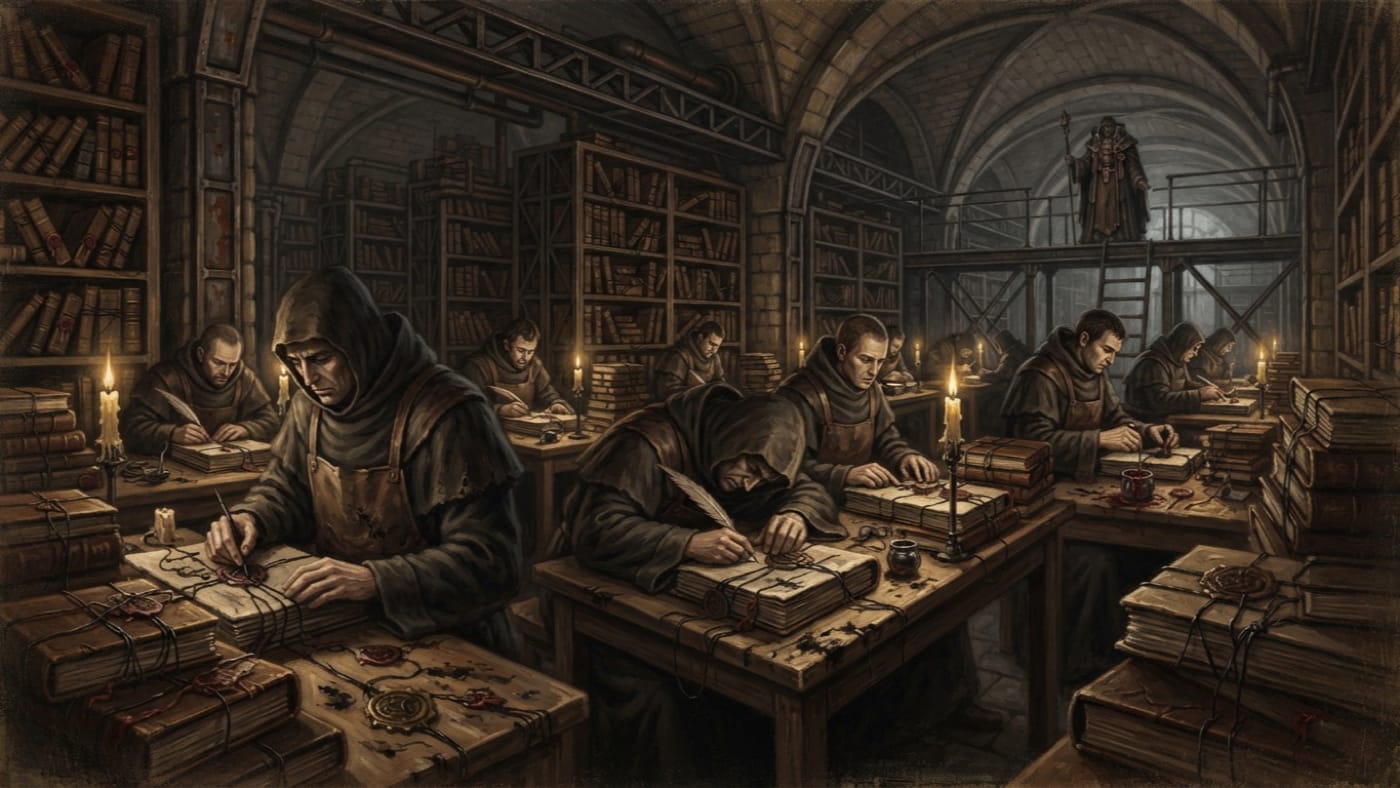
The Bureau's own account says its seal-binders chain classified volumes shut with wax, wire and prayer. It names three materials and stops there.
Wax is the Church's oldest notary. It takes an impression, keeps it, and shows any later disturbance to anyone who looks. Wire gives no impression of anything. It holds, and it holds a volume of vellum against the curiosity of every hand that is not entitled to it. The Bureau lists prayer alongside them with the same bluntness, as though it came from the same supply cupboard. Perhaps, in the Bureau's view, it does.
I have not been given the words of that prayer, and I will not make any up. A forged prayer on a classified volume would be a sin with two dockets, one in Doctrine and one in Records, and I have no wish to be the subject of either.
The published accounts are silent on the sequence. They do not say how many turns of wire go round a volume, what alloy is drawn, what goes into the wax, or whether the prayer comes before the knot or after it. What they do furnish is the room. The lower levels of the Basilica of the Ledgered Saints smell of iron gall and tallow. The work is done by candlelight, because Records allows no lantern near vellum. The Bureau considers fire too imprecise a way to destroy anything. Only a seal may break what a seal has bound. That is the Bureau's sentence, and the seal-binder makes it true one volume at a time.
The volume itself stays closed throughout this entry. I recommend the same discipline to the reader.
#On the Hand Permitted to Open
The knot is the whole of the matter. No hand below the rank of Archon may undo a seal-binder's knot.
The Archon of Records may. The office's published profile lists the knots among the things its hand may open, alongside Archon-tier folios and senior custody of the Great Ledger of Souls. Lesser officials who attempt the knots are prosecuted for fraying. The accounts give no penalty and describe no procedure. The word fraying is enough to keep most clerks' fingers in their sleeves.
That gives three separate duties, and the Bureau keeps them apart. One officer closes the volume. Another may carry it. A third, of Archon rank, may open it. A clerk below Archon tier may carry an Archon-tier folio the full length of Strasbourg without being permitted to read a line of it. Such folios are catalogued by weight, so the man carrying the folio knows to the ounce what he is forbidden to know by the page. If the string frays while it is in his care, he answers for it.
The accounts do not say that the seal-binder holds Archon rank. They do not say that the binder chooses which volumes are closed, or that the binder brings the prosecutions. They say the binder ties a knot that outranks everyone below the Archon. That is sufficient authority for one pair of hands at one desk, and more than most bishops will ever hold.
Archon's Override confirms the arrangement from the opposite direction. The Override is a spoken citation of archonal altitude. It makes a lower officer stand aside and yields to any equal or superior seal. It suspends a clerk's objection. It confers no rank on the person who speaks it, so it gives a lower hand no title to the knot. I have spoken the phrase at eleven checkpoints and seen eleven clerks go still. None of those occasions made me qualified to untie a seal-binder's work. I have never been tempted to find out whether the knot would agree with me.
Whether a lower hand fails at the knot because the law forbids it or because the knot itself resists, the Bureau has not said. The prosecution for fraying indicates law. Listing prayer among the materials indicates that the Bureau has not ruled out anything further. Both readings are in print, and I file both.
The Archon's hand has a ceiling of its own. The knot yields to the Archon. The Archon in turn yields to Ninth-Ratification and to any office that asserts a superior hazard. I state the order of precedence and leave the stair where it is.
#On the Vaults and Their Keepers
The best documented example of the work is on the first sub-level beneath the Basilica, in the Recantation Vaults. That is the archive-church that buttresses the Cloister of Concord, and Records keeps every floor of it that I am competent to name. My survey of that floor recorded the division of labour in one line: vault-keepers tend the shelves, and seal-binders tend whatever must be shut.
The distinction matters because the room is full of wax. Each recantation in those volumes is notarized stroke by stroke, and the tremor of the hand that wrote it is kept in seal wax beside the words. That is notaries' work and authentication. The accounts do not give it to the seal-binders, and neither do I. The wax beside a recantation remembers a hand that shook. The wax on a bound volume forbids any hand that has no business there. A careless visitor sees one trade at work. The Bureau sees at least four: the keeper who shelves, the notary who attests, the penitent who wrote, and the binder who closes.
The account of that floor does not make it the binders' headquarters. It does not make it their school or the place where the occupation began, and it is not the only room where they work. It records them there and in present service. The Bureau has supplied no staff roll for the floor and no count of volumes, and this survey adds none. The Bureau's total of some fourteen thousand scribes, notaries and census-takers is a figure for the whole Bureau. Anyone who divides it to estimate the number of binders will be doing arithmetic the Bureau has not authorized.
#On the Reported Deaths
The Bureau's published account of its own staff ends its description of the occupation with one sentence, and I reproduce it as the Bureau gives it. Several seal-binders have been found dead at their desks, still knotting.
Records attests the report. It does not explain it. The account names none of the dead and gives no year, and it puts no number beyond several. It names no cause. It does not say who found them, whether the knots they were tying were finished, or whether anyone of Archon rank was sent to see if the work could be undone. I have not seen the desks. I have seen the sentence, which was printed with the same calm as the line about census-scribes being fed by their parishes.
This report should be kept apart from the older account of the Recantation Desks, which tells of chained Rationalist clerks said to have gone on writing after death. The images resemble each other. The accounts are separate, and their resemblance proves no common room, no common hour and no common cause. I join nothing that the record has kept separate.
I offer no diagnosis. A Warden who invents a cause of death to tidy up a paragraph is a forger with a better title. The dead binders stay as the Bureau left them: found at their desks, and still knotting.
#On Present Service
In A.S. 201 the seal-binders of Records close classified volumes with wax, wire and prayer, in the candlelit lower levels of the Basilica among other places. The Archon of Records may untie what they tie. Nobody below that rank may, though lesser hands may carry the bound folios and are made to answer if those folios fray. That is the extent of what is documented, and this survey has kept to it.
The books stay shut. The clerks keep carrying them by weight. Readers who still want to know what is inside may apply to the Archon, whose name is classified, and whose reply will be recorded.