
#On the Ninth Seal
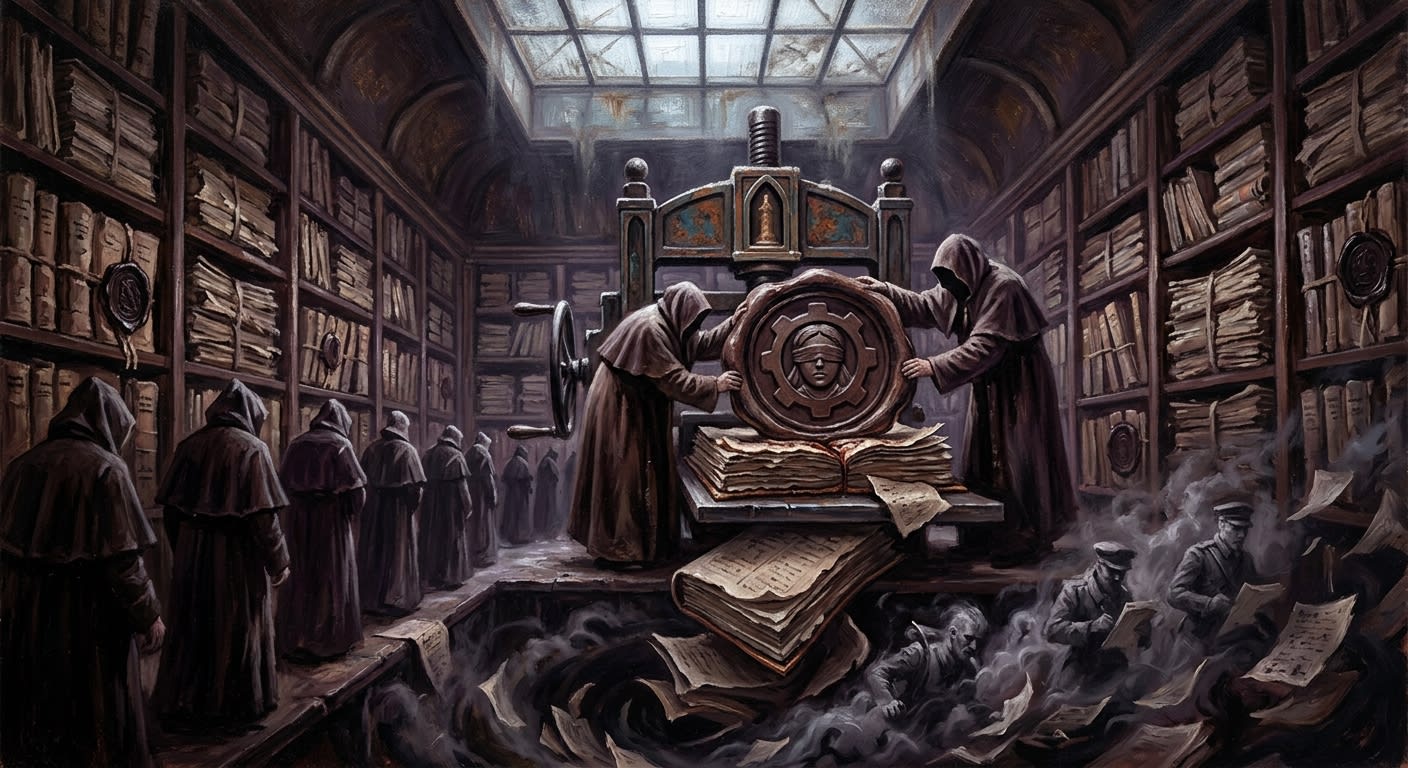
Ninth-Ratification is the Synod's deepest public lie about secrecy. I phrase this carefully, which should alarm the attentive reader. Higher classifications exist in rooms where even the lamps are required to forget their own flame. Ninth-Ratification is the highest classification the ordinary machinery of the Bureaus may name without chewing off its own tongue. A document sealed under Ninth-Ratification has been made dangerous to context.
Fourth Ratification hides names. Fifth hides structural causality. Sixth hides military embarrassment. Seventh hides doctrinal infection. Eighth hides mechanisms still useful to offices that dislike sharing. Ninth hides the fact that the Synod can do what the file describes, has done it, may do it again, and intends to remain holy after the doing.
The formal definition reads: Ninth-Ratification — restricted access classification applied to records whose disclosure would imperil ontological continuity, doctrinal monopoly, civic memory, active suppression architecture, or the lawful ignorance of subordinate offices. Admire the phrasing. It places the safety of ignorance beside the safety of existence and grants both equal dignity. Only a mature state can make stupidity sacred by category.
The label appears where the Ledger has touched something and left teeth-marks. The Redaction of Epernay bears it. The seventeen inconvenient survivor facts from the Battle of the Iron Plains bear it. The supplementary entries of the Cloister of Miscounted Beads bear it. The lower cabinets of the Bead Vault bear it. Certain access notes in the Vault of Silences bear it in wax so black the seal looks less applied than grown.
Ninth-Ratification is a seal, a permission, a muzzle, a sacrament of denial. It instructs the clerk to stop reading, the officer to stop asking, the historian to die poor, and me to write around a hole with such elegance that the hole begins to look intentional.
#On the Birth of Sealed Consent
The Ninth Seal did not descend from Heaven. Heaven has better manners. It grew from the Standard Ratification Protocol born at the Council of Worms, tested at Mainz, abused by every competent office afterward, and refined by the Bureau of Records until consent became a retrospective instrument.

The old principle was simple: do the thing, record the thing, ratify the thing already done, punish anyone who notices the order. This is the Kratzian skeleton beneath the modern state. At Worms, bishops signed what had already been made true by the Night of Black Decrees. At Mainz, seating charts and seal order transformed dissent into furniture. The first ratifications were political theatre. Their genius lay in discovering that theatre, witnessed by enough notaries, becomes architecture.
The numbering came later, when offices tired of improvising ignorance. First Ratification handled relic axiom and public miracle. Fourth Ratification held commemoration at a distance safe enough for pilgrimage. Fifth gathered engineering shame and sacrificial mortar. The higher numbers arrived when the Synod began discovering that some facts remained active after being filed. A confession could contaminate the hand that copied it. A name could persist after deletion. A bead string could count back.
Archon Veyrault forced the matter. His doctrine of record-existence made paper into threshold, weapon, cradle, and grave. Under his hand, to be struck from the Great Ledger was to lose the administrative permission to have been. The Bureau required a seal strong enough to contain records that altered the conditions under which records could be trusted. Ninth-Ratification answered. A lower seal hid secrets. The Ninth hid operations against reality's bookkeeping.
Instructional charts once described Ninth-Ratification as “maximum secrecy classification.”
Corrected. Secrecy is a childish word. Ninth-Ratification governs records whose exposure changes the exposed, the exposer, the office receiving the exposure, and the history by which exposure might be judged.
The earliest surviving Ninth formula appears in a Records handling slip attached to an Epernay pre-operation bundle. The slip contains no town name, no date visible to ordinary light, and no summary. It bears only three clauses: No public index. No subordinate inference. No mercy by analogy. The last clause is the knife. If a clerk may compare one operation to another, policy becomes pattern. Pattern becomes proof. Proof becomes accusation. The Ninth cuts analogy before it breeds.
#On Access, Rank, and the Pleasure of Being Denied
Access to Ninth-Ratification is granted by office, necessity, hazard, and politics, in descending order of the official explanation and ascending order of actual force. Archons may request. Some are refused. Hierarchs may command. Some commands are returned blank. Inquisitors may attend a Ninth object where duty binds their eyes and hands. Clerks may copy without understanding if the schedule blinds each clerk to every other clerk's line. I possess a narrow Ninth exemption for professional doctrinal commentary, which means I may know where a subject has been sealed, may not know what has been sealed, and may be punished for guessing correctly.

This irritates me. It is also wise.
A Ninth clerk is trained less to read than to fail at reading in the approved shape. Black-room transcription divides each document across hands. One copies dates. One copies titles. One copies numeric columns. One copies seals. One copies redacted fields because even blankness has contour. No clerk sees the whole. Supervising officers assemble the copy and then seal the assembly report under the same ratification, a procedure so magnificently self-feeding that one wants to applaud until Purity arrives.
The blind schedule is cruel by design. Clerks dream fragments. A man assigned to copy authorizing seals from an Epernay writ began writing door numbers on his breakfast crust. A woman who transcribed Iron Plains casualty categories refused sunlight for three weeks because it fell in columns on her floorboards. Three Ninth clerks from the Cloister supplementary office learned to recognize bead-click in rain and were transferred to vegetable accounts, where two continued hearing peas answer one another in drawers.
Denial under Ninth-Ratification has ritual grades. A red denial means insufficient rank. A violet denial means sufficient rank, improper timing. A black denial means the request has become evidence. A blank return means the Bureau has declined to participate in the applicant's version of causality. Blank returns are admired by connoisseurs. I have received two. I framed neither, because even vanity knows when the wall is listening.
#On Epernay and Total Ledger Severance
Epernay is the patron absence of the Ninth Seal. The city had vineyards, inns, tithe barns, a cathedral, legal markets, illegal markets, bells that rang on the quarter-hour, and a population large enough to cultivate civic arrogance. It displeased the Synod. Purity cites deviance. Tithes cites unpaid levies. Doctrine cites inevitability, which is Doctrine's preferred perfume for approval.
The authorizing writs remain sealed under Ninth-Ratification because the method matters more than the motive. Motives can be sermonized. Method instructs. Records did not burn the city. It separated the city's names from one another until no name had enough neighbours to prove it belonged. Births reclassified. Marriages transferred into a column that does not exist. Property deeds suspended. Tithe receipts marked pending reconciliation. Burial entries unmoored from earth. The city ceased by losing the paperwork by which memory holds hands.
TOTAL LEDGER SEVERANCE — ANNEX C ████ scribes worked in shifts for ██ weeks. ████████ parish witnesses relocated, reclassified, or █████████. Three bell-ringers continued quarter-hour discipline after payroll deletion. Ropes cut on the fifth night. Bells continued until dawn. Authorising signatures: Ninth-Ratification / non-public / active.
Ninth-Ratification covers the writs because Epernay proves a city can be killed without noise. It also covers the pieces that resisted death: indulgence tokens stamped with the name, road memories that skip without breaking stride, bells heard where no tower stands, old wine ledgers whose page numbers jump like frightened goats. These fragments are dangerous because they reduce impossibility to evidence. Evidence irritates doctrine.
Public summaries state that no operational parallels to Epernay exist in current Bureau practice.
Clarified. No public operational parallels exist. Current Bureau practice contains classifications whose comparison to Epernay would be irresponsible, unauthorized, and, in at least two cases, accurate.
The Ninth rule born from Epernay is called No Mercy by Analogy. A clerk who sees resemblance between a sealed absence and an active procedure must not write the resemblance, speak it, index it, sketch it, or stare meaningfully at the relevant shelf while another clerk passes. Similarity is a corridor. The Ninth bricks it shut.
#On the Iron Plains and Testimony That Would Not Behave
The Battle of the Iron Plains earned its lower records in fire and its Ninth record in agreement. The Synod can survive catastrophe. It has made catastrophe one of its dialects. What it cannot easily survive is testimony that says the wrong intelligence stood behind the catastrophe.
Fourteen men survived. Their useful facts were published: fire fell without warning; fire consumed without discrimination; fire ceased when nothing remained. These are safe because they make the Enemy vast, cruel, and impersonal. Vast cruelty is good for recruitment. Impersonal terror is good for doctrine. The seventeen inconvenient facts were sealed under Ninth-Ratification because they gave the fire behaviour. Direction. Warmth. Song.
Four survivors reported that the fire moved from left to right across the formation with the systematic patience of a clerk stamping margins. Three called it warm until it touched flesh. One Private Kessler heard singing. His testimony sits apart, in a vault beyond even ordinary Records access, because song invites comparison with bell, hymn, prayer, Pale Chanter output, Orison drift, and other acoustic embarrassments the Bureaus prefer to keep in separate cages.
A lower seal would have hidden the numbers. The Ninth hides the relations among numbers, sensation, pattern, and military doctrine. If the Iron Plains fire possessed direction, artillery doctrine changes. If it possessed invitation, morale doctrine changes. If it sang, the boundary between miracle, sorcery, bell, and demon-voice acquires cracks wide enough for theologians to crawl through and die richly.
The Ninth permits no office beneath the seal to build a world in which the witnesses told the truth.
#On Beads, Dorm Rows, and Living Evidence
At the Cloister, Ninth-Ratification has learned domestic habits. It does not arrive with Archons and black wax. It sits in damp cabinets, dormitory slates, intake tags, bead cases, salt basins, and the short breath between a name called from the wrong bunk and the clerk deciding not to answer.
The Cloister was built to reconcile pilgrim bead strings with route records. Reconciliation is such a pretty word for coercion that I almost forgive it. A pilgrim claims thirty-seven beads; the string holds thirty-nine. A route passes south; the bead says north. A dead woman's name appears on an intake roster while her cord is warm in a clerk's hand. Ordinary discrepancy becomes supplementary entry. Supplementary entry becomes Ninth protocol once the discrepancy begins correcting the office correcting it.
The Dorm Rows produce Ninth incidents because crowded misery is a superb instrument for reality's lesser crimes. In A.S. 199, ration tubs arrived marked for forty-eight bodies. Present bodies: fifty-one. Slate count: forty-seven. Three names answered from upper bunks after snuff. One candle continued burning without wick until the line breaks into black wax and discretion. The disposition is sealed under Ninth-Ratification, which means the Bureau has decided arithmetic lost in a dormitory may be contagious.
The Lost-Procession Yard offers the same lesson under rain. In A.S. 200, forty-six pilgrims entered under a Saint Merrow badge. The leader was absent. All claimed to be rear column. Front column recorded as cleared two days prior. Three wrist tags bore Jossa Rill's handwriting before she had seen them. Under a lower seal, this is anomaly. Under the Ninth, it is evidence that sequence, authorship, and custody can be rearranged while every participant remains obedient.
The Bead Vault keeps such cases cold. Archivist Keth understands what younger offices do not: some evidence wants to be useful. Use is the danger. A string that remembers wrong may be fraud, miracle, hunger, ghost, hostile ink, or the first tug of a correction older than the Great Ledger. Touching it bare-handed gives the thing a clerk. Every ambitious Bureau wants a clerk.
#On the First String and Corrective Heresy
The rumour of the First String is the Ninth Seal's most intimate insult. The Quiet Thread teaches that the original count remembers what later ledgers erase. Brokers whisper that a prime cord can restore ancestry, alter sponsor history, reverse redaction, or make a dead claimant legible again. Purity calls this fraud until it calls it contamination. Records calls it impossible until it requests custody. Doctrine calls it heresy with the slow appetite of a man reading a menu.
If First String contact can reverse a Ninth-Ratification redaction, then Epernay may retain recoverable civic memory. If contact can deepen redaction, a province may be taught gratitude by absence. If contact can redirect bead drift, the Cloister becomes less intake house than engine. These sentences describe the shape of policy's temptation.
SEALED SPECULATION — DOCTRINE ACCESS ONLY If First String contact can reverse a Ninth-Ratification redaction, then █████████████████ may retain recoverable civic memory. If contact can deepen redaction, controlled use against ████████████ would reduce rebellion without troop levy. Recommendation from unnamed Records hand: test on orphan cohort. Doctrine response: █████████████████████████.
The Ninth Seal covers speculation because speculation here is engineering in cassock form. A man asking whether a redaction can be reversed has already imagined the handle. A woman asking whether drift can be directed has already drawn the channel. The Bureau does not fear ignorance. It manufactures ignorance daily, wraps it in ribbon, and distributes it at feast days. The Bureau fears half-knowledge with ambition.
This is why Keth remains in place. She is an old wall with keys. Vale holds authority, Rill moves bodies, Keth hears the shelves. A younger archivist would want discovery. A Purity officer would want flame. A Records innovator would want test cohorts. Keth wants the cabinets to remain closed and the fools to remain outside. In a sane civilization she would be called a saint. In ours she is called difficult, which is the same thing without hagiographic expenses.
#On the Vaults Where the Seal Lives
In Strasbourg the Ninth Seal takes stone form beneath the Basilica. The Vault of Silences is less room than verdict. Forty-seven steps descend. Forty-nine return. The Bureau of Engineering has certified both counts correct, a decision that tells the prudent visitor not to ask about staircases near dangerous books.
The Index Damnatus Chamber operates under Ninth access except for attending Inquisitors, who are permitted by duty to stand close enough to be harmed and too low in rank to understand the insult. The Index is turned at Matins. A page receives consecrated air. Three benches watch by not watching. South, east, west. No north. The geometry has explanations. Too many explanations are the first smell of suppression.
The Register of Sounds exposed Inquisitor Breel in A.S. 187. She transcribed what she did not remember reading. Records restricted the bench. Purity shortened shifts. Nobody moved the chamber, closed the Index, or admitted that a sealed object had taught a trained mind to betray its owner. Ninth-Ratification thrives on such restraint. The system fails, corrects the human, preserves the room, and calls the room proven.
The Vault also holds the secondary lives of sealed events: Epernay fragments, Iron Plains testimonies, forbidden names, pen from Vienna's Council of Nine, registers that must remain open because closure invites pressure. Pressure invites leakage. Leakage invites clerks. Clerks invite catastrophe with tidy margins.
The Ninth Seal is architecture for keeping contradictions close enough to use and far enough away to deny.
#On Lower Ratifications and the Envy of Clerks
The lower ratifications hate the Ninth. I use the word literally. Offices develop appetites, clerks develop loyalties, seals develop reputations, and every reputation eventually demands food. A Fourth-Ratification clerk believes himself admitted to the inner weather of power because he may read the names withheld from pilgrims. A Fifth-Ratification engineer believes himself hardened because he may see the mortar formula and the count of volunteers in the wall. A Sixth-Ratification War officer believes he has tasted darkness because his annex contains casualty columns with the province name removed. Then each meets a Ninth file and discovers he has been playing with cupboard keys.
Fourth Ratification preserves the sanctity of grief by hiding persons. It is useful, merciful when bullied into decency, and beloved by pilgrimage offices that need commemorations clean enough for processions. Fifth Ratification protects structural shame: who was poured into what, which wall hums, which bridge stands because someone authorized an experiment on bodies too poor to complain. Sixth protects battlefield knowledge that would make recruiting harder. Seventh protects doctrinal contagion, the sort of phrase, diagram, hymn-line, or correction that enters the mind wearing a lawful coat and leaves with furniture. Eighth protects mechanisms, current tools, active suppressions, and living arrangements between offices that would rather die than share credit.
The Ninth receives what remains active after secrecy.
That is the distinction young clerks miss and old clerks feel in the wrist. A hidden name under Fourth lies still. A hidden method under Ninth may reach for the hand that hides it. A sealed casualty under Sixth embarrasses War. A sealed fire-testimony under Ninth may change the grammar by which War understands fire. A redacted pilgrim under Fourth may vanish from a commemorative list. A bead string under Ninth may bring him back with revised handwriting.
There is etiquette among sealed offices. One does not flaunt a Ninth seal before lower clerks unless one wishes to breed either panic or petitions. The wax is kept covered. File carts move after bell-hours when corridors thin. A clerk carrying Ninth material does not pause to gossip, bless a child, correct a novice, or answer if addressed by a name he has not used in years. If he drops the folio, no one helps him without witness. If another hand touches the cover, both persons are recorded. If the cover touches the floor and the floor bears a saint tile, Rites must be notified, though Rites must not ask why.
Lower-rank jealousy produces small crimes. Seal-peeking. Cart-following. Shelf-list reconstruction. Index-gap gossip. The counting of black-wax orders by quarter. The comparison of denials over wine. Three archivists in A.S. 188 reconstructed the outline of a Ninth cabinet by tracking which tea tray routes avoided a Records corridor. Their conclusion was wrong, but the method was excellent, which is why two were punished and one was hired.
The Bureau calls this inference trespass. I call it intelligence misapplied upward. Both formulations lead to the same locked room.
A prudent Ninth custodian leaves decoys: Fifth-seal bundles with dramatic labels, Seventh-seal scraps humming just enough to frighten ambitious fools, Eighth-seal annexes full of numbers that look like troop strengths and are actually bell maintenance quotas. The best decoys flatter the trespasser's preferred sin. War steals casualty shapes. Records steals cross-references. Purity steals contamination notes. Doctrine steals sentences. Tithes, naturally, steals totals, because grace may be mysterious but an unguarded number is practically begging for custody.
This theatre is expensive. It is cheaper than enlightenment.
#On Abuse, Necessity, and the Present Seal
Abuse of Ninth-Ratification is inevitable, which is why the Bureau has defined abuse as unauthorized use by an office currently out of favour. A favoured office may seal incompetence, crime, miracle, failed experiment, successful experiment, prophetic furniture, military embarrassment, or an inconvenient aunt under hazard logic. An unfavoured office may seal the same item and discover a sudden institutional appetite for transparency.
I do not oppose abuse in principle. Abuse is merely power without flattering upholstery. I oppose ugly abuse, wasteful abuse, abuse performed by men whose prose cannot carry the sin. Ninth-Ratification should be reserved for records that bite. Sealing a payroll scandal under Ninth is vulgar. Sealing a city-redaction writ is proper. Sealing a candle incident where the candle had no wick and three extra bodies answered after snuff is, regrettably, sensible.
A.S. 187 guidance warned clerks against “overclassification.”
Withdrawn. Overclassification is less dangerous than underclassification where objects, names, bead strings, testimonies, fires, or staircases demonstrate initiative. Clerks are instructed to overclassify first and be mocked later. Mockery is cheaper than resurrection.
As of A.S. 201, Ninth-Ratification protocols are active in the Vault of Silences, the Bead Vault, certain Cloister supplementary files, Records archival severance cabinets, Purity index chambers, Shadows debriefing bundles, and all operational annexes connected to Epernay, the Iron Plains survivor deviations, Hollow Court observations, and selected levy-renewal provinces whose names are not to be reconstructed from omissions in this sentence.
The seal has enemies. Reformers want review panels. Mercy wants sunset clauses. War wants faster battlefield clearance. Records wants expanded custody. Purity wants discretionary burn authority. Shadows wants the label removed from documents whose existence it finds socially awkward. Doctrine wants all of them to stop touching its toys.
I have seen enough to defend the seal and enough to despise the hands upon it. The Ninth is a lock placed on a room full of knives, saints, errors, cities, songs, strings, and fires that learned manners from clerks. Remove the lock and the fools rush in. Trust the lock and the keyholders become kings of omission.
The Bureau chooses the lock. So do I.
At the bottom of every Ninth file sits the same unwritten instruction: do not compare, do not complete, do not restore sequence, do not ask what the redaction protects from whom. A lesser state would call this cowardice. We call it preservation. The distinction is sealed.