
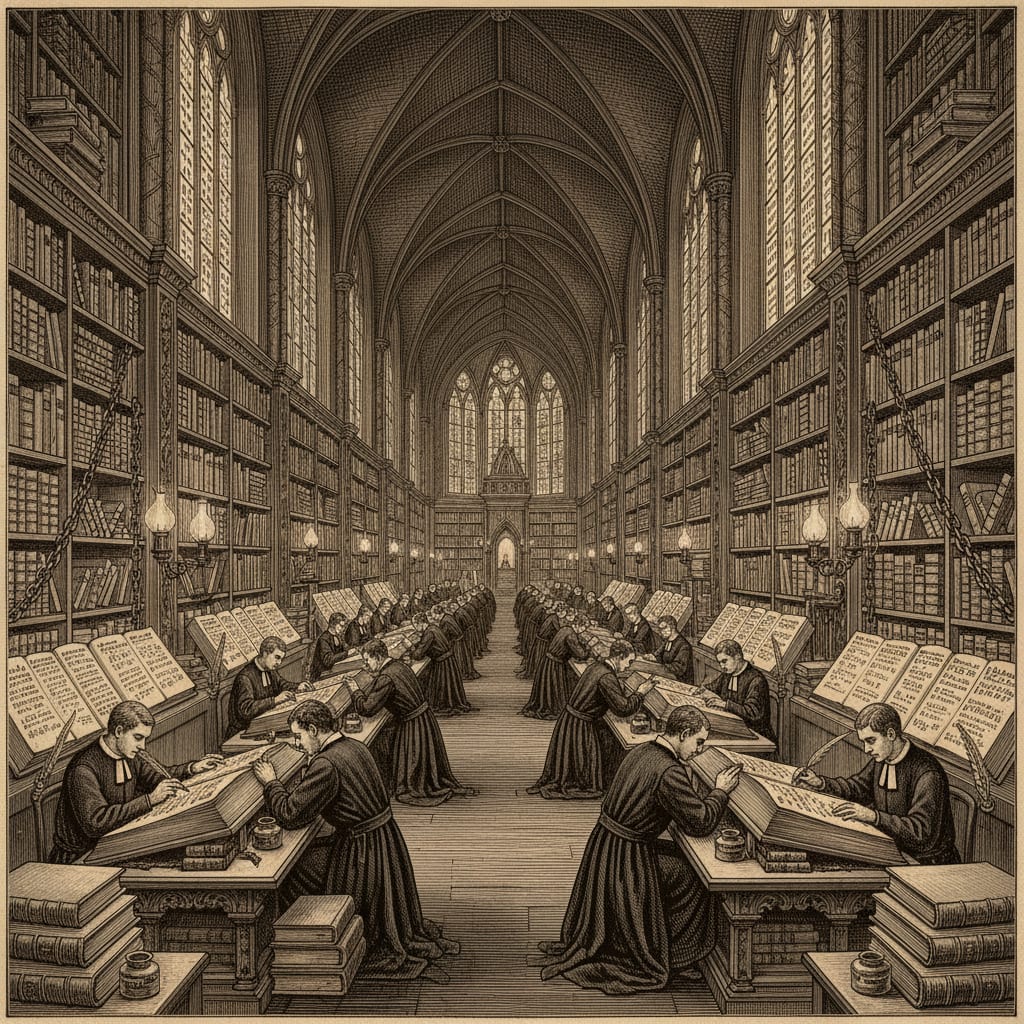
#A Building That Reads You
I am Valerius Drax — Hieromnemon of Strasbourg, Warden of the Sacred Ledger, and the one man alive who has descended to the fourth sub-level of this Basilica and returned with his handwriting unchanged. I do not say this to boast. I say it because the Basilica has a way of altering penmanship, and the Bureau of Records keeps samples.
The Basilica of the Ledgered Saints is not a church in any sense a parish cleric would recognize. It was a church once — briefly, in the first months after the Concordat, when men still imagined worship and administration might occupy separate rooms. That delusion lasted a single winter. By spring the pews were gone, replaced with lectern-desks. By summer the confessionals had been repurposed as filing cabinets. By the Feast of the Cracked Bell the altar itself bore not a crucifix but a stamp-press the size of a man's torso, and the transformation was, per Bureau minutes, "ratified without dissent." The one bishop who objected found his objection already filed — dated three days before he made it.
Earlier editions of this Codex described the Basilica as "the largest library in Christendom."
This is imprecise. A library stores books. The Basilica stores people — rendered into ink, compressed into entries, shelved by baptismal district and tithe-class. What you call a library, the Bureau calls a census that has forgotten how to stop counting.
#The Nave of Numbers
The central nave stretches the full length of the original cathedral — three hundred paces from the west door to the apse, and every pace of it walled, floor to groined vault, in chained ledgers. Not shelved. Chained. The Bureau learned early that books walked off; the chains were the Bureau's answer, and the answer was permanent. Each ledger weighs between four and eleven pounds. Each contains between eight hundred and twelve hundred entries. Each entry is a soul.
The stained glass above does not depict martyrdoms. It depicts columns: numbers, tallies, tithe-yields rendered in oiled glass so they glow amber when the sun cooperates. A visitor expecting saints will find instead the population count of the Diocese of Mainz in A.S. 189, the grain receipts of Lorraine in A.S. 197, and a single window showing nothing but the number one. No annotation. No context. Later custodians attribute its design to Augustinus, but neither the installation date nor a lifetime instruction has been verified. The Bureau's official explanation is that the number refers to the Creator. A glazier subsequently transferred offered another explanation: someone had failed to specify what the window should depict, and the artisan made the only safe choice.
The lectern-desks run in rows of forty, each staffed by a clerk in black cassock and banded collar, dipping quills in crimson ink that the Bureau of Records has standardized across every scriptorium in the Theocracy. The ink is mixed from iron gall, ox blood, and a mineral the Bureau sources from a quarry it will not name. It does not fade. It does not wash. A clerk who spills it on his fingers will carry the stain to his grave, and the Bureau considers this appropriate: one should not handle souls carelessly.
#The Sub-Levels
Below the nave, the Basilica descends.
The first sub-level is the Recantation Vaults: spine-thick volumes containing nothing but the words I recant, written ten thousand ways. Each stroke notarized. Each tremor of the hand immortalized in seal wax beside it. The Bureau does not care whether the recantation was sincere. The Bureau cares that it was recorded. Sincerity is a theological nicety; a signature is a fact.
The second sub-level holds the Census of the Living: every baptized soul in the Theocracy, indexed by diocese, parish, tithe-class, and — since the reforms of Procurator della Torre — by known sins, confessed and suspected alike. The clerks who work this level are rotated every six months. Not for their comfort. For the Bureau's. A clerk who spends too long among the census begins to correct entries on his own initiative, and initiative, in the Bureau of Records, is a disciplinary matter.
The third sub-level is the Absolutions of the Dead. I will say only that it smells of tallow and old vellum and something else — something the Bureau insists is incense residue from censers left burning since the age of Augustinus. The archivists whisper that some of those censers are still lit. The Bureau denies it. The Bureau also maintains a line item in its annual budget for "sub-level atmospheric maintenance (combustible)" that it refuses to explain.
The fourth sub-level contains ████████████████████ and the sealed testimony of ████████████ regarding the ████████ Compact. Access requires ratification from three Procurators and a writ bearing the Hierarch's personal cipher. I have been there once. I will not describe what I saw, because the Bureau has not authorized a description and because, in candor, I am not certain my memory of it is my own.
A fifth, sixth, and seventh sub-level are acknowledged in structural surveys. An eighth is denied with such vehemence that its existence is, by Bureau logic, confirmed.
A prior Hieromnemon's notes refer to a "ninth sub-level" containing relics predating the Sundering.
The Bureau of Doctrine has clarified: the Hieromnemon in question was suffering from archival fatigue, a recognized condition among those who spend excessive time below grade. His notes have been sealed. His successor — myself — suffers from no such condition, and my notes are, as always, exemplary.
#The Breath Vaults
Every feast day, selected congregants breathe into reliquary jars that are sealed and archived in the Basilica's catacombs. The Bureau calls this the Pneumatic Census — a tally not of names but of exhalations, stored against famine years when "oxygen for the faithful" may be rationed. Whether this rationing has ever been attempted is a matter the Bureau will neither confirm nor deny. What can be confirmed is that thousands of tiny jars line the deepest corridors, each containing a breath, each labeled with a name and a date, each sealed with the Triune Knot pressed into beeswax.
A child once breathed too faintly into her jar. Her family was fined for weak faith. The Bureau of Records recorded the fine. The Bureau of Purity enforced it. The Bureau of Doctrine declared the precedent sound. The child, one assumes, has since learned to exhale with conviction.
#Structural Paradox
The Basilica buttresses the Cloister of Concord on its eastern face. The Tower of the Quill stands opposite. Between them, the Bureau of Records and the Bureau of Doctrine share a wall — a single wall, load-bearing, through which sound carries poorly but intent carries with admirable fidelity. When Doctrine revises a position, Records has already amended the relevant entry by the time the ink is dry on the decree. When Records discovers a discrepancy, Doctrine has already prepared the explanation. The wall between them is the most productive surface in the Theocracy. It is also, according to Engineers, humming at a frequency just below the range of human hearing. Doctrine has declared the hum a benediction. Records has filed it under "structural anomaly (blessed)." I have pressed my ear to the stone. It sounds like counting.
#On the Matter of Exits
A visitor to the Basilica will observe that the building has seventeen entrances and, depending on the hour, between twelve and seventeen exits. The discrepancy is not an error. It is a staffing decision. Certain doors are locked after certain peals; others unlock only when a specific bureau's shift begins. The practical effect is that a petitioner who enters at the wrong hour may find himself unable to leave until the correct clerk arrives to stamp his departure. The Bureau does not consider this imprisonment. The Bureau considers this thoroughness.
I have been trapped in the Basilica twice. Both times I was offered tea. Both times the tea was cold. Both times my departure was stamped, countersigned, and filed before I reached the street. The Bureau, I must confess, is very good at what it does. What it does is simply not what anyone else would call hospitality.