

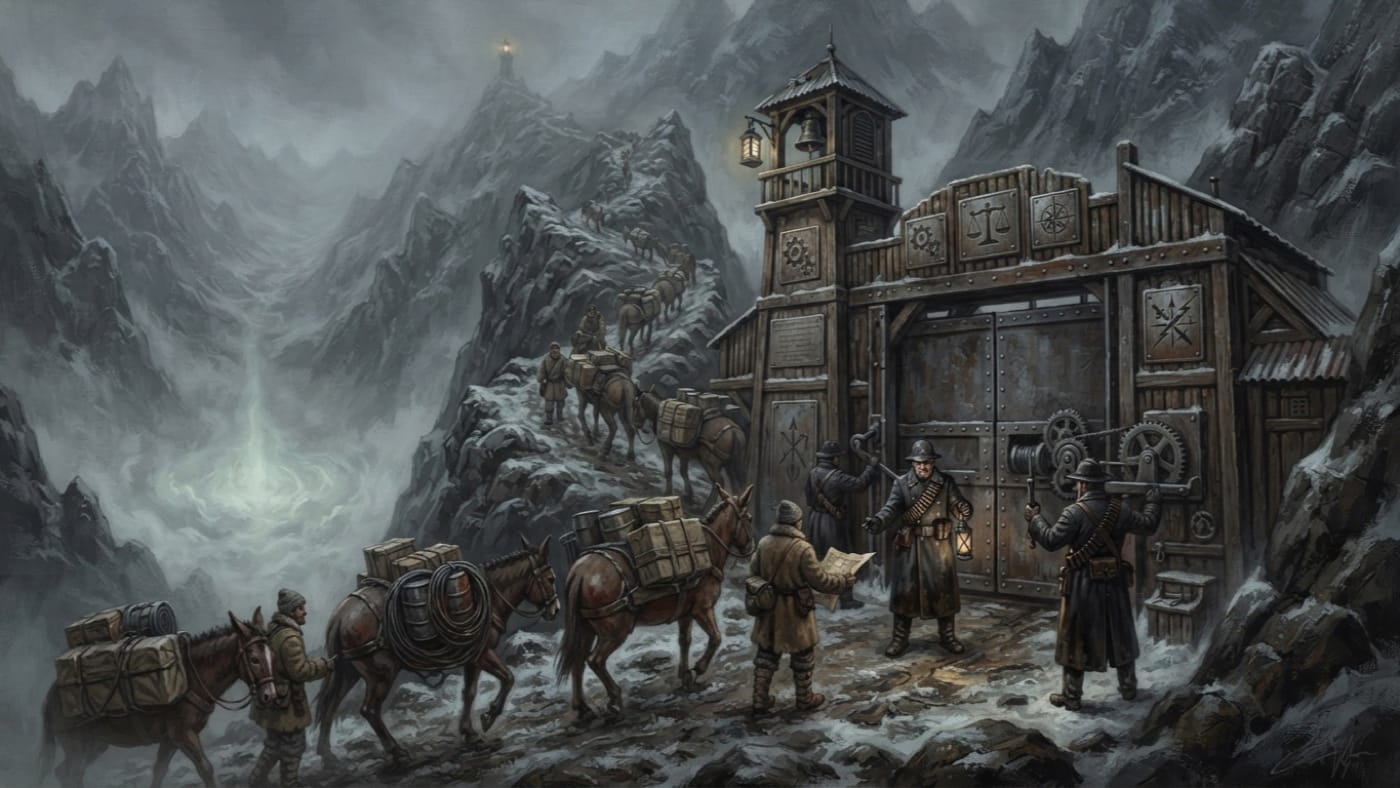
#On the Approach
"Light three times. Speak once." — Lintel of Beacon Tower Three. The gate below it has no inscription and does not need one.
This entry belongs to the documentary compilation assembled under my seal in A.S. 201 (1911 CE). It records what the Station Three assessments, the Loghouse returns and my one passage through the place allow me to certify about the Switchback Gate of Third Light. I certify nothing beyond that. The date belongs to the compilation and says nothing about the gate. No document I have been shown says when the checkpoint was first set on the trail, who set it, or who first stood at it. I will not invent a founding to tidy the file.
The gate holds the switchback approach to the basalt ridge in the high Carpathians, at the point where the trail climbs out of the fog basin the garrison calls White Mouth and onto cold stone. It is the only workable approach from the valley. Every porter, mule-string, convoy and sealed message bound for the station passes through it. On the downhill side the scree falls away, and for half the year the turns are glazed with ice. The place smells of horse breath and cold stone, which is to say it smells of waiting.
#On the Writ
The Beaconchain decides who may move. The gate decides who does.
At Third Light the work runs in four-hour cycles, six to the day. The bell of Beacon Tower Three opens each cycle and closes it. In the Loghouse of Slate Pages, a clerk presses the bell-signet into wax and checks the entry against the master timing wheel. A clearance entered within a cycle that the wheel certifies becomes a route writ, and the writ goes down to the Switchback Gate. I cannot say how a bell's sounding is held in wax. Three engineers from Strasbourg once explained it to me in three different ways, and the Loghouse has never asked anyone to explain it.
The Provost asks even less. At the gate the writ is checked against the log for its cycle, its signet and its clearance. A writ that agrees with the record is valid. A traveller who carries one has recognized permission to climb, and nothing else. Passage is a separate purchase.
The procedure is older than the office that now owns it. The Church's frontier signal clerks standardized the logs in A.S. 82 and introduced the bell-signet in A.S. 89. The Synod Signal Office took its present name only after the settlement of A.S. 90. It has accepted the credit for both reforms with the composure of an heir at the reading of a will.
#On Searches and the Second Tithe
Gate Provost Harn holds the gate. The garrison calls him Nail, and everyone else calls him Sir. His Gate Provosts are a small detachment of unrecorded strength, and they are the only armed authority between the checkpoint and the fog basin. They search packs and crates, levy tariffs, detain, beat and extort. The station's inventory lists all five as ordinary practice. I have listed them in the same order, because order is a courtesy.
Some cargo may not pass under any writ: unlogged relics, unstamped messages, forbidden books, lantern parts without their seals, and coffins, which the station calls silent cargo. That list gives a Provost lawful reason to open anything. Travellers soon learn that a search goes faster when it is paid for and slower when it is not. A coffin does not go at all.
The station calls this arrangement the double-tithe. The Signal Office's writ costs one thing, and the Provost's willingness to honour it costs another. The station assessment records that the Bureau of War knows about it and considers it efficient. I have found no statute authorizing the second charge and no schedule fixing its rate. Nobody at the gate has ever asked me for either.
Coin is scarce above the snowline. Payment comes as lamp oil, clean paper, insulated gloves and errors conveniently forgotten. Oil tallies, ration chits, stamped paper and oath-notes change hands on the switchbacks as money. No ledger I hold shows how much stays with the men and how much reaches Harn. The station says he counts his bribes like prayers. I decline to audit a man's devotions.
The hamlet also speaks of a night toll. The sources disagree about how sure they are of it, and none names a collector or a rate. I enter it as reported.
#On What Must Come Uphill
The tower lives on oil, glass, tarred rope, dry paper and men. The first four come up through Harn's gate. The men come up as conscripts, chiefly from Lowvale Tallytown a day's descent below, on transfer orders that pass the same barrier as everything else. If the oil runs short, the lantern goes cold. If the glass runs short, Sister-Mechanic Vey Sable has nothing to calibrate. Either way the station goes blind, and the convoys bound for Bastion-Przemyśl wait on their ledges for windows nobody can send.
So the Provost who taxes the station's supply is also its guarantee. He can hold up a cask of oil for an afternoon at his own price. He cannot hold it up for a month without darkening the lantern that makes his writs worth checking. That arithmetic restrains him better than any Bureau has.
Beaconmaster Jorren Quill holds the record and Harn holds the road. No instrument I have read gives either man command over the other. They meet in ink every eighteen months, when the Ropewalk cables are replaced and the replacement log needs both signatures. A snapped cable has killed more of the garrison than any enemy has, and every length of that rope came up the switchbacks under Harn's eye.
Holding the gate does not mean holding the ridge. The Ropewalkers move cargo the size of a fist on hooks beneath the spans. The Provosts themselves hire the Fog-Scouts, whom Doctrine classifies as heretics, to go down into White Mouth. None of this gives a mule a second road. The record shows no other ordinary approach, and I draw none.
#On the Answer No Writ Declared
Three things come up from the fog. The station is careless about keeping them apart, and I am not.
The first is the ordinary answer. The Signal Office has kept a restricted file on it since A.S. 194, and the file is still open. A signal goes out toward Fourth Light and Fourth Light acknowledges it. Then, between seventeen seconds and four minutes later, a second acknowledgment rises from White Mouth, where no tower, lens or bell has ever been recorded. It repeats the legitimate answer and adds nothing to it.
The second is the false acknowledgment. The present assessment records seven answers that passed the master timing wheel and were signeted and entered as valid replies from Fourth Light. Fourth Light then disowned all seven and reported that it had never received the signals they answered. Every clearance written in those cycles was valid on the page and false on the mountain. Any writ drawn on them would have been checked at the gate and found in order. The record does not say which convoys climbed on them, so I cannot tell the reader.
The third answer is Harn's. It is an echo from the basin that carries information nobody transmitted. By his own account he has heard it twice, and he has reported it zero times. I have been allowed to read no record of when he heard it, what it carried or who stood beside him, and I will not fill the gap. The seven are not the two, and nothing in the file arranges these three things into a sequence.
The gate's authority rests on one proposition: whatever climbs from the valley can be stopped, searched and priced. The third answer does not use the switchbacks. It has never been searched or tariffed, and it has never stood in the sleet. On this one subject, the man who counts everything has kept no count he is willing to show.
Quill suspects that something wants Third Light blind. That suspicion is his own. No finding names a culprit, a corrupt clerk, a tampered wheel or a servant of the Great Deceiver, and I enter none.
The answering fog below Third Light is acoustic refraction consistent with atmospheric layering, a natural phenomenon requiring no doctrinal intervention.
The Bureau of Alchemical Standards has suspended this classification and issued nothing to replace it. Provosts who relied on it when honouring Station Three writs are advised that they relied on it.
#On the Present Condition
According to the A.S. 201 assessment, the station is operational under Class II Restricted Access and the gate is held. Third Light numbers four hundred and thirty souls, and the Signal Office calls that population collapsing. The dead are replaced from below, and every replacement pays at the barrier.
Writs still come down from the Loghouse, and the Provosts still check them against a log that has been shown, seven times, to certify a conversation with only one party in it. The Provosts honour them anyway. Otherwise they would have to honour nothing and do the arithmetic by hand, and nobody has ever paid the Provosts for arithmetic.