

#On the Office and Its Charge
"Light three times. Speak once." — Painted on the lintel of Beacon Tower Three, origin unknown, refreshed quarterly by standing order.
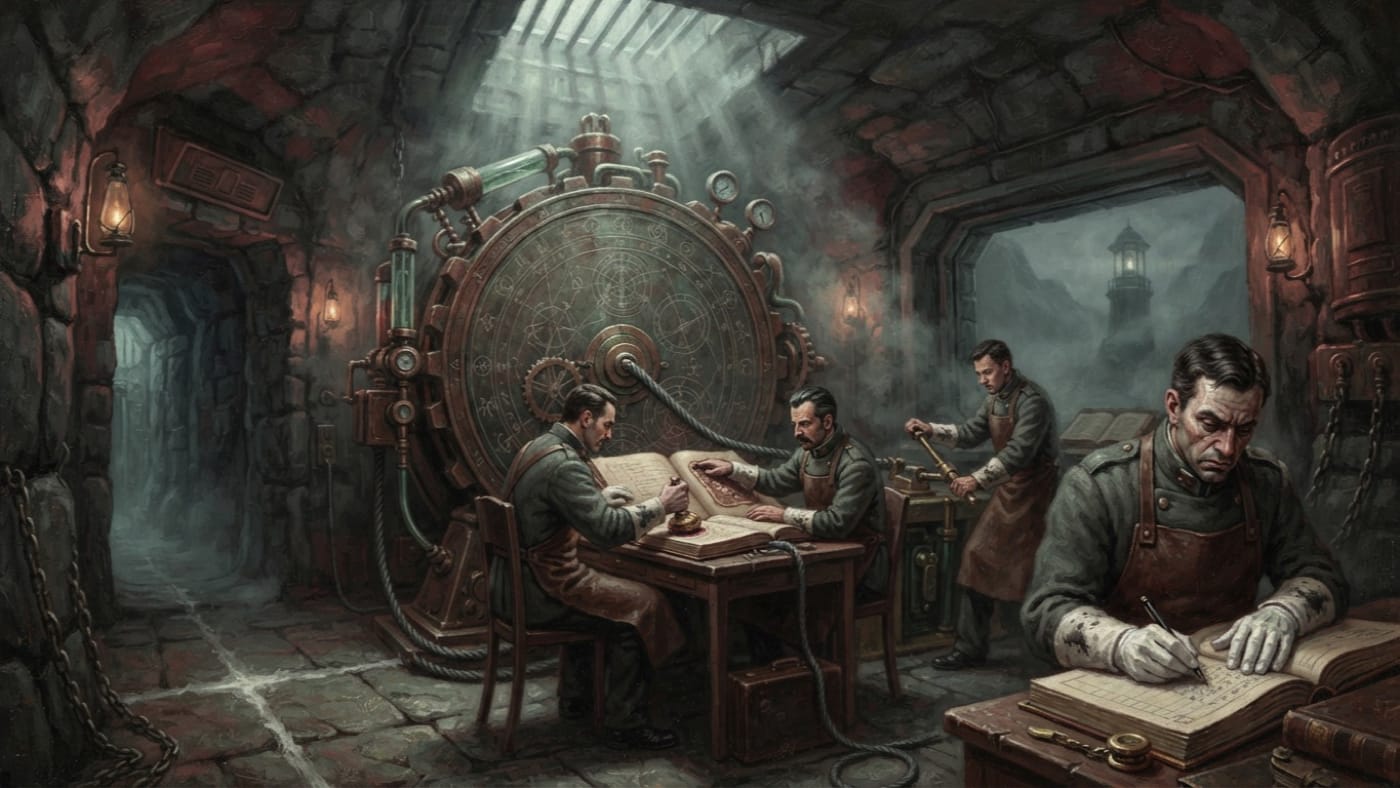
The Synod Signal Office at Third Light is a chapter bureau, a local house of the Church's authority. It is cut into the cliff thirty yards below Beacon Tower Three, on a basalt knife-ridge in the high Carpathians somewhere near 47°N, 22°E, where the thin air ruins a clerk's handwriting before it can touch his faith. It occupies the Loghouse of Slate Pages. It holds the logs, the master timing wheel, and the authority to declare a signal cycle valid or void. Its public duty is to keep the routes safe. In practice it decides what moved.
The Office should not be confused with the towers. The tower lights its lantern and rings its bell, but afterwards neither can testify that the lantern was lit, or that it was lit on time. Only the Office can make that statement, and the Beaconchain cannot function without it. The relay itself is rust-iron, glass, and rope. The Office is ink.
Older lore refers to Synod Signal Offices in the plural, and I have no reason to doubt it. I describe only the one I have seen. The files open to me do not say which house of Strasbourg it answers to, what instrument created it, who directs the Offices as a body, or where that person keeps a desk. I asked. My question was filed.
The Office at Third Light is commanded by Beaconmaster Jorren Quill. He commands that Office and no other. Valley gossip has made him master of every lantern on the ridge, and the gossip will be corrected in due course.
#On the Making of a Valid Cycle
The day at Third Light is divided into six cycles of four hours, and the tower bell marks each one. When the bell strikes, a clerk presses a bell-signet into the log. The signet is a wax impression representing the bell's tone pattern, and the clerk compares it against the master timing wheel kept in the Loghouse. No one showed me how a bronze note comes to sit in tallow, and the Office does not publish the method. I record the procedure and leave the method where it lives, in the clerks' ink-marked cuffs.
A certified signet attests four things:
- that the beacon was lit at the correct time;
- that the lantern was aimed on the correct bearing toward Fourth Light;
- that Fourth Light received the signal and acknowledged it;
- that all of this happened in the correct sequence.
Note the third item. Third Light can certify its own flame by its own hand, but it can certify the reply only by trusting what comes back across the ridges. A valid cycle is therefore a joint confession by two stations, and only one of them is in the room.
Convoy permissions, route clearances, storm warnings, and timing signals all travel the Chain this way. At Third Light, a permission without a recorded clearance has no administrative standing. The Gate may turn the convoy back, and a bastion roadhead may refuse it. If it dies in the passes, no one is answerable for sending it, because on paper no one did. The Office makes no claim that its ledger can erase men from the mountain. The mountain manages that without help. The Office decides only whether anyone must answer for it.
The Synod Signal Office officially holds that a bell-signet cannot be forged. Everyone who has served at Third Light holds that it can. Both positions are in force at once, and a clerk's advancement depends on which one he is heard to hold.
#On Corrections, Debts, and Passage
The Loghouse runs a market, and like any honest market it has a price list. Late entries are for sale, along with corrected timestamps, "lost pages," and cargo exceptions. Payment is usually in oil, which at that altitude is worth more than coin. One thing in the house is not for sale: the master timing wheel. The penalty for tampering with it is annihilation. That is a prohibition backed by a threat. It does not prove that interference is impossible, and the Office's habit of treating the two as the same thing will matter shortly.
A clerk who makes an error goes into debt, and the debt is worked off in night shifts and in cliff work on the catwalks, where a man's last mistake settles his account. Confessions are made under a silence hood, a canvas sack drawn over the penitent's head, and they are always stored. A clerk's errors become his file, the file becomes someone else's leverage, and that leverage keeps the house running. The Office governs through logs, audits, detentions, and log tribunals. Against falsification it uses the oath-collar. The station's own accounts disagree on whether every clerk wears one or only those a tribunal has already caught. The Office has not reconciled the accounts, and I will not do it on the Office's behalf.
Quill wears white kidskin gloves, always immaculate, and he is afraid of blank pages. A blank page means a missed cycle. A missed cycle brings a question from below the clouds, and at that altitude questions tend to become answers. The station reports that he has not missed a cycle in eleven years. That is a record of attendance. Honesty is audited separately.
The Office's writ also stops at the Loghouse wall. Sister-Mechanic Vey Sable maintains the relic-lanterns, but the Lanternwright Knot keeps the lens specifications and sells "selective blindness," a lens angled so that a particular convoy is never lit. Gate Provost Harn, called Nail, and his Provosts control actual passage: a route writ from the Office costs one thing, and Nail's willingness to honour it costs another. The Ropewalkers' Brotherhood holds the cables and the smuggling that rides beneath them. Below the ridge, unlicensed Fog-Scouts walk routes the Office has never logged. None of these people reports to Quill, and any of them can undo a correct entry with a bent lens, a closed gate, or a cut rope.
#On the Earlier Procedures
The dates that follow come from the station's own account, and I give them on its authority. In the winter of A.S. 72 / 1782 CE, a convoy bound for Bastion-Przemyśl was lost in the passes. Two lights were operating on the ridge by A.S. 74 / 1784 CE, and both burned in A.S. 76 / 1786 CE. Third Light was established on higher ground in A.S. 77 / 1787 CE.
Log procedures were standardized in A.S. 82 / 1792 CE, and bell-signets came into use in A.S. 89 / 1799 CE. Both dates are earlier than the constitution of the formal Synod in A.S. 90 / 1800 CE. Whoever kept the slate pages in those years was therefore the Church's frontier signal administration, under whatever name it used then. The title "Synod Signal Office" is applied to that work after the fact. Neither date marks the founding of the Office, and neither marks the day it took its present name. The founding date is unknown, and I will not invent a convenient year to cover it.
The earliest disciplinary precedent I can attest comes after the Synod's constitution. In A.S. 94 / 1804 CE, a signal clerk named Pell Oster sold three weeks of forged clearance windows to smugglers working out of the Lowvale. He was hanged from his own bell-cage, and oath-collar discipline followed. The Bureau of Records filed the execution under "equipment maintenance," which, to be fair to Records, was accurate.
#On Acknowledgments Without a Sender
Since A.S. 194 / 1904 CE, the Office has kept a file headed Anomalous Signal Behaviour — Station Three — Ongoing. It has remained ongoing. The first entries describe this sequence: a signal goes out toward Fourth Light, and Fourth Light acknowledges it. Between seventeen seconds and four minutes later, a second acknowledgment arrives from the fog basin, a direction with no station, tower, lens, or bell. The second answer matched the first in timing, bearing, and tone.
I inspected the station in the winter of A.S. 197 / 1907 CE and asked to see one week of the logs. They were perfect, with every signet aligned and every timestamp in sequence. My report said they were too perfect. Records filed the note under "Observations — No Action Required."
In A.S. 199 / 1909 CE, the Bureau of Alchemical Standards sent a team that stayed three weeks. Its report runs to four pages, three of them redacted. The fourth recommends further study. The echoes began to change that same year. They arrived half a beat late, then a quarter beat late, and then exactly on time.
By the assessment of A.S. 201, seven acknowledgments had passed certification at Third Light. Each was pressed, compared with the wheel, and entered as a valid reply from Fourth Light. Fourth Light then reported that it had received none of the signals those replies answered. The procedure had authenticated a reply that its claimed sender denied sending. The wheel passed all seven. That does not show that the wheel was left untouched, and it does not show that it was tampered with. It shows only that the wheel was asked the wrong question and answered that question correctly.
Beaconmaster Quill's assessment is that something has learned the Chain's protocols and intends to leave Third Light blind. I record the assessment as his. I do not sign it, and I have no rival theory to offer in its place. The file does not say what answers from the White Mouth, whom it serves, or how it does what it does.
The station's countermeasures are the ones it already had. Grounding chains are sunk into the basalt. Salt lines are laid across the catwalks, a practice the Bureau of Doctrine has neither sanctioned nor forbidden. The Lanternwright Knot sings flat calibration choruses at the start of each cycle. Sometimes the fog stays quiet under these measures for a day, sometimes for a month. Then it answers again, and the answer is always correct.
Earlier Bureau of Alchemical Standards assessments classified the answering fog as "acoustic refraction consistent with atmospheric layering," a natural phenomenon requiring no doctrinal intervention.
This classification has been suspended. No replacement has been issued, and this entry does not supply one.
The Office still certifies. Cycles are still struck, pressed, compared, and found valid. Convoys still move on those entries, because the Loghouse has no other way to let them move. Quill keeps his gloves white and his pages full, and an eighth such reply would be certified in the same hand as the first seven.