

#On the Third Census
The Third Census of the Synod falls in A.S. 130, which secular almanacs give as 1840. Posterity knows it from one sentence and one consequence. The sentence comes from the published account of the Ledger of Fidelity: after the count, the Synod knew the exact size of its population, and the Bureau of Oaths learned how many of those people had married without telling anyone. The consequence is a curve. Oath registrations rose sharply after that year, and every account of the Bureau written since has had to make room for them.
That is the entire documentary footing, and I decline to furnish it with borrowed chairs. The accounts give no total, name no director and cite no commissioning decree. They record no month of opening, no schedule of questions and no map of the districts walked. The Ledger calls the figure exact. I repeat the word because the Ledger chose it. I have no means of testing it, and no office has offered me one. A count is exact in the way a sealed folio is complete: by declaration, until someone with a key and a grievance unseals it.
The numeral implies a First and a Second Census, and this entry has nothing to say about either. A numeral swears no oath, and I do not take its testimony.
#On the Bond Before the Count
The census founded nothing. The Bureau of Oaths had held its charter since A.S. 92, two years after the Concordat of Strasbourg gave the Synod its permanent legal frame. By A.S. 130 the Ledger had been taking entries for thirty-eight years, and in all that time nobody had counted the people who ought to have been making them. Oath practice was older than the charter. Promises were heard and written down in the wartime Church, and the chartered Bureau inherited those habits, licensed them and charged for them.
The doctrine the census found waiting was already complete and already severe. A bond binds when a licensed Witnesser hears it spoken and the Bureau records it. Until then it is breath, and Strasbourg does not file breath. Marriage, guild bond, debt covenant, adoption and the soldier's Oath of the Line all pass through the same procedure of presence and registration. The Witnesser rinses mouth and hands in brine and touches the cord-sash at his hip. He holds a lead tablet as cold as a magistrate's regard. He seals the token in wax or knotted cord according to the custom of the district. He writes the vow down. From then on the vow is evidence.
The law attached to that evidence is old and blunt. Bureau doctrine holds that a marriage the Registry cannot find is no marriage at all. The parties are cohabitants. Their children are illegitimate, and their goods are held in mutual trespass. An inheritance follows the entry and ignores the household. A widow's claim to her husband's mill is worth exactly what Strasbourg can produce on vellum. All of this stood before A.S. 130. The census did not write it. The census showed how many people lived outside it.
#On the Marriages Unreported
The Ledger's phrase is "married without telling anyone," and anyone there means Strasbourg. The neighbours knew, because neighbours always know. The parish knew of the wedding feast, and the village knew whose cow grazed on whose strip. The Creator, if the catechism is to be believed, attended. The only party never informed was the vault, and the vault is the one witness the Bureau recognizes.
So the census caught the Bureau's jurisdiction in an embarrassing position. A whole stratum of the Synod's people lived as husbands and wives, raised children, divided harvests and buried one another with every outward sign of matrimony, and the archives beneath Strasbourg held nothing on them. They were spouses everywhere except in the one place where, in the Bureau's view, the word has legal meaning.
The Ledger does not explain how a count of persons became knowledge of unregistered marriages, and I will not supply the arithmetic. A count of heads does not, on its face, disclose vows. Somewhere between the enumeration and the Bureau's discovery there was a procedure, and the procedure is not on file.
What the discovery meant to the Bureau needs no procedure. Every unreported marriage was an affront to its doctrine and also an entry it had not yet been paid for. An institution that measures its own piety in volumes cannot learn of a vast and quiet population of uncounted vows and feel only sorrow. The Bureau felt appetite, and called it pastoral concern.
#On the Volumes That Followed
Three published accounts agree on the order of events. They are the Ledger's own, the Bureau's general entry, and my dossier on the present Registrar, which observes that the office "grew fat on registrations" after the count. All three put the census first and the swelling second. None of them gives a series of figures, a peak year or a rate.
The sequence carries no causation on its back. The record does not say whether couples came forward because they were summoned, frightened, shamed, fined or simply reminded, and each motive leaves an identical entry. Growth in registrations does not show that the population grew. It shows still less that devotion grew, whatever the Bureau's pamphlets claim on the subject. It shows that more vows reached the Ledger. The Bureau has always preferred that measure, because it is the one measure the Bureau itself keeps.
Every registration is a full entry, and a full entry costs shelving. Each one records the exact wording, the conditions, the identity of every party, the name of the witnessing officer, the date, the bell that sounded at the sealing, and a notation of cadence. Even the shortest betrothal takes half a page. Multiply that by a population newly made legible and the binders grow busy.
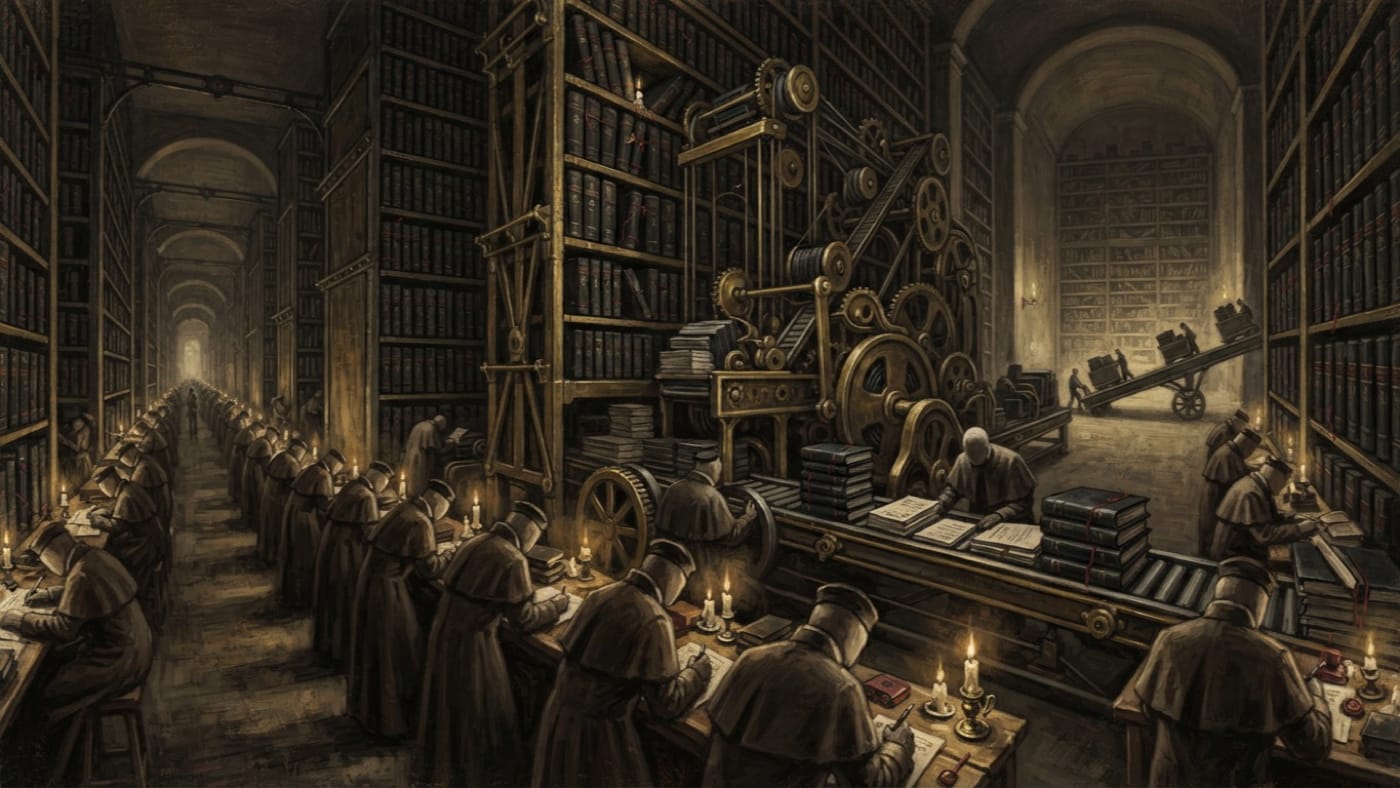
By the survey of A.S. 201 the Ledger of Fidelity stood at seven hundred volumes, bound in black calf-leather with brass clasps and crimson thread. The volumes rest in the vaults of the Bureau of Records beneath the Basilica of the Ledgered Saints and are read by tallow light, because Records permits no lantern near vellum. The administrative seat of the Bureau of Oaths is elsewhere, in the seven-storey granite annex of the Registry of Bonds, where assignments are issued and quarrels are filed. Oaths owns the words. Records owns the shelves. Neither has ever told me which of them carried the census returns, if anyone carried them at all.
Earlier descriptions of the Bureau of Oaths, including its own entry in this Codex, gave the Ledger of Fidelity as "approximately four hundred volumes."
The Ledger numbered seven hundred volumes at the survey of A.S. 201. The older figure belonged to an earlier count whose date is not on file. It must not be read as the size of the Ledger in A.S. 130, and the difference must not be credited to the census as a tally of its yield. The Bureau has described the discrepancy as "a measure of the Theocracy's growing fidelity." The Bureau of Doctrine describes it as a measure of the Bureau's appetite. I describe it as a correction.
#On the Record Retained
The Ledger keeps every entry it makes. A marriage registered in the years after the count has stayed on the page through whatever followed it, including widowhood, quarrel, emigration to a parish with a worse wine and a better magistrate, and annulment.
Annulment changes the bond and leaves the page alone. The petitioner gathers three counter-signatures and two witnesses to the dissolution. He pays a fee denominated in salt and keeps at least forty days of penitential silence. Then a single horizontal line of red ink is drawn through the entry while the parties watch, and the original wording stays fully legible beneath it. The parties go free. The page keeps the vow, the conditions, the bell, the cadence and the red line together, so that a clerk two generations later can read both the promise and its funeral in one glance.
That is the lasting yield of A.S. 130. The Synod learned a number it has not published. The Bureau gained, by means it has not explained, a great many entries it intends never to give back. A grandson contesting a field can now cite his grandmother's vow, sworn in the decade after the count, on its folio and under its bell. He has the census to thank for that, or to blame. The Ledger does not distinguish between the two.