

#On the First Rank
A Wicker is the lowest thing that wears a Lantern hood. It is the initiate rank of the Lantern Brotherhood, formally the Brethren of Vigil-Light, and every Circle the Brotherhood keeps has its own. Somewhere tonight, in some district command, a Wicker is being handed a flask of oil and told to stand where the light is.
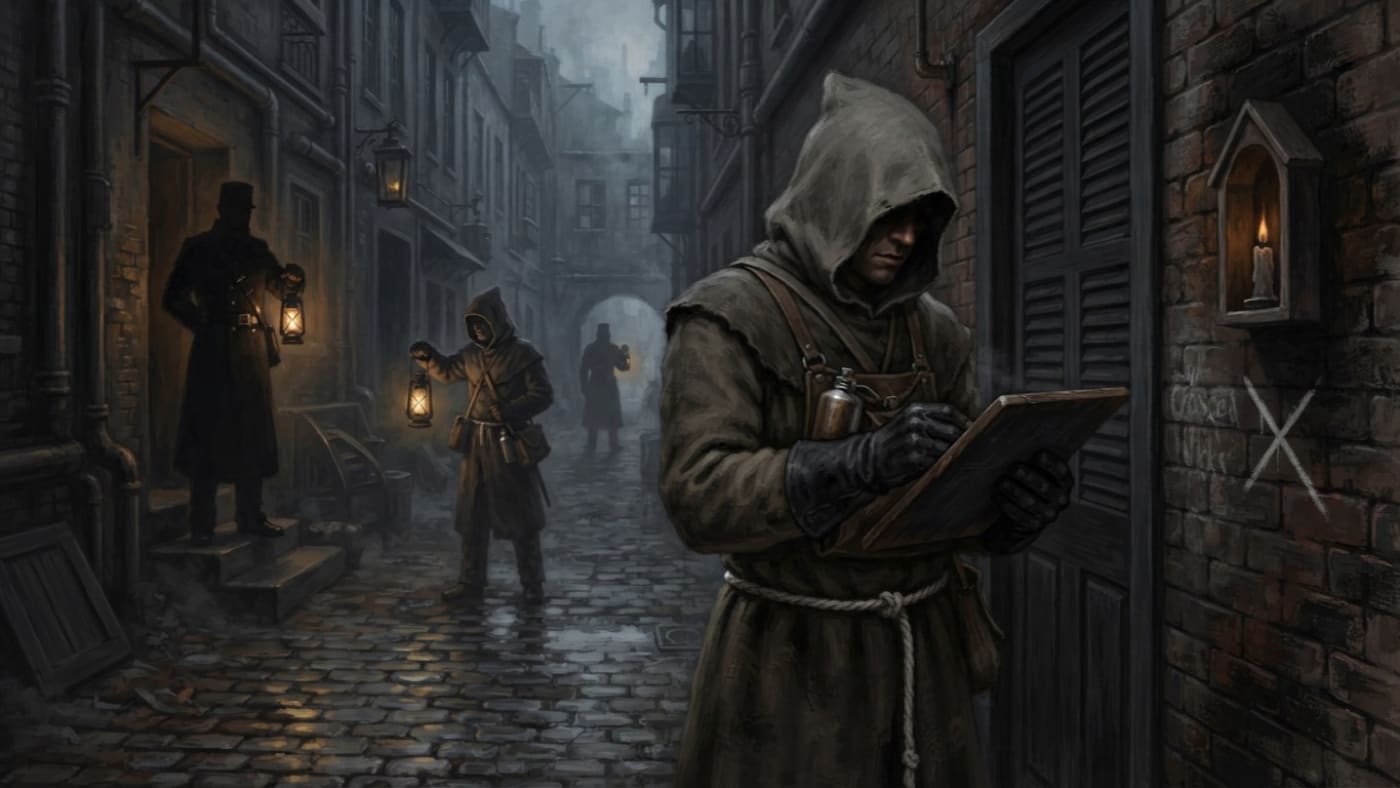
The Brotherhood recites its ladder in this order: Wicker, Spark, Lanternman, Wick-Sergeant, Circle-Captain, Gloam-Prior, High Lantern. Directly above the Wicker stands the Spark, a probationer who carries the lamp, runs messages and learns the marks. Above the Spark stands the Lanternman, the full member with blade and hooded lamp, who does the armed work of the order. The Wick-Sergeant leads a squad and keeps the patrol's arithmetic. The Wicker carries oil and chalk. Whatever authority it has is borrowed from the person above it, and only for the length of a street.
No rank on the ladder is a Church office, and the first rank is the furthest from becoming one. A Wicker carries no writ of its own. It signs no curfew exception, passes no sentence and enlists no recruit. When a patrol stops a household, the questions come from higher on the ladder.
The Ledger holds no founding year for the rank. It names no founder, no first recruit and no council that designed the office. This dossier was commissioned and compiled in A.S. 201 (1911 CE). That year dates my ink and nothing older.
#On Oil and Chalk
A lamp-and-mark institution uses up two substances faster than any others, and the Brotherhood gives both to its newest members. Oil is the order's supper and its authority. The oil allotment is part of a Brother's maintenance, and a Brother whose lamp has run dry cannot declare an inspection. Chalk is how the order writes on the city. The Brotherhood's field leaf lists the marks it chalks and smears on walls and thresholds: the Wick-Arrow for a path verified within the last watch, the Split Candle for two exits of which one lies, and the Crossed Wicks, where proof is required and will be produced one way or another.
Carrying the chalk does not mean choosing what it writes. The record gives the Wicker the supply. It does not give the Wicker the verdict a mark announces, or any office for keeping the marks. I note the distinction because the Brotherhood will forget it the first time a wall says something inconvenient.
The rank carries no blade. The sources say so plainly and do not explain why. My own reading is that an order whose testimony is produced by agreement does not want its least-tested members holding the instrument that ends disagreement. That is my gloss and it stays my gloss.
The Ledger's entry on the Brotherhood states that each Brother "carries a short blade in its scabbard and a glass-hooded ash-oil lamp in hand."
Corrected. That description holds from the Lanternman upward. The Wicker carries oil and chalk and no blade, and the Spark bears the lamp. The order's general appearance does not override its own rank list.
The ash-grey hood, the soot-black gloves and the single white cord belong to the order. The register records no Wicker badge, no Wicker cord and no Wicker colour, and I decline to invent one for the sake of a tidier plate. The Brotherhood maintains its members with a ration stipend, an oil allotment and a lodging right. No pay scale specific to the Wicker survives, if one ever existed. The recruiting age, the length of service and the timing of promotion to Spark are unrecorded. The Ledger leaves those lines blank, and so do I.
#On the Slate at Dusk
The Circle of Ashen Steps supplies the clearest documented work for the rank. Ashen Steps holds the bone-lanes of the Ossuary Rings at Bastion-Constantinople, the southern terminus of the Sagittal Line: funeral routes, cremation yards, night-cart depots and the households that keep vigil beside them.
The candle-tally pass begins at dusk. A Wicker carries the slate. A Lanternman carries the ash paste. The Wick-Sergeant walks one pace behind, with a lantern strapped at sternum height, so the light neither rises in disrespect nor dips into sentiment. The patrol walks clockwise around the ossuary ring, because the Circle holds that walking counterclockwise invites return. Every household flame gets a mark. Every dark window gets a second.
So the slate is the patrol's memory, and the hand holding it belongs to the member with the least say over what it will be used for.
A dark window has more than one meaning. It may be an empty house, or a family too poor to buy approved wax. It may be a body kept back for one last unsanctioned night of farewell. It may be a refusal to pray. The slate cannot tell these apart. It can only report that a flame was absent. The Circle's own daily order is careful on this point: in the early night, missing flames are noted and nothing is done about them yet. The Circle investigates later, and the Circle decides what follows, whether a warning, a Marrow Fine that takes a family's wax ration, or something that ends with a body-tag.
The tally ends up in the Counting Room, Ossuary Office Seven, where the Circle scratches its candle counts into slate under walls ridged with dripped wax. What the Wicker carries out at dusk is the first draft of a record the Circle later corrects, reconciles and sometimes keeps twice.
This procedure belongs to Ashen Steps. The Ledger does not show the clockwise rule, the slate assignment or the three-person tally being used in any other Circle. A Wicker of the market wards or the rope-roads carries the same oil and chalk. Whatever work it does with them is not on file here.
#On Learning the Count
The Brotherhood's rite-list names a general initiation, the Taking of the Wick. The initiate keeps a skull-candle burning through a full curfew cycle while reciting the names of the local dead, real or assigned. The order states the lesson without embarrassment: light is quota, and quota is truth.
Ashen Steps keeps a variant called the Candle-Tally. The initiate keeps a candle ledger through a full night and marks every household flame they see. If the tally is wrong, the Circle makes it true, by creating a reason for someone's candle to have gone out.
I have read that clause many times and it has not got any better. The Circle does the correcting. The rite says nothing about what the initiate is told, or what the initiate understands while the arithmetic is settled on some household's door. It records only that the count will agree in the end, and that an initiate keeps the count.
Two further rites shape everyone who wears the hood. At Oil-Confession, before a shift, each member washes their hands in thin lamp-oil and names one fear and one lie told in service of vigilance. The lie is catalogued and never absolved. At the Hooding, a senior pinches the lantern hood until the flame thins (this is mercy), then opens it (this is law), and repeats this until the initiate stops flinching. The ledger is the first thing a new member learns. The flinch is the first thing the order takes away.
None of this proves that a given Wicker knows what its slate leads to. It proves only that the order trains its newest members in the count before it trains them in anything else.
#On Toleration and Blame
The Brotherhood exists by local licence. A Warden clerk's signature and a curfew list carrying its name make a Circle legitimate for as long as the clerk keeps signing. The order holds no Bureau commission, and no Wicker acquires one by carrying a flask. The Curfew Ordinance of Quiet Hours standardised the routes the Circles walk. It did not found the order or this rank, and it grants neither of them anything.
When a scandal reaches print, the Synod stops calling the Brotherhood a holy necessity and starts calling it a gathering of unofficial actors. The Brothers know what happens next, and the Ledger's own account of the Brotherhood puts it in one line: the newest Wicker is sacrificed first, as caught freelancing.
The source names no particular Wicker and gives no particular method. In the order's idiom, sacrificed means named, disowned and offered up, and the form it takes depends on the Circle and on the night. The choice of victim follows from the ladder. The first rank has the shortest record, the fewest friends among the Wardens and the least standing to dispute what a Triangle of Witness says about it. An auditor will easily believe that the newest member acted alone, because the newest member has never been allowed to act any other way.
The Wicker carries the oil the order runs on and the chalk it writes in. At Ashen Steps it carries the slate the Circle counts from. When blame comes down, it carries that too.