
#On Full Membership
A Lanternman is a man who has been permitted a blade. That is the whole promotion. The Brotherhood has never claimed it was more.
The Lantern Brotherhood ranks its people by what they are allowed to carry. The Wicker carries oil and chalk and gets neither flame nor steel. The Spark bears a lantern, runs messages, and learns the marks. The Lanternman receives the short blade and the hooded lamp, and from then on he is a full member: a body the Circle may post, send, lose, and replace. Above him is the Wick-Sergeant, who keeps the patrol mathematics and decides where proof is required. Above the Sergeant is the Circle-Captain, who negotiates with the Wardens so that nobody beneath him has to.
On the street the word is used loosely. A child pointing at any grey hood after curfew says Lanternman, and the hood seldom bothers to correct the child. Inside the Brotherhood it is a rank, and a Spark who claims it early is reminded of his station by the flat of somebody's glove.
The rank is internal Brotherhood standing. It confers no ordination, no Warden key and no Bureau commission. The Brotherhood itself is tolerated: licensed in one district, revocable by a clerk, and deniable at the centre. Its auxiliary footing goes back to the A.S. 94 toleration clauses of the Curfew Ordinance of Quiet Hours, which found a use for vigil personnel and declined to say exactly what they were.
Earlier profession filings place the Lanternman beside the Alley-Marshal, beneath a Circle-Sergeant, and name the Night-Prior as the officer who bargains with Wardens.
Corrected. The Brotherhood's own ladder runs Wicker, Spark, Lanternman, Wick-Sergeant, Circle-Captain, Gloam-Prior, High Lantern. Bargaining with Wardens belongs to the Circle-Captain. Some Circles still use the older titles out of habit. This office does not certify that they are equivalent.
#On the Lamp and the Blade
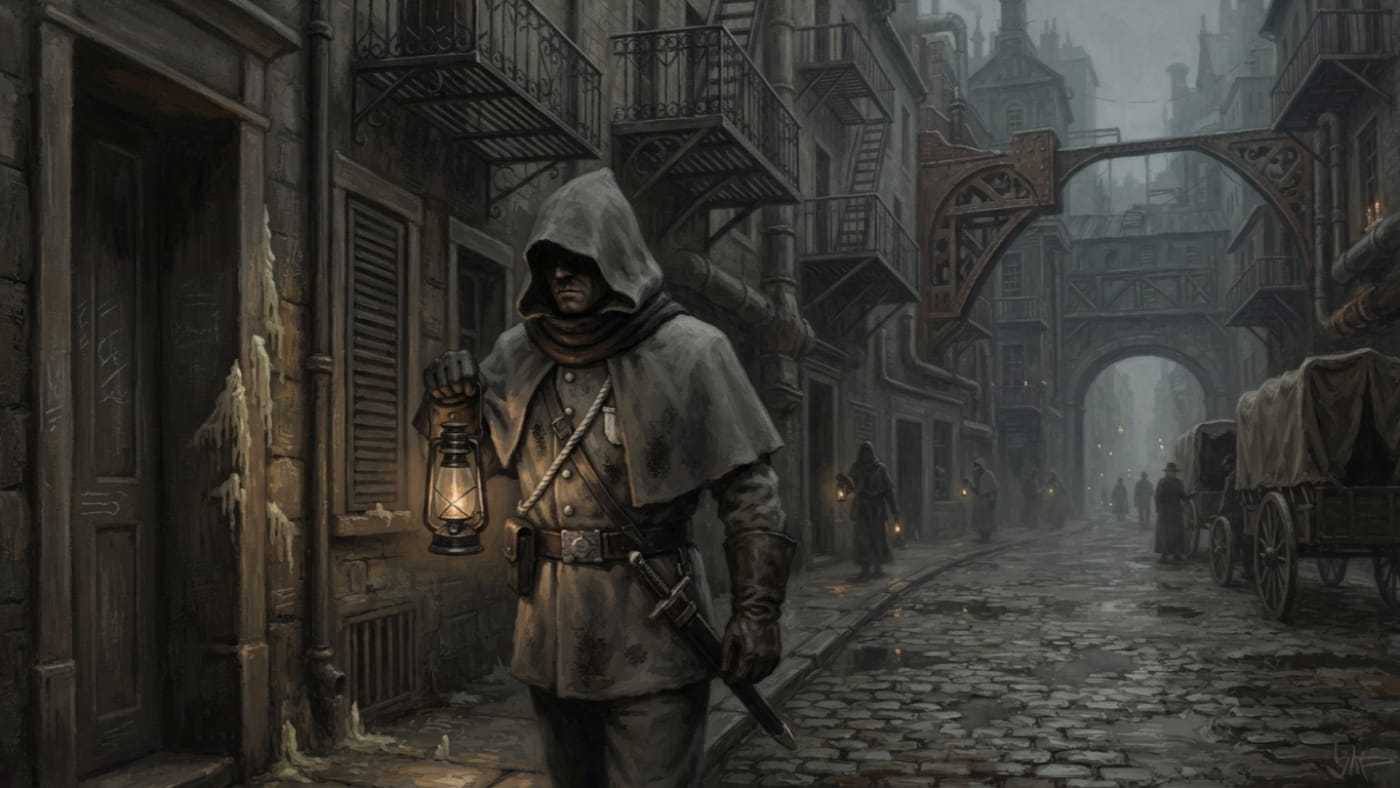
The lamp burns ash-oil behind glass, under a hood that can be pinched, half-closed, or shut. The blade is short, and its scabbard is meant to stay closed. Chalk and cord let him mark routes and bind a door without paperwork. A citation slate and a stamp let him create paperwork whenever he prefers it. He wears an ash-grey hood, a throat scarf that itches like penance, soot-black gloves, a lantern badge-disk, and one white cord for tolerated authority. The cord is the only holy-looking thing on him. It is also the only thing a clerk can confiscate in one motion.
The lamp comes first, and every Brother says so in the same five words: glass first, blood second. A cracked pane is a status wound. An unblooded blade is a status symbol, specifically a blade that has never had to be cleaned in public. The Lanternman spends late afternoon trimming wicks, rationing oil, and scraping last night's soot from the glass while his fingernails go permanently black. He never lights his flame from another Brother's flame, because the Brotherhood holds that this shares guilt. Considering how much guilt is already in circulation, the rule shows real fiscal prudence.
Before the shift comes Oil-Confession. Hands are washed in thin lamp-oil, and each member names one fear and one lie told in the service of vigilance. The fear goes unremarked. The lie is catalogued and never absolved. Then he knocks the lantern three times and whispers a line of belief he does not believe, and the night begins.
Most of his commands are given with the hood. Half-closed and steady means inspect. Fully closed with a single click means freeze, and blades come out. Two fast openings and one slow one mean a Warden is present and clean procedure must begin at once, which tells the reader everything about what procedure was before.
#On the Night's Proof
The contact protocol has four parts: question, hands, breath, story. The Brother asks softly so the subject answers loudly. He checks the palms for ink, powder, or grave-dirt and smells the breath for drink and prayer. Then he listens to the story and counts the places where it bends. Five dispositions follow: warn, tax, escort, arrest, or disappear. The Field Leaf lists them in that order. Practice is less orderly.
In districts that use it, the Triangle of Witness is the arithmetic above all this. An Anchor holds a visible lamp at a choke point. A Blade pair moves and searches. An Echo walks one lane over and stays unseen. A Lanternman may stand in any of these positions, as the Sergeant assigns him. Rope-Road runs pairs with a trailing Spark. Ashen Steps walks rings. The Triangle is doctrine, and no Circle keeps a fixed headcount for it.
This produces testimony that agrees with itself. It does not establish what happened in the alley. The Brotherhood is aware of the difference and has organised its shifts around it. If a Lanternman ends the night without proof, he brings names or maps instead. He never carries proof past dawn, because the Leaf says it spoils. That means someone more senior will find a use for it, and the use will be against him.
#On the Bone-Lane Posting
In the Circle of Ashen Steps, full membership comes with the smell of marrow-wax. The Circle holds the Ossuary Rings of Bastion-Constantinople, along with the funeral routes, the cremation yards, and the night-cart depots where the Bosphorus damp gets into everything, wool included.
The shift begins at dusk in the Counting Room, Ossuary Office Seven. It is a stone chamber with tallies scratched into slate and old wax hanging from the walls in pale ridges. There is a rack of bone hooks, a trough of ash paste, and a locked cabinet of body-tags. The Lanternman washes in ash and inventories hooks, tags, and approved wax. At the curfew seal the ring-walk begins, clockwise only, with every lantern strapped at sternum height. A raised lamp is called searchlight behaviour, and the Circle forbids it as disrespectful to the dead and alarming to the living.
The candle-tally pass comes first. The Wicker carries the slate, the Lanternman carries the ash paste, and the Wick-Sergeant walks behind with the arithmetic. Each household skull-candle gets a mark, and each dark window gets a second one. In early night a missing flame is only recorded. Thresholds under watch carry the local split-candle glyph in chalk. Other Circles use a split candle to mean two exits, one lies, and this office declines to standardise either reading.
At midnight he checks the body routes and either intercepts corpse-thieves or negotiates with them, whichever the Sergeant judges cheaper. Late night is for corrections, when the tallies are made true by a warning, a fine, or the taking of someone. Ash-Tongue dusts an offender's lips with ash until speaking hurts for days. Marrow Fine takes a family's approved wax, and with it their visible devotion. The ash paste the Lanternman carries on his tally rounds is applied by his own glove.
Before dawn he reconciles the tags, hands bodies to the sanctioned crews, and wipes away the chalk. The Bureau of Records receives clean numbers. The Rings receive their dead, or receive tags in their place.
#On Wax, Debt, and Useful Hands
The profession pays a ration stipend, an oil allotment, and the right to a bunk in a Brotherhood flophouse. The oil is never quite enough, and that is the design. A Lanternman who burns past his allotment owes for the difference. A Lanternman who takes a knife wound owes the man who stitched it. A Lanternman who needed a Warden's signature once owes that favour until the Warden decides otherwise. The night itself provides the remedy: paid escort, safe corridors, debt collection, and the one-night passage every Circle forbids and every Circle sells.
The profession's taboo list forbids taking coin from a widow on vigil night. Ashen Steps works almost entirely in vigil nights. Nobody in the Counting Room has asked for the taboo to be revised, and this office has not volunteered.
Marrow-wax is meant to pass through Tithes measure and Records receipt. Ashen Steps skims the excess and sells the shortage. Behind that sits the Two-Book Dead, the second ledger of bodies diverted for patrons, sale, and lost funerals. Nothing requires a Lanternman to read it in order to serve it. He takes a body to a side door, carries a tag he did not fill in, and is told the handwriting is the Sergeant's concern. How many Lanternmen know the second ledger by name, this office cannot certify. The cabinet is locked, and nobody has told me who holds the key.
#On Men Kept by Their Circles
Two names have come to this desk.
Vey Strahl serves Ashen Steps. He was a gravedigger before the Brotherhood took him, and Brothers who have watched him work call his blade calm, even gentle. It is rumoured that he once buried a man alive to balance the ledger. The rumour has no witness who will sign for it, and the Brotherhood is not in the habit of supplying one. His age, his enlistment and his remaining career are not on file.
Odran Pell holds the same rank in the Circle of Rope-Road Lanterns, high above the wards on the bridge-cords. He extorts lovers crossing between districts. He is said to be terrified of Wardens because he once carried their keys. How he went from key to cord is not recorded either.
One man has a gentle blade over the bone-lanes, and the other works by blackmail on the rope-roads. Same rank, same lamp, same white cord. The Circle sets the appetite, and the Lanternman supplies the hands.
#On Revocable Vigilance
Audits come as oil-ledger checks, wick-length inspections, and random verification of dark corners. The Bureau of Purity sends inspectors who are worse. The Bureau of Shadows is said to know which Brother sold which passage. It denies this, which nobody counts as evidence either way. When pressure rises, the Circle gives up its newest full member, found freelancing, and the Synod's language changes overnight from holy necessity to unofficial actors.
What scandal spares, the work takes slowly: smoke in the lungs, frost, falls, knives in the dark, rival crews, demon-hours. Then come the tells. He trims wicks that need no trimming, counts his footsteps, and scrubs soot from skin that is already raw. The last stage the Brotherhood describes is a moving checkpoint, which keeps the procedure and has dropped everything else. Families curse the hood and still look for its lamp when a night-cart wheel breaks beside the cremation yard. Exits are rare: a marriage into a guild, a flight to the trenches, or retirement into ash.