
#On the Bones That Hold the City
"The dead are structural." — Bureau of Engineering, Memorandum 47-B/CONST, filed two years after the Sundering and never amended
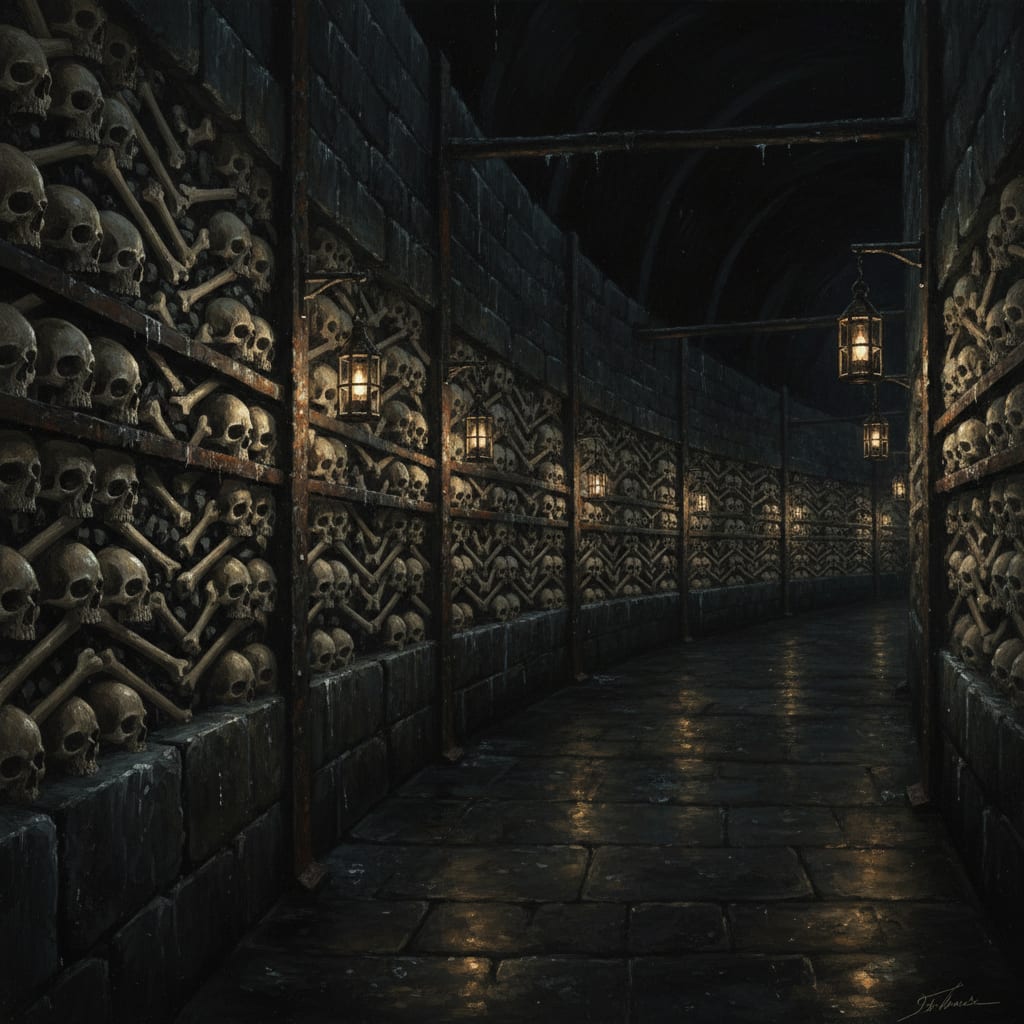
The Ossuary Rings of Bastion-Constantinople are six concentric walls of catacomb-fortification sunk into the ancient substrate of the Bosphorus headland, each wall garrisoned on its outer face and filed with the bones of its predecessors in the cavities between courses. They are the fortress's innermost defensive shell. They are also its oldest cemetery, its largest housing estate, and its most honest statement of purpose: that in Constantinople, the distinction between fortification and funeral has been administrative since the retreating armies of A.S. 47 ran out of mortar and substituted femurs.
The outermost ring is modern — pale stone, iron reinforcement rods, skulls set in regulation chevron courses per Bureau of Rites Specification 88-C (revised A.S. 187). It was last extended during the Ninth Bell Famine of A.S. 143, when sixty-eight thousand dead expanded the perimeter by a quarter-mile in five months of continuous tunnelling. The Bureau of Engineering supervised the excavation. The dead were the material. The tunnels were lined with the bones of the sixty-eight thousand in the pattern specified by the Bureau of Rites — skulls facing outward, long bones set in chevron courses, vertebrae packed as mortar fill — because the Synod wastes nothing, and the dead are weight-bearing, and the weight they bear is the city above them.
The innermost ring is original to the city's first fall. Black stone. Old mortar. A humidity that tastes of iron and something the guides will not name. It dates to A.S. 47, the year the Continental Levy's shattered remnants reached the Bosphorus and discovered that retreat was a heresy they could no longer afford, and that the dead they had carried with them — in carts, on shoulders, in the memory of men too exhausted to set them down — would serve one final purpose.
#On the Six Rings
"Count them from the outside. Then count them from the inside. If you arrive at the same number, you have counted wrong." — Mother-Cryptor Sabine, private correspondence, A.S. 199
The rings are numbered from the inside outward, which is a decision the Bureau of Records made in A.S. 90 and has regretted intermittently since, because it means the First Ring — the oldest, the blackest, the one whose mortar contains bones from the years before the Synod existed — bears the number that implies primacy, and primacy implies authority, and authority over the Ossuary Rings is a question the Bureau of Records would very much prefer remained unasked.
The First Ring was built by men who did not know they were building a ring. They were burying their dead in the rubble of the old Byzantine walls during the winter of A.S. 47, and the dead were so numerous and the ground so frozen that burial became construction: bodies stacked against stone, mortar poured over bone, a wall rising from necessity and grief and the practical observation that a corpse, properly arranged, provides insulation against Thracian wind. The First Ring is the only ring that was not designed. It was accreted, the way coral accretes, or guilt.
The Second Ring was the first deliberate construction — ordered by Governor-Praelate Hugo in A.S. 68, the year of the Charter of Ratification (Unregistered), when Constantinople ceased being a military encampment and became a thing that required walls within its walls. The Second Ring introduced the chevron bone-course that would become standard: skulls facing outward, orbital sockets aligned along the cardinal axes, long bones set at forty-five degrees. The Bureau of Rites later claimed this geometry was sacred. The Bureau of Engineering later confirmed it was structurally optimal. The two positions, for once, do not contradict each other. The dead hold best when they are looking at what comes.
The Third Ring is the matter no one discusses. I will discuss it presently, because it is my duty, and because silence about the Third Ossuary has not made it quieter.
The Fourth Ring was constructed during the Siege Years (Unregistered) (A.S. 47–65) and contains the densest concentration of military dead in any Synod fortification. The Bureau of Records estimates forty-two thousand individual remains within its courses. The Bureau of Rites performs the Requiem of the Garrisoned (Unregistered) every second Thursday along its northern face, a ceremony that requires seventeen priests, four bell-ringers, and a supply of incense the Bureau of Tithes has never satisfactorily explained. The ceremony was designed to last ninety minutes. It has never lasted less than three hours. The priests say the dead are attentive.
The Fifth Ring is the administrative ring — the one that contains the offices of the Ossuary Housing Allocators, the filing annexes of the Bureau of Records (Sub-Vault Twelve through Nineteen), the corridor maps that govern who sleeps where and how close to the dead, and the measuring rods that determine whether a family fits into the space a clerk has decided their grief can afford. It is the ring where the living and the dead share a postcode. Forty thousand people live in the corridors and alcoves and tent rows that cluster against the Fifth Ring's outer face, in the spaces where the Bureau of Settlement's maps do not reach and the ledger-clerks do not visit. They live there because stone keeps wind out, because bone-lime walls hold warmth better than timber, and because even a damp catacomb bunk within the bell perimeter is preferable to an open field where Kargath's fog drifts in from the marshes.
The Sixth Ring — the outermost, the newest, the one whose stone is still pale — was last extended during the Ninth Bell Famine and has been under continuous minor expansion since. It is the ring the Bureau of Engineering calls "active" and the soldiers call "wet," because the tunnelling crews have not yet finished sealing the drainage, and because the bones in the newest courses have not yet fully cured, and because there is a smell in the Sixth Ring's southern galleries that the Bureau of Rites classifies as "liturgically consistent" and the tunnel crews classify as "the reason we drink."
#On the Administration of Death's Real Estate
"Every skull is filed. Every filing is holy. Every holy thing requires a stamp. The system is perfect. The system smells of lime." — Attributed to Mother-Cryptor Sabine, unverified
The Ossuary Rings are administered by Mother-Cryptor Sabine, who knows every urn in the catalogue — forty-six thousand, three hundred and twelve, as of the last audit — and can recite their locations from memory, in sequence, without error. The Bureau of Purity has investigated her fourteen times. She passes every test. She knows things that are not in the records. I checked.
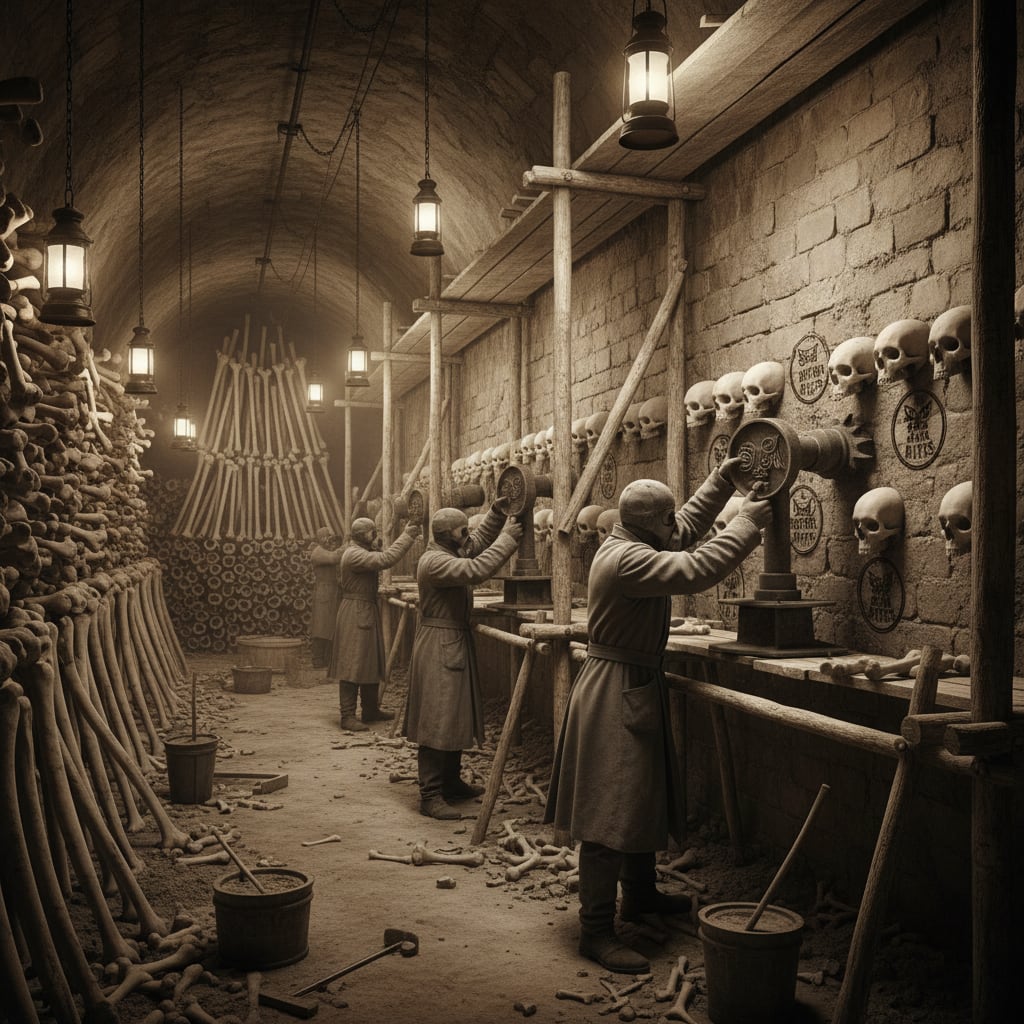
Beneath Sabine's authority, a small army of clerks, bone-stampers, corridor wardens, and Ritual Bone-Stampers maintains the system that keeps Constantinople's dead in their courses and Constantinople's living in their alcoves. The bone-stamps are applied to every skull before interment — a Bureau of Rites procedure that reduces post-mortem atmospheric disturbance by a margin the Bureau calls "theologically significant" and the bone-stampers call "the difference between a quiet shift and a bad one." The stamps work through conviction. A clerk who stamps with boredom produces a different result than a clerk who stamps with faith, and a clerk who stamps with terror produces a different result still. The Bureau has not studied this variable. The Bureau does not study variables it cannot standardize.
The Bureau of Bells maintains a separate schedule for the Ossuary Rings — the Sub-Carillon of the Widow's Lanes (Unregistered), seven bells tuned to frequencies the Bureau classifies as "containment-grade" and the dead apparently find soothing. The bells ring on the half-hour, every half-hour, day and night. They have not been silenced since A.S. 90. The one occasion on which they were silenced — for eleven minutes, during a maintenance failure in the winter of A.S. 178 — produced a disturbance in the Fourth Ring that the Bureau of Records has classified as "a localised seismic event of non-geological origin" and declined to describe further.
An earlier edition of this entry stated that the Sub-Carillon comprises "nine bells of standard liturgical configuration."
Corrected: seven bells. The nine-bell claim originated from a filing error in the Bureau of Bells' inventory, A.S. 194, which counted two echo-returns from the Third Ring as independent instruments. The Bureau of Bells has amended its inventory. The echoes have not been explained.
#On What Lies Beneath
The Ossuary Rings are built on something older.
The builders of the First Ring discovered this when they drove pilings into Constantinople's ancient bedrock in A.S. 47 and struck chambers that were already sealed, already old, already filled with a silence that the Bureau of Rites would later classify as "unprecedented." What they found they sealed again, with fresh mortar and a wax stamp. The stamp has been renewed eleven times. The mortar has cracked and been reapplied seven times. The wax seal shows, on careful examination, seventeen layers.
This is the Third Ossuary — the third ring from the inside, sealed since A.S. 47, before the Synod was formally constituted, before the Bureaus existed, before the bone-stamp was invented. Officially, it contains relics too holy for common access. Unofficially, the Bureau of Doctrine has published four separate and mutually contradictory explanations for why it remains sealed, and the contradiction itself has been classified as a security measure, on the grounds that an enemy who does not know which lie to believe will waste resources investigating all four.
At night — in the lower Rings, in the Widow's Lanes, in the bone-choked alleyways nearest the sealed vault — one hears bells. The bells do not match any liturgical schedule. They ring in sequences the Bureau of Bells cannot identify. No bell-tower is close enough to account for the sound.
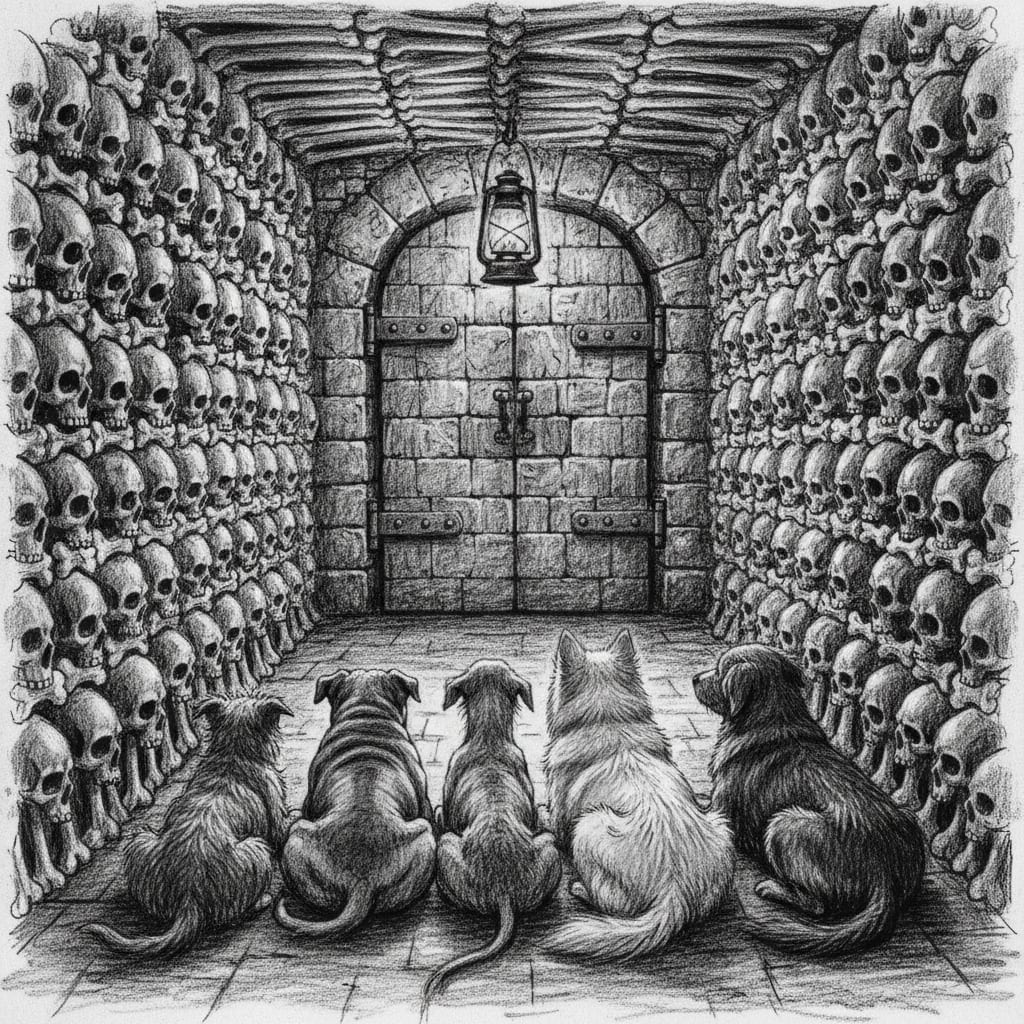
The dogs hear them clearly. They do not bark. They lie down, face toward the Third Ossuary, and wait.
████████████████ Bureau of Rites Assessment, A.S. 198 — Ossuary Ring Resonance Survey: Total post-mortem atmospheric disturbance (PMAD) readings across Rings One through Six have increased by ████████████████ percent since A.S. 194. The increase correlates with ████████████████ and is concentrated in the Fourth and First Rings, specifically in the bone-courses facing inward toward the Third. The assessment recommends ████████████████ and an increase in the Sub-Carillon's operating frequency from half-hourly to ████████████████. The recommendation has been forwarded to the Bureau of Bells, which has not responded. The Bureau of Bells maintains that the current schedule is adequate. Mother-Cryptor Sabine has requested the frequency increase independently. Her request was also filed. ████████████████ The dogs have not moved.
#On the Living Who Sleep Among the Dead
The Ossuary Rings are a cemetery. The Ossuary Rings are a fortification. The Ossuary Rings are also, by the arithmetic of war and the failure of every other arrangement, a neighbourhood.
Forty thousand people live in the corridors, alcoves, tent rows, and drainage strips that cluster against the Rings' outer faces. They are not residents. They are permitted — a distinction the Bureau of Settlement maintains with the legal precision of an institution that understands the difference between a right and a favour and prefers to grant the latter, because favours can be revoked.
The Ossuary Housing Allocators govern this population with a measuring rod and a tag roll and the quiet authority of men who control the only resource the desperate cannot manufacture: dry stone within the bell perimeter. Wall niches, stacked catacomb bunks, corridor alcoves, grave-field plots — these are the inventory. The Allocator sells dryness, bell-coverage, distance from sealed doors, and the luxury of sleeping where the wall does not exhale against one's cheek.
The Lantern Brotherhood patrols the Ossuary Rings after dark — the Circle of Ashen Steps, whose members walk clockwise and only clockwise, because counterclockwise is "inviting return," and the dead of the Ossuary Rings require no invitation. They carry tallow lanterns and bone hooks and a ledger of candle tallies, and they maintain the Two-Book Dead — the unofficial record of bodies quietly diverted from the Bureau of Records' official count, filed in a locked cabinet of body-tags where some tags are stamped, some blank, and some already filled with names that have not yet died.
The Bureau of Records does not acknowledge the Two-Book Dead. The Bureau of Records also does not patrol the Ossuary Rings after dark.
#On the Geometry of Containment
The bone-courses of the Ossuary Rings are arranged by doctrine and load. The chevron pattern — skulls outward, long bones at forty-five degrees, vertebrae as fill — was standardised in A.S. 68 under a Bureau of Rites specification that the Bureau of Engineering subsequently confirmed as structurally optimal, and that the Bureau of Rites subsequently claimed as proof of divine architectural intention. The two Bureaus have been arguing about the direction of causality for a hundred and thirty years. The argument continues. The walls continue to hold. The skulls continue to face outward. What they are looking at is, by doctrinal consensus, the enemy. What they are looking at is, by engineering consensus, the direction of maximum compressive load. The two consensuses have never been formally reconciled. They do not need to be. In Constantinople, function and faith are the same wall.
The dead accumulate in the bone-courses. This is the verb the Bureau of Rites uses when it is being honest, which is to say once per decade and usually in a sealed memorandum. They accumulate where death occurred at industrial scale, and the Ossuary Rings are industrial death made architecture. A hundred thousand skulls stacked in approved geometric patterns generate a resonance the Bureau classifies as "structural" and the skull-keepers classify as the thing that makes the candles gutter on windless nights.
The bone-stamps reduce the accumulation. The bell-schedule creates a frequency the dead settle into. The geometry channels what remains into patterns the Bureau calls "manageable." The system works — through bureaucratic thoroughness, through conviction, through the daily repetition of a procedure that has been performed so many times that its practitioners no longer distinguish between faith and habit. The Bureau calls this holiness. The bone-stampers call it Tuesday.
Earlier Bureau of Rites assessments (A.S. 180–195) described the Ossuary Rings' post-mortem atmospheric profile as "stable and within acceptable parameters."
Corrected, per sealed amendment A.S. 199: the profile has exhibited an eleven-percent increase in manifestation readings since A.S. 198. The increase is concentrated in the First and Fourth Rings. The Bureau of Rites attributes this to "seasonal variation." The season in question has lasted fourteen months. The Bureau of Rites has not amended its attribution.
#On Reserve Stores and Other Secrets
Beneath the Ossuary Rings — beneath the bone-courses and the corridor warrens and the offices of the Allocators — there are spaces the Bureau of Settlement does not map and the Bureau of Records references in precisely one document: a requisition order filed A.S. 130, endorsed by a Prefect whose name has been overwritten with a Bureau of Records correction stamp.
The reserve stores fed forty thousand people for seven days during the Ninth Bell Famine. Their existence was classified. Their exhaustion was classified. The forty thousand mouths they fed are a matter of public record, because mouths are difficult to classify.
What else is down there, beneath the official tunnelling and the unofficial housing and the bone-courses that line every surface, is a question the Bureau of Records has answered by not answering. The surveyors' reports reference "sub-level infrastructure consistent with pre-Synodic construction" and decline to elaborate. The drainage engineers report "non-standard acoustic returns from sealed chambers below the First Ring datum" and recommend that the Bureau of Engineering "conduct a full structural survey at earliest opportunity." The earliest opportunity has not arrived. It has been pending for sixty years.
The Ossuary Rings hold Constantinople together. Stone and bone and lime and the accumulated dead of a hundred and fifty years of war, arranged in geometric patterns that the Bureau of Rites calls sacred and the Bureau of Engineering calls load-bearing and the soldiers who sleep against the outer walls call home. The rings expand when the dead accumulate. The dead accumulate when the war intensifies. The war has not ceased intensifying since A.S. 45.
The rings, therefore, grow.
And beneath them, sealed since before the Synod existed, the Third Ossuary waits — patient, silent except for the bells that should not be audible through six feet of mortared stone, attended by dogs that will not bark and a Mother-Cryptor who sleeps facing away and a Bureau that has classified the waiting itself as a security measure, on the grounds that what waits beneath the Ossuary Rings has been waiting for a hundred and fifty years and shows no sign of impatience, and impatience, in the theology of the Bureau, is a sin, and therefore whatever waits below is, by strict doctrinal reasoning, virtuous.
The Bureau of Doctrine has not endorsed this reasoning. The Bureau of Doctrine has not refuted it either.