
#On the Origin of a Deniable Lamp
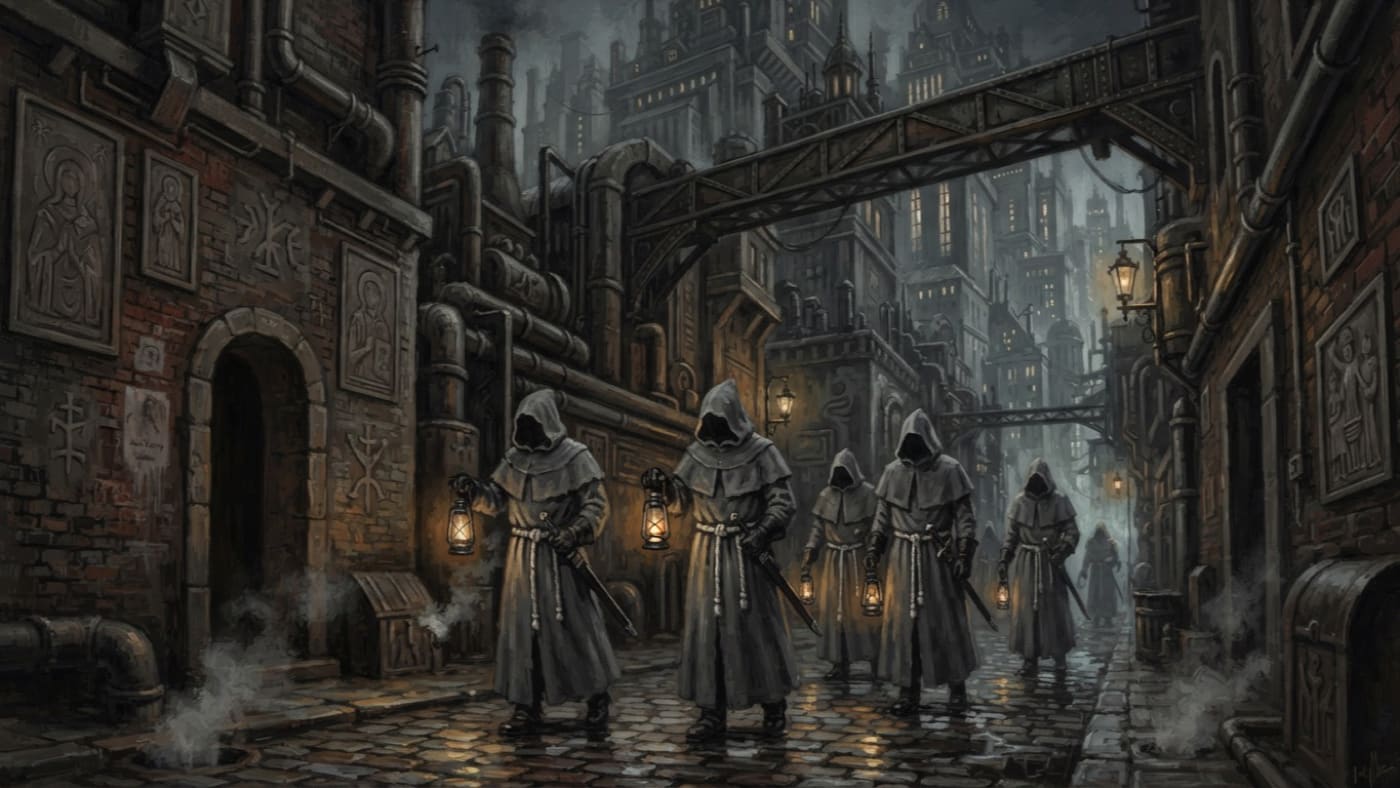
Every ward that has the Brethren of Vigil-Light calls them the Lanterns. A few wards call them things I decline to put in Ledger ink. They are a vigilante order of night patrollers. Each wears an ash-grey hood, soot-black gloves and one white cord for tolerated authority, and carries a short blade in its scabbard and a glass-hooded ash-oil lamp in hand. The Wardens can hold a street. They cannot hold a warren, a stairwell, a rope-walk and a bone-lane at the same hour, and the Synod has always preferred two organs of control to one. Redundancy is sanctity. The Brotherhood is the cheaper organ.
Its status is tolerated. A local licence, a Warden clerk's signature and a curfew list bearing its name make a Circle legitimate for exactly as long as the clerk keeps signing. Strasbourg can deny it in a sentence. A district can revoke it in an afternoon. Nothing in a Brother's lamp, badge-disk or blade amounts to a Bureau commission. The Brothers who believe otherwise usually learn the difference from a Warden, in front of witnesses.
The Curfew Ordinance of Quiet Hours of A.S. 94 (1804 CE) standardised the curfew routes the Brotherhood now walks. The Lantern Accord of A.S. 139 (1849 CE) brought its watch circles into the procession structure as crowd escorts beside the Pageant Captains. Both changed the work. Neither founded the order. This entry gives no founding year, founding council or sole founder, because the Ledger holds none.
The Ledger's index rows for the five Circles describe each as "descended from the A.S. 94 curfew toleration clauses."
Correction: the Ordinance regulates curfew hours, routes and Licensed Consolators. Records holds no consulted original of any clause naming the Brotherhood, and the index wording rests on summaries of summaries. The Circles walk the Ordinance's routes. No stamped record establishes their descent from it.
The patrons make it worse. Strict Circles invoke Saint Varro of the Procession when a patrol fails to return, and some trim their wicks to Vicar-General Anselm Rihn as a logistics saint of curfew routes. The older street tradition honours Saint Aelia of the Ember-Gate, who was very probably invented, and a Brother Marn, who was very probably real and was the first to map the alleys like a ledger. Four patrons do not add up to a founder. They add up to an order that prays to whoever is useful that night.
#On the Triangle of Witness
The field doctrine is one sentence. It is memorised from a folded wax-paper leaf, and then the leaf is burned: no alley is watched unless three lights have seen it.
The three lights are positions. The Anchor holds a fixed, visible lantern at a chokepoint so the street can see that it is being seen. The Blade is a moving pair that stops people, checks hands, breath and story, and searches. The Echo walks one lane over, unseen, and never intervenes. When something happens, the Echo writes the first report, the Anchor confirms it, and the Blade supplies the detained person. On worse nights it supplies the body. A Triangle may be five Brothers or a dozen. What matters is that three positions will say the same thing.
The arrangement produces consistent testimony, and it produces corroboration just as reliably whether or not anything happened, because the Echo has already told the Anchor what to confirm. The Brotherhood's catechism admits this with a candour I envy: And if the Synod does not see? Then we must make proof.
Lamps carry the orders. Two quick openings of the hood followed by one slow one mean a Warden is present. Every Brother in sight returns to clean procedure: slate out, blade sheathed, questions asked in the approved order. The existence of that signal says enough about procedure the rest of the time. The silent hand-code and mirror-shard flashes came from battlefield practice at the Silence Domes and were adopted for urban hush-zones. A borrowed drill proves nothing about whether a bell-dead alley and a Dome share a cause. After an arrest, the Circle leaves an Ash-Stamp on the nearest wall, a smear of ash and wax that serves as a receipt that the Synod acted there.
#On the Five Circles
A Circle is a district command with a territory, a specialty and a tolerated sin. The Ledger names five. No city must contain all five, and this entry places none of their houses.
The Circle of Nine Wicks holds market courts and ration queues. It stages contraband discoveries on schedule, disciplines crowds into lines, and sells light permits to stallholders who want their windows "properly lit" and their stalls left unselected. Its creed: A queue is a prayer. A shove is heresy. Its own charter names the Confession Closet, a drawer of blank confessions and pre-signed citations still waiting for their guilty.
The Circle of Ashen Steps walks the ossuary rings, clockwise only. It polices funeral routes, keeps candle tallies, hands bodies to the ash crews, and skims marrow-wax on the side. Its second ledger, the Two-Book Dead, records bodies diverted to patrons. The families who buried those names have not been told.
The Circle of Rope-Road Lanterns commands the elevated crossings and pulley districts. From above it sees who crosses between wards, with whom and carrying what, and it sells what it sees. Its doctrine runs If it falls, it was always falling. On the nights a patron asks, someone falls.
The Circle of Mute Radiance works bell-dead alleys and dome-scarred quarters by hand-code and mirror alone. It suppresses panic, detains people without a word, and removes them without writing anything down. The Tongue Cabinet attributed to it is a rumour, and the Ledger enters it as one. No inspector has opened it. I do not intend to be the first.
The Circle of Stained Proof enters relic and glass markets as polite buyers carrying coin. It stages a public seizure, complete with a gasp and a moral, and keeps one beautiful thing from each haul. That aesthetic tithe is officially held for disposal. Disposed pieces survive at a remarkable rate.
#On Rank, Rite and Oil
The ladder runs Wicker, Spark, Lanternman, Wick-Sergeant, Circle-Captain, Gloam-Prior, High Lantern. A Wicker carries oil and chalk and no blade. A Spark carries the lamp and the messages. The Circle-Captain bargains with Wardens. The Gloam-Prior coordinates a whole city and keeps its quiet-night statistics reassuring. Some wards still use the older street titles, Ember-Page, Alley-Marshal, Circle-Sergeant and Night-Prior, for the same kinds of work. No rank on either list is a Church office.
Two rites carry the doctrine. At Oil-Confession, before a shift, each member washes their hands in thin lamp-oil and names one fear and one lie told in service of vigilance. The lie is catalogued. It is never absolved. Without any instruction from Doctrine, the Brotherhood has built a confessional that produces a ledger and no grace, and I confess a brief professional jealousy. The Hooding teaches authority. A senior pinches the lantern hood until the flame thins (this is mercy), then opens it (this is law), and repeats it until the initiate stops flinching.
The pay is a ration stipend, an oil allotment and a lodging right in a Brotherhood house. Everything else comes from escort fees, passage sold by the night, collected debts, sold names, and bribes paid in bread and favour notes. Oil is therefore both supper and authority. A Brother whose lamp runs dry cannot declare an inspection. A Brother who cannot declare an inspection is only a hooded figure in an alley after curfew, which is to say a suspect.
#On Accommodations
Tolerant factions of the Brotherhood cooperate with organisers of the Silent Godless. The Bureau of Purity lists them among the cells' symbiotes, and the arrangements are what a Brotherhood economy would lead one to expect. A patrol walks one lane short. A Triangle's Echo writes nothing that night. A courier buys night passage and pays in maps and names. A Circle-Captain hears from a cell where the next queue riot will start, and is grateful. None of this makes a single Brother an atheist. A Lantern does not need to doubt the Creator to sell a corridor to someone who does. Every such arrangement is conditional and priced, and it can end in a Triangle report the moment an audit makes betrayal cheaper than silence.
The Lantern Mercy Preachers are a separate account. Some watch circles began shielding Mercy speakers for the sake of quiet streets, since a preacher who soothes a queue spares a Circle the labour of beating it. That accommodation split the Brotherhood. A schism at Cologne separated those who cut every Mercy contact and returned to hard curfew from those who kept the routes open. The Ledger holds no consulted record of the year.
The same lamps escort Pale Kin networks for a fee, and some Circle-Captains act as their patrons. Some Brothers enforce curfew without exception. Some bargain. A few shelter people by "lantern shadowing": they walk beside a fugitive in silence so that rivals assume the fugitive is protected. One Circle can hold all three kinds. So, over a single week, can one Brother.
Shared vocabulary misleads the careless. The rebel Lanterns preach mercy. The Red Lanterns of the Inquisition seize and brand. The Brotherhood patrols under tolerated authority. The three share a noun and nothing else: no common origin, no common command, no common roster.
#On Revocation
Audits ruin patrols. So do Warden reassertions, inquisitors, rival Circles with a grievance, and the genuine demon-hours when a flame goes flat and the Triangle learns that its testimony was never the most dangerous thing in the alley. The Synod calls the Brotherhood a holy necessity until a scandal reaches print, and afterward calls it a gathering of unofficial actors. The Brothers know the order of events. The newest Wicker is sacrificed first, as caught freelancing.
Conscience is spent in small payments: a mother crossing curfew for medicine, a child carrying bread, a stall that cannot survive seven unlit nights. Then a street needs an example, and there is a list of absent names, any one of which will serve.