

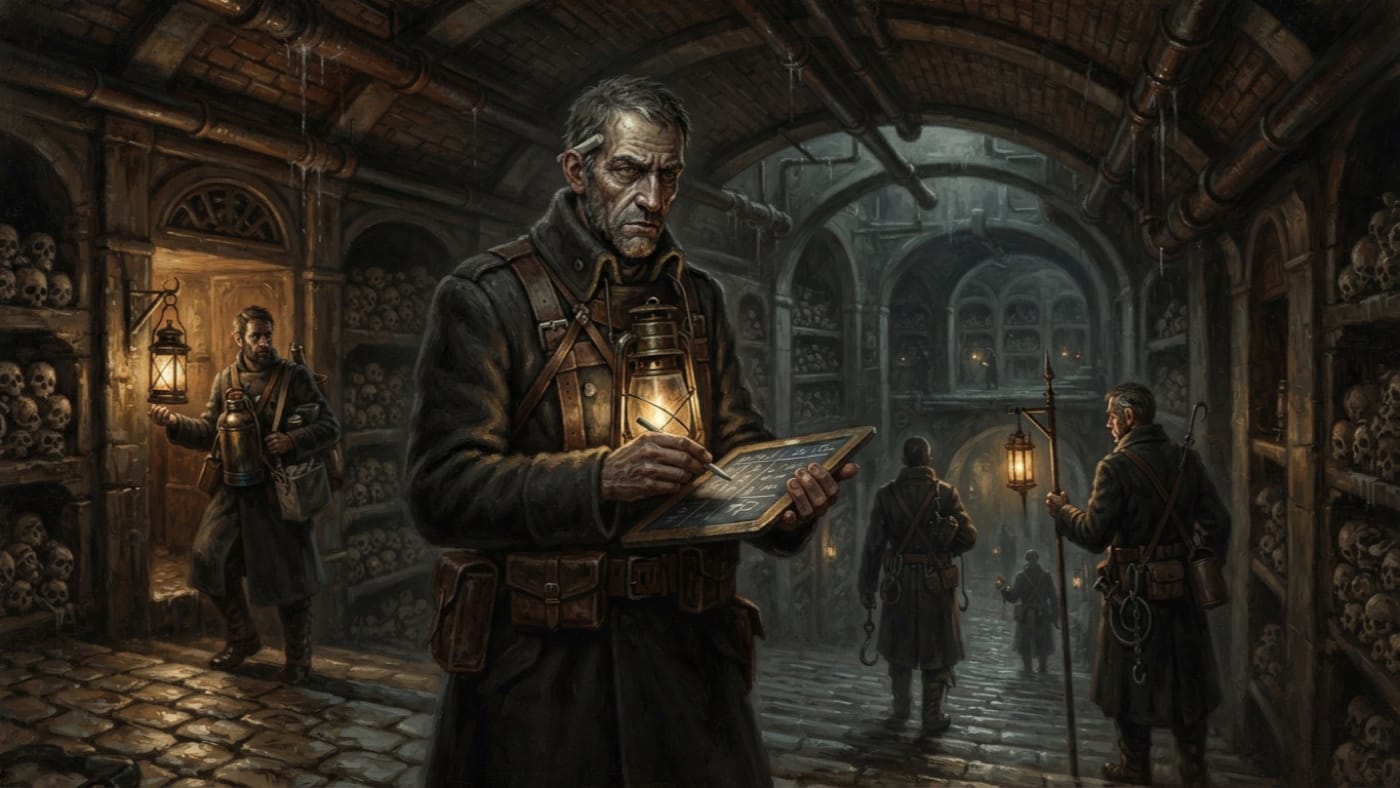
#On the Sergeant's Station
The Wick-Sergeant is the first man in the Lantern Brotherhood whose job is to count other men's nights. Below him the ladder runs Wicker, Spark and Lanternman. The Wicker gets oil and chalk, the Spark gets a lamp and errands, and the Lanternman gets a blade. Above him sit the Circle-Captain, the Gloam-Prior and the High Lantern, who comes out for festivals and crackdowns. The Brotherhood's ladder gives the Sergeant one line: squad lead; keeps patrol math, assigns "proof." I have read Bureau constitutions that granted less.
The squad belongs to him. The district Circle belongs to the Captain, and so does the bargaining with the Wardens. The city's quiet-night statistics belong to the Gloam-Prior, who keeps them pretty for the auditors. The Sergeant stands between a street and a report, and he owes each of them a number.
The rank is internal to the Brotherhood. It comes with no ordination, no Bureau commission and no Church office. The Brotherhood's own standing is a local licence, a Warden clerk's signature and a place on a curfew list. Its patrols walk the routes that the Curfew Ordinance of Quiet Hours standardised in A.S. 94, and the clerk can withdraw the licence whenever he likes. Over his Lanternmen the Sergeant's command is close to absolute. Beyond them he commands nobody.
The squad leader of a Lantern Circle is the Circle-Sergeant, who serves above the Alley-Marshal and answers to the Night-Prior.
Corrected. The Brotherhood's own ladder runs Wicker, Spark, Lanternman, Wick-Sergeant, Circle-Captain, Gloam-Prior, High Lantern. Older profession filings and some wards still use the street titles. This office does not certify that any old title matches any current rank.
#On Patrol Arithmetic
The ladder calls it patrol math, and the Field Leaf supplies the sums. At dusk the Sergeant sets the routes, the intervals and the number of lamps at each choke point. By dawn those routes must have produced something.
That something is proof. On the Leaf, the places that owe proof are marked with Crossed Wicks in chalk, and the Leaf states plainly what the mark asks for: take someone, find contraband, or fabricate a reason. The Sergeant decides where the wicks are crossed. His Lanternmen then find whatever the chalk has already promised.
Physical proof travels in the Proof Jar, a wax-sealed vial for powders, fibres and fume-scrapings. A patrol that comes back with an empty jar pays instead in names of suspects or maps of new corridors. The Sergeant accepts all three as currency. Nothing may be carried past dawn. The Leaf says that proof spoils. The Brothers explain that this means a superior will find it and use it against whoever is holding it. So the Sergeant turns the night into a report before the morning can audit him.
He has a method for this. In Circles that run the Triangle of Witness, an Anchor holds a visible lamp at a choke point. A Blade pair moves through the streets and searches. An Echo walks one lane over and stays unseen. The Echo writes the first report, the Anchor confirms it, and the Blade brings in the detained man or the body. The Sergeant posts Brothers to these places as the night requires. He holds none of them by right, and each Circle deploys as its ground allows. Three lights produce testimony that agrees with itself. Nobody asks the alley for its account.
Published report also places the Oil-Confession catalogue in the Sergeant's keeping. Before each shift, every Brother washes his hands in lamp oil and names one fear and one lie he has told in the service of vigilance. The lie is written down and left unabsolved. Keeping the book makes the Sergeant no confessor and gives him no sacramental office. He does not need either. The man who assigns the squad's proof also holds the list of everything the squad admits to having made up.
#On the Bone-Lane Tally
The Circle of Ashen Steps shows the arithmetic most plainly. Its ground is the Ossuary Rings of Bastion-Constantinople, together with the funeral routes, the cremation yards and the night-cart depots, where the damp off the Bosphorus has softened the chalk by midnight.
At dusk the squad washes in ash and inventories its hooks, tags and approved wax. At the curfew seal the ring-walk begins. Ashen Steps walks clockwise only and fixes every lamp at sternum height. These are the Circle's rules, and I have found no paper that makes them rules of the rank. The walk keeps a fixed order. A Wicker goes first with the slate, and a Lanternman follows with the ash paste. The Wick-Sergeant walks one pace behind with his lantern strapped to his chest, where its light falls on the slate and the windows together.
Each lit window gets a mark. Each dark window gets a second mark. A dark window may mean an empty house, a family too poor for approved wax, a body kept one night past registration, or a refusal. The slate cannot tell these apart, and nobody asks it to. Watched thresholds receive the Circle's split-candle glyph in chalk. Elsewhere in the Brotherhood the same glyph means two exits, one lies. Ashen Steps has never asked what it means elsewhere.
In the early night the discrepancy is only written down. The charter is explicit: missing flames are noted, and nobody acts on them yet. At midnight the squad checks the body routes. It either stops the corpse-thieves or negotiates with them, depending on which the Sergeant judges cheaper.
Late night is for corrections. The Candle-Tally initiation has already taught every Brother the doctrine: if the tally is wrong, make it true. A correction can be a warning. It can be an Ash-Tongue, with the offender's lips dusted with ash until speaking hurts for days. It can be a Marrow Fine, which confiscates the household's approved wax. It can also be the taking of someone. The Sergeant chooses which, and the slate records only the result of his choice.
Before dawn the tags are reconciled. The bodies go to the sanctioned crews, and the chalk is wiped off the thresholds. By sunrise the columns agree.
#On Wax and Accountable Bodies
The Sergeant's product is columns that agree. Agreement tells nobody what the columns contain.
Ossuary Office Seven, the Counting Room, holds the tally slates, the wax deposits, the bone hooks, the ash paste and a locked cabinet of body-tags. The office is numbered seven. There are six Rings. The clerk who reconciled the two has my sympathy.
Marrow-wax contains marrow fat from sanctioned remains. It is supposed to pass under Tithes measure and Records receipt. Ashen Steps skims the approved stock and sells it privately. So one arm of the Circle takes wax from households by fine, and another sells wax to households. No surviving paper shows that any particular confiscated ration reached that market. The incentive is there without one.
Behind the wax stands the Two-Book Dead, a second ledger of bodies diverted to patrons, to sale and to lost funerals. A reconciled slate is exactly what such a ledger needs. It is also exactly what an honest squad would hand in. The rank itself proves nothing about custody of the ledger, the cabinet key or a share of the profit. Any diversion would first have to persuade the man who balances the columns. His columns would also be the last place to show that he had been persuaded.
#On a Named Holder
The roster names one Wick-Sergeant of Ashen Steps: Rulik "Sootmouth". He knows every ossuary tunnel, and he coughs up wax-sweet phlegm. According to the roster, he sells marrow-wax to pay off a daughter's ration debt. His defenders repeat that reason. His enemies say the daughter is dead. I leave her where the record leaves her. Friends and enemies agree that his tallies are excellent. The cough, the trade and the motive are his own, and the rank requires none of them. Vey Strahl, a Lanternman, serves in the same Circle, and no paper puts him under Rulik's orders on any given night. Rulik's dossier lists his present station, and whether he is still alive, as unconfirmed.
#On Revocable Command
The Sergeant answers in two directions. His Captain wants the quarterly reconciliation clean. The Warden clerk who signs the Circle's licence wants a quiet ward, and wants a name ready if the ward stops being quiet. The Sergeant supplies both from the same slate.
He has hands for the work. His Lanternmen hold people, hook them, fine them and dust their lips. The Field Leaf calls the result an arrest. The Wardens call it detention by tolerated auxiliaries, and they keep the keys to every cell a Brother has to borrow. When two fast openings and one slow flash pass along the squad's hoods, a Warden has arrived and clean procedure begins. The Sergeant learns faster than his men what procedure looked like a minute earlier.
Audits come as oil-ledger checks, wick-length inspections and spot checks of dark corners. A short wick raises a question. An empty Proof Jar at dawn raises a worse one, because a Sergeant with nothing to show must account for the night with names. When the pressure grows too great for a slate to absorb, the Circle gives up whoever is cheapest to lose. A Sergeant costs more than a Lanternman and far less than a Captain.
The work takes its own payment: smoke in the lungs, frost, falls on wet bone steps, knives in the tunnels. A Sergeant who has walked enough rings starts counting his own footsteps between windows. Nobody orders him to.