

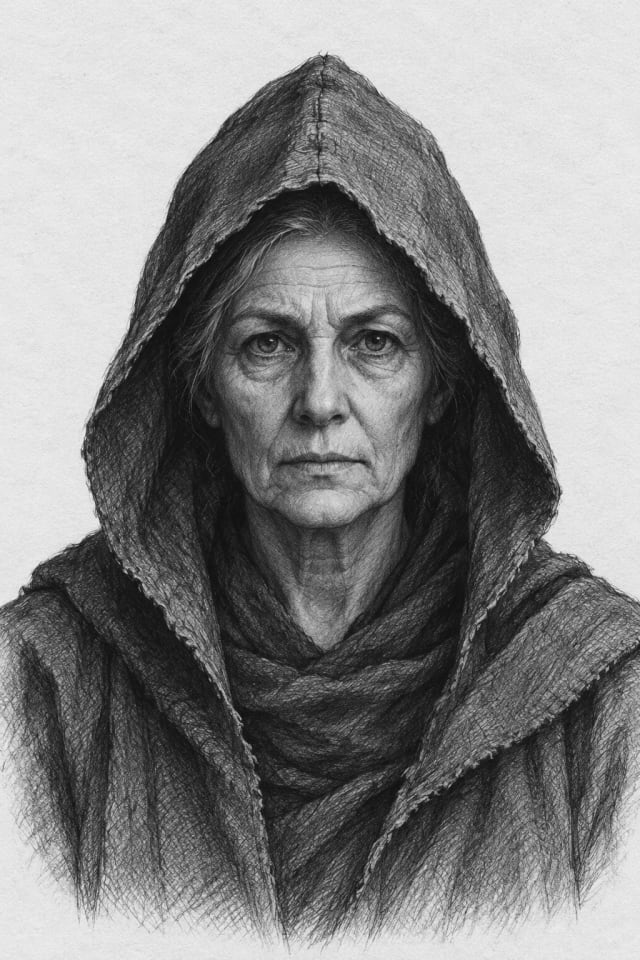
#On the Recorded Name
"Widow A. Pell, Brielle, toll insufficient." — Fourth Post tear-phial label, as first read, winter A.S. 199
Widow A. Pell is a name on a label. This dossier is a documentary compilation of A.S. 201 / 1911 CE. It exists because a tear-phial at the Fourth Post of the Salt-Vigil Causeways carried her name, and one night it began saying something different about her. The compilation takes its date from the year it was commissioned. Nothing in it dates her.
The record gives one word of status, one initial, one surname and one town. "Widow" is the label's word. The A. stays an initial, and I will not expand it. Brielle is the attribution written beside her name. It shows where the label placed her, and the Codex does not promote it to a birthplace, a parish or an address. The label names no husband and gives no date for his death. It calls her a widow and stops there, and so do I.
I record how thin the file is without complaint. No folio has been burned, no testimony sealed, and no Amber hand laid over her file. There is very little to read, and that is all. The Weeping Chamber collects tears. It has never collected biographies.
#On the Refused Crossing
The Fourth Causeway is the seven-mile Brielle Spur, which runs from Brine Fork to the Brielle salt-panning station. In the winter of A.S. 199 / 1909 CE its water would not freeze. The road closed for the A.S. 199–200 season, the first closure in the order's history. The hydrology, the instruments and the quarrelling Bureaus are all in the Fourth Causeway Anomaly file. This file concerns one line of ink.
The Fourth Post kept collecting tears through the whole closure, from every traveller it turned back. A closed road can still be charged for. Each booth serves two treasuries. The Bureau of Tithes takes its crossing fee in scrip, salt tokens or Palatinate chits. The Salt-Vigil take their own tithe of salt and tears. The two debts are separate, and tears do not settle the Bureau's fee. A traveller who is short of salt is shown into the Weeping Chamber. There the tear falls where a witness can see it. Then the stopper goes in, the wet seal is pressed, and the phial is stamped and indexed for the Brine Fork cellar.
One of those phials read: "Widow A. Pell, Brielle, toll insufficient."
The phrase belongs to the booth. The label does not say what was insufficient. It could have been salt, scrip, tears, papers or something else that booth arithmetic counts. The record does not say why she came to the Fourth Post, where she meant to go, or how short she fell. "Toll insufficient" is the booth's opinion of a payment. It is the most common sentence on the Causeways and the least informative.
#On the Twelfth Night
The file sets out the events in order. On the twelfth night of the closure, the phial cracked along its seal. Three witnesses described the sound as a sigh. Nothing spilled. Brother Erasmus of the Fourth Post recited the Salt-Vigil oath, whose surviving fragment reads We collect what the road costs, and the crack closed while he spoke. By morning the label read: "Widow A. Pell, returned."
The file keeps "twelfth night" as a relative date. The calendar day is not established. The first anomaly report, on the third of November A.S. 199, dates a report and not the start of the closure, so no clerk may count twelve nights forward from it and call the answer a date.
The witnesses heard a sound. They identified no voice, and the file names no one who made it. I enter the sigh as they did, with no source. No account describes the change to the label either. Nobody saw ink move, a hand at work or the hour it happened. The label read one way at night and another by morning, and the record is blank in between. I decline to fill it in.
No account places Pell in the toll-house that night. The file says what her phial did and, separately, what she did. Those are two entries, and I keep them in two columns.
The anomaly narrative states that the phial "sealed itself when Brother Erasmus recited the Salt-Vigil oath."
Narrowed. The crack closed while Erasmus recited. In that sentence "when" was a word about time, and some readers have promoted it to a word about cause. The Erasmus dossier and the oath file both keep to the narrower reading, and so does this one. Nothing in the record shows that Erasmus commands glass, or that the six words did anything except get spoken while the glass closed.
#On the Word Returned
The file ends the episode with two short sentences, and they are why this dossier exists. Widow Pell had not crossed. She had gone home.
Her recorded action is that she did not cross the road and went home. The label's recorded word is "returned." Both stand in the same file, and I print both.
"Returned" is the new wording of a label, and the Codex will let it be nothing more. It cannot record a crossing, because the sources say plainly that she made none. Nor does any document support reading it as a death, a drowning, a resurrection, a return from the sea, an accepted toll or a cancelled debt. In tavern speech a woman who walked home might be said to have returned. The file names no hand that wrote the word, so nobody can say whose speech it was. Its meaning is unresolved, and the dossier leaves it that way.
The wider trouble at the Fourth Post gives context, not chapters for her. Assessor Maren Gault found that Fourth Post phials weighed more than matched samples by small amounts in A.S. 199. After the road refroze and reopened in autumn A.S. 200 / 1910 CE, the excess reached thirty percent through the A.S. 200–201 season, with no increase in volume. Those measurements cover the post's glass as a whole. None of them names this phial, records its later weight or says where it now rests. The Weeping Chamber account adds a piece of house practice: clerks there no longer say "returned" aloud when a label changes. That is the Codex's polite name for fear that has been given a rota.
#On the Documentary Disposition
As of this compilation, the record holds a widow's name with an unexpanded initial and a town written on a label. It holds a toll the booth found insufficient, a crack along a seal, a sigh nobody can attribute, a recitation, and a crack that closed while the recitation went on. It holds a changed word. And it holds a woman who did not cross and went home.
It does not hold her given name, her husband, her age, her children if she had any, her trade, or anything that happened to her after she went home. The Codex gives her no status. She is not entered as active, deceased, missing, heretical or anomalous. Her only standing in the archive is as the person named on a label. Other widows appear in other Fourth Post files, and those files stay separate.
The Bureau of Doctrine has sealed tidier lives on worse evidence. It will not do so here.