
#On the Island Where Roads Divide and Grief Is Stored
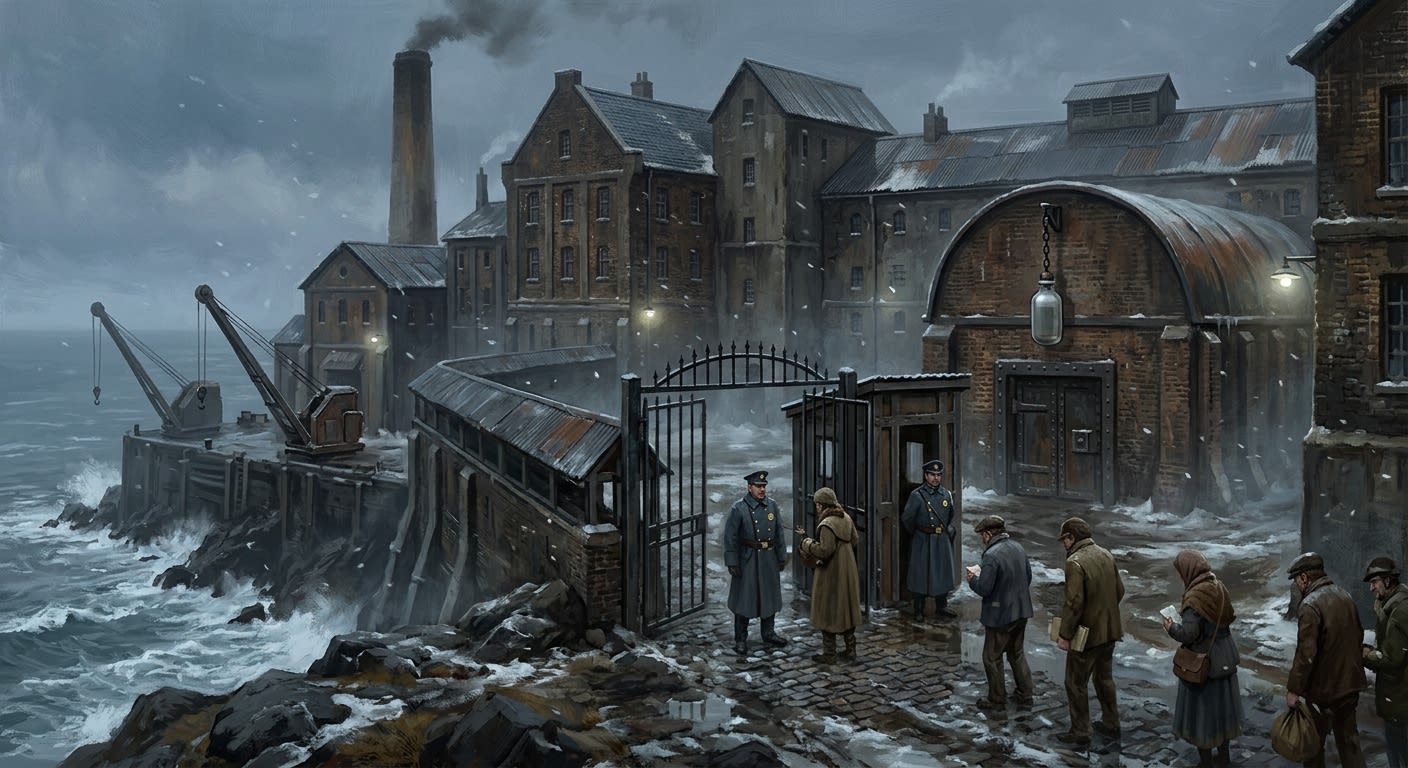
Brine Fork is the marsh island where the Salt-Vigil Causeways become a decision.
From the west comes the Candlewick Spur, eleven miles of salt-hardened timber and reed-bundle prayer from the Candlewick Palatinate's canal gates. From the northeast runs the Long Salt toward Hamburg's winter approaches, straight enough to offend the marsh and profitable enough to be called holy by men who would invoice a saint's shadow. From the south the road bends toward the Queue Road's western gatehouse, carrying pilgrims, convoy clerks, prisoners, fish wagons, salt-panners, auditors, widows, and that most durable cargo of the Synod, complaint under seal.
Brine Fork receives them all. It has a chapter-house, three toll courts, a salt store, a kitchen that smells of ash bread and brine broth, a prayer room floored in damp stone, a Road Tribunal (Unregistered) bench, the office of Prior Idris of the Sixth Tide (Unregistered), and beneath it all the Phial Cellar, forty-two feet by twenty-eight feet in the Bureau of Records measurement and larger in every way that troubles sleep.
#On the Making of a Fork
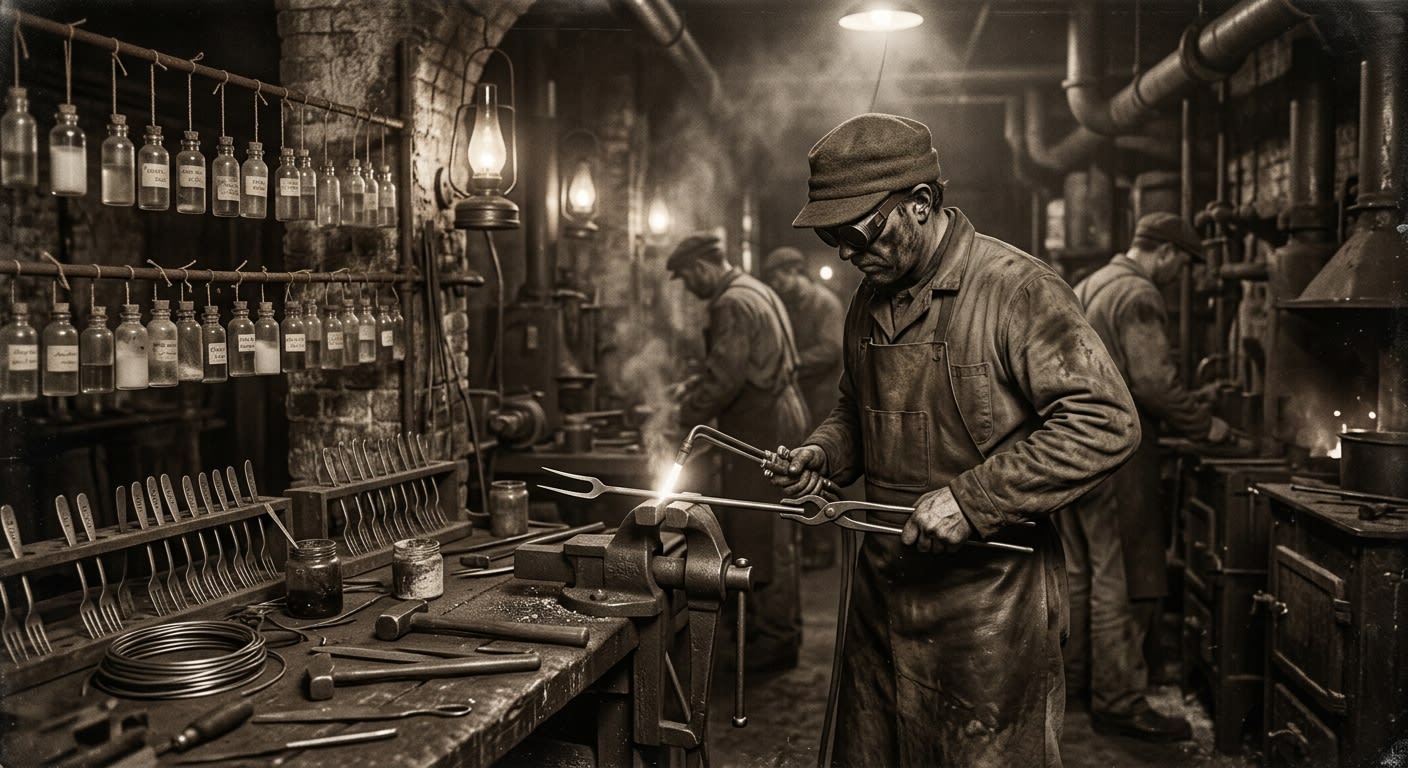
The site began before it had a name worth stamping. In A.S. 52, when Sundering refugees stumbled westward across frozen flats and learned that marsh ice can be road, grave, or joke according to weather, salt-hermits guided them between reed huts for a toll of salt and confession. The earliest crossing point sat where three shallows met around a low hummock of shell, peat, and stubborn grass. There the guides kept clay vessels for tears, salt jars for road-surface work, and a bell so cracked that its sound resembled a spoon dropped in a coffin.
The Synod did what the Synod always does when faced with useful misery. It improved the paperwork.
In A.S. 82, eight years before the Concordat, Veyrault's Bureau of Records formalized the Salt-Vigil order (Unregistered) and fixed Brine Fork as the central chapter-house. The old hermit hummock acquired stone footings, a toll-booth, a salt shed, a Weeping Chamber, a pier for shallow barges, and a little raised room where the prior could watch three roads misbehave at once. The island flooded that spring. It flooded the next spring. It has flooded nearly every spring since, and the Bureau of Engineering has recommended demolition in fourteen annual reports, each report drier than the floor it describes.
Early travel summaries describe Brine Fork as a service post attached to the Causeways.
Corrected. A service post supplies a road. Brine Fork governs three, feeds seven, stores the tears of all, and decides which misery receives salt before first frost. The summaries have been reclassified as optimism with poor boots.
The Salt-Vigil learned the island's habits faster than Engineering. Floors were raised by half-bricks and then by full courses. Ledgers were stored in waxed crates hung from ceiling hooks. The kitchen hearth was rebuilt on a stone plinth after the A.S. 116 thaw put eels in the soup. The prior's office received a second stair when the first began dipping below water at high tide, and a third stair when pilgrims started calling the second stair an omen. The cellar remained below. This proves either confidence, error, or a theology of drowning too profitable to amend.
#On the Three Roads and the Seven Demands
Brine Fork is called a fork because mapmakers enjoy eating while they lie. A fork has clean tines. Brine Fork has seven seasonal roads, three permanent arguments, and more informal tracks than any honest surveyor will draw without hazard pay.
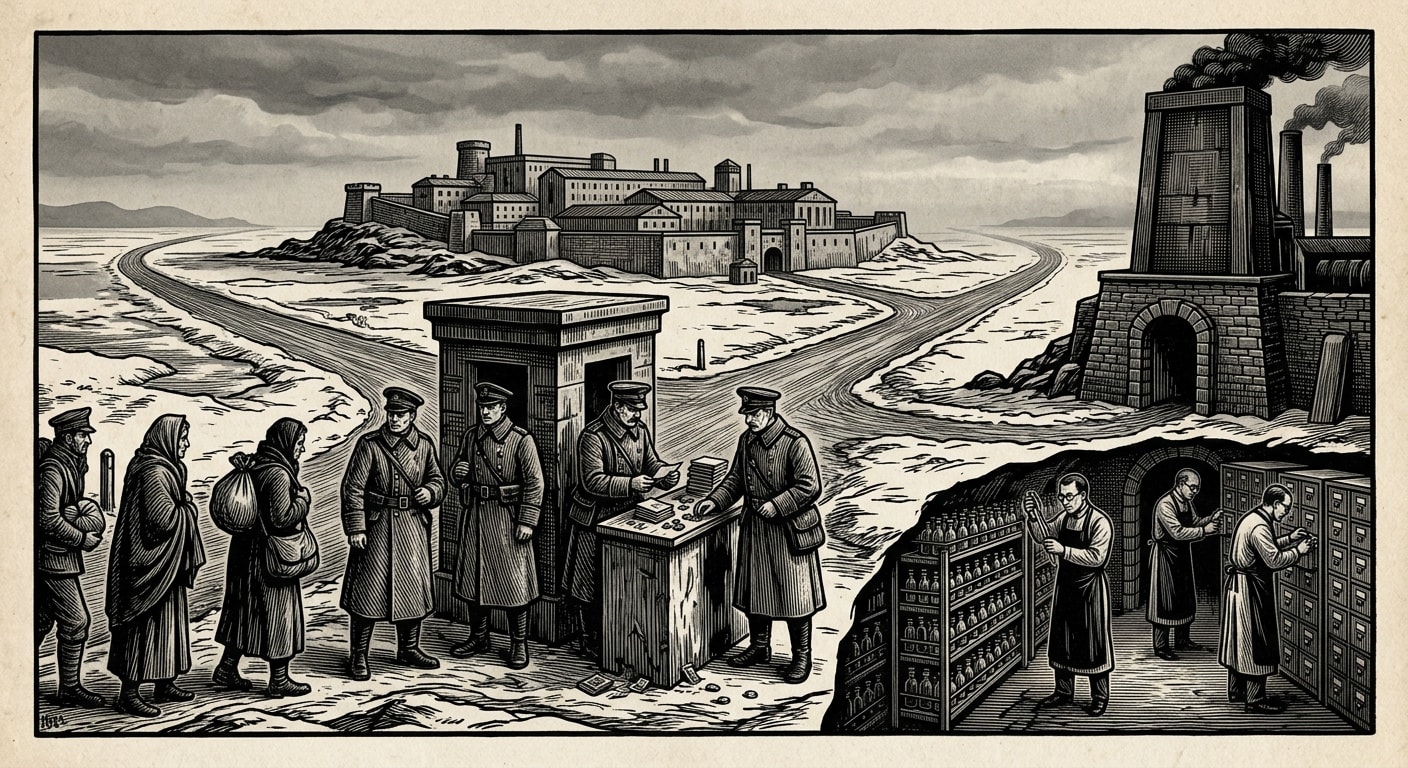
The Candlewick Spur brings wax-sealed chits, registry clerks, pigment wagons, and the thin bureaucratic smell of legitimacy manufactured upstream. The Long Salt carries northern traffic: Hamburg loads, coastal goods, winter military provisions, and pilgrims who have mistaken endurance for sanctity. The southern road feeds the Queue Road and its western gatehouse, that temple of delay where men learn that waiting can be monetized if benches are cold enough. The lesser spurs run toward fishing villages, salt-panning stations, and settlements which the Bureau of Records acknowledges according to weather, taxation, and mood.
At Brine Fork every route is weighed against the others. Salt allotment for the Long Salt means the Fourth Causeway receives poorer surfacing. Lamp oil for the Candlewick Spur leaves the southern toll-house dark after second bell. A military convoy toward Hamburg can close the pilgrims' lane for six hours. A failed freeze on the Brielle Spur can send complaint, spoilage, prisoner deaths, and Bureau inspectors into the chapter-house like rats into a grain bin.
The Road Tribunal sits twice weekly in hard season and whenever weather has committed an actionable offence. Its bench is a long plank in the west court, salt-scored, damp, and carved with initials by defendants who were later fined for damaging sacred infrastructure. Toll disputes, pass fraud, lost phials, missing salt blocks, convoy priority, pilgrim exemptions, corpses found between stakes, and arguments over whether a traveller has wept enough all pass beneath its ledger. A Tribunal rider may void papers on the road. At Brine Fork, the rider may also void stories.
#On the Chapter-House Above
The chapter-house is squat, grey, and practical in the manner of a clenched jaw. Its lower stones are dark with brine. Its upper walls wear salt like old lace. Windows are narrow against wind, spray, and the unreasonable tendency of winter to enter where theology has failed to caulk.
Inside, the public rooms arrange themselves by cruelty of need. The toll court faces the western door. Travellers enter, stamp snow from their boots, present salt tokens, wax chits, Bureau scrip, military exemptions, or faces already preparing to be denied. To the right stands the Weeping Chamber, a room with a bench, a table, a vial clerk, a Salt-Vigil witness, and no fire. To the left lies the salt store, where four hundred tons of winter tithe pass by sack, block, crust, and sweepings before being mixed into road aggregate. Behind the court are the kitchen, infirm bench, prayer room, prior's office, and the iron-banded hatch whose warning plaque possesses the rare virtue of bluntness: NO FLAME, NO SONG, NO OPEN VIAL.
The Salt-Vigil who serve here are less romantic than pamphlets prefer. They mend straps. They count blocks. They scrape ice from thresholds. They dry salt-cloth socks over smoking braziers and then put them back on before dawn because the Vow of Exposure is not satisfied by philosophical sympathy. They are hard, chapped, underfed, suspicious of warmth, and capable of a hospitality so severe it resembles sentencing. A traveller may receive soup, pallet, passage, or rebuke. All four come with a receipt.
Prior Idris governs from a room whose window faces the split between the Long Salt and the southern road. He has lost three toes, most of his patience, and the ability to tolerate young officials who mistake indoors for authority. His desk holds route ledgers, salt issue books, phial intake copies, transfer denials, and a small bowl of grey water taken from the Fourth Causeway during the A.S. 199 closure. It has never frozen.
#On the Cellar Below
Beneath Brine Fork, seventeen steps descend to the Phial Cellar.
The room contains six racks, eleven thousand four hundred and six sealed tear-phials at the A.S. 199 count, and enough disciplined dread to qualify as architecture. Each phial bears date, toll-station, collection hand, wet seal, and origin field. Each was filled in a Weeping Chamber by a traveller who lacked salt, coin, scrip, exemption, or the emotional dryness necessary to freeze with dignity outside. The oldest surviving glass sample dates to A.S. 83, the first full winter after charter; it hums when carried, so since A.S. 170 it has not been carried. This is procedure, and procedure is fear with a filing habit.
The Cellar makes Brine Fork more than a junction. Roads divide above; grief accumulates below. A missed payment may be contested with a phial. A disputed crossing may be resolved by wet seal. A family may be charged after death because the origin field proves that the deceased paid in sorrow rather than salt. The vial clerks call this evidentiary preservation. The Bureau of Records calls it proof. The traveller calls it nothing, having already left something more intimate than coin in glass.
Certain Salt-Vigil catechisms describe the Phial Cellar as “the memory of the road.”
Amended for doctrinal precision. Memory suggests recollection. The Cellar performs retention, weight, acoustic response, frost pattern, label degradation, and creditor behaviour. It is less poetic and much less forgiving.
Assessor Maren Gault entered the Cellar in A.S. 198 and began measuring the kind of fact that makes Bureau prose shorten. Frost under toll events. Origin fields thinning under sealed wax. Rack Six leaning toward Fourth Post samples. The old phial responding to widow classifications. Her transfer request was denied, naturally. One does not remove a competent witness from a room merely because the room has begun answering.
The Fading Winter injured Brine Fork in its most sensitive organ: labels. Origin fields faded while dates, fees, seals, and debts remained. Thousands of sealed grief samples threatened to become unattached to the penitents who had paid them. Personhood thinned. Obligation endured. Strasbourg received this news with the solemnity appropriate to a miracle that favoured accounting.
#On the Fourth Causeway's Shadow
The Fourth Causeway Anomaly made Brine Fork's centrality embarrassing.
In A.S. 199, the Brielle Spur refused to freeze. The failure took place seven miles away, at the eel bend near the Fourth Post, yet Brine Fork felt it in salt orders, rerouted traffic, spoiled wagons, closed hearings, prisoner delays, and the sudden arrival of Bureau men who brought instruments, seals, and the soft indoor smell of pending blame. Brother Erasmus touched the water and shook. Gault tasted it and wrote: grief without owner. Prior Idris denied transfer requests with the serenity of a man who believes being marked by a road creates jurisdiction.
The Fourth Post phials came back heavier.
Equal volume. Equal glass. Equal seal-wax. Equal clerk. Thirty percent excess by the A.S. 200–201 season. Brine Fork received them as it receives all things: in a locked crate, under witness, through the salt store, past the plaque, down the steps. Rack Six leaned by visible degree. Engineering denied the lean. Denial is easier on dry floors.
BRINE FORK NIGHT INTAKE — FOURTH POST CRATE, MIDWINTER A.S. 200 Witnesses: Mother-Warden Sile Mourn-Lit, Clerk Juno Glass-Throat, Assessor Gault. Observation: crate exterior dry; interior phials filmed; labels intact except three origin fields. Audible event: one sigh beneath Rack Six after placement. Clerk Juno ordered salt circle renewal. Gault note: “Do not store beside Rack One.” Subsequent marginalia in unknown hand: █████████ drinks where roads decide.
From that winter forward, Brine Fork changed practice. Fourth Post phials rest overnight in salt circles. Lanterns are covered after second watch. Widows are housed away from the south room if the floorboards answer. Prisoner transfers no longer use the eel bend. Brother Erasmus is watched by men who pretend watchfulness is care. No phial may be lowered into open water, a rule so sensible that three Bureaus immediately asked why it was necessary.
#On the Market of Necessary Cold
Brine Fork is holy infrastructure, which means it is also a market.
Salt tokens pass through the west court in quantities sufficient to make Tithes jealous. Candlewick wax chits circulate at a discount after fog. Hamburg convoy notes are honoured when the ink holds. Military exemptions override pilgrim claims unless the pilgrim carries relic certification, a category so often forged that the Salt-Vigil test the paper by smell and the claimant by patience. Fish wagons pay less if spoilage has begun, more if spoilage can be blamed on an official closure. Prisoners pay nothing, which is why their guards are charged for delay.
Around this lawful commerce clings the inevitable rind. Grief-for-hire women wait near the outer reed fence, selling tears to merchants whose consciences are dry but whose papers are poorer. False origin slips move in waxed sleeves. Salt blocks are cut with chalk. Old phial seals are softened over steam and pressed onto newer sorrow. The Vial Vault Clerks detect what they can and monetize what they cannot. The Road Tribunal punishes these frauds with fines, exposure, pass voiding, and occasional labour on the Long Salt, which is the Salt-Vigil's elegant method of teaching criminals to respect surfaces.
Brine Fork also sells certainty. A traveller who leaves the chapter-house knows whether his route is open, whether his toll is settled, whether his grief has been accepted, whether his name remains attached to what he paid, and whether the marsh intends to take him under current conditions. That last knowledge is frequently approximate. The Salt-Vigil never promised omniscience. They promised the road would be fed.
#On the Present Condition
As of A.S. 201, Brine Fork operates under seasonal Green classification with Amber practices attached like leeches beneath the forms.
The seven roads open and close according to frost, salt supply, Bureau appetite, and whatever old grief moves under the Brielle Spur. The chapter-house still floods each spring. The kitchen still feeds travellers with broth so salty it could preserve a bishop. Prior Idris still stands bare-handed at the toll line for six winter hours each day, proving obedience by risking fingers he can ill afford to lose. Assessor Gault remains below, measuring the Cellar and the patience of her superiors. The drawer receiving her reports sticks more each quarter.
Brine Fork's danger lies in its usefulness. Destroy it and the winter arteries clot: Hamburg loads delay, Candlewick chits sour, Queue Road gates swell, convoys reroute, pilgrims freeze, prisoners die late, and the Bureau of Tithes discovers theology in lost revenue. Preserve it and the Phial Cellar grows, the Fourth Post samples gain their impossible weight, the origin fields fade, and the road continues drinking with all proper receipts attached.
No sane authority would build its winter logistics through a marsh island that stores tears beneath the floor, floods annually, argues with ice, and permits a toll order to speak of grief as maintenance material.
The Synod did not build Brine Fork. We found it already useful. Then, with our customary genius, we made it official.