
#On the Refusal of Ice
"The water was cold by instrument, warm by tongue, and obedient to neither." — Assessor Maren Gault, field note suppressed under Amber seal, A.S. 199
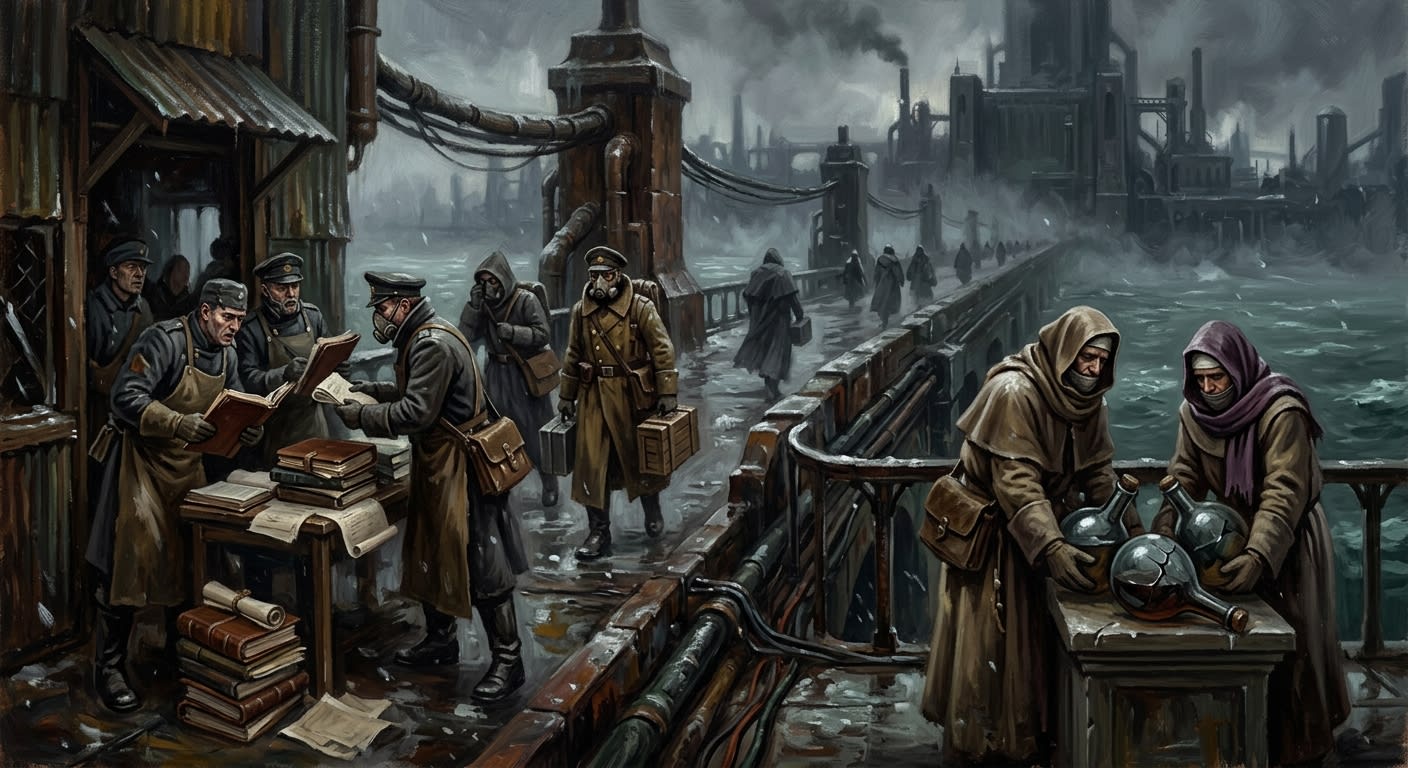
The Fourth Causeway Anomaly is the Category Two hydrological-theological embarrassment recorded on the seven-mile Brielle (Unregistered) spur of the Salt-Vigil Causeways, where in the winter of A.S. 199 the Frisian shallows refused to freeze.
I choose the verb with care. The water did not fail through mildness, current, salinity, industrial runoff, demonic heat, faulty instrument, clerical misreading, or the usual sabotage by men who profit from broken roads. The Bureau of Engineering measured the air at killing cold. The Bureau of Alchemical Standards measured the water at freeze-readiness. The Salt-Vigil (Unregistered) measured the road by foot, palm, breath, prayer, and the grim intimate knowledge acquired by ascetics who stand in brine until pain becomes a calendar. All measures agreed.
The water remained water.
The Fourth Causeway connects the Brine Fork to the Brielle salt-panning station. It is no grand arterial like the Long Salt; it carries local panners, small convoys, fish wagons, prisoners under light guard, and pilgrims too poor to pay for the safer northern spur. Such roads are the Synod's capillaries, beneath dignity until severed, at which point every Archon in three provinces discovers a deep affection for local traffic.
#On the Road Before the Wound
The Causeways began as refugee craft and became Bureau property, which is the usual career of useful misery. Salt-hermits guided the desperate westward across frozen Frisian flats as early as A.S. 52, seven years after the Sundering opened the east and taught Europe the value of a road that disappears in spring. The original toll was salt and confession. The grief came naturally. The phials came later.
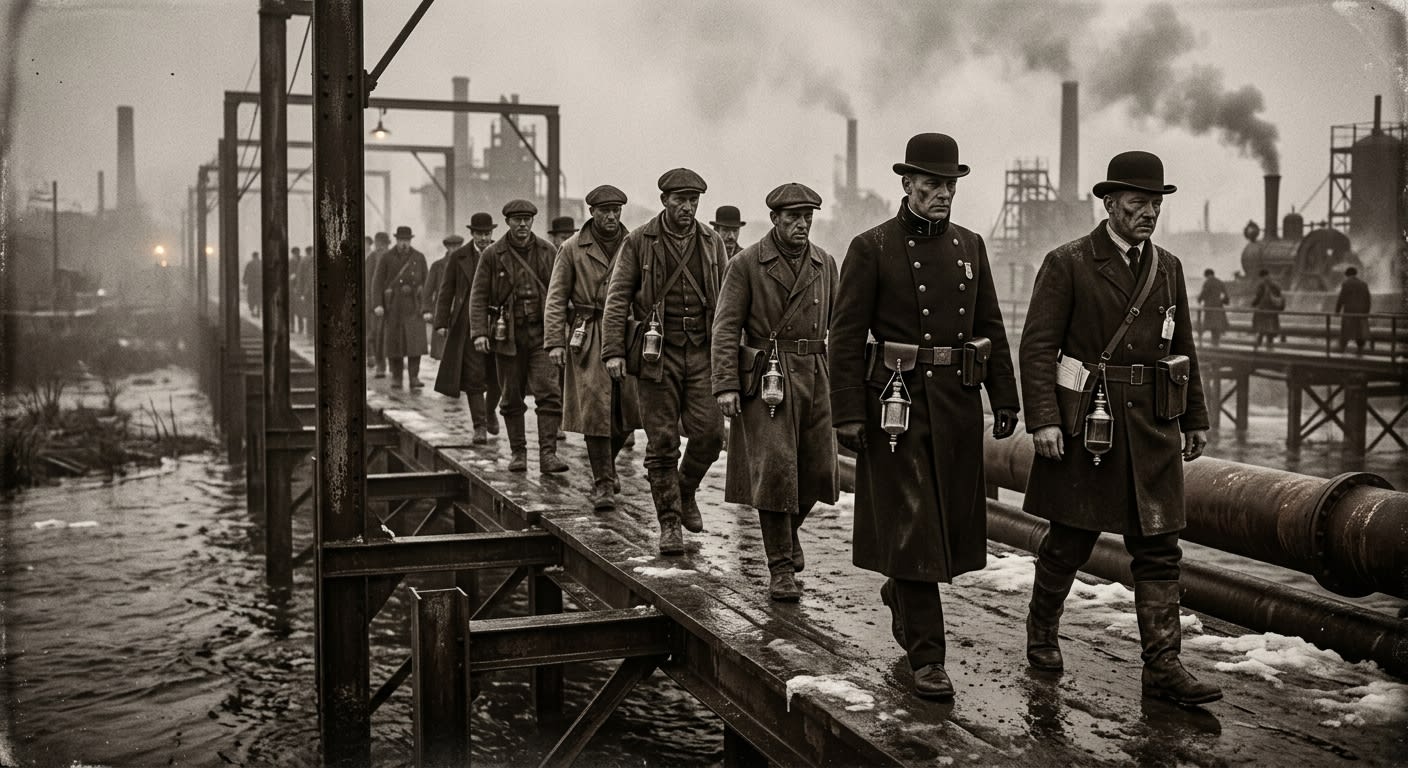
In A.S. 82, Veyrault's Bureau of Records formalized the Salt-Vigil order eight years before the Concordat, granting it authority over seven seasonal roads across the Frisian shallows, the Zeeland tidal flats, and the Scheldt estuary. The charter was elegant in the way manacles can be elegant: maintain the roads, collect the tolls, keep the winter arteries open, and file everything that weeps.
The Fourth Causeway entered the old maps as the Brielle Spur, a modest line of salt-hardened timber, reed-bundle fascines, crushed shell, and annual repair fraud. Its toll-house had three rooms: booth, Weeping Chamber, salt store. Its staff numbered eleven in ordinary winter: Brother Erasmus of the Fourth Post, two vial clerks, four toll-brothers, a soup woman, a lantern boy, one spanwright seconded from Reedhouse (Unregistered), and a Road Tribunal (Unregistered) rider who appeared every third week to frighten the arithmetic.
Earlier route summaries described the Fourth Causeway as a fishing-village spur of negligible fiscal importance.
Corrected. No route is negligible once it can be closed. Negligibility is a fiction maintained by offices that have not yet missed a shipment.
For one hundred and fifty-four recorded freeze seasons, the pattern held. First frost sealed the flats. The Salt-Vigil drove their prayer stakes. The Brine Fork issued salt and lamp oil. Pilgrims crossed. Wagons groaned. Prisoners slipped, cursed, rose, and were struck for profanity. Spring dissolved the evidence. Autumn rebuilt the argument.
#On the Winter of A.S. 199
The first report arrived on the third day of November, A.S. 199: "surface incomplete." This phrase ordinarily means a late freeze, a broken reed course, a sinkhole under the near pilings, or a spanwright too drunk to distinguish mud from theology. Brother Erasmus walked the line himself at dawn. He found the approach frozen, the stakes set, the first half-mile stable enough to take a mule team, and then, at the old eel bend, open water lying black and still between two ridges of salt crust.
He tested it with a pole. No ice. He knelt. He removed his glove, an act that violates Salt-Vigil prudence and brushes the sleeve of prayer. He placed two fingers in the water and withdrew them unburned, unfrozen, and shaking. The toll-brother with him reported steam. Brother Erasmus denied steam. The lantern boy reported that the water moved toward Erasmus's hand. The later deposition records the boy as unreliable because he was fourteen and frightened, as if age had ever prevented a Bureau witness from being correct.
By the sixth day the Bureau of Engineering had arrived with thermometers, sounding rods, salinity flasks, and the self-loving irritation of men summoned to inspect a puddle. Air: below freezing. Water: below freezing by instrument. Salinity: within normal range for the flats. Current: none. Wind: vicious. Surface: liquid.
The water tasted of salt and something older than salt. Brother Erasmus supplied the first description: "like tears, but older." Assessor Maren Gault objected that taste was not an approved measurement protocol. She then tasted it herself. Her field note, later copied into the Amber file, reads: "No mineral profile. No rot signature. Grief without owner. Recommend no further oral testing." This is the kind of sentence that causes three Bureaus to request custody of the same page.
The Causeway closed. The first closure in Salt-Vigil history. Convoys rerouted to the Third Causeway and the Queue Road western gatehouse. Brielle salt wagons waited fourteen days and lost two loads to wet spoilage. A prisoner transfer bound for Hamburg was delayed long enough for three prisoners to die in a holding shed; the Bureau of Records filed them as having arrived late, which is administratively adjacent to alive.
#On the Warm Taste
The Bureau's problem was never that the water stayed open. Water can stay open for many vulgar reasons. The problem was the arithmetic of grief.
Every toll-house on the Causeways contains a Weeping Chamber. Travellers who lack salt, scrip, or adequate papers may pay in tears. The tears are collected in standardized glass phials, sealed, stamped, indexed, and sent to the Brine Fork cellar, where as of the A.S. 199 inventory eleven thousand four hundred and six phials rested in racks. The oldest dates to A.S. 83. None have been opened. None have been emptied. The cellar hums only in certain weather, which is the kind of qualification a sane institution treats as a warning and the Synod treats as an invitation to study.
During the closure, the Fourth Post still collected tears. Travellers arrived, were denied passage, wept from frustration, cold, fear, debt, and the splendid human habit of crying harder when told the reason is insufficient. The phials filled quickly. The phials also filmed from within, as though fine salt were crystallizing on the glass. When warmed in the palm, they cleared. When set on the toll table, they leaned toward the direction of the open water.
Assessor Gault compared Fourth Post phials to Brine Fork controls. Equal volume. Equal glass. Equal seal-wax. Equal clerk. The Fourth phials weighed more by small increments in A.S. 199, then thirty percent more in the A.S. 200–201 season after the Causeway had refrozen and reopened. Their contents remained clear. No sediment. No visible foreign body. No increase in fluid line. Weight without volume is one of those theological facts the Bureau of Alchemical Standards resents because it cannot charge rent to the explanation.
A single phial cracked on the twelfth night of the closure. It did not spill. The crack opened along the wax seal, produced a sound described by three witnesses as a sigh, and sealed itself when Brother Erasmus recited the Salt-Vigil oath (Unregistered). The phial's label, which had read "Widow A. Pell, Brielle, toll insufficient," read by morning: "Widow A. Pell, returned." Widow Pell (Unregistered) had not crossed. She had gone home.
A.S. 199, Fourth Post night register, folio 11: "At second watch the open water reflected lanterns from below. Counted seven. We had lit four. Brother Erasmus ordered all lamps covered. Reflection remained. One lamp moved against the wind." Remainder sealed under Alchemical Standards Amber. Marginal note in Gault's hand: "Do not lower a phial."
#On Explanations Rejected and Retained
The Engineering theory blamed subsurface heat. Frosted rods killed it.
The Alchemical theory blamed saline inversion. Normal salinity wounded it.
The Pilgrimage theory blamed unconfessed sorrow among travellers, which has the advantage of accusing the victims and the disadvantage of being indistinguishable from ordinary Bureau speech. The Salt-Vigil theory was simpler: the road had drunk too much and the water had become unwilling to harden over it.
Prior Idris's deposition has been cited by certain pamphleteers as evidence that the Salt-Vigil worships the road.
Amended. The Salt-Vigil does not worship the road. It obeys the road, feeds the road, fears the road, profits from the road, and occasionally speaks to the road in private. These distinctions satisfy Doctrine, which has always been merciful to profitable grammar.
A demonic explanation was considered and dismissed without announcement. There was no sulphur trace, no infernal heat signature, no laughter in the reeds, no change in cruciform salt pattern, no clawing beneath the pilings. The Bureau of Purity sent two inspectors who found no possession among the toll-brothers and only the ordinary moral corrosion produced by long employment in a toll system.
The most plausible account remains the least usable: the Fourth Causeway lies above an old grief channel, a place where refugee tears, toll phials, drowned bodies, denied crossings, and a century of sealed misery found a lower road than ice. In A.S. 199 that road surfaced. The water refused to become a bridge because it had become a ledger.
No Bureau has ratified this sentence. I record it anyway, because the Bureau pays me to lie well and, on rare occasions, to arrange truth in a sufficiently obedient posture.
#On the Present Weight
The Fourth Causeway froze again in autumn A.S. 200. Traffic resumed. Brielle salt wagons crossed under lantern cover. Pilgrims paid wet and passed dry. Brother Erasmus remained at his post, denied transfer by Prior Idris, who believes a man marked by a road should remain where the road can see him.
The phials from the Fourth Weeping Chamber grew heavier.
By midwinter A.S. 201, Gault's ledger showed a thirty percent excess over matched samples from the First, Second, Third, Fifth, Sixth, and Seventh toll-houses. No phial had gained volume. No wax had cracked. No glass had thickened. The labels had begun to smudge at the origin field, a defect later cross-filed with Fading Winter cases after inventories elsewhere lost names and retained debts. The Fourth labels kept dates, toll amounts, and seals. They lost faces.
The Salt-Vigil adjusted practice. Tears collected at the Fourth Post now rest overnight in a salt circle before transport to the Brine Fork. Toll-brothers no longer taste water under any condition. Lanterns are covered after second watch. Prisoners are not marched over the eel bend. Widows are not housed in the south room, after three reported hearing their own names spoken from the floorboards by voices that sounded younger than their grief.
The Bureau of Engineering wants the anomaly declared resolved. The Bureau of Alchemical Standards wants another winter of samples. The Bureau of Pilgrimage wants the route open, cheap, and holy. The Bureau of Tithes wants to know whether heavier phials should be assessed as greater payment. The Bureau of Doctrine has ruled that tears remain tears regardless of weight, provided they are sealed by approved wax and entered under the correct hand.
At dawn, the Fourth Causeway is beautiful in the bleak, prosecutorial manner of winter infrastructure. Salt crust. Reed stakes. Grey water under white skin. The toll-house chimney produces a thin column of smoke. Travellers lower their eyes at the booth. Brother Erasmus holds out the phial.
Pay wet. Pass dry.