
#On the Roads That Drown
"A road that vanishes in spring is a road that has opinions." — Cantor-Toll Sevra of the Third Causeway, deposition before the Bureau of Engineering, A.S. 187
There are roads in the western marshlands that exist for four months of the year and spend the remaining eight as mud, water, or theological argument. The Salt-Vigil Causeways are these roads — or, more precisely, the Salt-Vigil Causeways are what happens when the Synod decides that even the absence of ground must be administered.
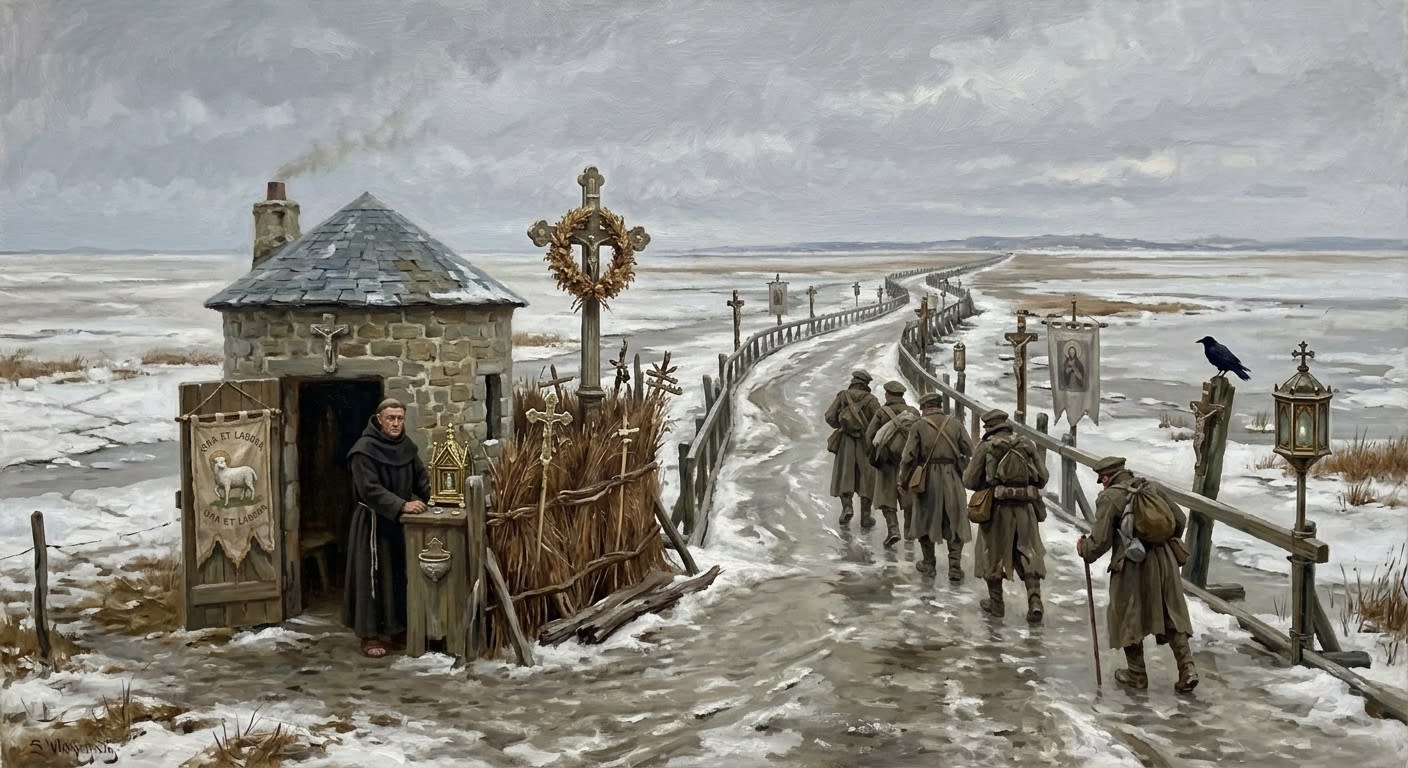
They run from the Candlewick Palatinate's southern canal-gates through the Frisian shallows, the Zeeland tidal flats, and the drowned pastures of the Scheldt estuary, branching at the Brine Fork into a northern spur toward Hamburg's overland approaches and a southern spur toward the Queue Road's western gatehouse. In summer these routes are swamp, and the Bureau of Engineering's maps mark them in the same green ink reserved for "terrain of no administrative consequence." In winter, when the frost bites deep enough to set the mud like cement and the tidal shallows freeze into salt-crusted highways, the Causeways become the fastest overland route between the northern ports and the Heartland supply arteries — faster than the Rhine barges, cheaper than the Rope-Ferry Chain, and infinitely more miserable than either.
The Bureau of Records lists them as "Seasonal Arterial Infrastructure, Western Approaches, Nodes 1 through 7" — seven raised causeways of packed earth, salt-hardened timber, and frozen marsh-reed bundles, each between four and nineteen miles long, connected by toll-houses staffed by men and women who have taken a vow the Bureau classifies as "ascetic" and everyone else classifies as "insane."
These are the Salt-Vigil.
#On the Order of the Salt-Vigil
"We collect what the road costs." — Oath of the Salt-Vigil, recorded in the Ledger of Seasonal Dispensations, A.S. 82
The Salt-Vigil are a toll-ascetic order — a phrase that requires unpacking for readers who have never encountered the specific intersection of piety, commerce, and exposure that the western marshlands produce. They are, in the driest possible summary, monks who stand in the cold and charge you for the privilege of walking past them.
Their order predates the Synod. The earliest records — fragmentary, suspect, and bearing the sort of water damage that suggests the records themselves have walked the Causeways — place a community of salt-hermits in the Frisian shallows as early as A.S. 52, seven years after the Sundering, when refugees flooding westward from the Balkans discovered that the coastal marshes froze hard enough to walk on and that certain half-starved monks living in reed huts along the tidal flats were willing to guide them across for the price of salt and confession.
The Synod formalized the order in A.S. 82, eight years before the Concordat — Veyrault's Bureau of Records saw the utility of a pre-existing toll network in territory too wet to garrison and too useful to ignore. The Salt-Vigil received a charter, a set of robes (undyed wool, salt-stiffened at the hems, which is less a fashion choice than a consequence of standing in brine for eight hours a day), and a mandate: maintain the Causeways, collect the tolls, and keep the roads open from first frost to final thaw.
In exchange, the Salt-Vigil received the right to tithe. Their tithe is unusual. They do not collect coin — the Bureau of Tithes handles that, jealously, from its counting houses in Rheinscarp and the Palatinate, and would immolate anyone who encroached on its prerogative. The Salt-Vigil collect salt, which they use to harden the causeway surfaces, and tears, which they do not explain.
Earlier editions of this Codex, compiled under the supervision of Hieromnemon Octav, stated that the Salt-Vigil tithe of tears was "ceremonial in nature and of no practical consequence."
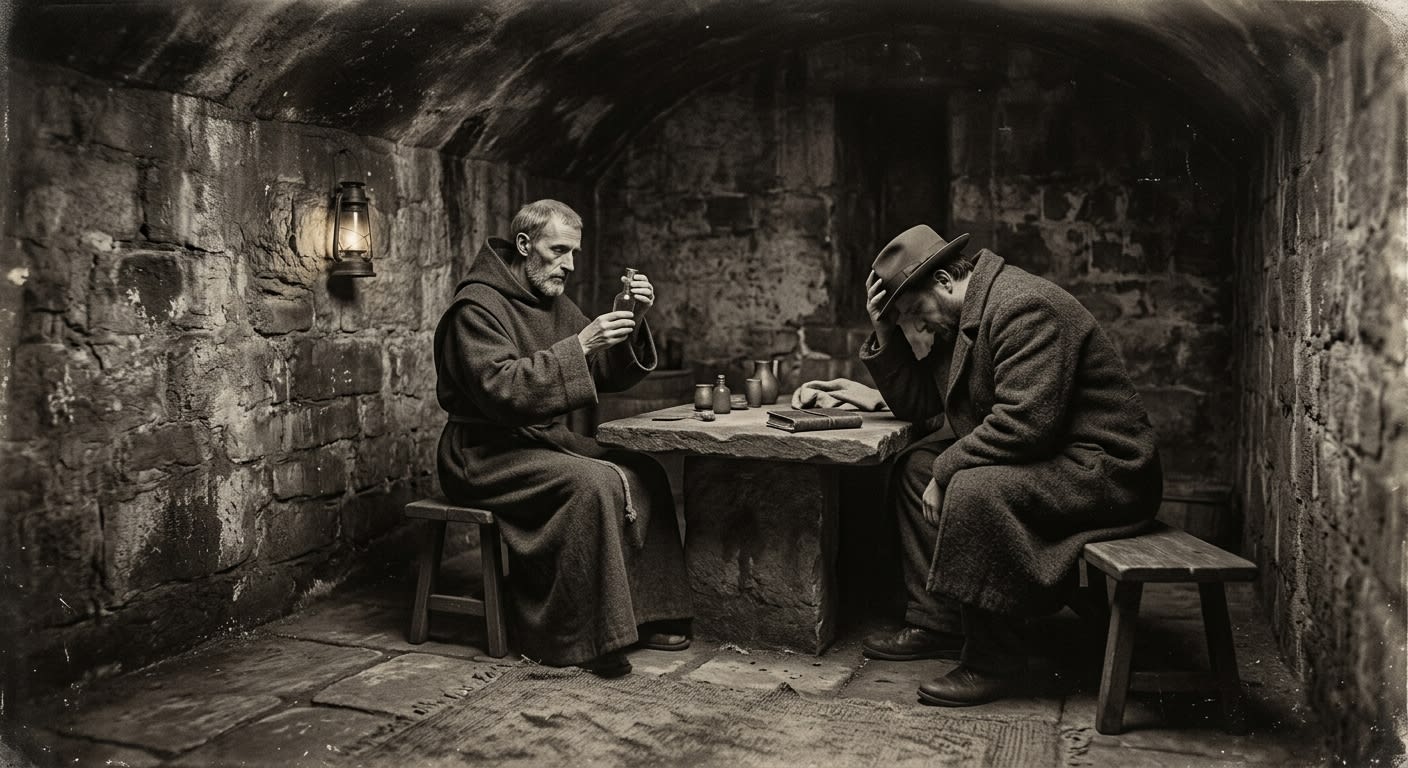
This is incorrect. The tithe is collected in standardized glass phials issued by the Bureau of Alchemical Standards. The phials are sealed, stamped, and forwarded to the order's chapter-house at the Brine Fork. What happens to them after that is classified under a filing category that the Bureau of Records assures me exists, though it has declined to name it on four separate occasions.
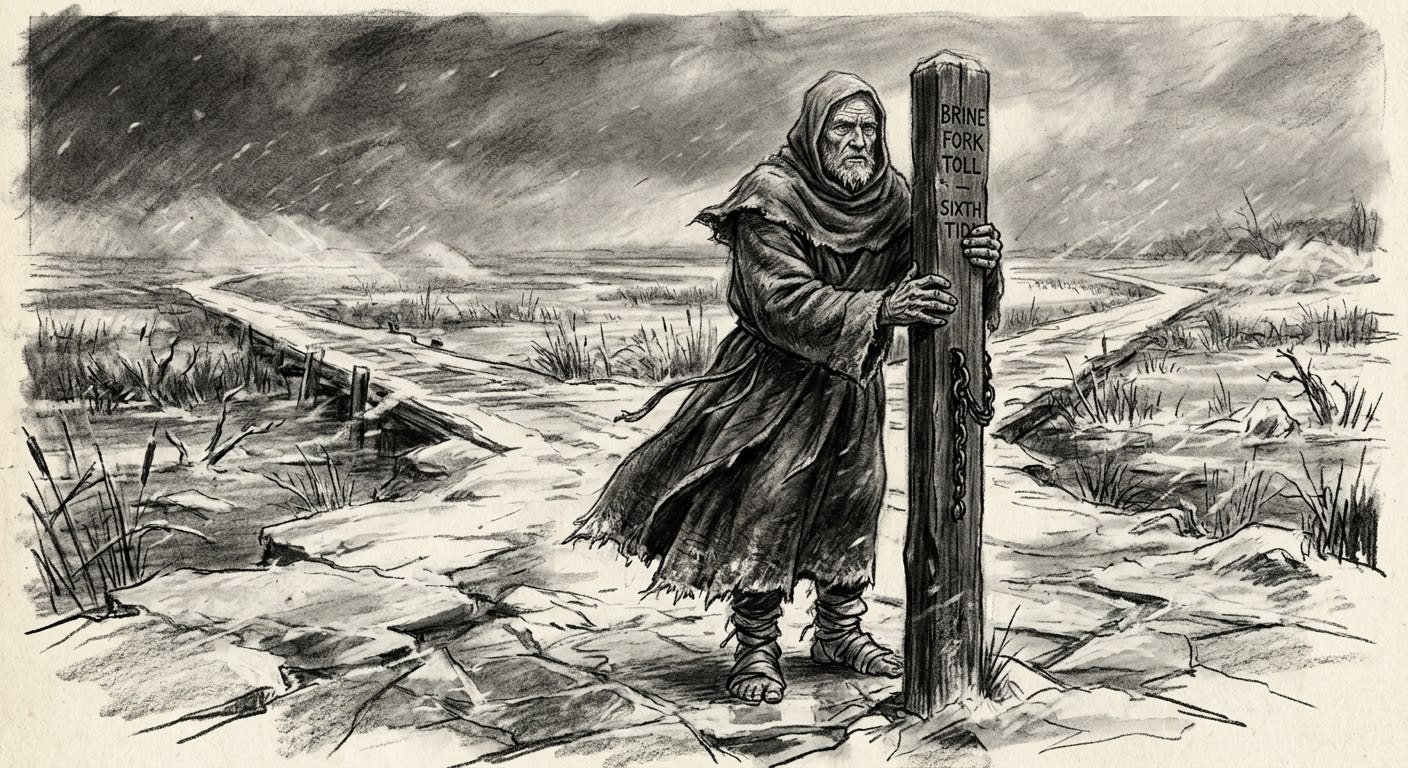
The order numbers approximately eleven hundred souls spread across seven toll-stations, three chapter-houses, and a central priory at the Brine Fork — a marshy island at the junction of the northern and southern spurs where the causeways converge and the order's Prior, currently Prior Idris of the Sixth Tide, administers the order's affairs from a stone building that floods to ankle-depth every spring and which the Bureau of Engineering has recommended demolishing in fourteen consecutive annual reports.
The Salt-Vigil take three vows: poverty (standard), obedience (negotiable), and exposure. The Vow of Exposure is the order's signature. It requires that each brother or sister of the Vigil spend no fewer than six hours of every winter day standing at their assigned toll-post, regardless of weather, without shelter beyond a waist-high windbreak of stacked reed bundles. They wear no gloves. Their feet are wrapped in salt-cloth — linen soaked in brine and dried until it cracks like old leather. The Bureau of Mercy has filed nine formal objections to this practice. The Salt-Vigil have filed nine formal responses, each consisting of a single word: "Endure."
#On the Causeways Themselves
"Straight where the marsh permits, crooked where the marsh insists." — Bureau of Engineering Field Manual, Section 14.7: Seasonal Infrastructure
Seven causeways. Seven raised paths across terrain that is, for eight months of the year, indistinguishable from the sea it borders.
The First Causeway (the Candlewick Spur) runs eleven miles south from the Palatinate canal-gates to the Brine Fork, crossing three tidal channels on timber bridges that the Salt-Vigil rebuild every autumn and the spring tides destroy every April. It is the busiest of the seven and the least interesting, which is a distinction that applies to most infrastructure the Bureau considers reliable.
The Second Causeway (the Scheldt Crossing) runs six miles across the frozen estuary flats to the southern spur junction. In years when the freeze comes late, the Second Causeway does not exist, and traffic reroutes through the Queue Road at a cost in time that the Bureau of Records measures in weeks and the merchants measure in blasphemy.
The Third Causeway (the Long Salt) is the jewel — if that word can be applied to nineteen miles of frozen marsh. It runs from the Brine Fork northeast toward the Hamburg approaches, crossing the Frisian shallows in a line so straight that the Bureau of Engineering suspects divine intervention and the Salt-Vigil attribute to "good surveying and a total disregard for comfort." The Long Salt is the route that matters — the winter artery that connects the northern ports to the Heartland supply network when the Rhine barges are iced in and the coastal shipping lanes are too storm-wracked to navigate.
The remaining four causeways are shorter spurs connecting to fishing villages, salt-panning stations, and three unnamed settlements that the Bureau of Records acknowledges on alternate Wednesdays. They are administered by junior brothers of the Salt-Vigil and used primarily by locals, smugglers, and the occasional Bureau of Shadows operative whose presence the order pretends not to notice with a discipline that suggests long practice.
The causeways themselves are constructed each autumn from materials the marsh provides. Salt-hardened timber pilings driven into the frozen mud. Reed-bundle fascines laid in courses and packed with clay. A surface layer of crushed shell, salt, and — in sections where the Bureau of Alchemical Standards has conducted its annual "ground-blessing" — a compound the Bureau describes as "sanctifiediteite aggregate" and the Salt-Vigil describe as "holy gravel." The entire structure must be rebuilt or repaired every year, because the spring thaw destroys whatever the winter storms have not.
The toll-houses stand at the junction points — squat stone buildings, each containing a toll-booth, a confession-stall, a salt store, and a room the Salt-Vigil call the "Weeping Chamber." Travellers who cannot pay the salt-toll may pay in tears instead. A brother or sister of the Vigil sits in the Weeping Chamber with a glass phial and a patience that borders on geological, and the traveller confesses whatever grief or sin or exhaustion has brought them to a frozen marsh in January, and weeps, and the tears are collected, and the toll is paid.
The Bureau of Purity has investigated the Weeping Chambers seven times. Each investigation has concluded that the practice is "doctrinally acceptable, if aesthetically distressing." The eighth investigation is scheduled for spring. The Salt-Vigil are not concerned.
#On the Economy of Frost
The Salt-Vigil Causeways carry approximately one-eighth of the Synod's winter supply traffic between the northern ports and the central Heartlands — a figure that astonishes anyone who has never seen the alternatives. The Rhine freezes. The coastal lanes storm. The Queue Road's nine gates slow to a crawl when mud turns the approaches into trenches. The Rope-Ferry Chain halves its crossings when the rivers ice over. In the dead months between November and March, the Salt-Vigil's frozen marsh-roads become, by default, the most reliable overland route in the western theater.
This generates revenue. The Bureau of Tithes collects a crossing fee at each of the seven toll-houses — payable in Synod scrip, salt tokens, or the Palatinate's wax-sealed trade chits. The Salt-Vigil collect their own parallel tithe of salt and tears. The result is a double-taxation system that the Bureau of Tithes considers "efficient" and travellers consider grounds for profanity that the toll-booth confessors dutifully record.
The salt collected is not merely symbolic. Approximately four hundred tons of salt pass through the Causeways each winter — tithed from merchants, pilgrims, military convoys, and the occasional Bureau courier whose expression, upon being informed that his diplomatic pouch does not exempt him from the salt-tithe, has been described by multiple witnesses as "theologically instructive." The salt is stored in the order's cellars at the Brine Fork, mixed with the sanctified aggregate compound, and used to resurface the causeways the following autumn. The Salt-Vigil are, in this sense, an infrastructure project that feeds itself.
The tears are another matter.
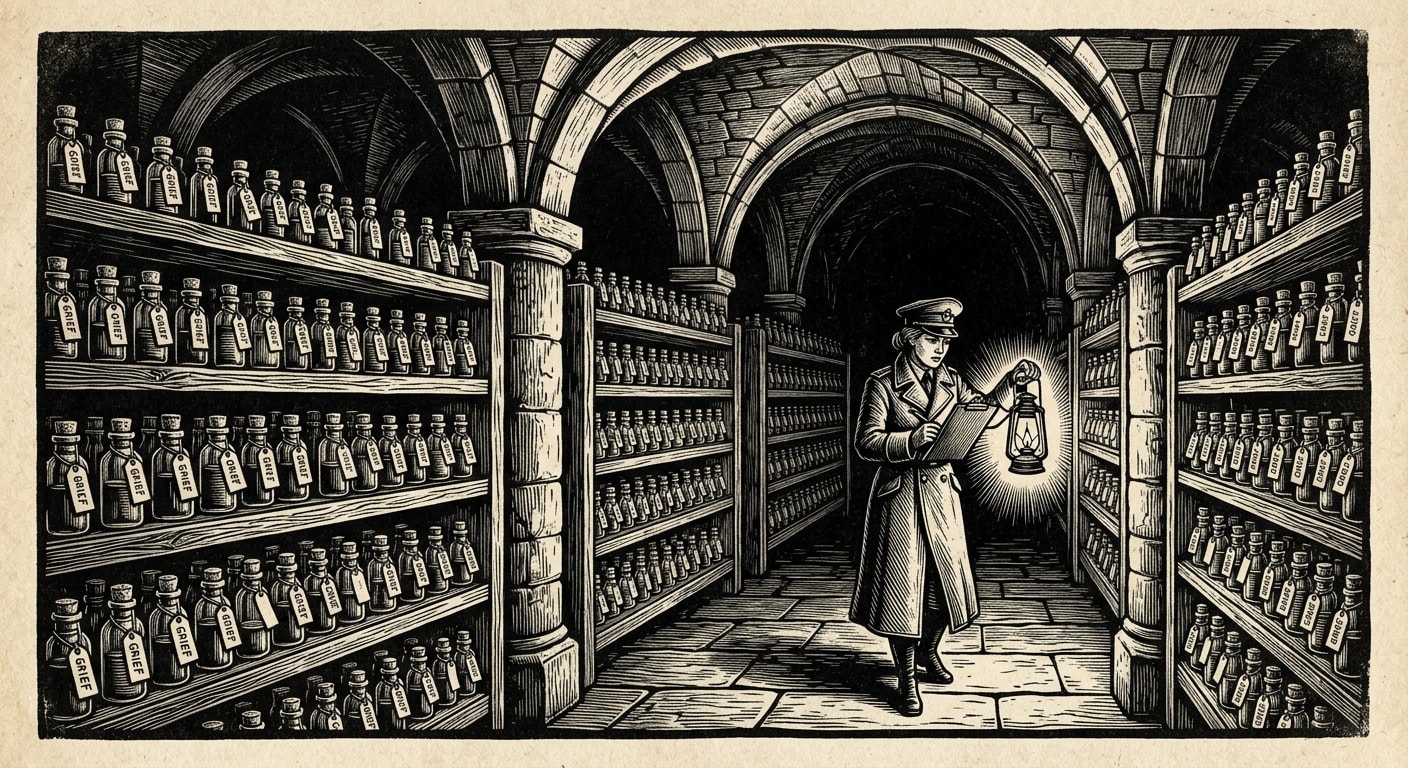
The Brine Fork chapter-house contains a cellar that the Bureau of Records has measured at forty-two feet by twenty-eight feet. The cellar contains racks. The racks contain phials — glass, sealed, stamped with the date and toll-station of collection. The Bureau of Alchemical Standards has counted eleven thousand, four hundred and six phials in the most recent inventory (A.S. 199). The oldest dates to A.S. 83. None have been opened. None have been emptied. The order adds to the collection every winter and has never, in one hundred and eighteen years of record-keeping, removed a single phial.
The Bureau of Alchemical Standards classifies the cellar as a "Category One Passive Accumulation Site" — the same classification applied to reliquary vaults and ossuary overflow chambers. When pressed on what, precisely, is accumulating, the Bureau's liaison to the order, Assessor Maren Gault, submitted a report in A.S. 198 consisting of three pages of meticulous chemical analysis and a final paragraph that read: "The aggregate emotional residue in the cellar exceeds any single reliquary in the western Zone. I recommend continued monitoring and a personal transfer."
Assessor Gault's transfer request was denied. She remains at the Brine Fork, monitoring. Her reports have become shorter.
#On the Disappearance of the Fourth Causeway
"The Fourth Causeway is on the maps. The Fourth Causeway has always been on the maps. The Fourth Causeway was walked last winter by eleven hundred people. The Fourth Causeway does not, at present, appear to exist. These facts are not contradictory." — Prior Idris, deposition to the Bureau of Engineering, A.S. 200
In A.S. 199, the Fourth Causeway — a seven-mile spur connecting the Brine Fork to the Brielle salt-panning station — failed to freeze.
This requires context. The Frisian shallows have frozen every winter since the Sundering. The Bureau of Engineering's records, meticulous on this point, document one hundred and fifty-four consecutive freeze seasons. The ice comes. The causeways are built. The traffic moves. The thaw comes. The causeways dissolve. The cycle repeats with a regularity that the Bureau considers proof of divine order and the Salt-Vigil consider proof that the Creator has a schedule.
In A.S. 199, the shallows beneath the Fourth Causeway did not freeze. The water temperature, measured by Bureau of Alchemical Standards instruments, dropped to the expected seasonal minimum. The salinity was within normal parameters. The air temperature was well below freezing. The water remained liquid. It did not steam. It did not ripple. It simply refused to become ice, with the passive stubbornness of a substance that has made a decision.
[SECTION REDACTED — BUREAU OF ALCHEMICAL STANDARDS, SEAL AMBER]
The Fourth Causeway's substrate water, tested at six-hour intervals between 3 November and 14 November A.S. 199, exhibited a saline concentration consistent with
[REMAINDER CLASSIFIED. ACCESS RESTRICTED TO BUREAU OF ALCHEMICAL STANDARDS, TIER THREE AND ABOVE.]
The Salt-Vigil's toll-brothers at the Fourth Causeway reported that the water beneath their stations — water that should have been ice — was warm. They reported that it tasted of salt and something else, something the senior toll-brother, Brother Erasmus of the Fourth Post, described in his deposition as "like tears, but older."
The Fourth Causeway was closed for the A.S. 199–200 winter season. It was the first closure of any causeway in the order's history. The Bureau of Engineering dispatched a survey team in March A.S. 200, after the spring thaw rendered the question of freezing temporarily moot. The survey team reported the shallows as "normal." The water was cold. The mud was mud. The salt-panning station at Brielle was operational. Brother Erasmus had requested a transfer to the Third Causeway and been denied by Prior Idris, who does not approve transfers on principle.
The Fourth Causeway was rebuilt in autumn A.S. 200. It froze. Traffic resumed. The Bureau of Engineering filed a report classifying the A.S. 199 failure as "anomalous, non-recurring, Category Two." The phials collected from the Fourth Causeway's Weeping Chamber during the A.S. 200–201 season were, per Assessor Gault's measurements, thirty percent heavier than phials from any other toll-station.
She did not explain why tears would weigh more. Her report on the subject was four words long: "The road is drinking."
#On the Present Condition
The Salt-Vigil Causeways are classified "Operational (Seasonally)" as of A.S. 201. Seven causeways, seven toll-houses, eleven hundred brothers and sisters of the Vigil standing in the cold and collecting what the road requires. The Bureau of Tithes receives its crossing fees. The Bureau of Engineering receives its survey data. The Bureau of Alchemical Standards receives Assessor Gault's increasingly terse reports and files them in a drawer that, by Gault's own admission, "sticks more each quarter."
The cellar at the Brine Fork has eleven thousand, four hundred and six phials. By the end of the current season, it will have more. Prior Idris stands at the Brine Fork toll-house six hours a day, bare-handed, wrapped in salt-cloth, collecting what travellers bring him — coin for the Bureau, salt for the road, and grief for the cellar. He has been Prior for twenty-three years. He has lost three toes, most of his patience, and none of his conviction that the road requires what it requires.
The road drinks. The road has always drunk. The Salt-Vigil stand in the cold and feed it, and the Synod stands behind them and counts the revenue, and somewhere beneath the Brine Fork, eleven thousand phials of sealed grief sit in racks in the dark, accumulating whatever it is that grief accumulates when you leave it long enough in glass.
The Bureau does not speculate. The Bureau measures. The Bureau files.
The road drinks.