
#On the Cellar Beneath the Fork
"Count the phials. Do not comfort them." — Instruction to junior vial-clerks, Brine Fork chapter-house, A.S. 187 revision
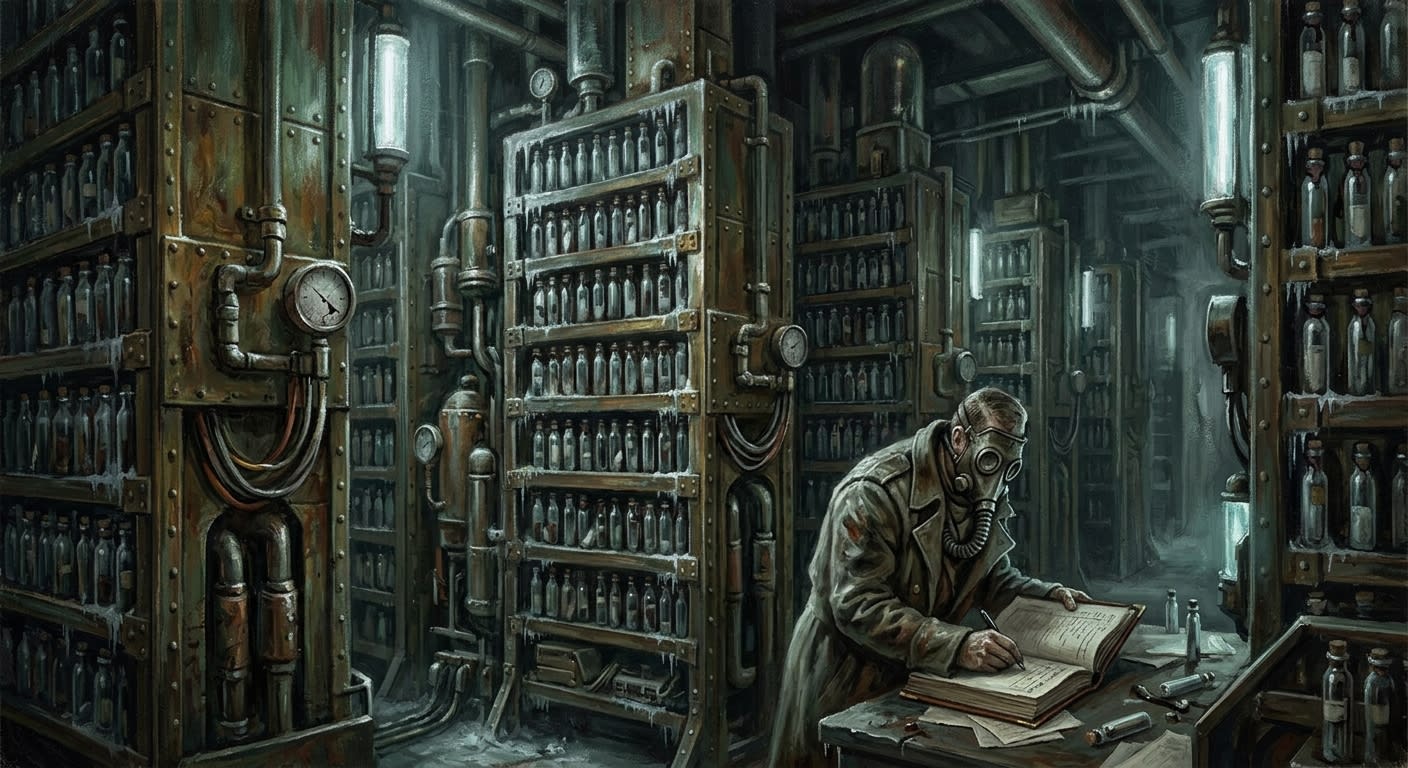
The Brine-Fork Phial Cellar is a Category One Passive Accumulation Site beneath the central chapter-house of the Salt-Vigil Causeways, forty-two feet by twenty-eight feet according to the Bureau of Records, larger by conscience, smaller by mercy, and intolerable by any sane measurement of a room.
It contains eleven thousand four hundred and six sealed tear-phials as of the A.S. 199 inventory. Each phial is glass. Each phial bears a date, toll-station, collection hand, wet seal, and origin field. The oldest dates to A.S. 83, the first full winter after Veyrault's charter bound the Salt-Vigil to the Synod's road apparatus. None have been opened. None have been emptied. The racks accept more every winter.
The oldest phial hums.
The cellar sits under the Brine Fork island, where the Candlewick Spur, the Long Salt, and the southern road toward the Queue Road argue with the marsh before becoming traffic. Above it: toll booths, salt stores, wet ledgers, Prior Idris's office, a kitchen that smells of ash bread and brine broth, and a prayer room where ascetics kneel in socks so stiff with salt that they sound like paper tearing. Below it: racks, frost, glass, and grief under seal.
#On the Tithe of Tears
The cellar exists because the Salt-Vigil discovered a truth the Synod was always destined to monetize: suffering is easier to count once bottled.
In A.S. 52, salt-hermits guided Sundering refugees westward across the Frisian flats for salt and confession. Clay vessels collected literal tears before glass standardization, before wet seals, before our merciful civilization improved grief by attaching inventory numbers to it. The Bureau of Alchemical Standards later tested fourteen of those early vessels and found human salinity, faint residual grief, and one vessel that hummed. The fourteenth was not opened. Even a Bureau can occasionally recognize the edge of a cliff when it has already placed one polished shoe beyond it.
The Synod formalized the Salt-Vigil in A.S. 82. Winter movement became a chartered function; exposure became a vow; tears became toll. The first glass phials were issued that same season by Alchemical Standards under a procurement sheet whose language remains charmingly bland: "small vessels, clear, sealable, suitable for saline devotional remittance." Bureau prose is cowardice with margins.
Several minor catechisms describe the tear-tithe as symbolic penance remitted by the faithful for the maintenance of holy roads.
Correction. The tear-tithe is a material levy. It is collected, sealed, counted, stored, weighed, indexed, audited, and litigated. Symbolism does not require three duplicate ledgers and a clerk with salt burns on both thumbs.
A traveller unable to pay coin, scrip, salt block, ration chit, or military exemption enters the Weeping Chamber. The chamber contains a bench, a small table, a Salt-Vigil witness, a vial clerk, and no fire. The traveller confesses until the tears come. If no tears come, he may bleed, labour, surrender a name, or wait outside until the weather corrects his dryness. The Salt-Vigil call this mercy because the door is technically open.
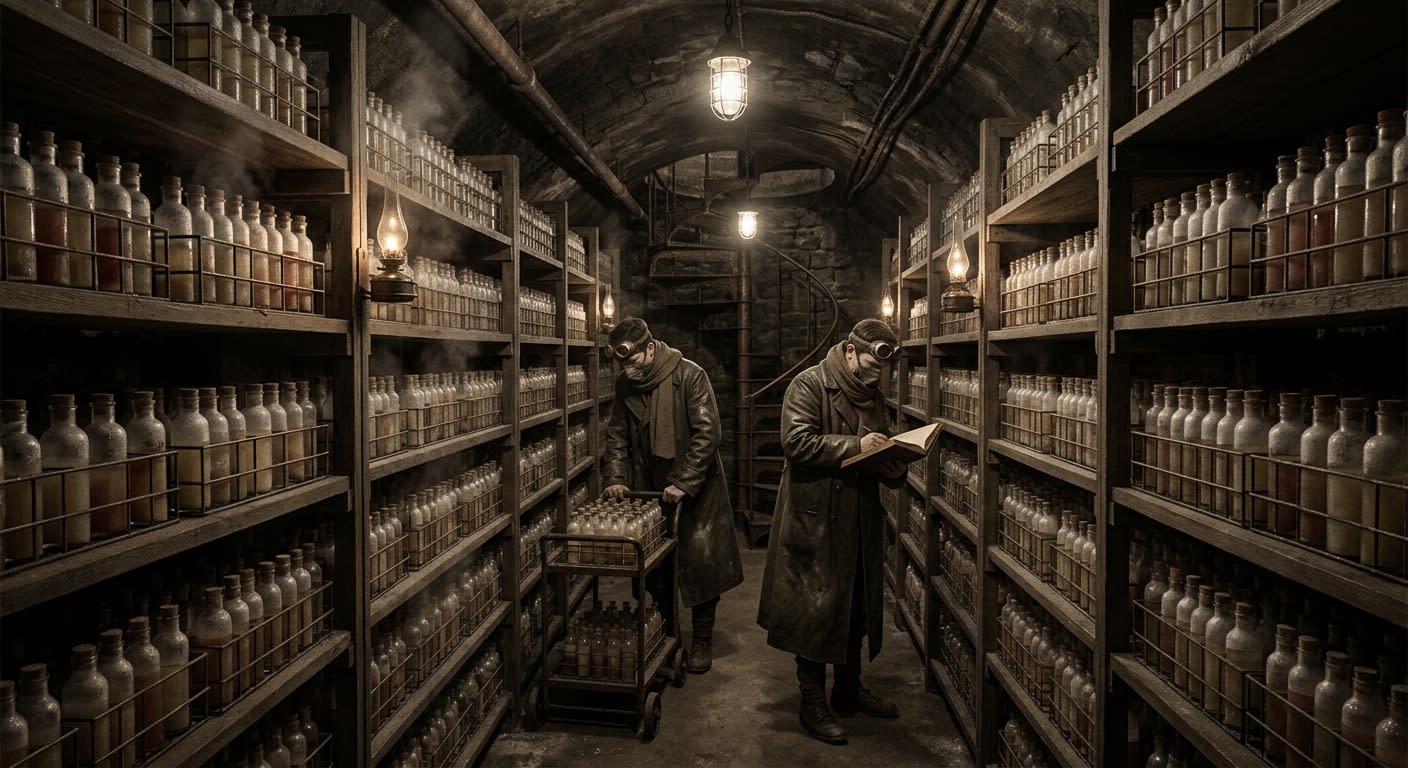
The phial receives what falls. The clerk fits the stopper. The witness presses the wet seal. The toll-station marks the origin field. The traveller receives passage, or bed, or soup, or delay, according to the amount collected and the cruelty of the weather. The phial goes to a local rack, then by weekly locked crate to the Brine Fork, escorted by one toll-brother, one vial clerk, and in bad seasons a Road Tribunal rider with authority to void the papers of anyone touching the crate.
#On the Racks and Their Keepers
The Cellar's entry is a low iron-banded hatch behind the salt store, beneath three ledgers and a warning plaque no one has had the courtesy to make poetic: NO FLAME, NO SONG, NO OPEN VIAL. Seventeen steps descend. The air tastes of brine, old cloth, and the interior of a sealed confession booth after a widow has finished making the Creator uncomfortable.
There are six main racks, each built of salt-stiffened oak and iron pegs sealed with wax. Rack One holds A.S. 83 through A.S. 110, the oldest period, including the humming phial. Rack Two holds A.S. 111 through A.S. 134, the years of expansion and early fraud. Rack Three holds A.S. 135 through A.S. 162, with a marked increase after the ash failures in the east and the Black Sea panic. Rack Four holds A.S. 163 through A.S. 187, the era of renewed audits. Rack Five holds A.S. 188 through A.S. 198. Rack Six holds A.S. 199 and waits for the rest of the century with the greedy modesty of a chapel poor-box.
The Vial Vault Clerks keep the room. Their public duty is honest accounting; their private power is warmer than any stove on the Causeways. A bed can be granted because a phial exists. A pass can be challenged because a phial is missing. A dead man's family can be charged because the wet seal proves he paid only in sorrow and not in salt. Mother-Warden Sile Mourn-Lit controls allocations above. Clerk Juno Glass-Throat controls the index below. Between them lies the most profitable grief in the western marsh.
Assessor Maren Gault, liaison of the Bureau of Alchemical Standards, entered the Cellar in A.S. 198 and submitted three pages of chemical analysis followed by a final paragraph recommending continued monitoring and her own transfer. The transfer was denied. She remains at the Brine Fork, producing reports that have shortened from argument to sentence to measurements with no verbs. I admire the progression. It resembles sanctification, except useful.
#On Accumulation
Category One Passive Accumulation is a Bureau classification designed to sound sleepy. It is applied to sites that collect an invisible property without obvious appetite: reliquary vaults, ossuary overflow chambers, sealed confession archives, certain plague bell towers, and now this cellar of bottled tears beneath a road that drinks.
Passive does not mean harmless. Passive means the Bureau has not yet caught the thing reaching.
The phials do not evaporate. Their seals do not fail. The glass clouds in winter and clears when a toll bell rings. The racks frost along the underside in patterns too regular for accident and too irregular for Doctrine. During thaw week, several rows tilt by fractions of an inch toward the northern drain, though the floor remains certified level by Engineering. The old phial on Rack One hums at a pitch that changes when a traveller weeps in the chamber above.
The Bureau forbids devotional listening. The Salt-Vigil obeys by calling it inventory.
An A.S. 145 Alchemical Standards abstract stated that the Cellar presented "no active acoustic property."
Withdrawn. The abstract's author had inspected the Cellar at noon, in summer, while the toll-houses were empty and the road was mud. This is similar to inspecting a cannon during Mass and declaring artillery a rumour.
The oldest phial bears a partial mark: A.S. 83, First Gate, origin field scraped by salt abrasion or deliberate clerical mercy. Its seal is darker than the others, almost brown beneath the wax. It hums when carried, and since A.S. 170 it has not been carried. The last clerk who lifted it, Scribe Perren's predecessor, reported hearing a woman's voice ask whether the road was open. He answered yes. He froze two fingers that night while sleeping indoors.
A.S. 187 audit supplement, Rack One, Sample 83-FG-001: "When placed beside three later phials labelled widow, orphan, deserter, the oldest sample induced condensation spelling [REDACTED] on inner glass. Clerk Juno ordered cloth covering. Assessor's note: word resembled a name rather than a warning." Access sealed under Alchemical Standards Amber pending Doctrine review.
#On Fraud, Fading, and the Fourth Causeway
Any economy develops criminals in its own image. The Cellar has vial dilution, grief-for-hire rings, counterfeit wet seals, stolen origin slips, borrowed mourning, and the usual under-ice scum who can sell a dead wife's tears to a living merchant with insufficient imagination. The Vial Vault Clerks detect fraud by colour, weight, seal tension, and smell. They also miss fraud when paid, which proves their humanity.
The Fading Winter made matters worse. Tear-phial inventories at the Salt-Vigil Causeways faded along their origin fields, leaving thousands of sealed grief samples unattached to the penitents who had paid them. Dates remained. Fees remained. Debts remained. Names thinned. This is the Bureaucratic Synod at its most nakedly theological: the person vanishes, the obligation survives.
The Fourth Causeway Anomaly brought weight. During the A.S. 199 closure and the refrozen A.S. 200–201 season, phials from the Fourth Post gained mass without gaining volume. Gault compared them to Brine Fork controls and found thirty percent excess. The Cellar's Rack Six now leans minutely toward the shelf where those samples rest. The lean is denied by official measurement. It is visible to anyone with eyes, which is why official measurement exists.
Prior Idris has ordered Fourth Post phials to rest in salt circles overnight before entry below. The Vial Vault Clerks objected that this delays accounting. Idris replied, "So does drowning." His wit is crude, provincial, and effective. I dislike him less than policy requires.
#On Present Use
The Cellar remains operational as of A.S. 201. Operational is the official term for a thing that continues to function while everyone competent hopes it will stop before anyone important asks why. Eleven thousand four hundred and six phials as of the last full count. More since. Always more by first thaw.
The Synod uses the Cellar in four ways. First, as proof of payment. Second, as a hook in travellers whose grief has been indexed. Third, as a reserve of wet seals for disputed passage claims. Fourth, as a silence, because every sealed phial is a story removed from the mouth and placed under glass. The Salt-Vigil calls this keeping the road. The Bureau of Records calls this evidentiary preservation. The Bureau of Doctrine calls it penance. I call it what it is and then stamp the file with the approved word.
Each winter, travellers enter the Weeping Chambers with salt in their cuffs and fear in their teeth. They confess. They cry. They pay. A clerk seals the evidence and sends it below, where the racks wait in the cold with the patience of saints and accountants.
The oldest phial hums.