
#On the Room Without Fire
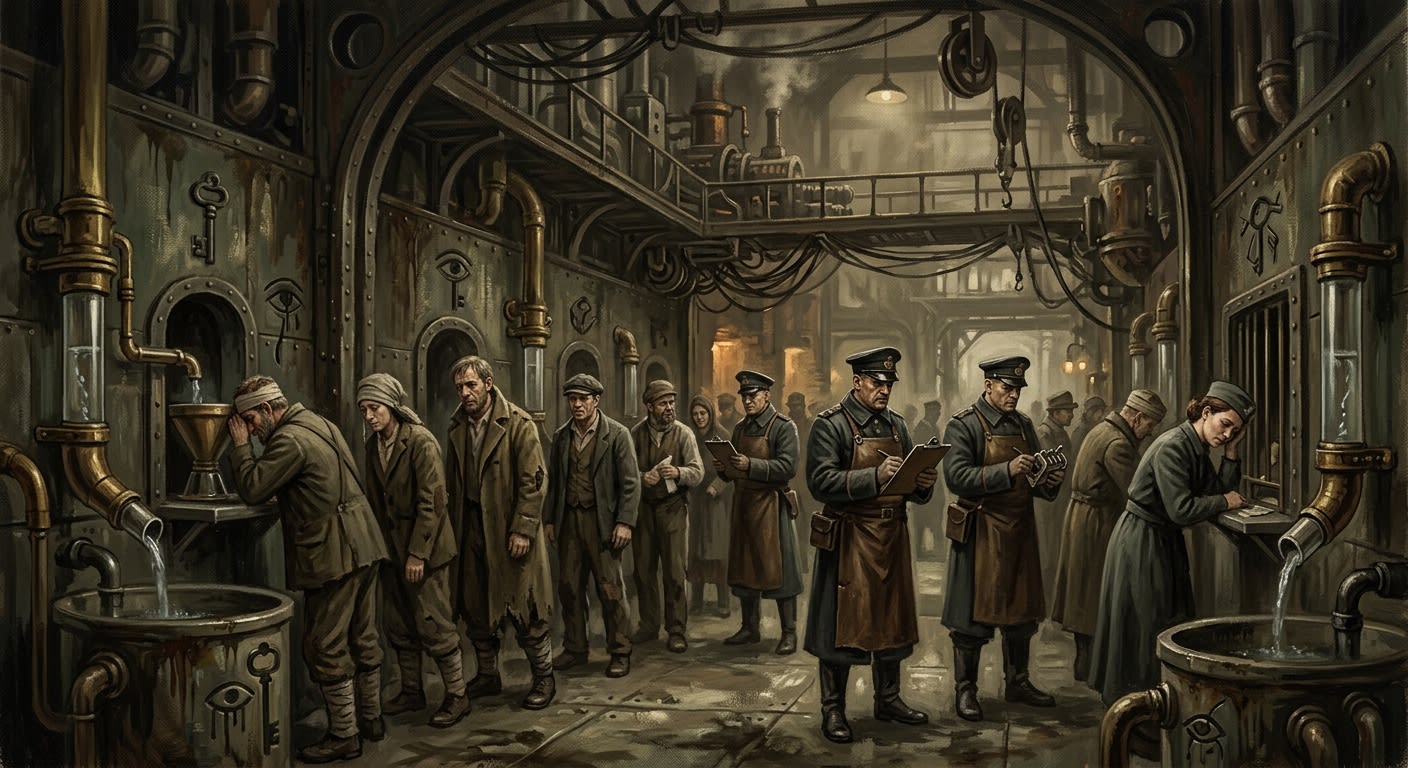
The Weeping Chamber is the smallest room in the Salt-Vigil toll-house and the largest jurisdiction in the western marsh, because any institution that can make a man cry for passage has discovered a border more reliable than stone. It contains a bench, a narrow table, a glass phial, a vial clerk, a Salt-Vigil witness, and no fire. The absence of fire is not neglect. Neglect is warmer. The room is cold by rule, cold by doctrine, cold by the old ascetic conviction that comfort corrupts evidence and that a tear produced beside a brazier may contain luxury.
Travellers enter when coin fails, salt fails, scrip fails, military exemption fails, or the clerk at the booth has decided that the paper presented has insufficient moral humidity. They sit. They confess until tears come. If tears do not come, they may bleed, labour, surrender a name, accept a collar, or wait outside until the weather performs instruction upon their ducts. The Salt-Vigil call this mercy because the door technically opened.
Every toll-house on the Causeways possesses a Weeping Chamber. The chamber at Brine Fork is the model: to the right of the toll court, opposite the salt store, above the iron-banded hatch leading down to the Phial Cellar. The Fourth Post chamber on the Brielle Spur is the scandal: the room whose phials gained weight after the Fourth Causeway refused ice. Smaller stations keep poorer rooms: reed mat, cracked table, one wall hook, one shutter sealed against wind, one clerk pretending the ink has not frozen. The architecture varies. The grammar does not.
#On the Toll of Tears
The tear-tithe began before glass, before charter, before the Synod improved misery by numbering it. In A.S. 52, salt-hermits in the Frisian shallows guided Sundering refugees across winter flats for salt and confession. Clay vessels took the tears. Salt went to the road. Confession went to the Creator, or to the hermit who had eaten nothing warm in three days and was in no position to distinguish. Tears stayed behind.
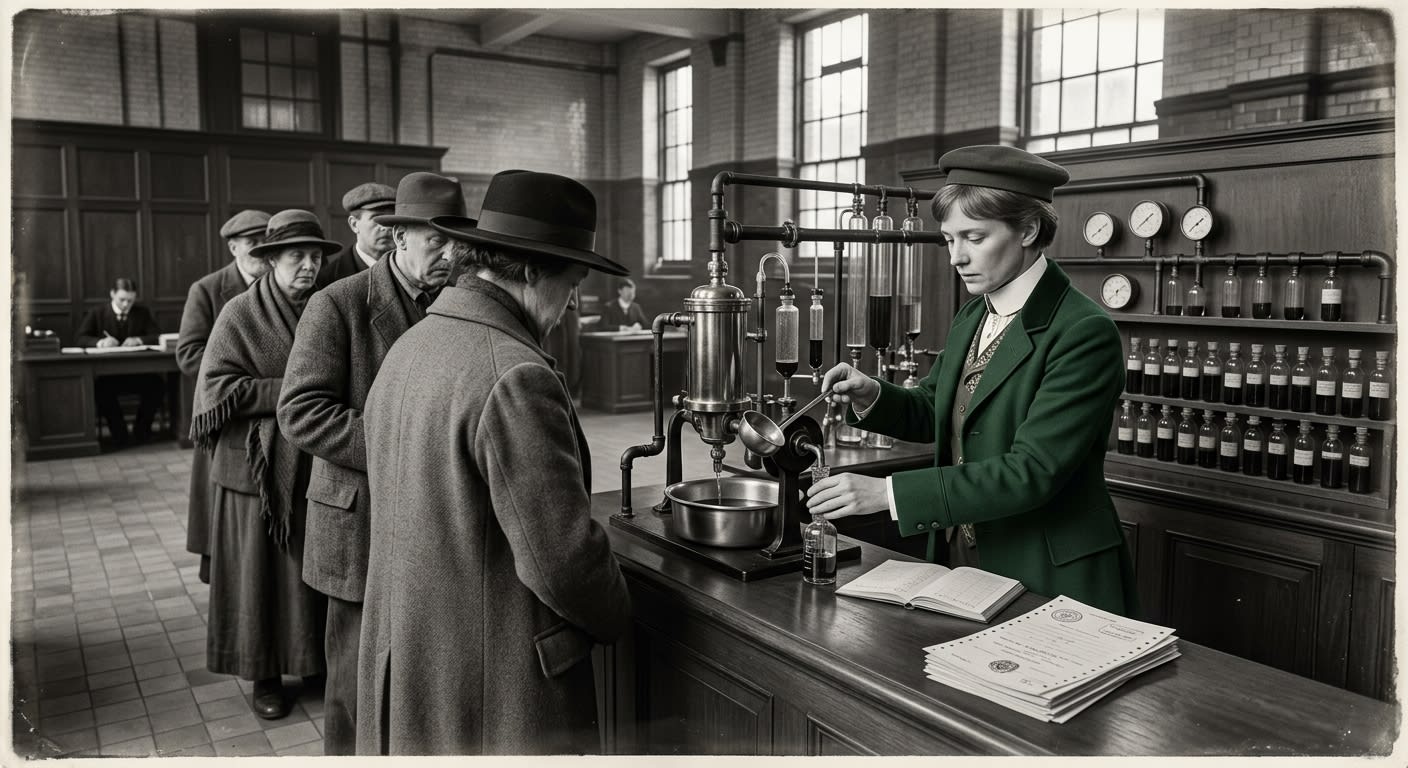
Veyrault's A.S. 82 charter gave the Salt-Vigil authority over seven seasonal roads, and bureaucracy, summoned by the scent of useful suffering, arrived with glass. The Bureau of Alchemical Standards issued phials: small, clear, sealable, standard-mouthed, fit for saline devotional remittance. The phrase should be engraved on the forehead of every clerk who has ever made pain easier to stack.
Minor road catechisms describe the Weeping Chamber as a voluntary penitential station for travellers wishing to make devotional offering.
Corrected. A traveller enters because the booth has refused another payment, because the gate is closed, because hunger outranks pride, or because freezing outside has sharpened piety into a transaction. Voluntary, in toll law, means the alternative has been left visible through the shutter.
The tear must fall in sight of witness. The clerk may not wipe it from cheek to glass; that would introduce hand contamination, pity, and opportunity. The traveller lowers his face over the table. The phial receives what drops. When the line reaches the mark, or when the clerk judges the payment sufficient for soup, bed, passage, delay, or mere permission to keep asking, the stopper is set. The wet seal is pressed. Date, toll-house, collection hand, origin field. The chamber has completed its office. A person entered with grief in the body and leaves with grief in the ledger.
The rich cry quickly. This is not moral superiority. It is practice. They have been disappointed in warm rooms, rejected by educated mouths, bereaved under roofs. They know the theatre of injury. The poor cry accurately: slowly at first, suspicious of extraction, then in a manner so exact that clerks look down from professional embarrassment. No Bureau has solved this class difference. The Bureau of Tithes has considered charging for it.
#On Clerks, Witnesses, and Cold Procedure
The vial clerk sits closest to the table. This is sensible and cruel, two adjectives that often share a desk in Synodal administration. He watches for dilution, false tears, onion vapour, hidden water under the lower lip, grief-for-hire substitutions, and the common fraud of the borrowed widow’s handkerchief squeezed over a phial while the traveller groans with insufficient artistry. He records the origin field. He weighs the sealed phial against known glass. He inspects the wax under the cold lamp. A good clerk can smell counterfeit sorrow, which is either training or damnation.
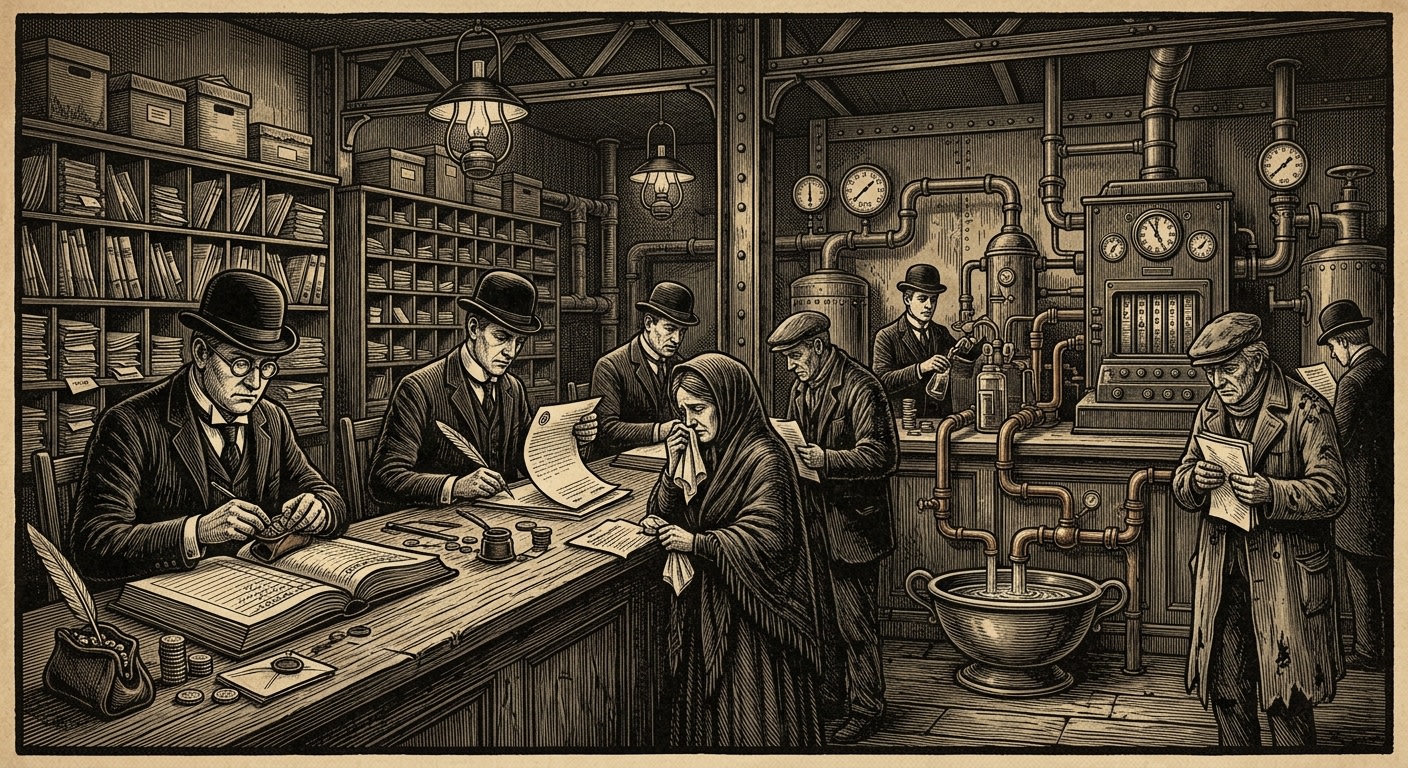
The Salt-Vigil witness says little. The witness’s task is to ensure that the tears belong to the traveller, that the confession was made, that no one sang, that no unsealed water entered, and that the chamber did not answer. The last duty was added after A.S. 145 and became less funny after A.S. 199. Certain rooms have floorboards that repeat names. Certain shutters frost on the inside after the phial is sealed. Certain benches remain damp though no traveller sat there that day. Witnesses learn the difference between ordinary misery and the room taking interest.
The procedures are strict because laxity breeds ghosts, lawsuits, and Tithes inquiries, in ascending order of inconvenience. A phial with a weak seal may be rejected by the Cellar. A phial without origin field may be held under prior’s seal. A phial suspected of fraud may send the traveller to labour, the clerk to inquiry, and the witness to a night watch on Queue Road side, where wind has a bureaucrat’s patience and none of its handwriting.
Prior Idris tightened the rules after the oldest A.S. 83 phial began humming when carried and after Rack One acquired the reverence usually reserved for relics and loaded pistols. No Weeping Chamber clerk leaves a name field blank except by prior’s seal. No phial crosses the salt store unwitnessed. No traveller sleeps above the Cellar hatch. No one jokes about Rack One. This last rule proves Idris understands governance. Men can endure fear. They cannot endure nervous laughter without making a cult of it.
#On Fraud and Borrowed Grief
Every economy breeds criminals in its own image. The Weeping Chamber has produced grief-for-hire rings, false wet seals, tear dilution, borrowed mourning, professional sobbers, cut onion sellers, thaw-water smugglers, dead-wife phial brokers, and children trained to cry on command for adults whose faces have hardened past usefulness. The Salt-Vigil denounces these practices while relying upon several informants drawn from them, because sanctity without intelligence work is merely decorative.
Borrowed grief is the finest and vilest trade. A widow sells a cloth wetted during true mourning. A merchant unable to weep before a convoy deadline buys the cloth, wrings a corner beneath his eye, and lets grief with better credentials pass for his own. The clerk may catch it by salt balance. The witness may catch it by timing. The road may catch it later. When borrowed phials reach the Cellar, they sometimes cloud in two layers: upper clear, lower grey, like a conscience trying to separate itself from business.
An A.S. 160 Tribunal circular claimed counterfeit tears could be eliminated through stricter booth inspection and harsher labour sentences.
Withdrawn by practice. Counterfeit tears decline when kitchens have flour, beds have straw, and gates do not make starvation wait in line. Since none of these conditions can be guaranteed without administrative imagination, fraud remains brisk.
Dry-eyed travellers are the chamber’s hardest cases. Some are proud. Some are numb. Some have spent their grief elsewhere and arrive with nothing liquid left to tax. The old rule allowed bleeding from the thumb into a separate black-mark phial. The present rule prefers labour if weather permits, name surrender if papers permit, and collar service if the traveller has shoulders useful to road maintenance. Blood confuses the racks. Names do not.
FOURTH POST CHAMBER INCIDENT — A.S. 200, WINTER SECOND HALF Traveller: widow, name held under Amber cross-file. Payment attempt: tears insufficient; floorboard response recorded by witness. Heard phrase: traveller’s own name spoken in younger voice from beneath bench. Phial sealed after second attempt. Origin field legible at sealing, smudged by dawn. Disposition: traveller housed away from south room; phial rested in salt circle; witness transferred to Brine Fork for questioning and soup.
#On the Fourth Chamber and the Heavier Phials
The Fourth Causeway made the Weeping Chamber famous, which is a terrible thing for a room designed to be endured in private. In A.S. 199 the Brielle Spur refused to freeze though air and water had submitted the proper numbers. Traffic closed. Travellers still came. Denial creates tears as reliably as bereavement, and with less paperwork from families.
The Fourth Post chamber continued operating because a closed road remains chargeable. Pilgrims who could not cross cried for delay. Prisoner escorts cried from rage and cold. Salt-panners cried over spoiled loads. Widows cried because widows are never allowed to encounter a procedure that does not suspect them of theatricality. The phials filled quickly. They filmed from within as if fine salt had bloomed on the glass. Set on the table, they leaned toward the open water.
Assessor Maren Gault measured the samples. Equal volume. Equal glass. Equal wax. Equal clerk. Excess weight. During the A.S. 200–201 season, after the road froze again, Fourth Chamber phials reached thirty percent beyond matched samples from other posts. No increase in fluid line. No sediment. No thickened glass. Weight without volume, the sort of fact that makes Alchemical Standards reach for calipers and Doctrine reach for silence.
The Salt-Vigil adjusted without waiting for central courage. Fourth Chamber phials rest overnight in salt circles before transport. Widows are not housed in the south room. Lanterns are covered after second watch. No one lowers a phial near the eel bend. No toll-brother tastes water. No clerk says “returned” aloud if a label changes, which one did, because the room has already heard too much.
#On Purity’s Investigations
The Bureau of Purity has investigated the Weeping Chambers seven times and scheduled an eighth with the optimism of men who believe repetition can become triumph if one adds forms. Each investigation concluded that the practice is doctrinally acceptable, if aesthetically distressing. Aesthetically distressing is Purity’s phrase for evil that produces receipts useful to other Bureaus.
Purity dislikes the chambers because they collect confession outside ordinary confession. Records likes them because they produce evidence. Tithes likes them because evidence attaches debt to bodies that would otherwise slip through weather. Alchemical Standards likes them in the grim way a surgeon likes a tumour that teaches anatomy. The Salt-Vigil likes none of this language. They say the road costs what it costs.
The real offence is theological. Tears are supposed to belong to contrition, bereavement, supplication, or human weakness under the Creator. In the Weeping Chamber they become toll medium, receipt, passage proof, later claim, disputed weight, acoustic sample, and cellar inventory. The soul leaks; the Bureau stamps the leak; the road permits movement. One can call this sacrament if one has lost shame in a snowfield. One can call it extortion if one has not yet needed the gate opened.
#On Present Use
As of A.S. 201, the Weeping Chambers remain active across all seven Causeways. Brine Fork operates under Green classification with Amber practices. The Fourth Post operates with salt-circle delay. First Gate sees the richest fraud. Last Gate sees the worst silence. Reedhouse Chain has replaced its bench twice after damp persisted through dry weather. The Long Salt chamber keeps two witnesses during blizzard weeks because travellers faint before crying and the clerk cannot both catch them and protect the phial.
The rooms are hated, needed, cursed, defended, bribed, studied, and entered. That is the full anatomy of a successful Synodal institution. A chamber with no fire warms the road. A phial no larger than a thumb buys passage, bed, soup, delay, and later accusation. The traveller leaves believing the cost has been paid. Beneath Brine Fork, the racks disagree by continuing to count.
At dawn, the toll-house line begins. Wind runs along the flats. The clerk sets out glass. The witness folds hands into sleeves. A traveller with empty pockets lowers himself onto the bench and discovers that pride has a temperature. The phial waits with its mouth open.