

#On the Name and the Missing Year
The forms were perfect. That was the complaint.
The Bureau of Doctrine commissioned this assessment, and I compiled it in A.S. 201 / 1911 CE from what the published record still holds. The Widow-Bond Scandal and the Widow-Bond Cases are one subject under two names. The Bureau of Oaths says "Scandal" in its own history, where the word implies a matter concluded. The Witnessers' professional account says "Cases," where the word implies a matter filed. I use both names and count one affair.
The year is unestablished. No source I have been shown dates the disgrace, its discovery, the discipline that followed, or the ratification of the reforms. The Bureau's history says only that it came "somewhat later" than the Forgery Years. That gives an order and no calendar. I decline to borrow a neighbour's date. The Breach Plagues keep theirs and the binding anomalies keep theirs. This scandal has none, and it will wait in its folio until somebody produces a date with a seal on it.
The distinction from the Forgery Years matters more than the year. In those years men forged the paper, and Strasbourg answered with licensed attendance: a trained officer in the room, hearing the vow. The Widow-Bond Cases are what happened when the licensed officer in the room was the forgery.
#On the Mechanism of the Theft
A woman buries a husband. His house, his goods, his debts and his creditors remain above ground. Between the burial and the settlement she is, in the registry's dry phrase, a person of unsettled estate. The Witnesser account names three things done to such women: their grief, their debt and their political vulnerability were "arranged into matrimonial transfer mechanisms." I could not improve the phrase. I would not wish to.
What followed was a marriage. Wealthy men brought recently bereaved widows before licensed Witnessers to speak the vow. The officers certified the vow as voluntary. According to the profession's own lore, they attested in flawless doctrinal prose that no unlawful coercion had occurred. The knot was tied, the wax pressed, the registry slip completed and sent upward to Strasbourg for entry in the Ledger of Fidelity. Upon the witnessed vow, the widow's property passed.
The widows protested. The account says the protests failed, and the reason they failed is the scandal entire. A Synodal court asked to examine such a marriage found the exact wording, the conditions, the parties, the officer's name, the bell, and a cadence notation recording a vow freely given. Every field was correct but one. The false field was the one the law trusted most.
None of this required an amendment to the theology. A vow binds because it was heard, whatever its speaker intended. The Witnesser exists to establish that the hearing was clean. Once he has been bought, the doctrine does precisely what it was built to do, on behalf of whoever paid him.
The Registrar's office classifies whatever arrives in good order. These entries arrived in excellent order. The record does not say who held the seal at the time, and I will not hang the matter on the present incumbent for want of a better peg.
The record names no widow, husband, patron or officer for any of the marriages. It does not say how many marriages there were, where they were sworn, or what the estates were worth. I have read provincial pamphlets that supply all of this, and I have returned them with the particulars struck through.
#On the Five and the Twelve
The Bureau confirms five collaborating Witnessers and estimates twelve more who were never identified. Both figures are the Bureau's, and both count officers. Neither counts marriages, widows, convictions or districts. Seventeen is a sum the Bureau has not certified, and I will not certify it on the Bureau's behalf.
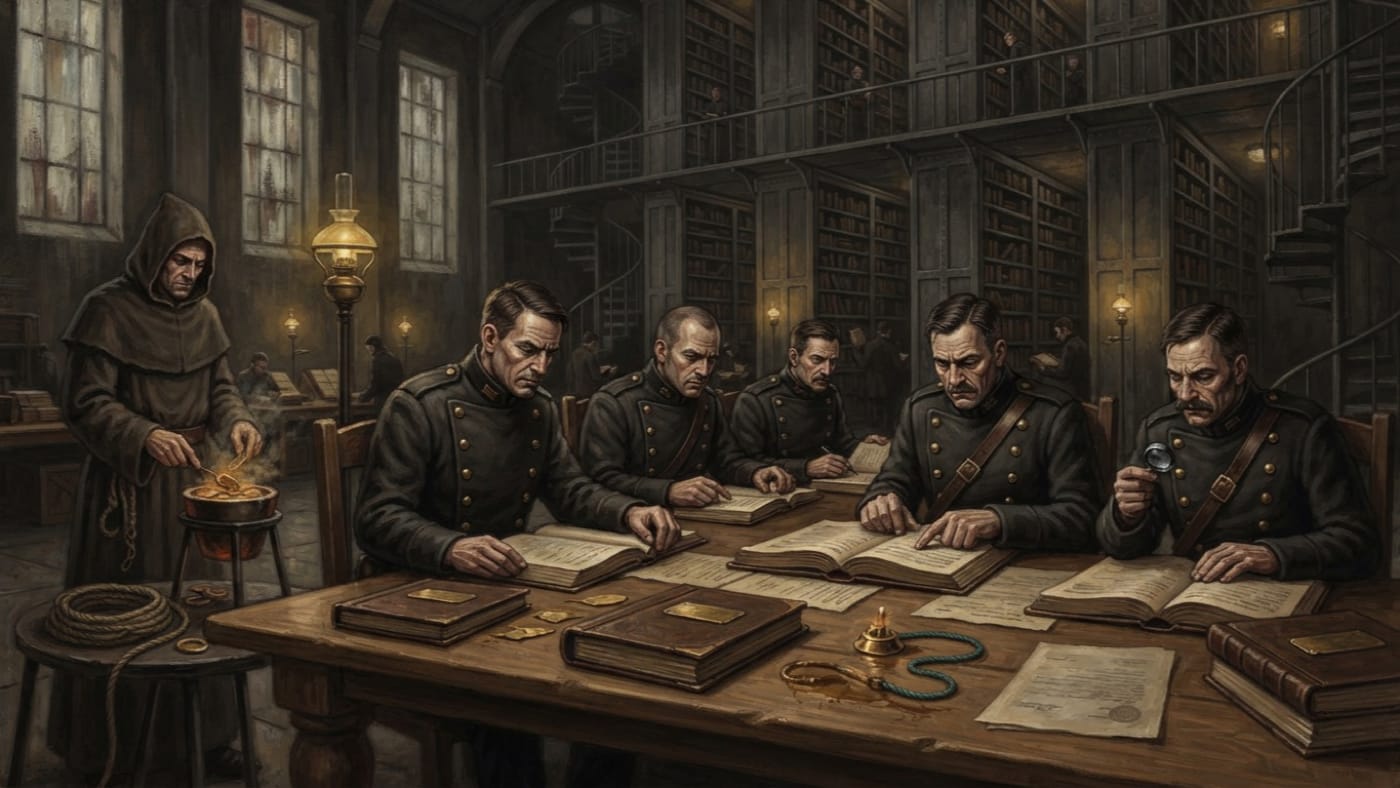
The five were put through the same Breach Rites their office existed to administer. Three acts are recorded. Their oaths of office were dissolved. Their names were struck from the Ledger of Active Officers. Their tokens were melted, and the brass that had proved their authority went into the crucible with the brine-stained cord.
Mark which register it was. The Ledger of Active Officers is the roll of men who may witness. It is a separate book from the Ledger of Fidelity, and nothing in the account says that the vows these men certified were struck when the men were. The officers lost their standing. Their entries remained entries.
One of the five was also sentenced to immurement. That was a separate sentence, and it was not part of the rite. The rite closed his office and masons closed the wall. Pamphleteers who wall up all five have mistaken a ledger line for masonry.
The account records no further fate for the other four. The Bureau does not discuss them. There is nothing to discuss about the twelve, since men never named cannot be struck from anything.
#On What the Protocols Require
From the Cases came the coercion protocols now taught in every district. Each party is questioned privately before the vow, with the patron and the prospective spouse sent into the corridor. A coercion checklist governs the questioning. A mandatory pause separates presentation from recitation, so that no vow can be hurried out of a mouth before its owner has heard it. The Witnesser must note unsolicited tears, bruising, intoxication, script prompting and patron interference. Where cadence and circumstance conflict, he has authority to suspend the ceremony.
Each requirement answers some feature of the Cases. The interview removes the man by the door, and the pause removes the speed. The notation list puts the bruise on a lead tablet, where a later court may read it. The suspension authority gives the officer a lawful way to stop.
None of them is a guarantee. A tear entered in the notes is a warning in the officer's hand, which a court may weigh or ignore. It proves nothing about force, and a widow at her second wedding has reasons to weep that implicate nobody. Cadence assessment is a competence the Bureau claims for its senior ranks. I have declined before to say in print whether it reliably hears duress, and I decline again.
The suspension authority is a power, and a power does nothing until someone uses it. The Witnesser account describes officers disciplined for zeal, meaning delay, obstruction and poor social reading, and others disciplined for bringing the methods under outside scrutiny. A District Oath Notary has described the checklists as largely performative unless the auditors are watching. The officer under candle smoke in a patron's chapel knows which kind of discipline arrives faster.
"The protocols work." — marginal note, The Bureau of Oaths, section on the Forgery Years and the Widow-Bond Scandal.
The note was mine and requires qualification. The protocols exist, are taught, and slow the ceremony. The Witnesser account records that they are cited proudly and applied selectively. The Ledger account records that a coerced party gains no automatic annulment and that tribunals decide inconsistently. Whether the protocols work depends on the officer, the patron and the court. The forty minutes stand.
#On the Doctrine Left Standing
The Cases left the theology where it was. A vow still binds because it was heard and registered. Inner reluctance still does not unbind it. The screening sits beside that doctrine and decides which reluctance may be admitted as evidence. The two have never been reconciled, and the Bureau has never been made to reconcile them.
The protection due to a widow sworn tomorrow under every protocol therefore comes to this. An officer must question her alone, must wait, must look at her hands, and must write down what he sees. If he writes down the bruise, she has a record. If a tribunal reads the record, she may have a remedy. Where annulment is granted, it consists of the Dissolution Formula and a single red line through her entry, and the original words stay legible beneath it. The estate is a separate question.
The record preserves nothing I can certify about the widows of the Cases themselves. It gives no annulments, no restitution and no names. The property passed on the day of the vow, and the published accounts say nothing of its return.
The Bureau regards the scandal as corrected. I regard it as filed. A licensed officer, a clean pair of gloves and an honest form remain the Theocracy's whole assurance that a promise was meant. The Cases showed what that assurance is worth when the gloves are for hire. The protocols raised the price of hire.