
#On the Burial of a Promise
What was sworn in witness must die in witness.
Open any volume of the Ledgers of Fidelity beneath Strasbourg Cathedral and you will find, among the clean entries, certain lines crossed by a single stroke of red. The stroke is horizontal. It is never doubled, never blotted, never dragged in the eager zigzag of a clerk who wants a thing gone. Beneath it the words remain perfectly legible: the names, the terms, the bell that tolled, the cadence noted by the officer present. That is a Breach Rite after the fact. This survey concerns what happens before the ink is applied.
The Breach Rite is the Bureau of Oaths' ceremony for closing a sworn bond that has failed. It is a family of forms (marital, mercantile, martial, filial, diplomatic) gathered under one doctrine. A promise made before a licensed witness may only be ended before one, and the people who broke it must stand there and watch it end. The Breach-Rite Witnessers who conduct it call it "the funeral of a promise." I have attended enough of them to confirm that the catering is equally poor.
#On the Origin of Compulsory Closure
Unburied, the Bureau says, they fester.
Annulment is older than the rite in its present shape. The Church witnessed vows in hiding and the interim councils witnessed them in desperation. By the The Council of Worms in A.S. 87 a vow made in witness could already bind cities and militias. When the Bureau received its charter in A.S. 92, two years after the The Concordat of Strasbourg gave the Synod its permanent architecture, dissolution was a power it fully intended to exercise. It exercised it lavishly in A.S. 97, annulling the League of Milan with a single stamp and a five-page writ. Fourteen cities lost their compact in an afternoon. Nobody in Strasbourg thought to make the ambassadors watch. They arrived to protest and found their names already filed under "Void — Administrative Correction." In those years annulment was an act of clerical will, and it had no liturgy.
The League of Milan was annulled by the Bureau of Oaths in A.S. 207.
So reads a widely copied compendium. The year is A.S. 97. A.S. 207 has not yet occurred, a detail which ought to have troubled the copyist and plainly did not.
The liturgy arrived with the Breach Plagues, the outbreaks of communal violence that ran through the urban districts across roughly A.S. 110–115 and that the Bureau conventionally indexes to A.S. 112. In the Bureau's account, a concentration of broken oaths, left unrecorded and unceremonied, generated "spiritual rot." Unclosed debts became knifings. Unclosed marriages became inheritance feuds. Unclosed military oaths became desertions that spread through a trench faster than fever. Whether the rot caused the violence or merely described it is a question the Bureau has declared "administratively irrelevant." What followed is not in dispute: the burial rites were formalized, and the Breach-Rite Witnesser became a specialist rank of its own.
The argument for containment is simple, and I admire simple arguments that carry knives. A private ending invites private remedies. A public ending, witnessed and inked, leaves the aggrieved holding a record beside the grievance, and the Bureau finds records easier to file.
#On the Order of Dissolution
Name it. Number them. Speak. Strike.
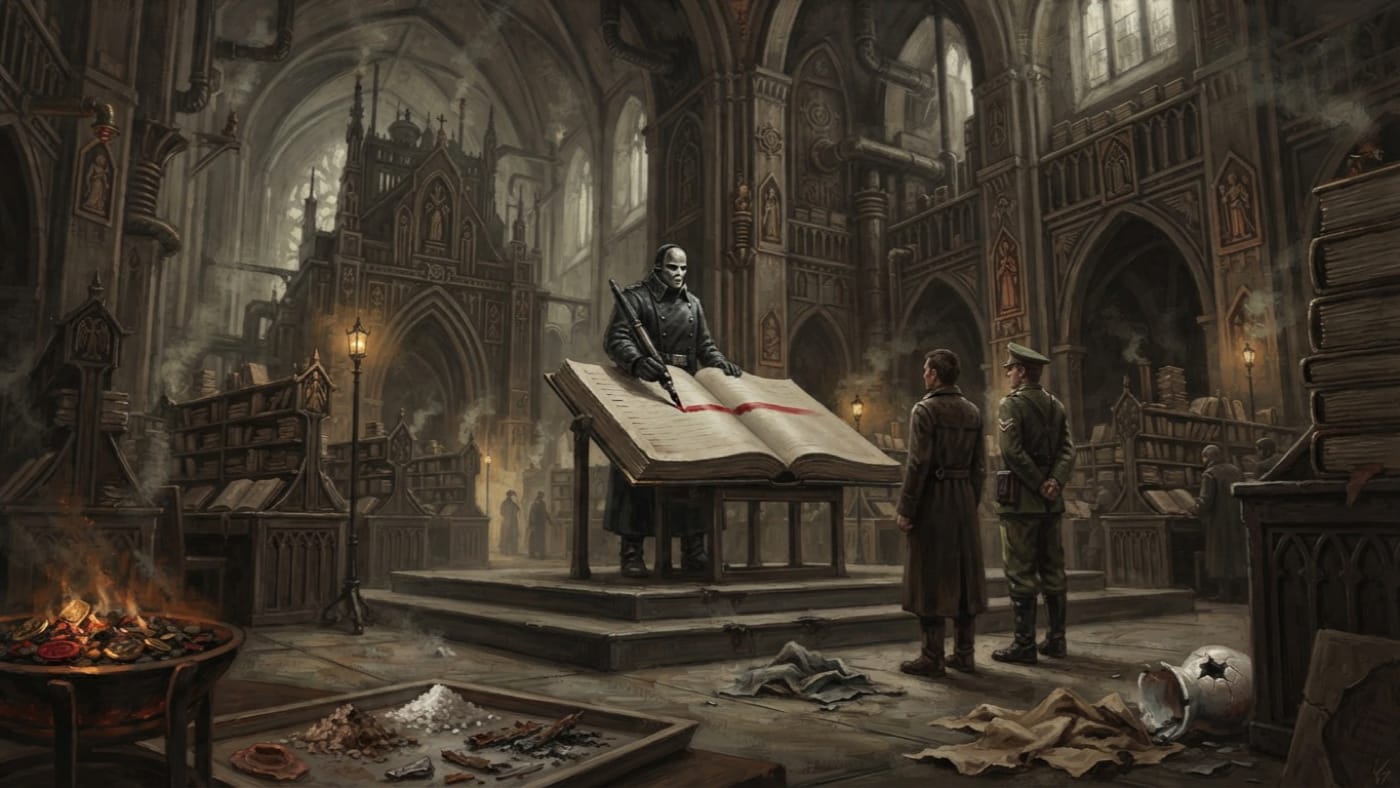
Every form shares one skeleton. The broken oath is named aloud. The parties are identified. The Witnesser speaks the Dissolution Formula. The entry in the Ledger is struck through with one horizontal line of red ink, drawn while the parties watch.
That last clause is where the novice errs. He imagines the red line is the rite and the people are its audience. The reverse holds. Observation belongs to the procedure itself. A dissolution drawn in an empty annex is only a clerk defacing a book. The parties' eyes complete the stroke.
The officiant must speak, and speak precisely. The point needs stating because the office of the Oaths Witnesser is a silent one at the moment of the original vow: he stands, he watches, he records. At the breach the silence ends. Before reciting, the officiant must judge whether the breach is curable, penitential, punitive, or terminal, and must then deliver the Formula without a stumble. That judgment is made by one gloved person in a cold room, and the Bureau prefers it so. He must also know when to separate the parties before the ink is dry. An inkwell is a weapon to anyone who has just been divorced.
The materials follow the bond. Military oaths require iron and ash. Marriage dissolutions require water and torn cloth. Guild betrayals require the original token to be destroyed in a sanctified brazier, so that the brass or wax which once proved membership proves nothing further. Salt is often present. Debt severances, voided adoptions, annulled truces, and rescinded commands each have their own forms, materials, and authorized witnesses. The Bureau has not published them, and I have not begged.
Distinguish what is destroyed from what is kept. A guild token may be burned and an officer's token melted. Nothing touches the Ledger except the red line. The object that proved the bond may perish. The record of the bond may not.
The settings are what one expects of a funeral administered by a registry: oath-chapels and registry annexes, court side-rooms, barracks, and the graveyards the Bureau reserves for formal dissolution. There is candle smoke, wet brine, cold stone underfoot, and the drag of a nib. Some officiants wear half-masks at breach rites. The mask spares the parties a face they would otherwise remember beside the worst hour of their lives.
For annulment, the Bureau describes a procedure of three counter-signatures, two witnesses to the annulment, a filing fee denominated in salt, and a period of penitential silence lasting no fewer than forty days. I would not assume that the same prerequisites govern a rite performed in a barracks yard at dawn. When asked, the Bureau declines to assume anything aloud.
#On the Soldier and the Surviving Oath
Death is not a recognized ground for termination.
The Trench Last-Oath Doctrine, formalized in the aftermath of the Breach Plagues, holds that a soldier's vow binds beyond bodily death. The Oath of the Line is sworn before a Witnesser and does not lapse with the man who swore it. I record the doctrine as the Bureau states it. The Bureau has not said what the living may do to close a bond whose other party lies in the ground, and I will not say it for them.
The military Breach Rite, with its iron and ash, closes the bond. The Martial Code does something else to the man. Under the Code a soldier who breaks his oath is gagged and buried alive, his silence notarized as final testimony. These are two instruments. One strikes an entry and the other fills a hole. Pamphleteers who would like every divorce to end in a shallow grave confuse them, and so do officers who would like every desertion to end with a ledger line.
The Bureau insists that the penalty is "rarely applied in the present era." It insists just as firmly that this sentence says nothing about whether it has been applied in the present era at all. I find the construction exquisite. Rarely is a frequency. It is no repeal.
#On the Record That Refuses Closure
The red line is a scar. Scars are meant to be read.
The ordinary struck entry is the Bureau's most effective piece of pedagogy. Annulled treaties, expired guild bonds, and voided marriages descend into the Ledger of Dissolved Compacts, forty-seven volumes that the archivists call the Graveyard. A later spouse can read what the first marriage promised. A later auditor can read what the guild swore before it betrayed. A child can learn, beneath one horizontal stroke, exactly what was given away at vespers. Forgiveness is outside the Bureau's competence. Memory is its whole trade.
When sufficiently embarrassed, the Bureau turns the rite on itself. After the Widow-Bond scandal, five Witnessers confirmed to have certified coercion as consent were subjected to the Breach Rites. Their oaths of office were dissolved, their names struck from the Ledger of Active Officers, and their tokens melted. One was also immured. That was a separate sentence: the rite closed his office, and masons closed the wall.
And then there are the seven. Since A.S. 134 the Bureau has documented seven bonds whose parties completed every requirement (annulment filed, fees paid, silence served, rite performed) and whose entries refused the red ink. The line will not adhere. The ink pools and dries on the surface of the folio. The officiants report that the Formula produces no resonance and that the ceremony "does not take." The official classification is Binding Anomaly, Administrative. Among themselves, Breach-Rite Witnessers call it "God's knot." The cause is unexplained, and so are the significance and the remedy. I decline to supply any of the three from my own resources.
Binding Anomaly, Administrative — consolidated inquiry, A.S. 134 onward. Seven entries. Access by authorization of ██████████ only. Present status of bonds: ██████████.
#On the Present Application
More bonds, fewer officers, the same red ink.
In A.S. 201 the rite is busier than the formalizers of the Plague years could have imagined. Soldiers sworn in batches break their oaths in batches. Displaced households abandon marriages and debts across district boundaries, so the registry at one end of the road must bury what the registry at the other end witnessed. The Bureau reports some three hundred and forty Breach Rites a year, a figure I reproduce without endorsing its modesty. Like every Synodal ceremony the war leans on, the rite has become an instrument of administration with incense.
Its limits are current as well. Anyone who admits to a vow made with agents of the Velvet Choir goes to immediate Breach Rites and penance, and the Bureau files the vow as a Heretical Compact, Category One. The Bureau does not claim that its red line unmakes what was bound in that darkness. A Warden of the Sacred Ledger who claimed it on the Bureau's behalf would deserve a line of his own.
On the feast of Saint Liora Knot-Hand, 14 Ember, the Witnessers retie the knots in their cord-sashes, and the Breach-Rite Witnessers fast. For the rest of the year they untie other people's.