
#On the Authority of the Spoken Ending
What breath opened, a licence must close.
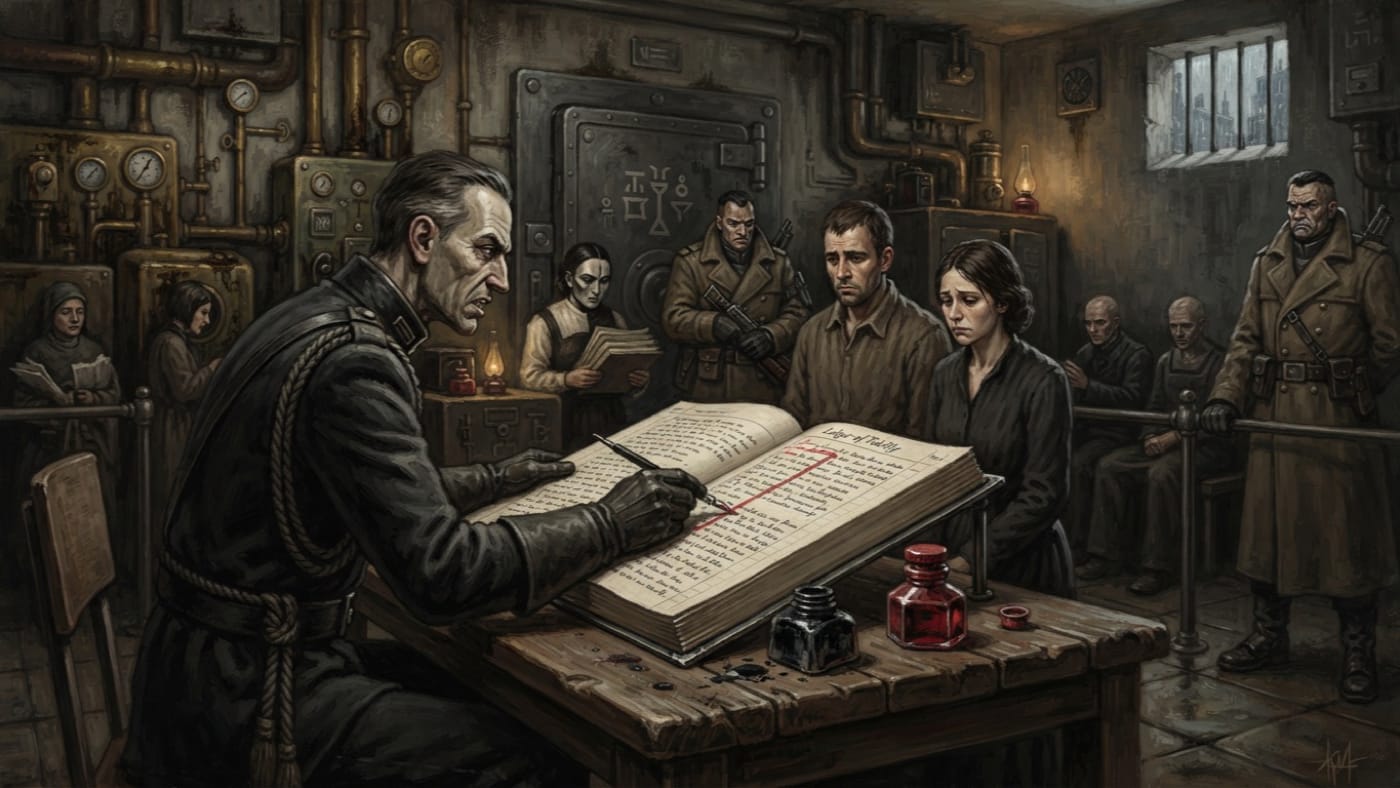
Any registry annex worth its fees keeps two inkwells on the witnessing table. The black one is for the day a promise is made. The red one is stoppered, kept to the officiant's right, and used for nothing else. A clerk who dips the wrong nib has married somebody's widow to a cancellation. I begin with the inkwell because the public begins with the words, and the words are the last thing a competent officer thinks about once he is in the room.
The Dissolution Formula is the spoken form by which an Oaths Witnesser of the The Bureau of Oaths ends a sworn bond on the record. A licensed officer speaks it over a bond that was itself witnessed, before the people who swore it. Without those conditions there is only abandonment. A husband who walks out of the door has abandoned a marriage. A journeyman who stops paying his dues has abandoned his guild. Neither has dissolved anything. The bond sits in the Ledgers of Fidelity exactly as it was sworn, black and whole, and every clause waits for the creditor, magistrate or cousin who cares to invoke it. Desertion is a private sin. Dissolution is a public act with a fee schedule.
The principle is older than the present handling of the rite. By the The Council of Worms in A.S. 87 the Church held that a witnessed vow binds beyond the convenience of the people who speak it. The The Concordat of Strasbourg in A.S. 90 and the office settlement that followed gave the Witnessers their cords, their ledgers and their standing. If only a witness can bind a promise, only a witness can unbind it. Strasbourg found this symmetry so pleasing that it charged twice.
#On the Promise Brought to Burial
Nothing is dissolved that was not first written down.
The Formula does not address the parties' feelings. It addresses the entry. When the bond was made, the Witnesser recorded its exact wording, the conditions attached, the tokens issued and his own notes on tone, cadence and breath. Those notes record, for instance, whether of my own free will arrived on the first beat or was dragged in on the third. The officer who comes later to end the bond reads the entry before he does anything else. He is closing a particular sentence spoken on a particular day, and that sentence has to be answered.
Before the Formula is spoken, the officer must judge the breach. Bureau practice classes it as curable, penitential, punitive or terminal. The judgment decides what the parties carry out of the room: a way back, a penance owed, sanctions attached, or nothing further between them. The tests for each class belong to the Breach-Rite specialist's training, and I do not reproduce them for the idle reader. Their consequences are easy enough to see. A guild separation can cost a man his mark and his custom. A debt severance can leave the column open behind it. A dissolved marriage puts two persons back on the parish rolls as strangers who share a history in red.
As a matter of doctrine, the Bureau holds that a broken vow is a spiritual rupture and that a failed promise left unburied breeds rot in the households around it. I need not test the doctrine myself. The Breach Plagues of roughly A.S. 110 to 115 tested it in the streets with knives, and the profession came out of those years with its burial rites formalized and its opinion of private reconciliation settled for good.
#On the Formula Within the Rite
Precision is the only mercy the rite allows.
The governing text of the office states the requirement in a single line: the officiant must speak the Dissolution Formula precisely. Everything else in the rite bends to category and district. That line does not bend.
I will not quote the Formula. A tract travels into kitchens and taprooms, and I have no wish to hear it slurred by apprentices at weddings as a party piece. Its authorship appears in no folio I have been shown, and in my Bureau that is a rarer distinction than sainthood. The Grave-Tongues keep Saint Liora Knot-Hand as their patron, the woman who corded a starving district together one witnessed knot at a time. No record credits her with the Formula, and the devotional printers may stop implying it whenever they like.
The rite itself varies by bond. Marriage dissolutions, guild separations, debt severances, voided adoptions, annulled truces and rescinded commands each have their own materials and their own authorized witnesses. Salt is common, and so is torn cloth. Burned fragments of the original token, iron filings, ash and water appear as the category demands. Anyone who claims to know which belongs to which in every diocese has never worked in two of them. The officer arrives in cord-sash and clean gloves, with the ledger or vow-slate, wax and brine. Some wear the half-mask. Most have rinsed mouth and hands in brine beforehand. These are the habits of a trade that handles endings for its living, and none of them is the Formula.
Every category of rite comes down to two shared acts. First the officer names the failed bond aloud, as it stands in the record. Then he draws the red line through the entry. The parties must watch both. They stand in an oath-chapel, a court side-room or a barracks, or at the edge of one of the graveyards reserved for dissolution, and they watch their promise end in ink. The Bureau will not let this happen out of their sight. An ending left to private imagination becomes a grievance, and a grievance given one winter becomes a funeral.
One more duty needs mentioning. The officiant must know when to separate the parties before the red line is dry. Estranged spouses, ruined partners and the cousins of creditors have been known to read wet ink as permission. The ink is precise, and so is the officer. Their relations are another matter.
#On What the Ledger Retains
The Bureau forgives nothing it cannot later produce.
An annulled oath is struck through in red and left legible beneath the stroke. The black entry survives with its wording, its conditions and its cadence notes, and the copies go to the vaults beneath Strasbourg, within hearing of the Cathedral bells, where the Ledgers of Fidelity keep the history of what was sworn. The Formula promises no forgetting. It does not wipe out liabilities that the record leaves standing, and it does not lift sanctions imposed by other authorities for other reasons. It ends the bond. The family's reputation stays as it was.
Later readers always come. Auditors check dissolution rates against district complaints. Judges' clerks pull struck entries when property changes hands, and children arrive with a petition and a grudge, wanting to know why their mother's house went to a creditor after vespers. All of them read the red stroke and the black writing beneath it together.
That retained evidence cuts in more than one direction. A Witnesser who certified a coerced vow, perhaps letting voluntary pass when it came out too quickly, leaves his successor two jobs: burying the bond, and preserving the proof of his own failure under the cancellation. After the Widow-Bond cases, the Bureau stopped treating that inheritance as an embarrassment and started treating it as a resource. A breach specialist opens the original folio and reads the first officer's handwriting first. Sometimes it is the only honest statement in the file.
#On the Soldier and the Unclosed Bond
Some vows were sworn to outlast the man.
Under the Trench Last-Oath doctrine, certain battlefield vows persist beyond bodily death. The doctrine says so, the Bureau of Doctrine affirms it, and the trenches act on it as though it were weather. What the Formula can accomplish over a bond whose speaker lies in a shell-hole is a question for the Breach-Rite manuals and the doctrinal committees. This survey does not answer it.
One confusion I will correct, because it gets into civilian heads. The Bureau's records note that soldiers who break their oaths are gagged and buried alive, their silence notarized as final testimony. That is martial punishment, imposed by command under martial clarification for a military crime. The Dissolution Formula is the closure of a recorded bond. The two may share a graveyard and occasionally a Witnesser. They do not share a purpose, and a woman dissolving her marriage in a registry annex is not issued a spade.
The file contains one case that I record exactly as the file records it:
A.S. 134 — District Breach inquiry concerning a covenant that reportedly resisted dissolution, the red line failing three times to adhere to the folio despite correct inks, seals and witnesses. The parties were separated by order of ███████. One died. By the inquiry's account, the bond did not.
The inquiry's authority is concealed and its findings are attributed. I give no cause, no remedy and no names. Readers who want a moral can go to a chapel.
#On the Present Application
The Formula has not changed. Everything around it has.
In A.S. 201 the rite is performed under conditions the office was never designed for. Mass enlistment fills the registries with batch-sworn soldiers. Displacement fills them with marriages that crossed districts faster than their paperwork did. Debt covenants now carry clauses touching food access, housing permits, burial rights and transport priority, so a single severance can reach into a family's bread, roof and grave at once. District offices are overburdened, breach cases queue behind enlistments, and the Grave-Tongues work evenings in side-rooms that still smell of the morning's weddings.
The requirement has not moved. The officer still reads the original entry, judges the breach, names the bond as it was sworn and draws the red line while the parties watch. He still separates them before the ink dries. He does all of this faster, for more people, in worse rooms, and the Bureau measures his breach processing time while it insists that nothing has been abridged.
Strasbourg calls this continuity. The annexes call it the evening shift.
The red well is refilled weekly now. The black well is refilled daily.