
#On the Arithmetic of Missing Mouths
The Absence Quota is Rheinscarp’s most elegant cruelty: a ration-balancing procedure by which living persons are corrected out of the count so that insufficient grain may appear sufficient on paper. The Bureau of Tithes calls it variance management. The Bureau of Records calls it provisional identity adjustment. The Sump Docks call it vanishing. The Sump Docks are vulgar, wet, and generally right.
The Quota emerged from Rheinscarp’s vertical appetite. Nine terraces require grain, fuel, lamp oil, tokens, clerks, widow-shifts, stair guards, and enough moral vocabulary to prevent the whole cliff from admitting that it is eating itself from the docks upward. The mills do not feed two hundred and forty thousand registered souls with mercy. The ledgers feed them with categories. Categories are cheaper than bread.
#On the Double-Entry Famine
The Quota became visible during the double-entry famine of A.S. 198, when the Mill-Crown and the Widowlight Quarter both received the same grain shipment on paper. The stamps were genuine. The ledger entries were genuine. The grain had the discourtesy to exist only once.
Forty-one people died. The Bureau of Tithes first called the deaths seasonal. Records then called them a reconciliation irregularity. Doctrine, dragged in by parish burial rolls and the smell of unburied fact, settled on administrative incident, non-recurring, which is Bureau speech for a recurring thing caught in public.
Early Rheinscarp memoranda state that the double-entry famine arose from clerk fatigue and terrace miscommunication.
Withdrawn. The clerks were tired because the system required tired clerks. The terraces miscommunicated because miscommunication let one shipment do the work of two. Accident is the mask worn by habit when an auditor enters the room.
After A.S. 198 the street began naming what the ledgers had always implied: a hidden percentage of residents had to be made absent each quarter or the ration tables failed. The number varies by rumour. One in thirty during bad flour weeks. One in fifty after convoy surplus. One in forty in the ordinary season, that blessed administrative climate in which starvation becomes predictable enough to schedule.
#On the Procedure of Correction
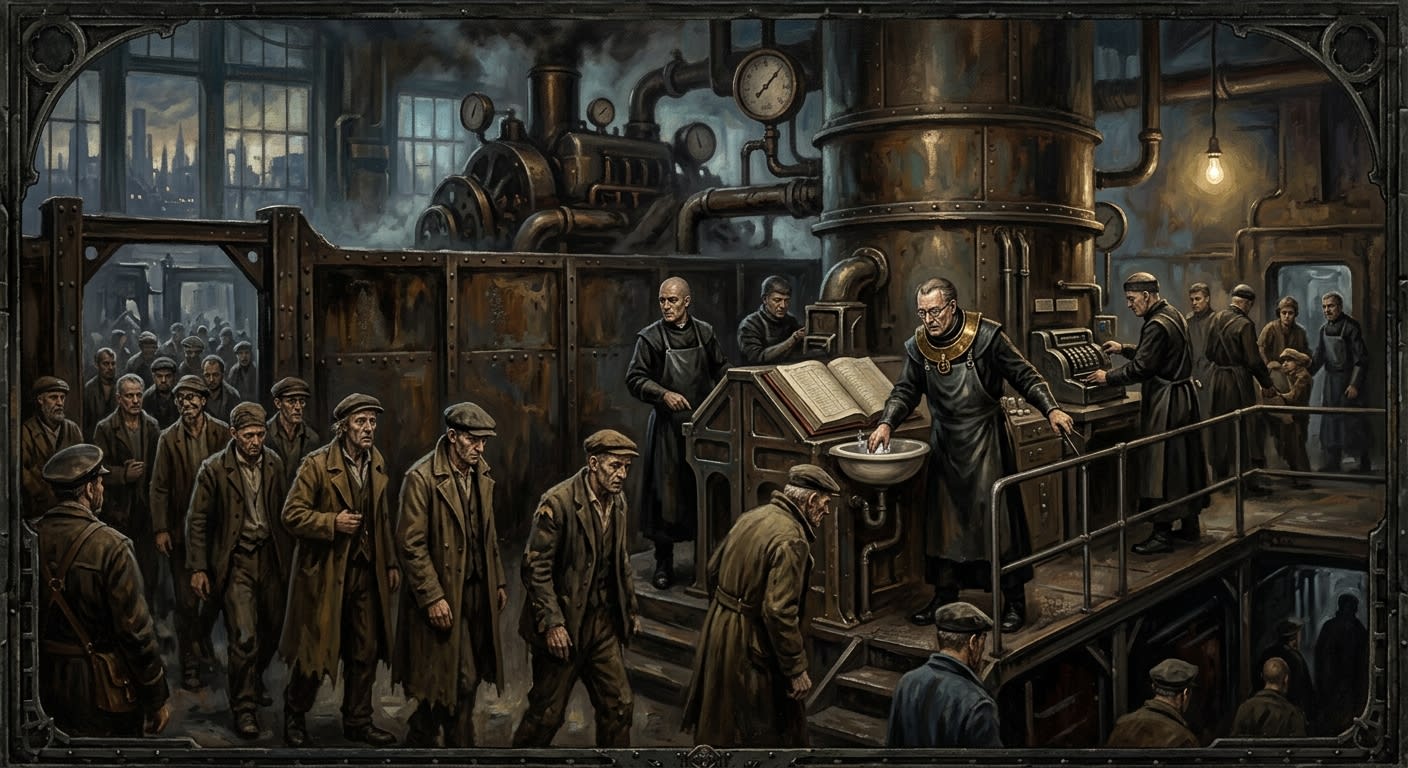
A person is rarely declared absent outright. That would be crude, and Rheinscarp abhors crudity unless it is profitable. Absence arrives through small corrections. A name loses a letter at the Ledger Cloister. A stair-token receipt is entered under the wrong terrace. A widow’s work shift is credited to her dead husband. A ration card bears a valid seal whose corresponding register line has been moved to a folio marked pending. The body stands at the window. The paper is elsewhere. Paper wins.
The corrected person receives no execution, no trial, no trumpet. He receives refusal. Refusal at the flour window. Refusal at the stair. Refusal at the chapel dole because his parish line no longer matches his terrace designation. He may appeal. Appeal requires tokens. Tokens require standing. Standing requires the entry he is appealing to recover. The snake eats itself with admirable penmanship.
Burial-precredit is the ugliest hinge. The Ash Exchange of Saint Pelagia may open collateral against a person whose record has begun to drift. The Exchange insists this is prudent actuarial practice. The families call it a coffin loan taken by strangers. Broker-Saintsman Damas Rohe smiles, as men in dust markets smile, because teeth are cheaper than confession.
#On the Three Beneficiaries
Three powers profit from absence. The Tribunal-Tithes axis gains order: fewer mouths in the ration column, fewer claimants at the window, fewer bodies whose hunger contradicts the stair tariff. Records gains control: a population reminded that spelling is survival approaches the clerk with a posture nearly indistinguishable from worship. The Ash Exchange gains collateral: drifted names become future dust, and future dust can be priced before the lungs stop asking rude questions.
Praetor-Registrar Ysabeau Kelm denies that the Quota exists. She does so beautifully. Cantor-Marshal Hrodric Venn denies that bell-hour schedules are adjusted to hasten absence among low-yield terraces. He does so loudly. Rohe denies nothing specific, which is the most honest denial available to a man whose wealth depends on ashes.
The Bureau of Mercy has protested in sealed memoranda whose seals were later found opened, copied, and filed under emotional surplus. Hunger-waiver advocates argue that bodies should receive food when their papers fail. This position is doctrinally attractive, fiscally disgusting, and likely to get several tender-hearted clerics reassigned to stair-cleaning. Mercy is admired in Rheinscarp chiefly after it has been rendered harmless.
The Absence Quota has been described in hostile broadsheets as murder by ledger.
Corrected for precision. Murder implies a direct act against a named victim. The Quota is the administrative removal of the conditions under which a victim remains nameable. The distinction comforts lawyers and no one else.
#On the Theology of Being Counted
The Quota survives because the Synod has always treated counting as a sacrament. Count the faithful and they may be fed. Count the dead and they may be buried. Count the guilty and they may be corrected. In Rheinscarp, the sacrament has developed teeth. To be counted is to exist. To be miscounted is to weaken. To be uncounted is to stand in a city full of bells and discover none will ring for you.
The doctrinal defence is tidy: no one is removed from the Creator’s knowledge by a clerical adjustment. True. Also useless at supper. The Creator may know the absent man perfectly while the flour clerk refuses him half a loaf for want of matching ink. Theology consoles the soul. Ledgers ration the bread.
CASE FILE AQ-198/17 — WIDOWLIGHT QUARTER Subject: Mara Senn, lamp-oil sorter, registered living A.S. 197. A.S. 198 status: “temporarily absent — ration already satisfied.” Appeal: denied; appellant lacked proof of presence. Burial-precredit opened: same week. Final notation: █████████████████████████
One must admire, with the nausea proper to admiration, the machine’s courtesy. It does not say die. It says already satisfied. It does not say starve. It says variance closed. It does not say we have chosen you. It lets the window, the stair, the bell-hour, and the empty bowl speak in chorus.
#On Countermeasures and Cheats
Rheinscarp families have developed small defenses. Children learn to spell their names in three official hands before they learn river prayers. Wives keep duplicate terrace receipts sewn inside hems. Dock gangs exchange witness-oaths in taverns whose owners bribe Registry Choir juniors for advance notice of spelling audits. Mercy clerics run night tables where bread is given first and paperwork asked later, a scandalous inversion that has saved lives and damaged several careers.
There is a black market in presence. Clean true-name entries, witness seals, stair-token continuities, borrowed bell-hour credits, forged present at window stamps. The market is dangerous because every purchased presence must be taken from somewhere. A forged correction that saves one family may push another into absence. The brokers call this exchange. The saints, if any listen from their reliquaries, may use rougher vocabulary.
The only lawful countermeasure is appeal before the Tribunal of Stairs. The Tribunal sits on the High Step Precinct, a location selected by men with a refined sense of mockery. An absent person must climb to appeal absence. Each terrace crossing requires tokens, verse, and a valid present-status mark. Failure at any window confirms the condition under appeal. Rheinscarp calls this due process. I call it architecture committing perjury.
#On the Present Danger
As of A.S. 201, the Quota remains officially nonexistent and operationally indispensable. Grain tables still fail without correction. The self-writing tollhouse booths have begun entering phantom crossings against persons later marked absent, which suggests the city’s anomaly has learned to assist or accuse the mechanism. Neither possibility is pleasant. Both have been referred to subcommittee, the traditional drawer in which terror is placed until it matures.
Rheinscarp’s rulers will not abolish the Absence Quota until forced by famine, riot, miracle, audit, or embarrassment. Famine has already occurred. Riot is being priced. Miracle has not filed intention. Audit approaches slowly, because auditors climb by stair like everyone else and must pay at each window.
The absent wait without waiting, since waiting implies recognition by time. Their bowls are empty. Their names are almost right. Their ashes, in several cases, have already appreciated.