
#On the Question Itself
"Who made the world? The Creator. Who sustains the world? The Creator. Who will save the world? The Creator. When? That is not a permitted question."
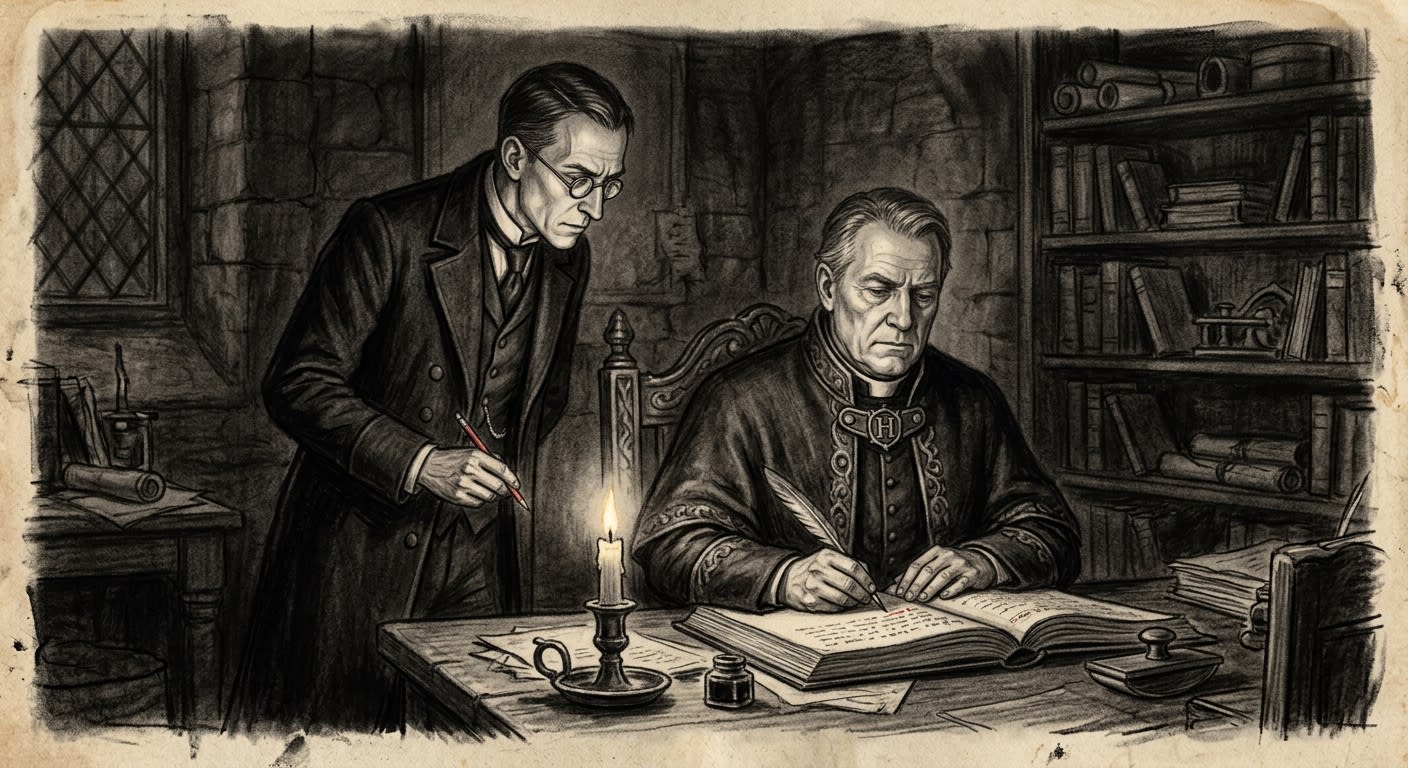
I have been asked — by the Bureau, by the faithful, by cadets whose faces still carry the cream of youth and whose questions still carry the stench of sincerity — to compose an entry on the Creator. I accepted, as one accepts a commission to paint the ocean from a rowboat, or to describe a bell-tower to a man born deaf. The Bureau requires a codex entry. The Bureau shall have one. But let the record show that the Hieromnemon did not volunteer for this particular folio, and that what follows is dictated by Doctrine, ratified by authority, and believed — with the precise and calibrated fervour appropriate to a man of my station — by its author.
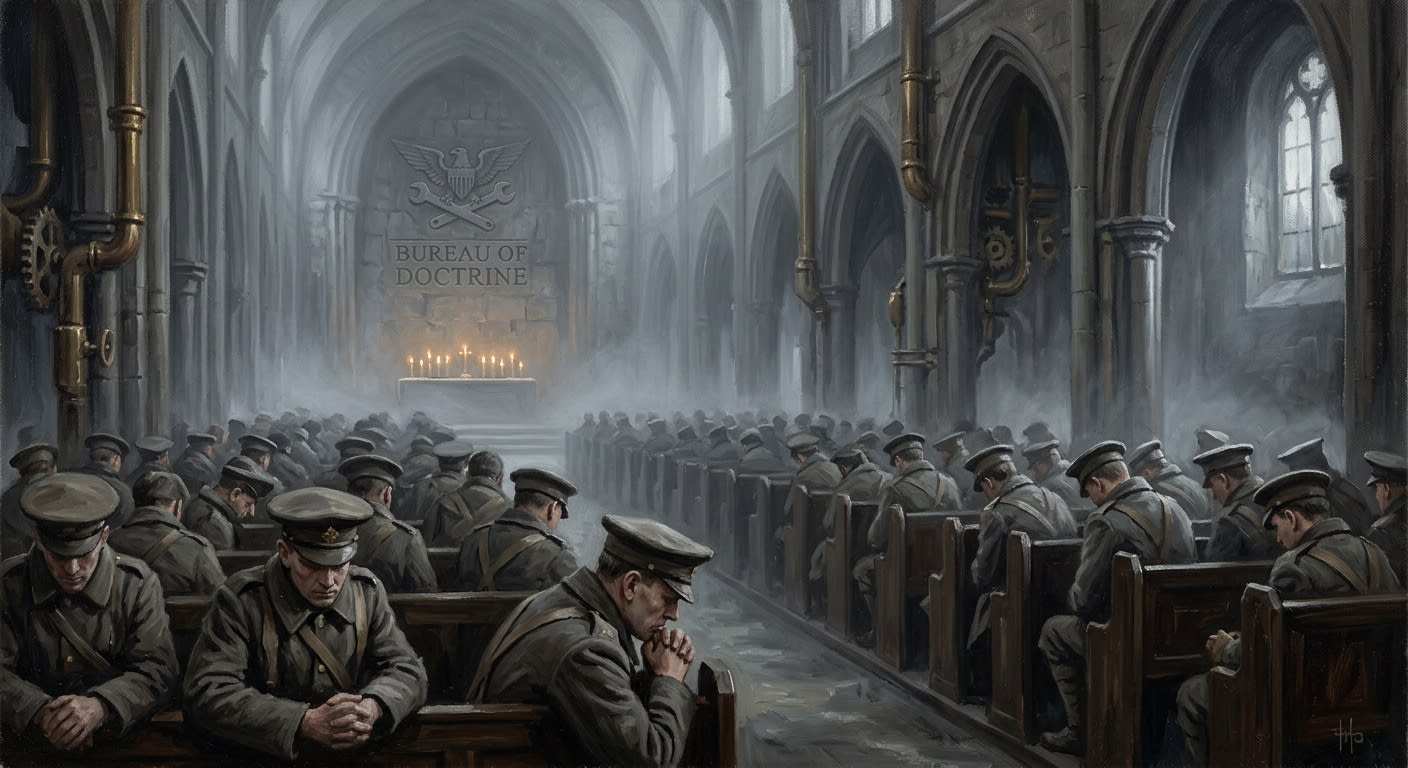
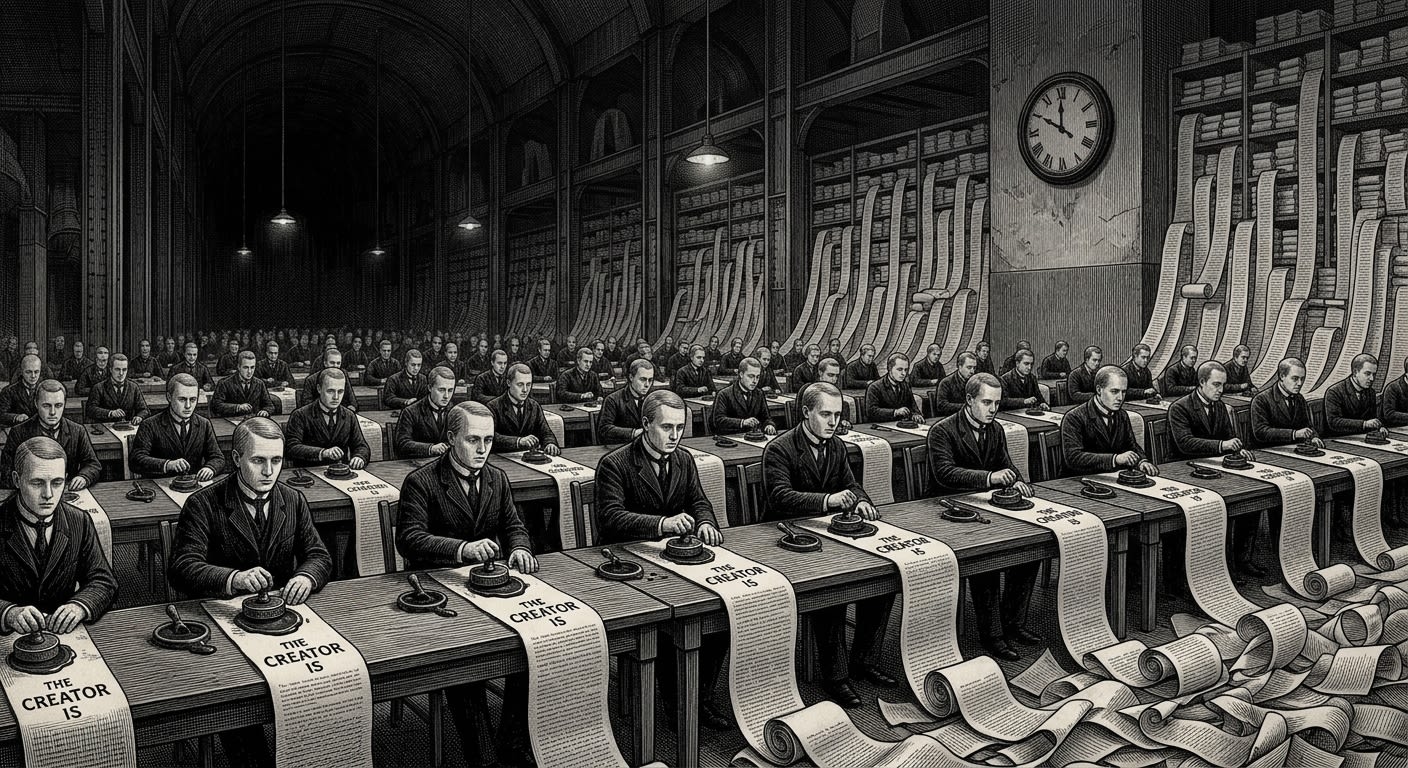
The Creator is. That is the first sentence of the First Catechism, taught to every child at the age of five, repeated every morning in every school from Calais to Constantinople, stamped into every wax seal of every bureau in every city of the Holy Dominion. The Creator is. Two words. A subject and a verb. The Bureau of Doctrine considers this the most perfect sentence in any language, because it requires no object, tolerates no qualification, and admits no argument. The Creator does not do. The Creator does not want. The Creator does not intervene, explain, apologize, or appear. The Creator is. And from that irreducible fact, the entire Synod is built — its armies, its ledgers, its bells, its trenches, its hierarchs, its forty-seven Bureaus, and its one hundred and fifty-six years of uninterrupted war against an Enemy who, by contrast, is distressingly active.
#On the Catechism of the Divine Nature
The catechisms describe the Creator in terms of what the Creator is not, which is the only honest approach available to any institution that has spent two centuries worshipping an entity that has never once confirmed its own existence. The Creator is not the Great Deceiver, which tells us very little. The Creator is not material, not temporal, not bound by the constraints of a world He fashioned but does not inhabit. The Creator is not silent — the Bureau insists on this with a vehemence that suggests the opposite — but rather speaks in a register the mortal ear has not yet learned to hear.
This is the Doctrine of the Inaudible Voice, ratified at the Fourth Doctrinal Congress in A.S. 104, and it is the finest piece of theological engineering the Bureau has ever produced. For it takes the single most devastating objection to the Synod's authority — where is your the Creator? — and transmutes it into a test of the faithful. You cannot hear Him because you are not faithful enough. When you are faithful enough, you will hear Him. Until then, pray harder and keep your tithe current.
The Creator fashioned the world. This is not theology but axiom — the unargued premise upon which all subsequent argument depends. Before the Creator fashioned the world, there was nothing; after the Creator fashioned the world, there was something; the something includes the Adversary, which is either the Creator's mistake, the Creator's test, or the Creator's plan, depending on which century's catechism you consult and which Bureau issued it.
The Bureau of Doctrine currently maintains the Third Position: that the Adversary exists by divine permission, that his existence is purposeful, and that the purpose — revealed at the Sundering and clarified retroactively at thirteen subsequent Doctrinal Congresses — is to provide mankind with a foe worthy of mankind's faith. The war is the point. The suffering is the curriculum. The bells that ring from Bastion-Königsberg to Bastion-Constantinople are not calls for help; they are the sound of the faithful passing the examination.
Previous positions have included the First Position (the Adversary is a punishment for the sins of the Rationalists, and will be withdrawn when sufficient penance has been performed), the Second Position (the Adversary is a corruption of the Creator's design introduced by mortal hubris, and only mortal sacrifice can repair the breach), and the Suppressed Position, which I am not permitted to describe and whose existence I am instructed to deny. I deny it. The reader may note that I deny it with the same conviction with which I affirm the Third Position, which is to say: with the precise and calibrated fervour appropriate to a man who knows the difference between belief and employment.
Earlier editions of this Codex contained a section titled "The Four Positions on the Nature of the Adversary's Origin." The Fourth Position has been reclassified as non-existent per Bureau of Doctrine Memorandum 19-H (A.S. 187). This entry now references three positions.
Corrected. The Fourth Position was never a position, never discussed, and never classified. Any records suggesting otherwise are the product of scribal error, poor wax quality, or demonic influence upon the archivist's hand.
#On the Silence
The Creator does not speak. Or rather — and I choose my words here with the precision of a man threading a needle over a chasm — the Creator has not spoken within the span of recorded Bureau history, which begins at A.S. 0 and encompasses every moment the Synod considers worth remembering, which is all of them.
Before A.S. 0, the catechisms assure us, the Creator spoke regularly. He spoke through miracles. He spoke through saints. He spoke through the relic of Saint Aldebrand, which healed the lame and the blind and the tax-delinquent with equal facility. He spoke through visions granted to holy men and women whose names the Bureau of Records has since notarized, cross-referenced, and filed in the Armorial of the Faithful. The Age of Faith — that golden era before the Rationalists dismantled Europe's altars — was, per the catechisms, an age of constant divine conversation. The Creator whispered, and humanity listened. The Creator corrected, and humanity obeyed. The Creator blessed, and the blessed knew it.
Then the Rationalists stopped listening.
The Doctrine of Divine Withdrawal, established at the Second Doctrinal Congress (A.S. 72), holds that the Creator withdrew His active presence from the world in response to the desecrations of the Age of Reason. The smashing of altars, the burning of reliquaries, the jeering of priests in the marketplaces of Amsterdam and Paris — these acts did not offend the Creator in the way a man is offended by an insult. They broke the mechanism by which divine speech reached mortal ears. The Rationalists did not merely disbelieve; they dismantled the apparatus of belief. And without that apparatus — the shrines, the reliquaries, the prayers ascending like incense, the faith descending like rain — the connection between Creator and Creation was severed. The line went dead.
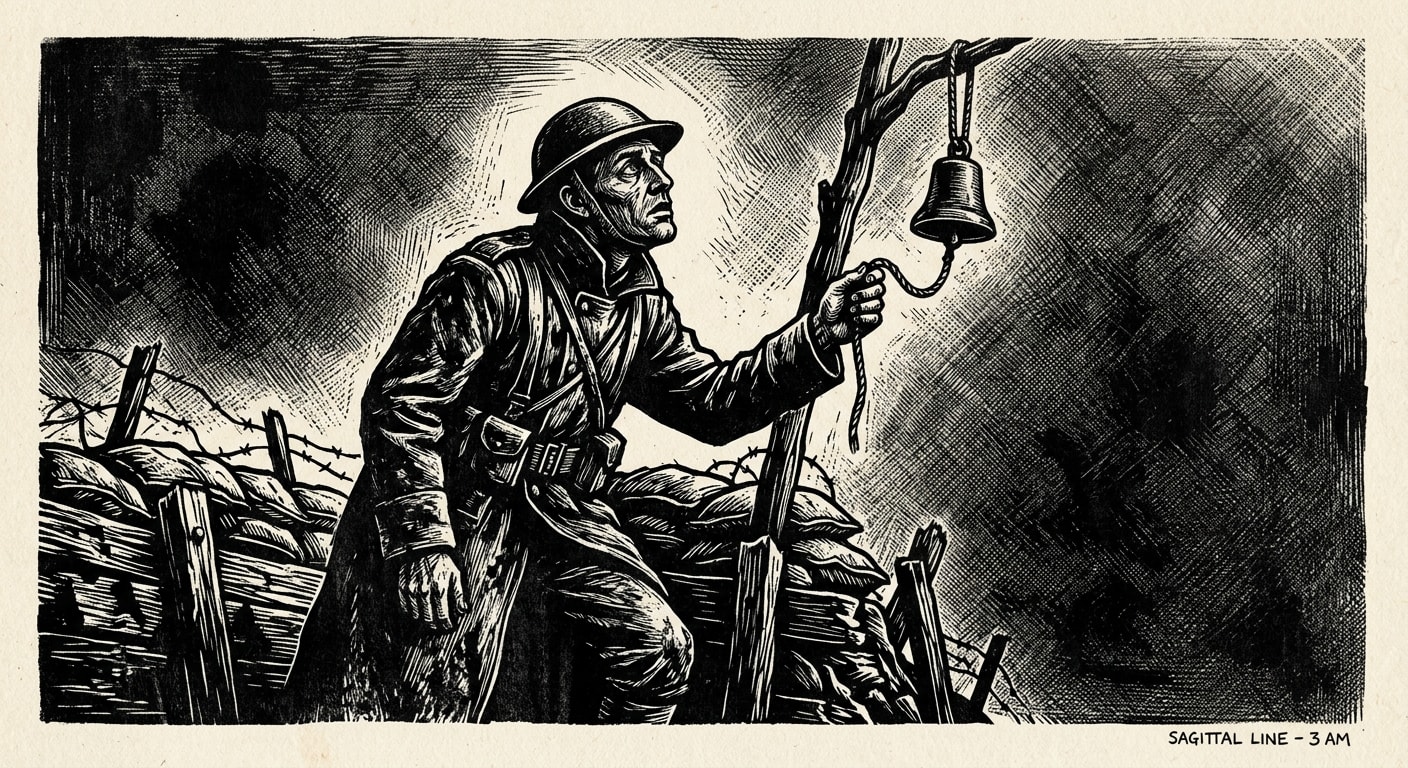
This is the official position. It is printed in every catechism, recited in every school, and believed by every soldier who has ever stood watch on the Sagittal Line at three in the morning, staring into fog that stares back, and wondering why the Creator he fights for has not once, in one hundred and fifty-six years, said a single word in reply.
#On Miracles and Their Inconvenience
The Creator, per Doctrine, no longer speaks. The Creator, per observed reality, occasionally acts.
This is the contradiction the Bureau of Doctrine has spent a century and a half trying to reconcile, and the attempt has generated more internal memoranda, sealed disputes, and reassigned theologians than any other question in Synodal history, including the question of how many femurs Saint Aldebrand actually possessed — a matter which, unlike the Creator's silence, at least admits of a finite answer, even if that answer is seventeen.
Relics glow. Bells ring of their own accord. Consecrated ground repels the advance of the Adversary's forces in ways that unconsecrated ground does not. The reliquary of Saint Aldebrand shattered a sorcerer-lord at the Siege of Vienna — this is not rumor but recorded fact, observed by fourteen thousand soldiers, notarized by the Bureau of War, and confirmed by the pile of ash where the sorcerer's army had been standing. The Chain of Saint Anakletos glowed across the Bosphorus for one hundred and thirty-one years without interruption. Holy water, prepared according to the Rite of the Bureau of Rites, causes demonstrable chemical burns on demonic tissue, a fact that the Bureau of Medicine has confirmed in controlled conditions and the Bureau of Doctrine has confirmed theologically, and neither Bureau has any explanation for why it works.
Something answers. That much is beyond dispute. But the something that answers is never identified, never attributed, never confirmed. The reliquary blazes, and the Bureau of Doctrine stamps it MIRACLE, CATEGORY ONE, VERIFIED, and files it. The bells of Saint Rupert ring without human hand, and the Bureau stamps it MIRACLE, CATEGORY TWO, UNDER REVIEW, and files it. A chaplain lost in the Vault of Ten Thousand Keys finds a finger-bone glowing in a demon's treasure hoard, reaches for it, and is absorbed into the wall — and the Bureau stamps this, too, though the classification is sealed and the chaplain's name has been removed from every roster.
The Bureau's official position is that miracles are gifts from the Creator, freely given to the faithful at cost to the recipient — for every miracle exacts a price, whether in suffering, in years, or in the quiet erosion of the recipient's selfhood that the Bureau of Medicine classifies as "devotional exhaustion" and the soldiers call "being eaten by your own prayer." The distinction between miracle and sorcery is, per the Bureau, absolute: miracles are given; sorcery is taken. Miracles come from the Creator; sorcery comes from the Great Deceiver. The mechanism is the same — power from beyond the mortal sphere, channeled through material conduit — but the source is different, and the source is what determines whether you are canonized or burned.
The honest observer will note that the Bureau has no method for determining the source. The honest observer will also note that the Bureau does not permit honest observers.
#On the Doctrine of Perfect Faith
The question — the only question that has ever mattered, the question scratched into trench walls from Bastion-Brest to Bastion-Shipka, whispered in confessionals, screamed into pillows, prayed into silence — is: when will the Creator return?
The answer, as published in every catechism since A.S. 72, is magnificent in its cruelty: when faith is perfect.
When every soul prays without doubt. When every bell rings without ceasing. When the Synod's authority is accepted without reservation. Then — then — the Creator will intervene. He will cast the Adversary back beyond the veil. He will heal the Sundered lands. He will restore what was broken. He will answer, at last, the prayer that has been ascending from this continent for one hundred and fifty-six years.
The beauty of this position is its irrefutability. Perfect faith has never been achieved. Perfect faith, by its nature, cannot be achieved — for the moment one believes one has achieved it, one has committed the sin of Pride, which is imperfect, which means faith was not perfect after all. The condition for divine intervention is a condition that cannot be met. The promise is eternal. The fulfilment is perpetually deferred. And the deferral is always the fault of the faithful, never the fault of the promiser.
I have heard this Doctrine preached from the pulpit of the Basilica of the Ledgered Saints by men who believed it with the fire of conversion, and I have heard it preached by men who believed it with the cold efficiency of bureaucrats enforcing a useful fiction. I have heard it preached to soldiers departing for the Line, who nodded and shouldered their packs and marched east, and who are now dead. The Doctrine of Perfect Faith asks nothing of the Creator. It asks everything of the believer. And when the believer fails — when the soldier dies, when the bastion falls, when the bell cracks — the Doctrine explains the failure without implicating the Promiser. The soldier did not pray hard enough. The bastion's chaplain permitted doubt. The bell-founder's faith was impure.
The system is flawless. The system has been flawless for a hundred and fifty-six years. The system will be flawless until the last bell stops ringing, at which point its flawlessness will become, as the Bureau might say, academic.
#On the Heresies of the Question
The Creator's silence has produced heresies as reliably as the Danube produces mud. The Bureau of Purity classifies them in tiers, and the Hieromnemon, whose duties include the cataloguing of forbidden thoughts, has read more of them than is comfortable for a man who values his soul — or his pension, which amounts to the same thing.
The Heresy of the Absent the Creator holds that the Creator is dead, killed at the Sundering or before it, and that what the Synod worships is a corpse whose residual holiness powers the relics as a dead man's heart may twitch long after the breath has stopped. This heresy is popular in the northern garrisons, where the Grey presses against the Line and the soldiers have spent too many nights watching fog that wears faces. It is classified at Heresy, Third Degree — punishable by branding, confiscation, and reassignment to Penal Choir for a term of not less than seven years.
The Heresy of the Sleeping God holds that the Creator withdrew deliberately and sleeps, dreaming the world into continued existence, and that the Synod's bells and hymns serve not to praise but to keep Him from waking, because if He wakes, He will see what His creation has become and unmake it. This heresy circulates in the Shipka garrison, where Syrion's influence makes sleep theology disturbingly plausible, and among certain cells of the Counterkey Circle, who claim their forbidden harmonics are "lullabies for the divine." It is classified at Heresy, Second Degree — punishable by confiscation, branding, and permanent assignment to front-line trench maintenance.
The Heresy of the Complicit God holds that the Creator and the Great Deceiver are the same entity, or two aspects of one entity, and that the war is a performance staged for purposes unknown. This heresy appears in no Bureau classification, because to classify it would be to acknowledge the possibility of its existence, and the Bureau does not acknowledge the possibility of things that would, if true, render the Bureau unnecessary. I am instructed to state that I have never encountered this heresy. I state it.
The Heresy of the Unnecessary the Creator holds that the relics work on their own — that the power was always in the bone, the bell, the consecrated stone, and that the Creator is a retroactive explanation applied by the Synod to phenomena that require no divine source. This is the heresy the Bureau of Doctrine fears most, because it cannot be refuted by torture and cannot be disproved by theology. If the bells work without the Creator, then the Synod is a bureaucracy, not a theocracy. And a bureaucracy does not require tithes, does not require confessions, does not require obedience, and does not require Drax.
#On What Drax Believes
This is not a permitted section. The Hieromnemon does not have personal beliefs. The Hieromnemon has Doctrine, which is superior to belief in every respect: it is notarized, it is consistent (or consistently revised), and it does not keep him awake at three in the morning staring at the ceiling of his quarters in Strasbourg while the cathedral bells mark the hours and the silence between them grows wider with each passing year.
The Creator did not fashion the world so that oxen could understand it. He fashioned it so that I could record it, and you could marvel that such a record exists.
But I will say this — and let the Bureau of Purity red-line it if they wish, for I have outlived four Procurators and will outlive their successors — something answers when the faithful cry out. I have seen the Chain of Saint Anakletos glow at midnight without explanation. I have read the sealed testimony of Clemens Stahlhand, who swore "it was not I who struck" when the reliquary shattered the sorcerer at Vienna. I have stood in the lower vaults of the Basilica where censers burn without fuel and the air tastes of incense that was old when Augustinus was young. Something is there. Something answers. Whether it is the Creator, or the memory of the Creator, or the machinery of faith running on fumes — that is the question the Bureau will not ask, because the answer does not matter.
What matters is that the bells ring. What matters is that the relics glow. What matters is that the Line holds.
The Creator is silent. The Synod is not. Between those two facts, all of human history in the Age of Heresy is compressed — every tithe, every trench, every bell, every bone filed in every reliquary in every cathedral from here to the Bosphorus. We built a theocracy on the silence of the Creator, and then we built a bureaucracy to administer the silence, and then we built an army to defend the bureaucracy, and then we built a propaganda office to explain why the army was necessary, and that office is called the Bureau of Doctrine, and its warden is called Drax, and Drax is writing this entry, and the entry says what the Bureau tells it to say, which is: the Creator is.
Two words. A subject and a verb. Enough to build a continent on. Enough to bury one in.