
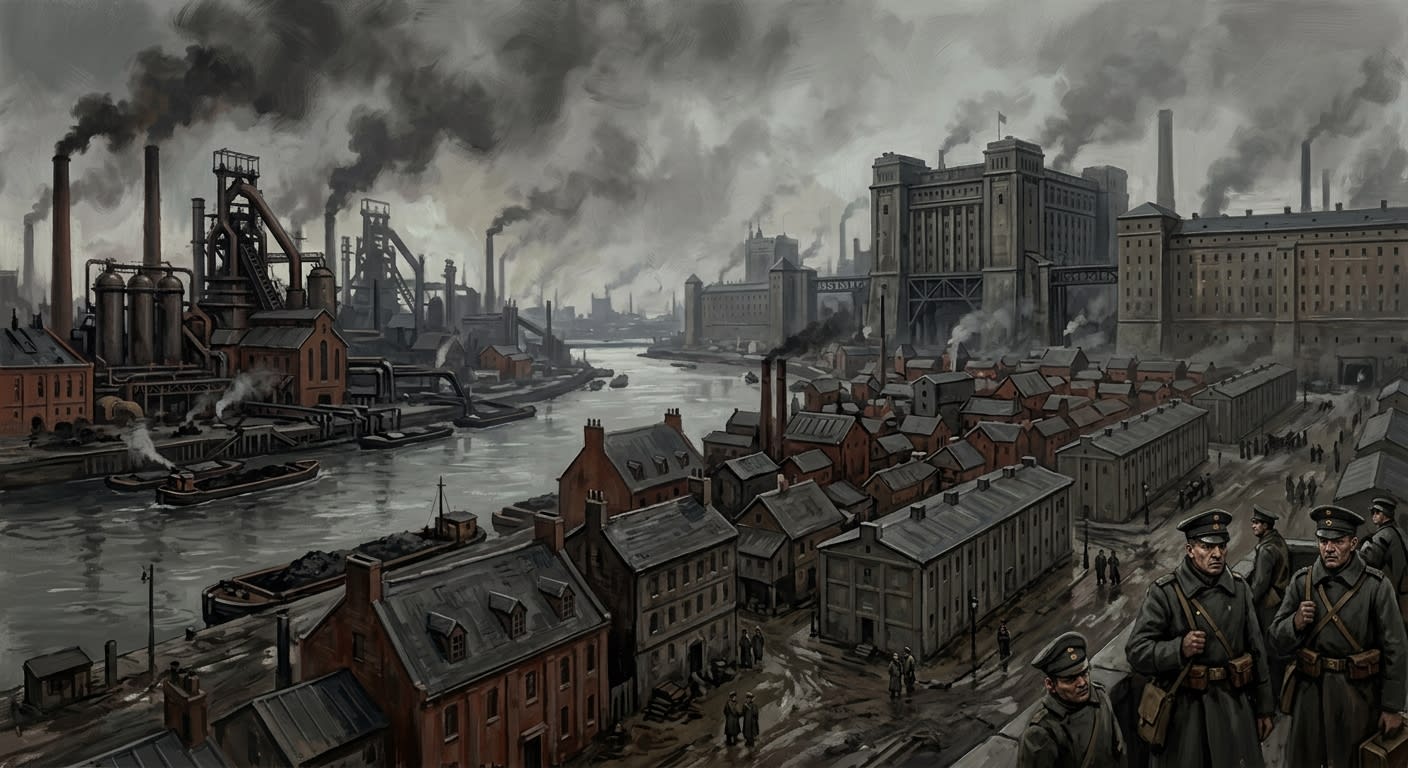
#On the Central Heartlands and Their Polished Throat
Zone 2 is the Central Heartlands: Germany, Switzerland, northern Italy (Unregistered), Austria’s (Unregistered) safer western ribs, the Rhine basin, the Ruhr (Unregistered) foundries, the Swabian training yards, the cathedral banks, the salt roads, the hymnsteel cities, the cooperage towns, and Strasbourg seated in the middle like a spider wearing a mitre. It is safe territory, officially. It is also the place where safety is melted, stamped, calibrated, drilled, tithed, audited, and sent east in sealed wagons.
If Zone 1 is the rearward paradise that invoices the war, Zone 2 is the counting house with furnaces under the floor.
The map gives Zone 2 comforting names: Central Heartlands, core cities, safe industrial belt, cathedral interior, Rhine security depth. The Ledger gives it better names: principal administrative mass; safe manufacturing base; central conscription substrate; reliquary finance region; doctrinal memory field. One sounds like geography. The other sounds like what happens to a person after geography acquires clerks. Between the two sits the citizen, warm, indexed, and already late for a bell he did not choose.
Here stand Aachen, Stuttgart, Mournwater, Brast, Cologne, Essen-of-Hymnsteel, Munich, Hamburg, Kanzleiburg, Regensburg, Ulm, Florence, Milan, and the lesser teeth of an obedient jaw. Roads knot. Rails converge. Bells regulate shifts. The Synod’s safe middle does not rest. It produces.
#On Strasbourg, the Rhine, and the Blessing of Being Near the Desk
Zone 2 is ruled by proximity to Strasbourg even where the roads deny it. The Basilica of the Ledgered Saints, the cathedral precinct, the Sigillary, the Relics Archive, the Bureau seats, the cathedral bells, the locked lower galleries, the ratification rooms, the stairwells where clerks learn to lower their voices before entering power: these are capital structures, and they are weather.
Strasbourg’s authority falls outward through Zone 2 in rings of seal, schedule, and fear. Cologne receives it as rivalry dressed in obedience. Aachen receives it as permanent shame. Stuttgart receives it as sons. Essen receives it as measured voice. Brast receives it as hymn imposed on oil. Mournwater receives it as purity stamp over river mud. Regensburg receives it as treaty memory. Ulm receives it as paper discipline and nameless labour. Milan receives it as inspection behind velvet.
The Rhine basin makes the zone rich and spiritually unpleasant. Rivers carry coal, relic dust, troop orders, field hospitals, amended decrees, debt packets, confessional abstracts, and enough wet paper to drown a lesser government. Cologne keeps archive-banks and vault finance beneath a cathedral that remembers the First Council and the later yoking. Koblenz sits at water’s hinge. Mainz tolls, weighs, and nurses its goring shame. Trier preserves old episcopal memory with the caution of a man holding a knife by the blade.
The river cities are pious because piety travels well by water. They are corrupt for the same reason.
Several instructional maps describe Zone 2 as “the tranquil central interior of the Synod.”
Corrected. Tranquil interiors do not maintain seal furnaces, confession vaults, training yards, quarantine annexes, rail courts, and punitive memory levies at this density. The cartographers confused quiet with carpeting.
#On Aachen, Whose Gate Still Teaches
No account of Zone 2 may omit Aachen, because Aachen is the city by which the Central Heartlands learned that safety can be opened from within. In A.S. 25, Guillaume surrendered the western gate to the Rationalists. The Betrayal of Aachen broke the faithful front without the courtesy of a siege. The city survived. Survival was its indictment.
Aachen is now clean, prosperous, watched, and taxed for memory. Its western gate is preserved under penitential continuity, a phrase that lets the Bureau ignore hinges replaced three times while insisting guilt remains original. Soldiers kneel on the threshold. Pilgrims cross barefoot. Children recite the Gate Litany before they can multiply fractions. Merchants pay the memory levy with public solemnity and private expertise in evasion, the ancient civic duet.
Aachen’s lesson spreads across Zone 2: centrality is vulnerability with better roads. A gate city may surrender. A factory city may be sabotaged. A cathedral city may misremember. A rail city may redirect. A shrine-town may counterfeit. The safe core is safest when every hinge is witnessed and every witness knows the cost of sleep.
AACHEN INSTRUCTIONAL ANNEX — ZONE 2 GATE DOCTRINE, A.S. 198 Question posed to cadets: “Which gate is most dangerous?” Approved answer: “The gate already trusted.” Unapproved answer submitted by Cadet █████: “The clerk.” Disposition: cadet reassigned to Records intake; answer retained for instructor use under seal.
#On Industry, Heat, and the Moral Education of Machines
Zone 2 makes the war possible by putting sacred names on industrial appetite. Essen-of-Hymnsteel sings rifle steel into obedience. Brast teaches fuel to kneel before entering guns. Mournwater grades saint-dust into casks. Stuttgart grades boys into categories. Cologne grades bones into acceptable plurality. The region is a choir in which every voice belongs to a furnace, a clerk, or a mother trying not to weep where the inspector can mark it.
Brast is the Warm City: ninety-two thousand registered souls inside slag berms, pressure bells, rail manifests, soot-fall, and sanctified distillate. Its chrismole began as ordinary fuel in A.S. 68, then received hymn and seal by A.S. 72 so that Doctrine could sleep beside artillery without smelling chemistry. The guns accepted the arrangement. Guns are famously tolerant when fed.
The Central Heartlands contain many such miracles of classification. A boiler becomes a vessel. A distillate becomes chrismole. A cask becomes reliquary transport. A ration shortage becomes training. A dead worker becomes logistics attrition. A boy crushed under a fuel cart becomes non-front family notification, pending. The language is colder than the iron it excuses.
Brast’s Amber status, sulking engines, missing sealed drums, substrate speculation, and fume-fever clusters make the central claim plain: Zone 2 is safe only because its dangers have been persuaded to wear factory numbers. When a machine answers a hymn incorrectly, Engineering arrives with gauges, Doctrine arrives with seals, War arrives with demands, and the worker arrives at Ash-Hospice Row if he arrives anywhere at all.
#On Boys, Rations, and the Swabian Arithmetic of Loss
Stuttgart is Zone 2’s catechism-barracks city, the place where Swabian thrift is spent in sons. Its modern function fixed after the First Continental Levy and hardened more sharply in the A.S. 112 season, when Conscription discovered that orderly objections offended more deeply than riots. Stuttgart had tables. War had trains. The trains won.
The Long Yard (Unregistered) turns boys into measured expenditure. They march with papers, without belts, under catechism, in silence, with kit, with another boy’s weight across the shoulders, and through mud mixed from clay and the ash of rejected petitions. Bread is weighed to the quarter ounce. Soup is issued by fatigue category. Salt comes after drill so thirst may instruct where sermons grow hoarse.
The Short Ration Week (Unregistered) is Zone 2’s civic philosophy stripped to bone: two-thirds bread, half broth, full drill, double hymn, no explanation beyond a slate marked FRONT CONDITIONS. Those who steal badly are punished. Those who steal cleanly are observed. Those who denounce untidy thieves may become monitors. Stuttgart does not remove sin from boys. It teaches sin to report upward.
War broadsheets once described Stuttgart’s ration discipline as “the loving hardening of civic youth for sacred service.”
Revised. “Loving” attracted inquiries from mothers, physicians, and one priest with an inconvenient memory. The current formula is “field-compatible austerity under catechetical supervision.” Uglier phrases often have fewer witnesses.
At the Western Rail (Unregistered), families stand close enough to see faces and too far to pass food unless they throw well. Throwing is prohibited after the sausage incident of A.S. 143, which proves Swabia retains comic genius under oppression. The trains depart east. The boys hear wheels. The mothers hear Cost (Unregistered), Stuttgart’s bell. Records hears completion.
#On Mournwater and the Saint-Dust That Settles Wrong
Mournwater is Zone 2’s river-belt confession: a cooperage town that became a reliquary port because broken jars once spilled saint-dust into the locks and profit, like grace under supervision, entered the wood. Founded as an industry around A.S. 98 and chartered in A.S. 104, it now certifies holy slurry, grades micro-reliquary substrate, seals casks, sells futures, and listens each morning for the Settling Bell (Unregistered).
The whole town holds its breath while dust descends in the Grading Hall of Settled Light. True dust forms rosary strata. Tainted dust forms shapes: jawbone, finger, rib curve, signs that make graders reach for red-sealed ledgers and Purity reach for vocabulary. The official phrase is Irregular Settling Pattern, Category Two. The local word is crumble-wrong. Local words survive because they do not have to comfort superiors.
Mournwater matters because the Line consumes miracles in units small enough to ship. Trench shrines need dust. Field hospitals need dust. Bastion chapels need dust. The saint-dust economy feeds the moral courage of men who are not allowed to know how often their relic supply has been diluted, misgraded, traded on futures slips, or produced by whatever the Ossuary Shoals have become upstream.
Zone 2’s holiness is like its industry: processed at scale, packed in approved containers, and dangerous when humidity changes.
#On the Present Condition of the Core
As of A.S. 201, Zone 2 remains rich, obedient, crowded, smoky, pious, watched, and indispensable. Strasbourg rules. Cologne counts. Aachen remembers under protest. Stuttgart trains. Brast burns. Essen sings to steel. Mournwater rings the Settling Bell. Munich stages stores toward the central corridor. Hamburg swallows northern cargo. Kanzleiburg commands with Prussian bones under Synod skin. Milan bows beautifully while calculating. Florence hides beauty where Relics can catalogue it.
The region’s strength is its density: more rails, more offices, more bells, more trained hands, more stored grain, more inspected workshops, more cathedral vaults, more ways to turn error into policy before it crosses a border. Its weakness is the same density with different lighting. One false hymn travels through a factory. One misprinted routing table reaches three corridors. One tainted cask of dust crosses a dozen shrines. One city gate opens, and history gets teeth.
Zone 2 believes itself the Synod’s heart. That is tolerable vanity. It is closer to the throat: everything necessary passes through, every command learns voice, every scream is swallowed before reaching the table.