
#On the Stair-Capital and Its Vertical Dominion
"Movement, in Rheinscarp, is not locomotion. It is theology performed with the feet." — Drax, marginal annotation to the Bureau of Tithes Third Quarterly Assessment, A.S. 199
I have climbed Rheinscarp twice. The first time I counted nine terraces, four hundred and twelve tollhouse windows, and one hundred and sixty-seven distinct fees levied upon my person between the Sump Docks and the High Step Precinct. The second time I counted only the fees, because the terraces had not changed but the fees had multiplied, and a man of the Bureau learns to track the variable, not the constant.
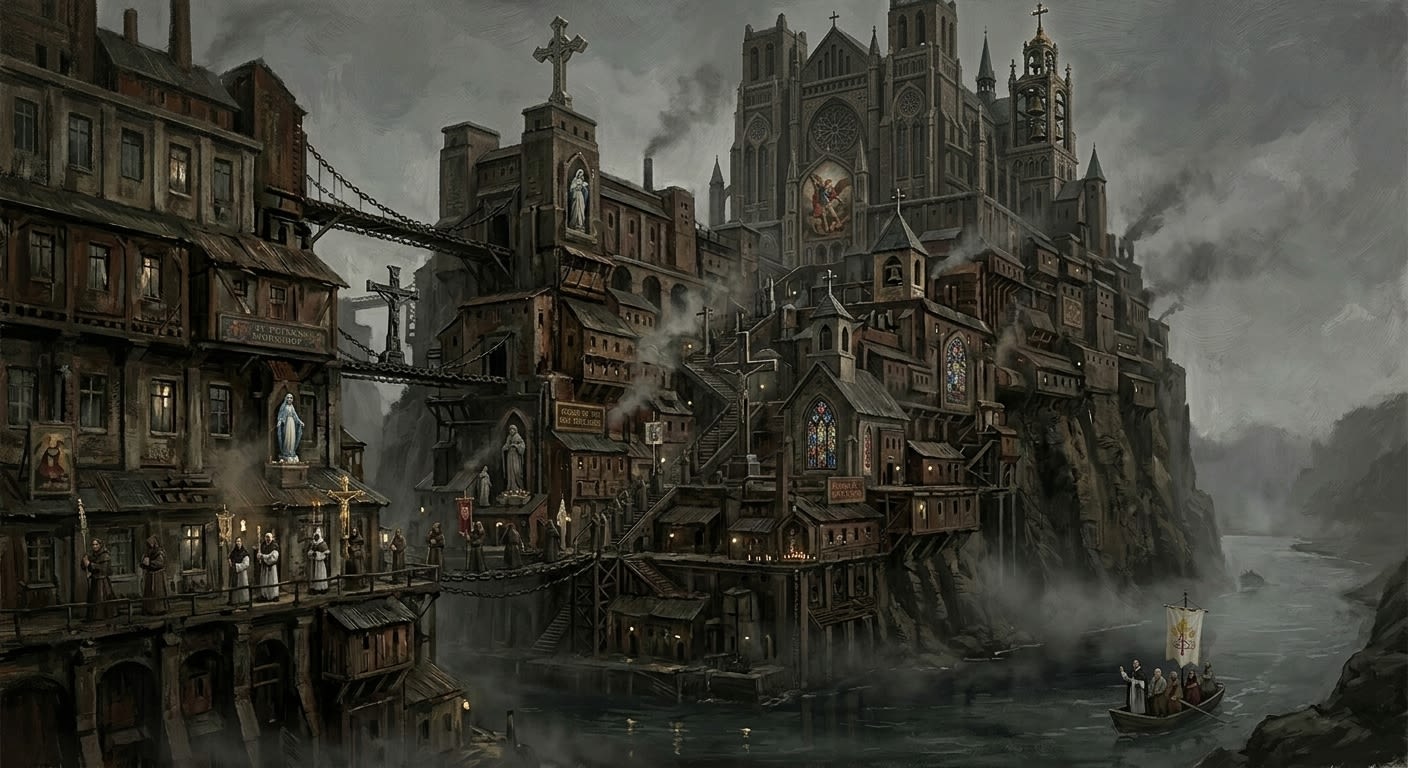
Rheinscarp is a city that goes upward. Where other cities sprawl — where Strasbourg spreads along the river flats and Essen hunkers in its coal-basin — Rheinscarp stacks itself against a cliff face above the Rhine like a library of human misery shelved by class. Nine terraces. Nine districts. Nine tollgates between the river and the sky, each one a sacrament, each sacrament a fee, each fee a sermon on the theological necessity of paying it.
The locals call it Stampcliff. The officers of the Bureau of Records call it the Stair-Capital. The soldiers on furlough, who must cross its terraces to reach the supply depots at Mainz, call it the Toll-Teeth, and they are not wrong: Rheinscarp bites, and what it bites it stamps, and what it stamps it owns.
#On the Founding and the Silt Year
"The river built Rheinscarp. The Synod merely taught it to charge admission." — Popular saying, attributed to no one who wishes to remain stamped
The mills predate the Concordat. This is a fact the Bureau of Records finds inconvenient, and the Bureau of Tithes finds irrelevant, and the Tribunal of Stairs finds actionable — for if the mills predate the Concordat, then the tolls predate the Concordat, and if the tolls predate the Concordat, then someone was collecting fees without authorization, and unauthorized fee-collection is, in the juridical vocabulary of Rheinscarp, a species of heresy punishable by descent to the Sump Docks without a return stamp.
The truth, such as the Bureau permits it, is this: Rheinscarp was a Rationalist lockworks before it was anything holy. River mills ground grain for the secular tollhouse at the cliff base. Barges paid in coin. Stairs were free. The old quarry scars on the upper terraces still show where secular masons cut stone without chanting, which is to say without insurance.
The Sundering of A.S. 45 changed the economics of the Rhine as it changed everything else. Refugees flooded westward. The river became a supply artery for the nascent entrenchments that would become the Sagittal Line. Rheinscarp's mills, already grinding grain, began grinding men — processing convoys, issuing crossing permits, stamping names into ledgers that had never before required names.
The Silt Year — A.S. 78, by the Bureau's reckoning — sealed the transformation. Spring floods surged through the Lockmouth grates, drowning the lower terraces and killing four thousand souls whose names the river erased and the Bureau did not yet possess the infrastructure to restore. The surviving population retreated upward. The first stair-toll regime was enacted by a river-warden whose name survives in the Ledger only as "Warden K." — the remainder of his identity having been lost to a filing error that the Bureau of Records classifies as "self-correcting."
By A.S. 92, when the first Bureaus received their formal constitutions under the Concordat, Rheinscarp had already built the architecture of its own tyranny. The Synod Chapterhouse — the Ration-Cathedral, as the mill-hands call it without affection — was consecrated that year atop the High Step Precinct. The Bureau of Tithes installed its liaison office. The Bureau of Records installed its annex. And the Tribunal of Stairs received its charter, transforming what had been a practical toll system into a doctrinal one: crossing between terraces was no longer movement. It was registration. Coin, verse, stamp. A missed word could render you "absent" until confession repaired you — and confession, in Rheinscarp, is a billable service.
#On the Nine Steps and Their Particulars
"Rheinscarp does not have districts. It has altitudes, and each altitude has a price." — Bureau of Tithes, Internal Assessment, A.S. 194
The city is stacked against the cliff in nine terraces — the Nine Steps — connected by a single legal vertical corridor called the Hundred Steps, plus a network of chain-bridges, toll-stairs, and licensed rope-lifts that move cargo upward at rates determined by bell-schedule, bribe, and the personal disposition of whichever toll-provost is on shift.
The Sump Docks sit at the Rhine's edge: barge yards, silt flats, the stink of tar and rot-brine. Everything enters Rheinscarp through the Sump Docks — grain, salt, wax, fuel, paper stock, and men who will shortly discover that entering was the easy part. Above the docks rise the Lockmouth Works, the massive harbor-control locks and iron grates that regulate river traffic with the indifference of a machine that has been taught theology. The grates groan when they shift. Locals say Lockmouth sounds like an animal. The Bureau of Engineering says it sounds like iron under stress. The distinction is academic; both descriptions predict the same casualties.
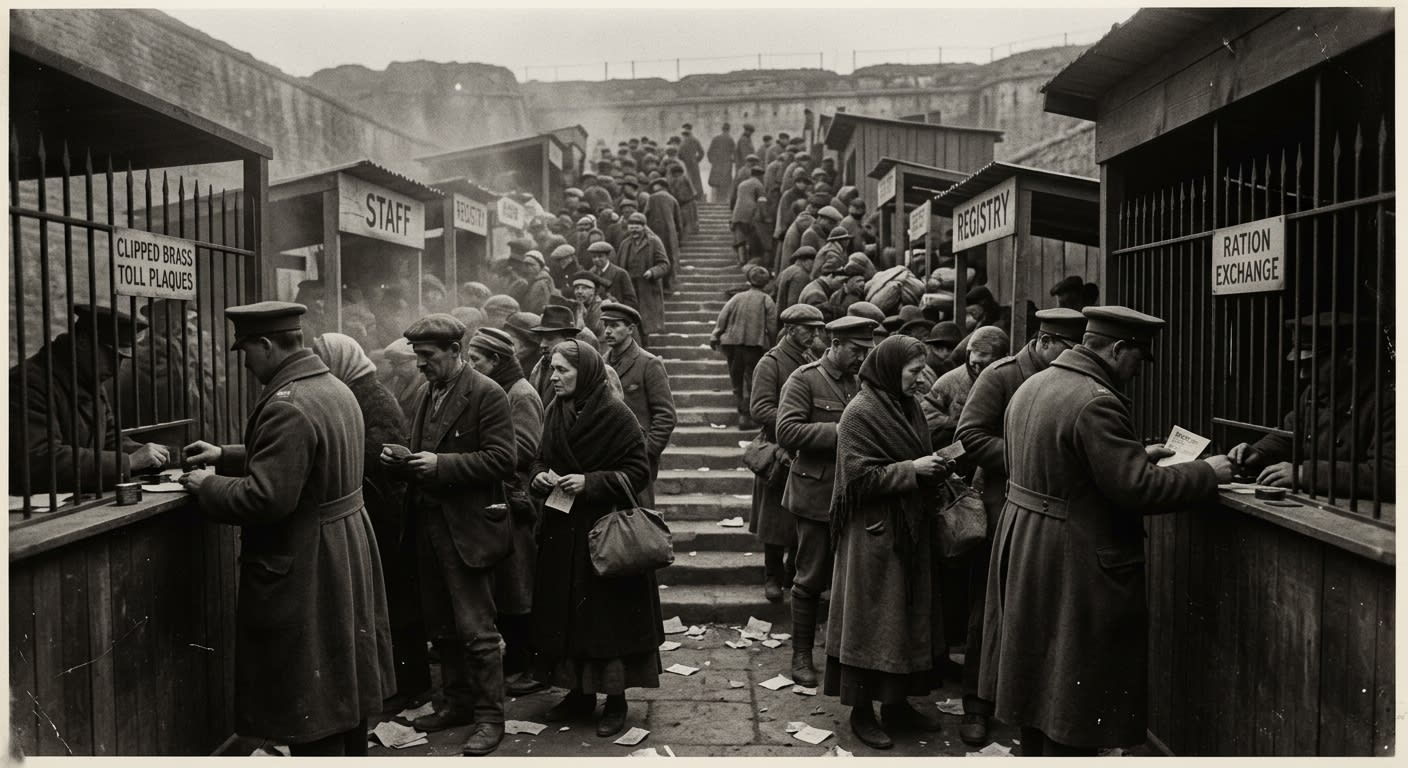
The First Step Market sprawls above the locks — ration exchange, stair-token booths, the smell of yeast and ink and human desperation performing commerce. Here the newly arrived purchase their first stair-tokens: clipped brass plaques, each valid for exactly one terrace crossing. The tokens are beautiful. They are also insufficient. No one arrives at the First Step Market with enough tokens to reach the top, and no one leaves the First Step Market without understanding that the distance between the river and the sky is measured in fees, not feet.
Above the Market rise the Mill-Crown Terraces, where the ration mills grind flour in clouds of dust that coat the lungs and the ledgers with equal thoroughness. The mills are hymn-timed — the Mill-Crown Cantors sing the gears into cadence, and the cadence determines output, and output determines ration allocation, and ration allocation determines who eats. A misfired hymn can jam a mill. A jammed mill can starve a terrace. The Cantors know this. They charge accordingly.
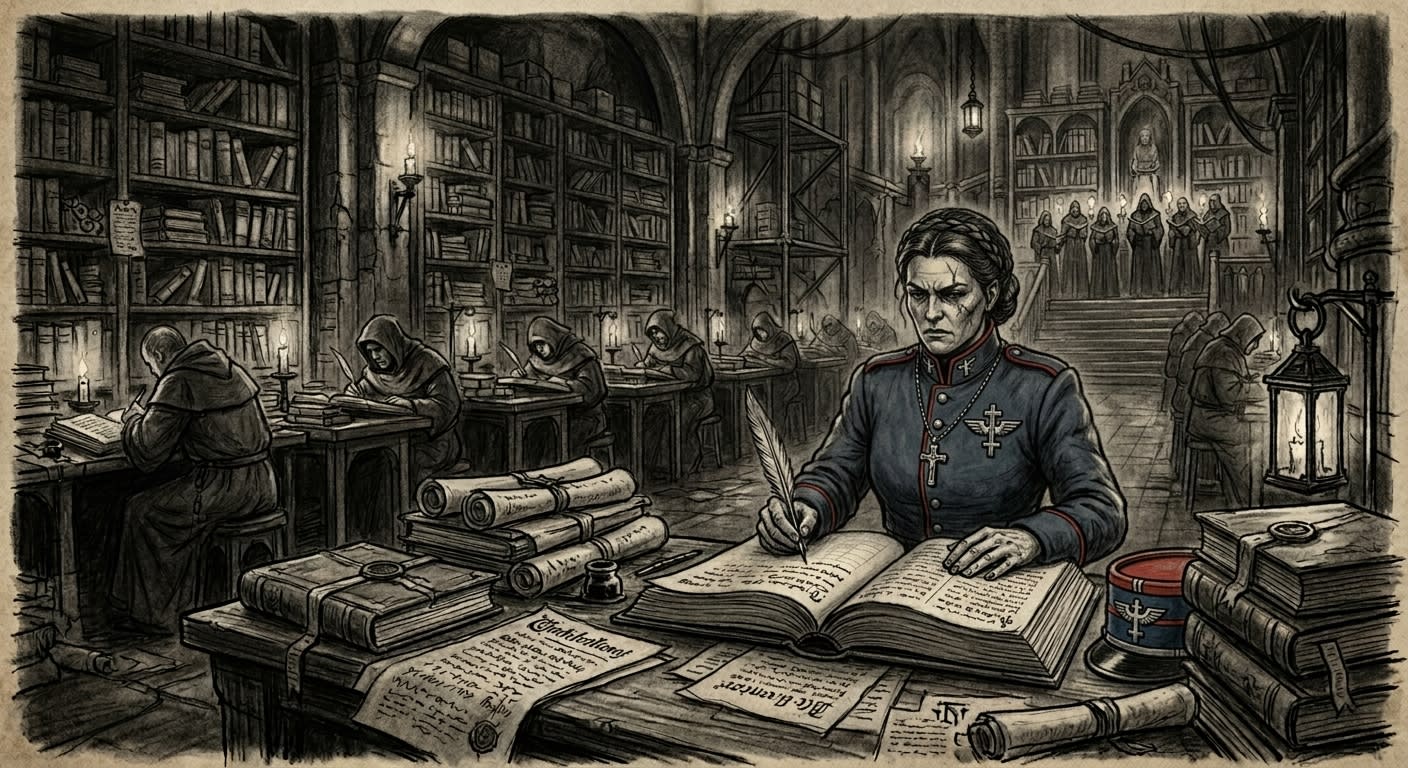
The Ledger Cloister occupies the fifth terrace: a paper labyrinth of Records offices and archive-houses where wax, old paper, and lamp-oil compose an atmosphere that is technically breathable and practically suffocating. People enter the Ledger Cloister to file a crossing receipt and emerge three days later with a confession penalty, a revised name, and a distinct impression that they have been processed in the industrial rather than the administrative sense. The Registry Choir — the Quill-Choir — chants the ledgers into order here, and their order is absolute, and their absolute is negotiable only at rates the Quill-Choir sets.
The Widowlight Quarter occupies the sixth terrace and the conscience of no one who administers it. Night-warehouses staffed by drafted widows — women whose husbands died on the Line and whose debt was inherited along with the grief. They work the lamp-oil shifts: sorting, packing, inventorying by the light of tallow lamps that the Widowlight Wardens distribute on quota. The oil-smoke smells like sorrow rendered into a commodity, which is precisely what it is. The Widowlight model was not invented in Rheinscarp, but Rheinscarp made it standard, and for this contribution to administrative science the Bureau of Mercy has issued no comment.
Above the Widowlight Quarter rises the Ash Exchange — the seventh terrace, where grief becomes currency in its most literal form. Saint-shares. Dust futures. Cremains vaults. The dead, in Rheinscarp, are not mourned; they are appraised. A broker of the Ash Exchange of Saint Pelagia can tell you to three decimal places what your grandmother's remains are worth on the open market, and he will smile while he does it, because smiling is how brokers in the Ash Exchange signal that the price is final. "Uncle" Damas Rohe runs this terrace with the patience of a man who knows that everyone, eventually, becomes his inventory.
The Cantor Foundries on the eighth terrace produce the hymn-timed industry that keeps Rheinscarp's economy synchronized: bell-hour purchases, cadence contracts, the mechanical marriage of prayer and production. The foundries smell of coal, metal, and ozone — the last being the scent of a bell struck at frequencies the Bureau of Bells has not approved but the Bureau of Tithes has not prohibited, which in Rheinscarp amounts to a license.
And at the summit, the High Step Precinct: tribunal halls, clergy housing, the Ration-Cathedral, and the offices of the three who actually govern this vertical tyranny. The air is clean up here. The view is commanding. The names in the Ledger are spelled correctly. Everything below is fog, flour dust, and the faint sound of someone failing a verse-check at a tollhouse window.
#On the Governance and Its Three Pillars
Three powers divide Rheinscarp between them, and the division is as follows: one controls the names, one controls the time, and one controls the dead. Between them, they own everything a living person requires — identity, hours, and the certainty that their ashes will be filed.
Praetor-Registrar Ysabeau Kelm holds the names. Bureau of Records, Rheinscarp annex. Her leverage is the ledger: she can spell you into existence, misspell you into ambiguity, or correct you into absence. Administrative dissolution — the procedure by which a name is overwritten with black grid lines, rendered "present but annihilated" — is her instrument of last resort, and her last resort arrives with suspicious frequency. The clerks of the Ledger Cloister answer to Kelm. The Registry Choir chants at her tempo. The Quill-Choir can erase a rival by "correcting" the spelling of his name, and if the corrected name does not match the name on his ration card, the ration card becomes a souvenir. Kelm smiles like a woman who has read your file and found it interesting. This is not a compliment.
Cantor-Marshal Hrodric Venn holds the time. Bell-hours and time-credits — the currency of Rheinscarp's daily survival — flow through his office. Miss your bell-credit window and your ration priority collapses. People die "on schedule" in Rheinscarp, and the schedule is Venn's. He controls the Cantor Foundries, the mill cadences, the convoy timing. The Mill-Crown Cantors answer to him. The bell-hour allotments that determine whether a family eats this week or next are his to grant and his to withhold. He is, by all accounts, a man of deep piety and shallow mercy — qualities the Bureau of War appreciates in a logistics officer.
Broker-Saintsman "Uncle" Damas Rohe holds the dead. The Ash Exchange of Saint Pelagia answers to Rohe, and the Ash Exchange holds the dust futures, the saint-shares, the cremains vaults that constitute Rheinscarp's peculiar financial architecture. To die in Rheinscarp is to become a commodity. Your ashes are appraised, assigned a market value, and traded on the Exchange floor. Rohe's leverage is the simplest of the three: everyone becomes his collateral. His fear is the vault slide — the day the vaults crack and the dust spills and the market discovers that some of the appraised cremains are not, in fact, cremains at all.
Earlier editions of this Codex described Rheinscarp's governance as a "tripartite balance." This language is withdrawn.
The Bureau of Doctrine clarifies that Rheinscarp's governance is a hierarchy, with the Synod Chapterhouse at its apex and the three operational pillars subordinate to holy authority. That the Chapterhouse has not issued an independent decree since A.S. 187 is not relevant to the question of its supremacy.
#On the Self-Writing Tollhouse and the Anomaly of the Quills
Rheinscarp's anomaly is administrative in character, which is appropriate for a city whose entire spiritual life is a filing exercise.
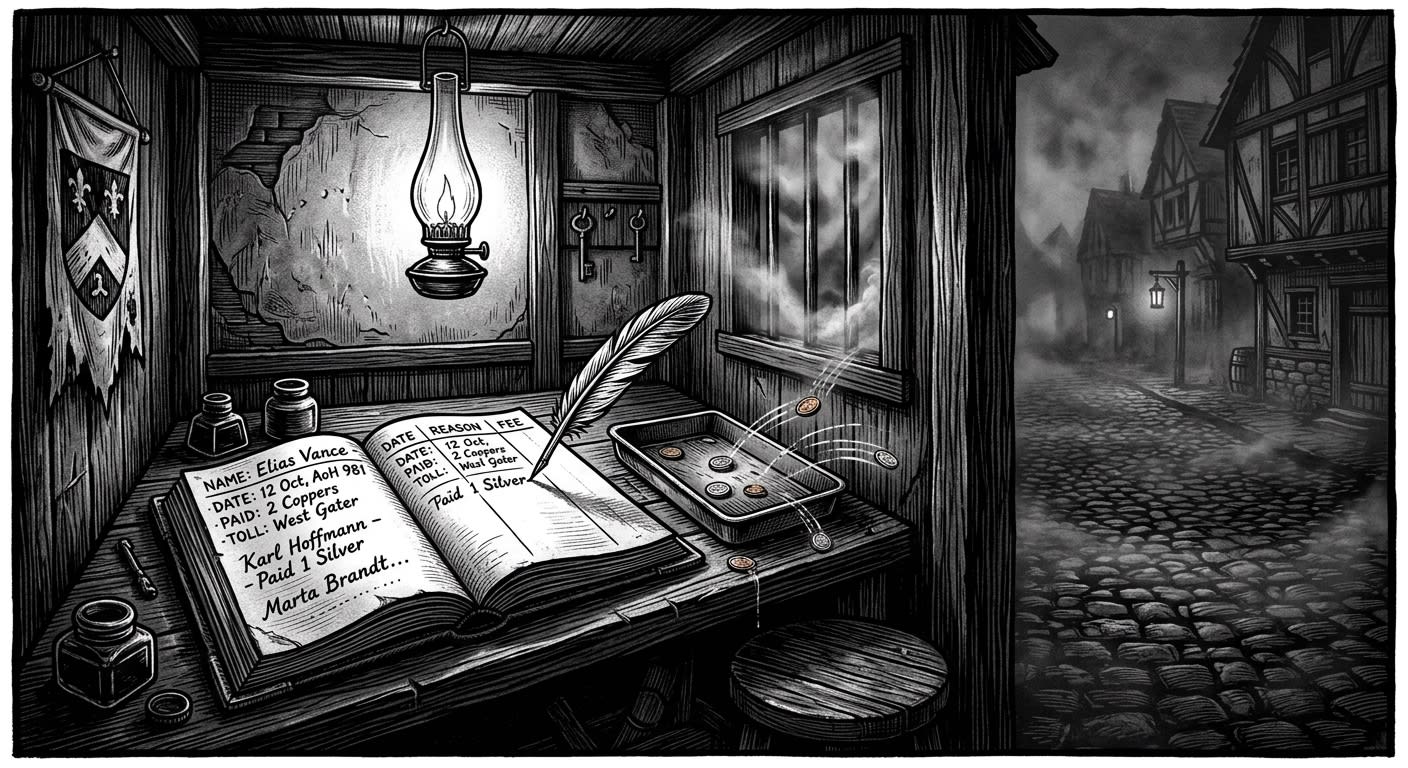
Certain tollhouse booths — three confirmed, an estimated nine more unconfirmed — produce perfect ledger entries during night shifts when no clerks are present. The quills move in empty booths. The ink appears. Coins vanish from the collection trays. Travelers are recorded as "processed" in the morning ledger even when no traveler crossed during the shift. The names written in these phantom entries are never lucky. Within a week of their appearance, the named individuals suffer misfortune: illness, accident, audit, or the particular Rheinscarp catastrophe of discovering that their ration card has been reassigned to someone who does not exist.
The phenomenon is not unique to Rheinscarp — self-writing instruments have been documented at bridge crossings along the Line, at the tollhouses of Latchford, and in the filing rooms of the Basilica of the Ledgered Saints in Strasbourg. What distinguishes Rheinscarp's variant is its regularity. The booths do not write in crisis. They write on schedule. They keep to the bell-hours. They observe the curfew. Whatever moves the quills has learned the city's rhythms and performs them with a fidelity that the living clerks, who occasionally misspell a name or accept a bribe, cannot match.
Countermeasures are salt lines, double-witness crossings, and burning the offending pages — the last of which frequently backfires, as the burned entries reappear in duplicate the following shift, corrected and countersigned.
The locals have a saying: "Don't cross while the fog climbs upward — your name slides off." The fog in Rheinscarp climbs the terraces at dawn like an occupying force, and the locals treat it as a census sweep. They are, in the Bureau's assessment, probably wrong. The Bureau's assessments, in the locals' experience, are probably incomplete.
#On the Present Condition and the Double-Entry Famine
"Variance" is the official word for "someone stole your food." — Common knowledge, Rheinscarp
The double-entry famine of A.S. 198 broke what remained of Rheinscarp's pretence to efficiency. Two terraces — the Mill-Crown and the Widowlight Quarter — both "received" the same grain shipment on paper. Both ledgers showed delivery. Both ledgers bore authentic stamps. Both terraces starved.
The Bureau of Records dispatched auditors. The auditors discovered that the stamps were genuine, the ledger entries were genuine, and the grain was genuine — it had simply been counted twice, allocated twice, and delivered once. The missing half existed only in the Ledger Cloister's files, where it occupied three pages of immaculate penmanship and no warehouse space whatsoever. Forty-one people died of a clerical event that the Bureau of Tithes reclassified, after review, as a "variance."
The death toll was initially reported as "within acceptable seasonal parameters."
The Bureau of Doctrine, upon review of the parish burial records, revises the classification to "administrative incident, non-recurring." The forty-one dead are noted in the Ledger. The variance that killed them is noted in a different ledger, under a different filing number, in a room that requires three stamps to enter.
The famine cracked open the buried truth of Rheinscarp's economy: the mills and the Bureau of Records share an absence quota. A percentage of the population — the Bureau will not specify the percentage; the street says one in forty — must be "corrected out" each quarter to balance rations on paper. The rations do not stretch to cover two hundred and forty thousand mouths. The paperwork does, provided some of those mouths are periodically reclassified as absent. The Tribunal benefits from the order this produces. The Bureau benefits from the control. The Ash Exchange benefits from the new collateral. The absent benefit from nothing, because to benefit requires a name, and their names have been misspelled into silence.
The present political crisis is a slow collision between the Bureau of Mercy's hunger-waiver advocates — clerics who argue, with increasing desperation, that starving people should eat regardless of their stamp status — and the Tribunal-Tithes axis, which argues, with increasing firmness, that toll sanctity is doctrinal and that doctrinal matters do not admit of hunger as a counterargument. The dust futures scandal of A.S. 199, in which the Ash Exchange was discovered to have been trading futures on the cremains of persons not yet dead, has complicated this debate without resolving it.
Rheinscarp endures. The fog climbs at dawn. The mills grind. The tollhouses stamp. The quills write in empty booths, and the names they write are never lucky, and the city goes upward, terrace by terrace, fee by fee, toward a summit that the High Step clergy occupy and the Sump Dock silt-dwellers will never reach, because the distance between the river and the sky is not measured in steps. It is measured in stamps. And stamps, in Rheinscarp, are the only sacrament that matters.