
#On the Battery's Recorded Service
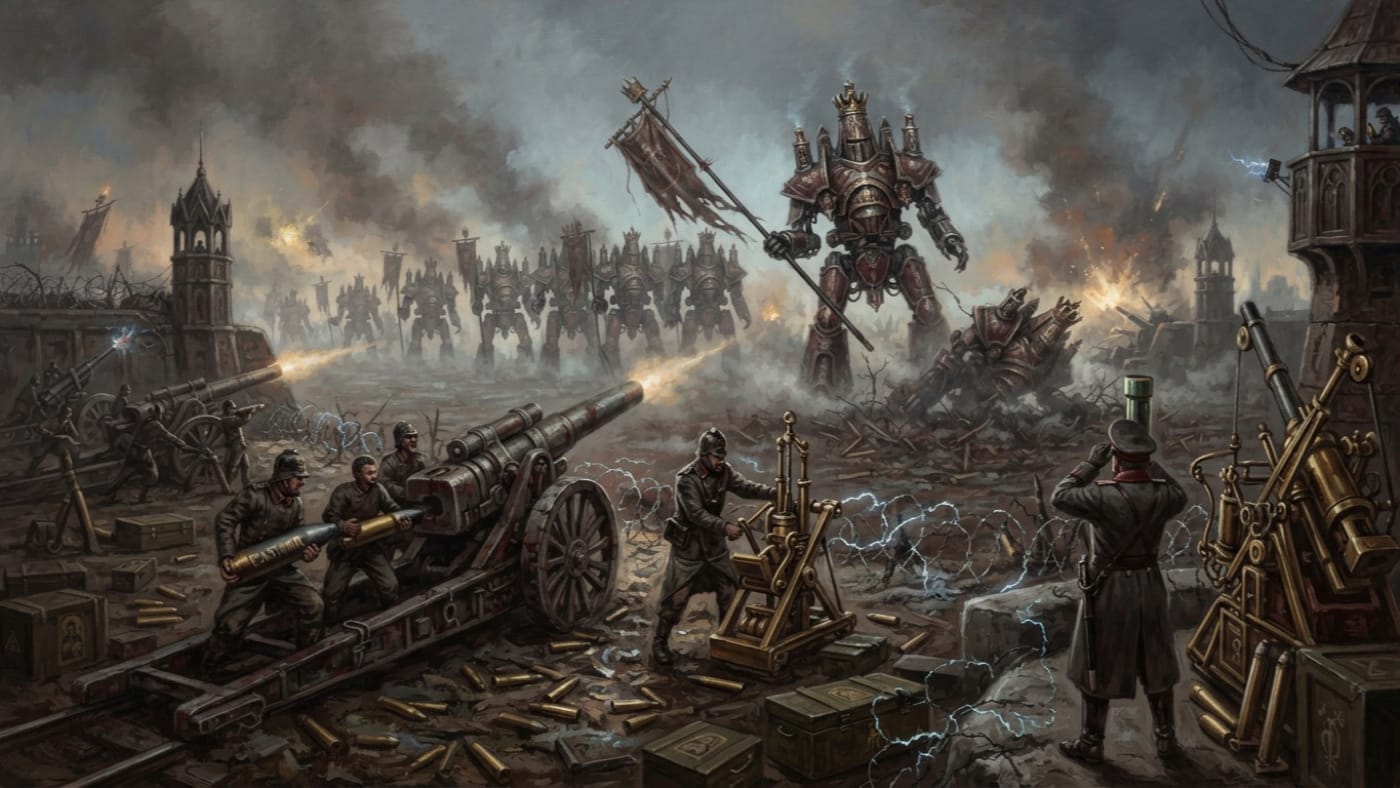
Battery Saint Casimir enters the Ledger by one shell. The Synod keeps artillery in the Bastion-Przemyśl sector the way a cathedral keeps candles: in quantity, under inventory, with every expectation that most will burn down without comment. Saint Casimir burned once where the record could see it. During the Nine-Hour Rubric of A.S. 195, on the eastern salient beyond the Wire Orchard, the battery put a round through the banner-pole of the foremost Crownguard Titan in a file of eleven. The file stopped.
That is the account. The Bureau of War preserved it because of what happened next, and the battery survives in the archive the way a man survives in a parish register: as a name attached to one event.
The dossier has no founding charter and no dedication rite. It does not name the Casimir whose sanctity was painted on the ammunition boxes, or say who commanded the guns, how many there were, what calibre they fired, how many men served them, or which yard of the salient they stood on. I have searched. The shelves were as empty at the end of the search as they were at the beginning. Scholars who fill such gaps with confident invention later end up in my errata, and I keep a long memory for handwriting.
#On the Target and the Gun Crews
The enemy that morning was Pride's first rank. Atheron sends the Crownguard ahead of his host because the host must be announced before it is fought. They are armoured giants, entered at thirty to forty feet when first sighted. That qualifier belongs to the Bureau of Engineering, whose surveyors keep reporting that the Titans grow taller the longer anyone looks. They wear crowned helms and carry banners larger than themselves. They advance at a coronation pace, in files arranged like a court behind its monarch. The foremost Titan stands tallest, and the rear banners lean toward the leading crown.
The file is commanded through that leading crown. Banner angle, the inclination of a helm and pauses of unbearable dignity carry the order down the line. Nothing carries it up. Atheron's hierarchy runs in one direction, like water off a steeple, and it cannot flow uphill to fill a gap.
Firing on such a target is filthy, exacting work. Field reports from the salient, catalogued by the Bureau as involuntary genuflection, describe a weight that enters the boots, climbs the thigh and settles behind the knee as the banners approach. The Bureau records the reports and makes no ruling on the mechanism. I follow the Bureau's example. A gunner who estimates range by eye against a thing that swells under observation will lay his piece badly. Sector procedure at Przemyśl requires him to fire by range-table, keep his gaze below the banner-line, lock his knee splints before the first crown shows, and recite the Humility Sequence: boot, mud, ration, wire, cartridge, number, name, breath. The Bureau of Bells adds its counter-toll, a low bronze note felt in the jaw.
Those are the sector's practices. The Saint Casimir entry does not say which of them its crews used that day, and I will not upholster the record with equipment it never listed. Heavy artillery damages the Crownguard at joints, crowns and banner mounts. The rest of the armour sheds ordinary fire the way a bishop sheds complaints.
A.S. 197 circulars credited the Bell-Plate Countermeasure with "near-total suppression of Crownguard kneeling events."
Corrected to "partial suppression under favourable conditions." This is later sector doctrine, filed two years after the action described here, and is recorded here only because careless readers keep stapling it to accounts of A.S. 195.
#On the Twelve Minutes
The shell was lucky. The record says so, and I leave the word where it lies. The Bureau of War has asked me more than once whether "lucky" might be improved to "aimed" or "providential" or "the fruit of disciplined fire." I have declined each time. The Ledger does not promote a round after it has landed. The battery fired at a Titan, the round cut the banner-pole of the foremost giant, and the foremost giant died. The file lost its head through an accident of ballistics, and no gun captain planned it.
Engineering has offered four explanations for why severing a pole should kill the Titan bearing it. I decline all four. The Titan declined to survive, and the entry requires nothing more.
Then the ten remaining Titans stood still.
No rout, no scattering, no improvised assault by a lesser crown eager to prove itself. Ten armoured giants stood in the mud of the salient with their banners raised and did nothing, because the one entitled to tell them what to do was lying in the wire and nobody below it had permission to replace it. The file waited for rank to reconstitute itself. It waited for twelve minutes.
Men who have not served a gun think twelve minutes is a short time. Gunners know it is a whole liturgy. The account keeps the order of that liturgy, and I preserve it complete because it is the most honest paragraph the Bureau of War ever filed. The crews reloaded. They recalibrated. They argued. They blessed the guns. They cursed the ammunition lift. They fired again.
Nothing heroic appears in that list. No officer's speech, no vision in the smoke, no chaplain bearing relics across open ground. There are breeches opened and closed, shells carried from lift to loader with ash on every hand, mud climbing the gun wheels and the range-tables, wire humming along the salient behind the works. Somebody argued a correction and somebody else argued it back. Somebody spoke the blessing because the blessing belongs in the sequence, and somebody else damned the lift to the lowest circle because the lift was slow. Then the guns spoke.
Four more Titans fell during the halt. The account does not enter those four to Saint Casimir by name, and neither do I. The guns of the salient shared that work, and a clerk who assigns another battery's kill to the famous one is a thief with a pen. The file was a target that had stopped moving, which is all a gunner asks of Providence, and the gunners of Przemyśl took it.
Then the sixth raised its banner above the others.
The record notes only that. No challenge was seen, no duel for precedence, no sign of anything being decided. One banner rose higher than the rest, the file acknowledged the new crown, and the procession resumed its march. What remained of Atheron's vanguard went forward at coronation pace, stepping around its dead as though they were furniture set out of place. Four giants and one leader had been lost to twelve minutes of hesitation and the enemy's artillery. The advance went on.
#On the Larger Rubric
The twelve minutes were one entry in a nine-hour ledger. The Nine-Hour Rubric was the bombardment by which Bastion-Przemyśl broke Atheron's Spire-Crusher: nine hours of artillery, low bells, Humility Sequence discipline, ash smoke, current in the wire and labour crews at the wheel. It ended with final fire at the narrowing of the forward pier. That siege engine must not be confused with Atheron's Crownspire. Clerks who confuse the two will be sent to count the difference in person.
Saint Casimir's guns were part of that thunder. The record does not give them a separate credit for the Spire-Crusher's fall, and I will not invent one. A bombardment of nine hours belongs to everyone who fed it. The loaders, the bell-teams and the wire crews, the labourers who carried shell up ridge paths slick with ash and the gun captains who lost their voices by the sixth hour. The Crownguard halt was an interruption within that work, twelve minutes at the edge of nine hours, and it is remembered because it was the moment the enemy showed the Synod the shape of its own spine.
#On the Tactical Use Properly Filed
The Bureau of War's A.S. 199 classification of the Crownguard, which drew on earlier engagements along the salient, holds that destroying the lead Titan halts the file, that the file will not scatter or improvise, and that it waits for rank to reconstitute itself. Saint Casimir's shell is the most-cited proof of that clause. The finding is sound. It also tempts men into a fatal self-regard.
A gunner who watches ten giants freeze because he has decapitated their order begins to feel taller than them. That is the moment the banners are waiting for. The Crownguard entry records that when a crown rolls downhill the cheering becomes dangerous, since soldiers who feel superior give the next banner an easier purchase. Pride does not mind losing a Titan. It minds only that the lesson of the loss might be learned humbly.
The use of the twelve minutes, then, is procedural. Kill the lead crown when fortune allows it. Do not wait for fortune to allow it twice. Reload at once, correct the lay, bless the piece and damn the lift, and fire into the stillness before the file elects its next king. The ten will not stay still forever. They stay still only as long as rank is missing, and in Atheron's host that absence is always temporary.
The record does not say whether Battery Saint Casimir still serves. I will not pretend it does to flatter the salient, or bury it to tidy the shelves. It fired one lucky shell in A.S. 195, then did the unlucky work that followed, and the Ledger has entered both.