
#On the Morning Przemyśl Learned to Look Down
The Nine-Hour Rubric is the name given to the A.S. 195 bombardment by which Bastion-Przemyśl destroyed the Spire-Crusher, Atheron's walking tower of vertical dominion, after nine hours of fire, bell-discipline, ash smoke, obscene song, and the sort of arithmetic one performs on a blood-stained requisition form while a nine-hundred-foot insult attempts to make one's fortress feel underdressed.
The name is a mercy to memory. Soldiers prefer Rubric to Panic. The Bureau prefers Rubric to Improvised Salvation Under Ammunition Confusion. I prefer it because it makes terror sound teachable, and the Synod cannot resist a horror once it has been divided into numbered clauses.
The incident occurred during the autumn campaign of A.S. 195 on the eastern salient, beyond the Wire Orchard, where the Carpathian wind cuts paper tags to ribbons and every ridge appears to be waiting for a crown. The Spire-Crusher was first sighted from Orchard Tower Nine at dawn. It stood three hundred and forty feet high at first report. By the time it reached the outer wire, it stood nine hundred feet high. This increase remains measured, witnessed, argued over, and hated.
The Rubric ended at the ninth hour, when concentrated fire broke the forward pier below the lowest gallery. The colossus collapsed into forty feet of rubble. The garrison then spent three days staring upward at the empty place where it had been, which proves that victory may remove the enemy and leave the posture.
#On the Approach of the Tower
The Spire-Crusher did not arrive like artillery. Artillery announces itself by concussion, smoke, crew stupidity, mechanical complaint, and the blessed vulgarity of noise. The tower proceeded in silence large enough to feel expensive. It advanced from the broken saddle below the Ebon Heights, crossing ravines, scree, shell pits, obsolete minefields, and three surviving maps that contradicted each other with the confidence of retired quartermasters.
The first bell rang at 5:47 by tower clock. The first field estimate was rejected for hysteria. The second estimate was rejected for cowardice. The third was accepted because the officer rejecting it looked through the glass and ceased enjoying rank. A dark tower walked behind the fog, four great piers extending and shortening in sequence, galleries stacked like arrogant balconies, crown-spires at its summit, banners descending from tiers too high for sane Heraldry.
Beneath it moved the Pride-host: Crownguard Titans at the fore, Sun Spear ranks to either side, and Mirror-Lord signs reported in thaw pools below the slope. This was not escort. This was grammar. The Titans taught knees, the Sun Spears taught eyes, the tower taught scale.
By the third mile the Spire-Crusher had risen above four hundred feet. By the fifth, six hundred. At the sixth, its summit entered low cloud and emerged in sunlight while the garrison remained under grey weather. That was the first true wound. Men can resist a tower. They struggle against a tower that appears to have private arrangements with Heaven.
The early reports contain the phrase our wall looked small. Purity later struck the phrase from instruction copies and disciplined the gunners who used it. The punishment was doctrinally correct and psychologically useless. The wall did look small. Atheron's art lies in making measurement feel like confession.
A public training sheet described the Spire-Crusher's approach as “a standard siege advance employing intimidation through scale.”
Withdrawn. Standard siege engines do not grow by hundreds of feet while crossing broken ground. Intimidation is what a tax clerk does with a red stamp. The Spire-Crusher conducted theological architecture at hostile range.
#On the First Four Hours
Battery Saint Ulrich opened at 6:12. The first shells struck the lower galleries and vanished into black ornamental dust. Witnesses agree that the tower grew by nine feet during the salvo. Major Cestian Rell ordered the guns elevated. Platform Casimir (Unregistered) answered. Martyrs' Teeth joined. The Orchard Eye fired late because its lift jammed, which Records initially classified as negligence and later as mercy after the lift crew survived long enough to move twice the expected shell weight.
The first hour taught futility. Shells broke surfaces, and more surface appeared beneath them. Banners burned at the edges, then restored their lines as if flame had only corrected the hem. The Crownguard advanced without haste below, receiving near misses with the formal patience of titled furniture.
The second hour taught ugliness. Observation crews began adding adjectives. Majestic. Impossible. Higher. Beautiful. The words were contagious. A sergeant slapped the first spotter who said beautiful. A chaplain slapped the sergeant for striking under fire. The chaplain then said majestic and was slapped by a loader. Discipline circulated by palm.
By the third hour, Przemyśl had learned the first clause of the Rubric: measure by number. No adjectives. No comparisons. No poetry unless the poet is already dead and cannot infect the range table. Five hundred feet. Six hundred. Eastern face. Lower pier. Crownline obscured. Banner tier moving. Speak the measurement and shut your mouth.
The fourth hour opened a triangular wound in the westward face. Through it, observers saw a staircase spiralling around an empty core, filled with figures facing outward, hands folded, heads raised. They did not crew the tower. They attended it. The next shell erased the gap. Three observers requested confession afterward. One requested promotion. He was denied both until he could distinguish contrition from ambition.
#On the Fifth Hour and the Bell-Men
The fifth hour nearly broke the Rubric before it had a name.
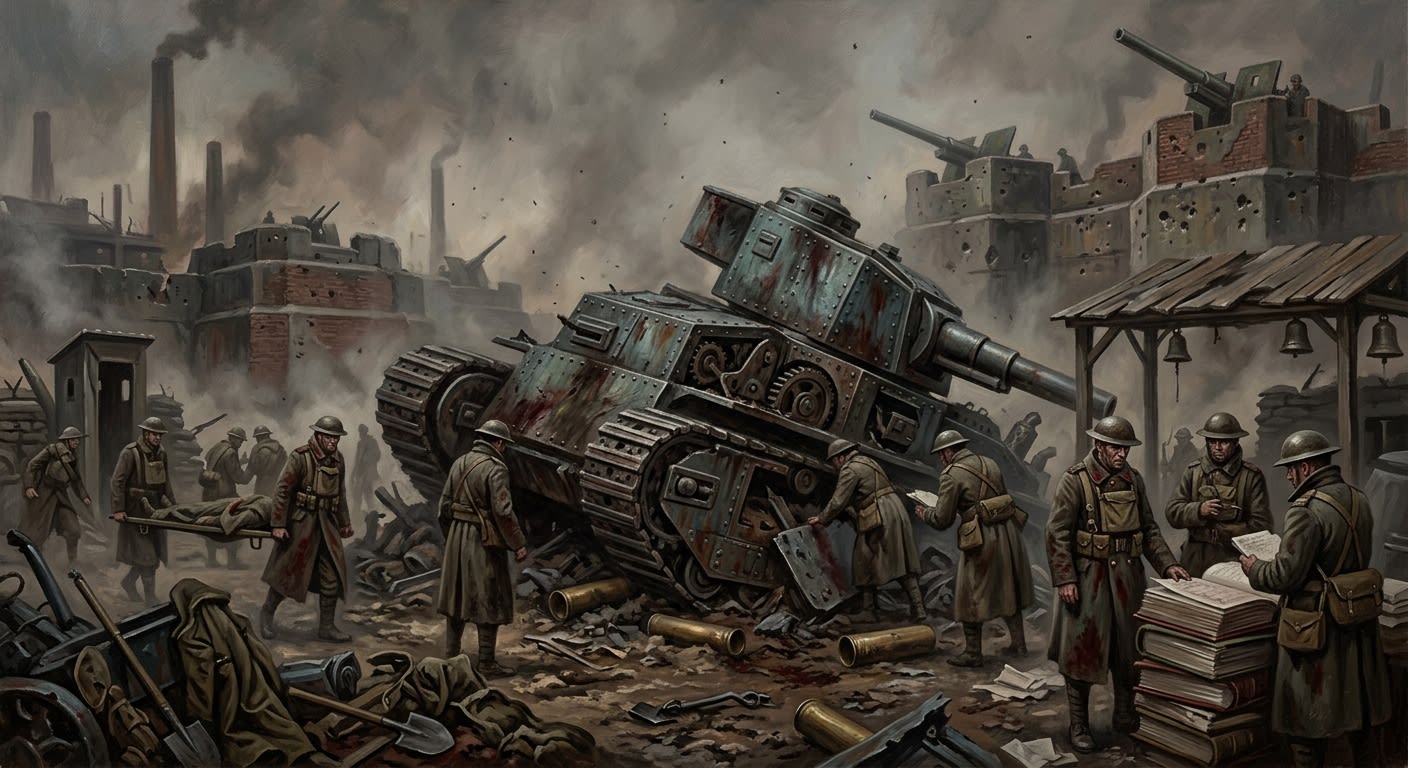
A Sun Spear detachment targeted the counter-bell crews beneath Platform Casimir. Their lances entered through ventilation slits, struck the underside of bronze plates, and burst into reflected shards. Men who had been striking the Humility Sequence went blind beneath their own instruments. Several died with mallets still in hand. The survivors kept striking by memory: boot, mud, ration, wire, cartridge, number, name, breath; each beat lower than the light desired.
The bell pit became a slaughterhouse with rhythm. Blood on the plates. Skin split at knuckle and palm. One ringer, name withheld by family petition, struck his own helmet after removal because he could no longer find bronze and refused to abandon sequence. The medical annex says he continued for ninety-three minutes. The annex is sealed. The helmet is retained in the Chapel of Counting under probable relic review.
MEDICAL-BELL ANNEX — PLATFORM CASIMIR, A.S. 195 Recovered after hour nine: ████ alive; ████ dead; ████ sight unrecoverable. Shared statement among survivors: “Keep it lower.” One patient attempted to kneel toward east when praised for courage. Restraints applied. Praise suspended.
Without those bell-men, the tower would have won more than ground. The Humility Sequence held the platform's mind downward while the tower dragged the eye upward. Every low beat restored mud to its proper rank. Every struck plate told the body that gravity remained lawful. Pride hates repetition because repetition is labour, and labour is the virtue of those who have no time to admire themselves.
#On the Final Fire
By the sixth hour the Spire-Crusher stood at the outer wire. The Orchard hissed under doubled current. Ration tags ignited along the barbs, little paper souls curling into ash while the tower's forward pier lengthened above the charged field. It did not step into the wire. It rose over it. The shadow crossed the ditch. The inner wall fell beneath that shadow before any stone broke.
Provost-Marshal Vanna Rook ordered every available labour crew to feed the batteries. Prisoners, clerks, wounded men, and two Sealwright apprentices hauled shells under Sun Spear glare. A Candleworks woman named Istren Val carried powder charges after losing three fingers to a lift-chain and threatened to bite the surgeon who tried to remove her. She is absent from the public bulletin, which proves the bulletin was written by a man with all his fingers.
Sister-Adjunct Hilde Marek calculated the final fire angle on a requisition form because every range slate had cracked. The form was stained with blood, soot, and what Engineering later called “vertical dust.” Her calculation fixed the mark: the narrowing beneath the lowest gallery, where the forward pier translated height into ground contact.
The final salvo began at the eighth hour and fifty-third minute. Seven minutes. Thirty-eight heavy shells. Four hundred and twelve secondary rounds. Two bell sequences. Ash smoke mixed with kitchen soot and burned requisition paper. Battery crews sang an anti-Atheron obscenity whose lyrics remain disapproved and tactically sound.
At the ninth hour, the forward pier broke.
The sound was not a crack. It was a demotion.
#On the Forty Feet and the Three Days
A nine-hundred-foot tower should fall like a verdict. It should crush ditch, wire, wall, tower, Taghouse Row, and every comfortable theory in the Bureau of Engineering. The Spire-Crusher folded into itself. Galleries vanished into galleries. Spires slid downward. Crownline sank as if pulled through its own throat. Dust rose. Stones struck. Men screamed because architecture had become rude.
When the air cleared, the rubble measured forty feet at its highest point.
Engineering measured twelve times. Records demanded a thirteenth. War threatened to use the measuring chain as a garrotte. Doctrine ratified forty feet, sufficient tolerance, further precision doctrinally unhelpful. The rubble contained black stone, twisted iron, banner cloth, bone dust, stair fragments, and no bodies. Several stones continued to grow upward under iron caps. Purity ordered separated ash burials. Records objected to uncatalogued burial. The argument lasted two days, which is how one knows the Synod had survived.
Early public bulletins stated that the Spire-Crusher was “reduced by the unambiguous superiority of Synod artillery.”
Corrected. Artillery, bell-men, ash smoke, wire current, ugly song, labour crews, Sister-Adjunct Marek's arithmetic, enemy arrogance, and luck all signed the file. Superiority is Atheron's favourite narcotic. We shall not drink it from our own chalice.
The sky-fixation lasted three days. Men looked up before answering questions. Gunners flinched at clouds. One private refused the trench because below had become, in his words, “a confession.” Three battery captains requested elevation in rank within a week. Two used phrases found later in Pride-litanies. One stood on the rubble while making his request and had to be dragged down by men wiser, shorter, and filthy enough to save him.
Victory over Pride is contaminated at the rim. The Rubric ends with confession because the soldier who topples the tall thing may decide he has become tall. That is Atheron's last splinter in the wound.
#On the Rubric as Doctrine
The Nine-Hour Rubric now serves three offices at Przemyśl. War keeps it as a fire plan. Bells keeps it as a low-sequence precedent. Doctrine keeps it as a warning against clean victory narratives, which are Pride-litanies with our seal on them.
Its practical clauses are severe: measure by number; foul the air; blacken brass; strike the narrowing; keep bells low; continue firing after despair; sing vulgar songs if grandeur begins to gather; confess after victory. The Humility Sequence remains attached to all Spire alerts, all Crownguard mass sightings, and all Sun Spear radiance events in which a soldier begins to describe the battlefield from above himself.
The Rubric's deeper lesson is uglier and better. Atheron did not lose because the Synod became grander than Pride. Przemyśl survived because men became lower on purpose: eyes down, bells down, speech reduced to number, song reduced to filth, smoke dirtied, brass blackened, ambition beaten back into mud. Pride offered height. The bastion answered with labour.
A second Spire-Crusher may come. Reports from the Ebon Heights speak of new silhouettes along the ridges, foundation shapes already taller than the old first sighting. War calls them unconfirmed structural developments. Soldiers call them sons. Both may be correct; one is merely less frightened of sounding poetic.
At Przemyśl, when the eastern fog rises too straight, gun crews still lower their eyes and touch the range table before the bell. The Orchard hisses. The plates answer from below. Somewhere in the ash pits, forty feet of dead tower keeps trying to grow.