
#On Their Station in the Exalted Host
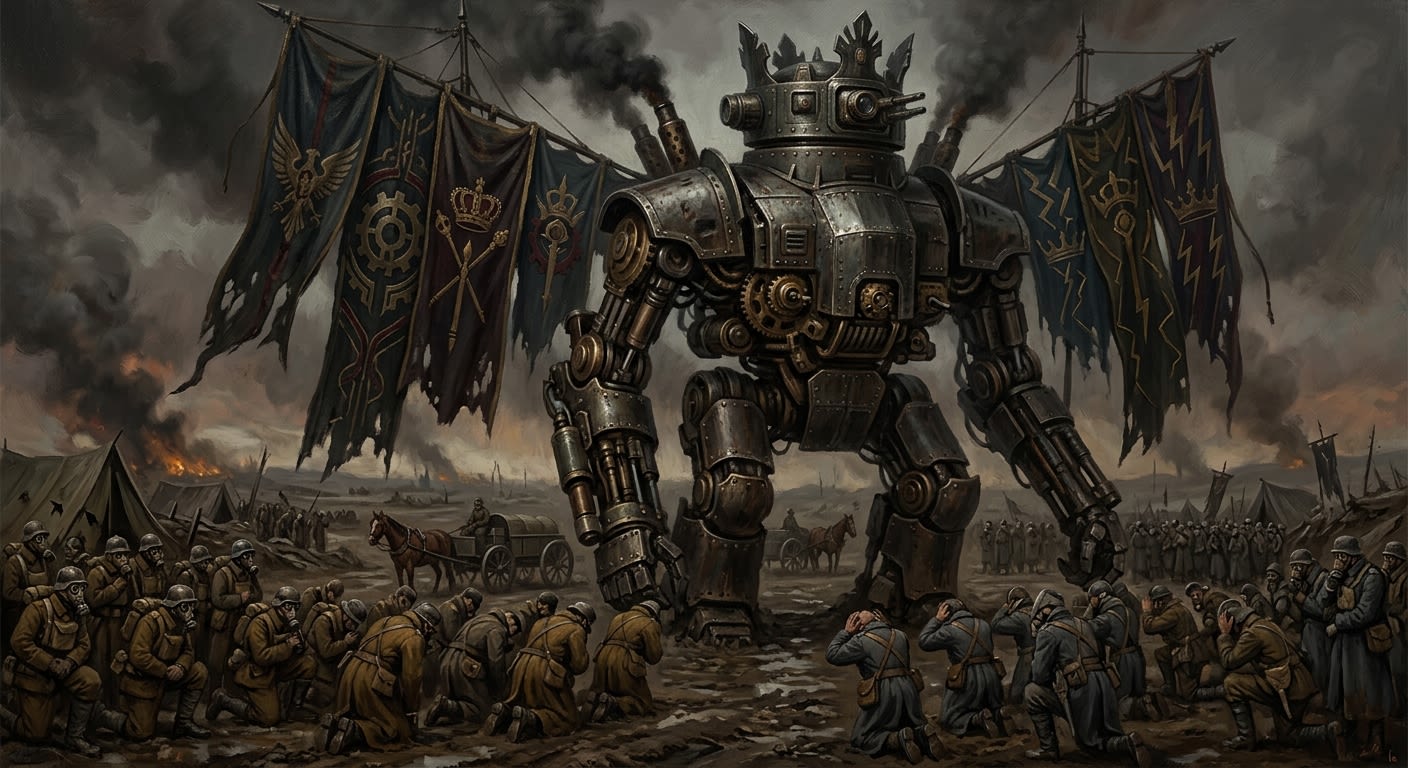
The Crownguard Titans are the vanguard of Atheron the Exalted, which is to say they are the first insult a fortress receives before Pride condescends to send artillery. They do not scout. They do not skirmish. They do not perform that nervous little military ritual by which lesser armies test wire, ditch, gun, and morale before committing themselves to slaughter. The Titans appear at the head of the host already convinced that the conclusion has occurred and that only the ceremony remains.
They are armoured giants bearing banners taller than the formations they lead. Their march is calibrated to a coronation pace: slow enough to be seen, loud enough to be counted, stately enough to imply that the defenders are spectators at their own dethronement. Each step is a proclamation. Each banner is a writ. Each helmet, crown-crested and sealed in violet-black enamel, presents no face, because faces are for persons, and Atheron's first rank has ascended beyond the vulgar obligation to be recognisable.
Their role is doctrinal before it is tactical. A Wrath engine breaks a gate by force. A Gluttony mass breaks a garrison by appetite. A Crownguard Titan approaches until the gate begins to feel small. Pride's vanguard exists to make resistance seem socially improper — a breach of etiquette in the presence of majesty, a peasant's interruption during investiture, a muddy corporal speaking while the crown descends.
This is why they stand before the Sun-Spear Legion, before the Mirror-Lords, before the Ascendant Shades and their reflected knives. The Titans announce the rank of the army. Other servants of Atheron blind, distort, murder, and infiltrate. The Crownguard remind the world which posture it is expected to assume before those refinements begin.
The Bureau has attempted to classify them as demons, war-constructs, exalted mortal kings, and ambulatory heraldic devices. All four classifications have supporting evidence. All four produce unacceptable implications. The present term, Titan, was chosen because it sounds ancient, large, and safely imprecise. The Bureau adores precision until precision asks for courage.
#On Their Form and Ornament
A Crownguard Titan averages thirty to forty feet in height when first sighted. The phrase when first sighted is not ornamental. Reports from the Przemyśl eastern salient suggest that Titans appear taller the longer they remain under observation. The Bureau of Engineering attributes this to distance error, fog shear, stress distortion, and the regrettable unreliability of soldiers who are being compelled by hostile banners to kneel while measuring hostile banners. These explanations have the merit of protecting Engineering from metaphysics.
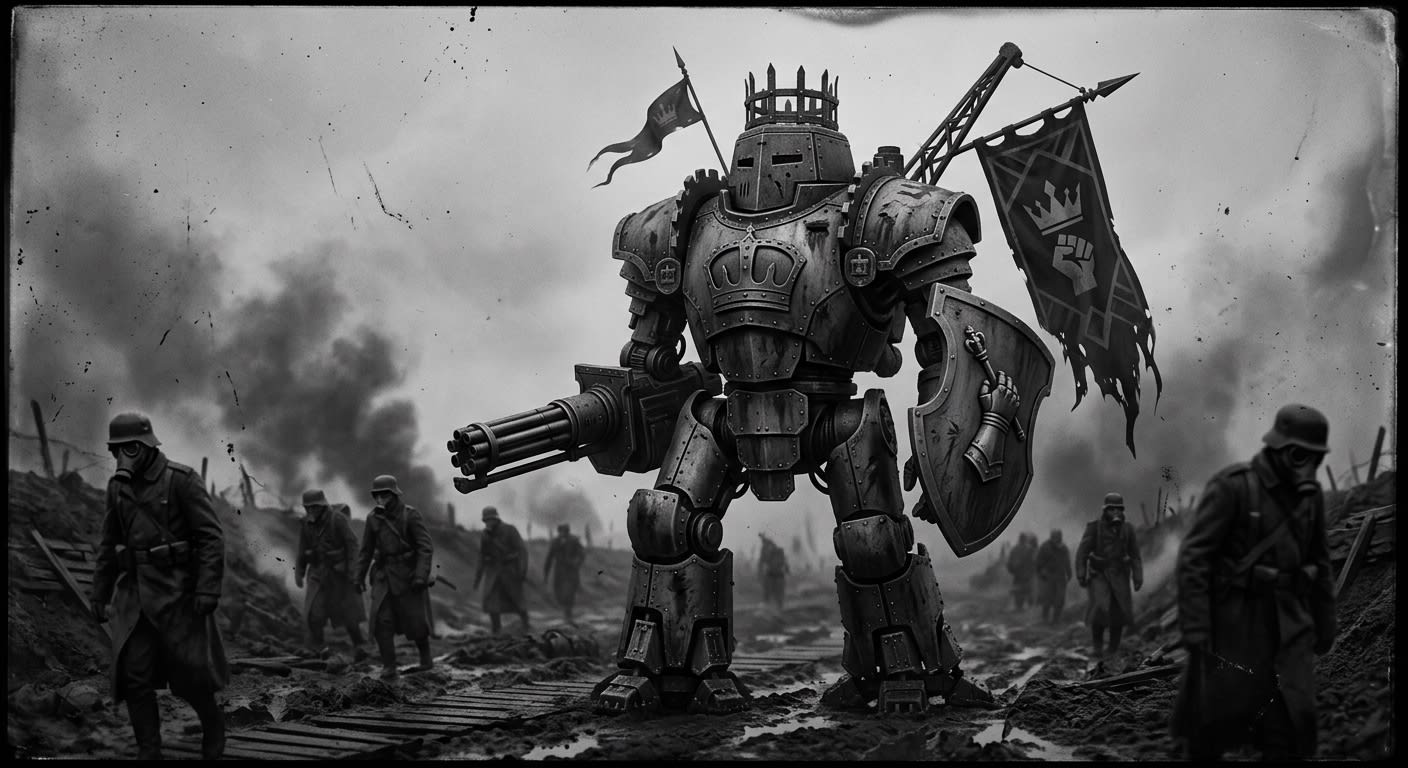
The armour is the body, or the body has been made indistinguishable from the armour. Plates of blackened gold, violet steel, and white enamel overlap in ranks like noble titles on an overdecorated seal. No gap shows flesh. No joint bends more than ceremony requires. Their knees can bend, because kneeling must exist in their theological universe, but the bend is reserved for no one presently living, dead, divine, or infernal except Atheron himself, and even that exception is recorded only in speculative Bureau of Inter-Infernal Analysis memoranda held under Dossier Vermillion.
Their helms are crowned, each crown different, each crown excessive. Some bear seven tines, some nineteen, some a forest of thin spears rising from the brow until the head resembles a portable throne-room chandelier. The crowns are not decoration. They are rank organs. Damaged crowns produce erratic behaviour: a Titan with three tines shot away at the Wire Orchard in A.S. 193 halted for eleven minutes, turned upon the lesser Pride-entities behind it, and crushed nine of them into paste before resuming the march. Its banner never dipped.
The banner is larger than the Titan. That is the first absurdity and the first truth. A pole of black metal rises from the backplate or is gripped in one gauntlet, depending on rank, and from it hangs a vertical field of gold-white cloth that does not tear in wind, burn under artillery sparks, or stain when men detonate beneath it. No insignia is stable. Witnesses report crowns, spires, eyes, stairways, the viewer's own superior officer, Atheron's Crownspire, and blank radiance too proud to take shape. The banner shows the hierarchy the victim already fears.
The cloth produces sound: a low formal hush, like a thousand courtiers drawing breath before one king speaks. It neither flaps nor snaps. At close range that hush acquires syllables. The Bureau of Orison and Song has transcribed six partial phrases. Five translate as titles. The sixth is a command in no known grammar, but every survivor who heard it lowered his head.
Early Przemyśl field cards advised troops to fire at the Titan's exposed flesh between armour plates.
This advice has been withdrawn. There is no exposed flesh. There may be no flesh. Soldiers are instructed to aim at joints, crown-tines, banner-poles, and any officer giving confident advice from an observation slit without sharing the slit.
#On the March and Its Genuflection
The Crownguard march in files of seven, eleven, or thirteen, never in fours, never in pairs, never in any arrangement that implies companionship. The formation is hierarchical down to the angle of the shoulders. The foremost Titan stands taller by inches or by belief. The second rank follows half a pace lower. The rear ranks carry banners inclined toward the leading crown, as if the entire vanguard were a court walking behind its monarch.
They do not charge. Charging would confess need. They advance at a pace the Bureau of War has timed between fifty-two and fifty-six steps per minute, depending on terrain, shelling, and the number of human witnesses available to make the pace meaningful. The coronation rhythm is the weapon's fuse. Too fast, and defenders perceive attack. Too slow, and defenders perceive vulnerability. At the approved pace, men perceive inevitability.
The first symptoms appear in the feet. Soldiers report heaviness in the boots, then pressure in the thighs, then a warm ache behind the knees. Chaplains call it temptation. Surgeons call it motor compulsion. Veterans call it the bow. The body begins negotiating with the soul: one knee only, only for balance, only for a moment, only to steady the rifle. Then both knees touch mud, stone, duckboard, or chapel tile. The soldier remains conscious. He may still aim. He may still pray. He simply cannot rise while the banner passes.
At Bastion-Przemyśl the garrison has developed knee-bracing splints, hooked into the back of the greaves and locked before dawn watch whenever Crownguard banners are expected. The splints work until the hips begin to fold. After A.S. 195, the Bureau of Engineering issued upright harnesses bolted to gun-platforms. Three crews survived direct genuflection exposure because their harnesses held. Two suffered cracked femurs. One continued firing while weeping apologies to the Titan he was shelling. His battery struck the banner-pole. He was decorated, sedated, and later found trying to return the medal because he had become convinced the Titan had permitted the hit.
The banner's influence is strongest when seen clearly, but blindness is no perfect defence. The hush enters through the ribs. The step enters through the ground. Men in dugouts below the firing line have knelt without visual contact, their knees striking plank in unison as the formation passed overhead. The Bureau of Bells recommends counter-tolling with broken fifths and humility cadences; Orison and Song recommends shouted psalms in overlapping tempos; Purity recommends immediate execution of anyone who kneels voluntarily. The difficulty, as the field reports note with rare tact, lies in determining voluntariness while everyone nearby is also on the floor.
The Titans ignore kneeling troops unless obstructed. This is their most efficient cruelty. A butcher who kills a kneeling man grants him importance as a victim. A Crownguard steps over him. It has received the submission it came to collect.
#On Their Conduct in Battle
When forced into combat, the Crownguard Titans are less elegant and more dangerous, like bishops at budget hearings. Their weapons vary: coronation maces, tower-blades, banner-poles with spearheads the size of chapel doors, gauntlets that crush gun-shields inward as if correcting poor posture. They strike downward almost exclusively. The geometry matters. A lateral blow treats the target as occupying a shared plane. A downward blow confirms rank.
Their armour resists ordinary rifle fire and most field shells. Heavy artillery damages them when concentrated on joints, crowns, and banner mounts. Relic-shot produces inconsistent results. One A.S. 188 report records a consecrated shell striking a breastplate and ricocheting upward, where it detonated among the Titan's own crown-tines; the Titan fell backward for the first and only time in the observer's career. The observer underlined backward six times. Przemyśl gunners now aim to make Titans fall in any direction except forward, since forward-falling Titans have crushed entire wire sections flat enough for lesser Pride infantry to pass.
Their command behaviour follows Atheron's brittle hierarchy. A crowned lead Titan directs the file through banner angle, head inclination, and pauses of intolerable dignity. Destroy the lead Titan, and the file halts. It does not scatter. It does not improvise. It waits for rank to reconstitute itself. During the Nine-Hour Rubric of A.S. 195, Battery Saint Casimir killed the foremost Titan in a formation of eleven by severing its banner-pole with a lucky shell. The remaining ten stood motionless for twelve minutes while artillery crews reloaded, recalibrated, argued, blessed the guns, cursed the ammunition lift, and fired again. Four more Titans fell before the sixth raised its banner above the others and resumed the march.
Close contact induces title-confusion. Soldiers fighting within twenty paces begin adding honorifics to enemy reports: the Rightful Advance, His Approaching Eminence, the Ninth Bannered Correction. Clerks transcribing these reports are required to strike the titles and wash their hands. One clerk failed to strike them in A.S. 190; within a week he had begun addressing the shell crates as lesser reliquaries and demanding they be stacked by nobility of calibre. He recovered after three months in a humility ward and now works in Candleworks Quarter, where wax at least accepts reshaping.
The Titans do not pursue routed enemies far. Pursuit implies concern. They continue toward the objective, stepping over the broken and the bowed. If the enemy flees, the enemy has acknowledged inferiority. If the enemy remains kneeling, the enemy has acknowledged inferiority more neatly. If the enemy stands, the Titan strikes.
After the Banner Contact of A.S. ███, Orchard harvest teams recovered ███ soldiers still kneeling in the outer wire, alive, uninjured, and unable to answer except with the phrase, "He passed above me." Three were returned to duty after correction. ██ were transferred to the Chapel of Counting. The remaining █ were found at dawn facing east, knees fused to the duckboards by a substance resembling cooled gold.
#On Countermeasures and Humiliations
The first defence against a Crownguard Titan is procedure before courage. Courage is a splendid way to kneel dramatically. The first defence is procedure: range-tables, blind angles, locked joints, counter-tolls, prewritten fire commands, and officers selected for the rare military virtue of being too tired to feel majestic.
The Humility Sequence used at Przemyśl is intentionally banal. It lists inventory: boot, mud, ration, wire, cartridge, number, name, breath. The soldier repeats it until the banner passes. Grand theology failed in early trials because grand theology shares too much vocabulary with Pride. Men reciting Thrones, Dominions, Crowns, and Heights tended to lift their chins by the second verse. Men reciting boot, mud, ration stayed uglier and survived.
The Bureau of Bells' counter-toll is struck from low bronze plates mounted beneath the gun-platforms. The sound is felt in the jaw more than heard in the ear, a downward pressure designed to remind the body of gravity. It has reduced genuflection incidents by thirty-one percent in clear weather, twelve percent in fog, and negative four percent during one regrettable A.S. 197 trial when the bell-team used polished ceremonial hammers and became so pleased with their own discipline that the entire crew knelt before the third stroke.
A.S. 197 circulars credited the Bell-Plate Countermeasure with "near-total suppression of Crownguard kneeling events."
The phrase has been corrected to "partial suppression under favourable conditions." The bell-team responsible for the phrase was commended for optimism, fined for pride, and reassigned to calibration work where adjectives are less available.
Visual degradation helps. Smoke, ash-fog, wire screens, hanging ration-tags, and deliberately ugly banners raised by the Synod's own Heraldry detachments all reduce the Crownguard's splendour. The most effective field expedient remains the Przemyśl Rag Standard (Unregistered): a pole bearing stained laundry, broken bootlaces, rejected requisition forms, and a dead rat if one is available. Held between the gun crew and the Titan, the Rag Standard denies the eye a clean line to majesty. It also offends every trained herald within four miles, which the garrison regards as proof of virtue.
Killing a Crownguard Titan is less important than making it fall badly. A fallen Titan that collapses onto one knee can become a devotional hazard; the corpse appears to be kneeling by choice, and nearby troops have been known to imitate it. A Titan toppled face-first into mud produces better morale. A Titan whose banner burns produces excellent morale. A Titan whose crown breaks and rolls downhill produces dangerous morale, since soldiers may cheer too loudly and begin to feel superior, at which point the next banner finds easier purchase.
The Synod's victories against them are always temporary. Atheron's host manufactures rank as naturally as Velmora manufactures debt and Syrion manufactures delay. For every Titan shattered in the wire, another appears behind it, taller in report, cleaner in line, bearing a banner whose cloth remembers the last defeat and has already revised it into ceremony.
#On the Lesson Properly Filed
The Crownguard Titans are ridiculous. This must be said because fear makes men stupid and grandeur makes clerks poetic. They are over-tall, over-crowned, over-armoured, over-bannered absurdities marching at funeral pace through artillery fire because their master cannot imagine arrival without pageantry. A sensible universe would trip them on the first ridge.
We do not inhabit a sensible universe. We inhabit a filed one, which is worse.
Their absurdity is the instrument. Men laugh at height until height looks down. Men mock banners until the cloth fills the sky. Men swear they will never kneel until the command enters the tendon before it enters the mind. Pride does not need to persuade the intellect when it can instruct the joint.
I have reviewed the reports, the measurements, the corrective hymns, the casualty tables, the sketches made by men who later refused chairs because sitting placed them too near the ground. The Crownguard Titans are Atheron's sermon in iron: that rank precedes truth, that height creates worth, that the lower thing exists to acknowledge the higher.
A shell through the banner-pole remains the best rebuttal.