
#On the Orchard That Bears Paper Fruit
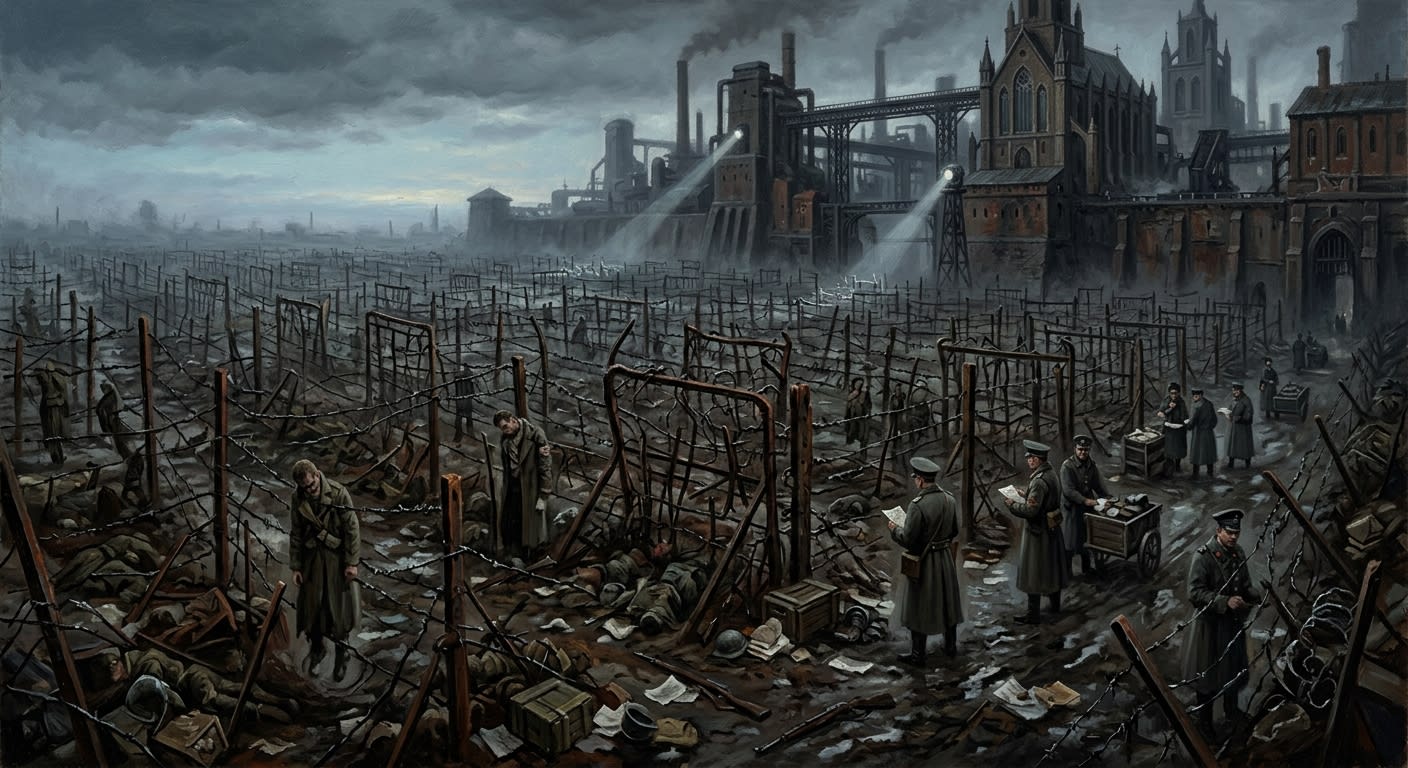
The Wire Orchard is the outer killing, sorting, listening, remembering, and humiliating apparatus of Bastion-Przemyśl, though the Bureau of Engineering prefers the phrase “three-mile forward denial grid” because engineers, having been denied poetry by temperament and training, often avenge themselves upon nouns. The soldiers call it the Orchard because at distance its posts look like dead trunks and its barbs look like winter branches. The refugees call it the Orchard because things hang from it. The Bureau calls it an Orchard because once a lie has become useful, it deserves a proper agricultural file.
It surrounds the bastion in belts, groves, lanes, knots, ladders, culverts, and ferrous thickets strung across the western Carpathian approaches. It is barbed wire, yes. Electrified wire, patrol wire, bell wire, tag wire, signal wire, prayer wire, and the small bright wire used by nervous clerks to bind expired permits into packets nobody will read until the widow has died. Every strand has function. Every function has a seal. Every seal has a clerk convinced that iron itself would defect without stationery.
The Orchard grows from the bastion's old Rationalist stone core outward toward the east, where the Carpathian passes open toward Atheron's dominion. It is not laid in straight military belts like the polite manuals recommend. It forks. It snags. It loops around shell pits, climbs broken pylons, descends into drainage cuts, vanishes into scrub, rises again under tower lamps, and seems always to have known where a man will panic. The official diagrams show concentric rings. The patrol maps show lanes. The Wardens' hand copies show names.
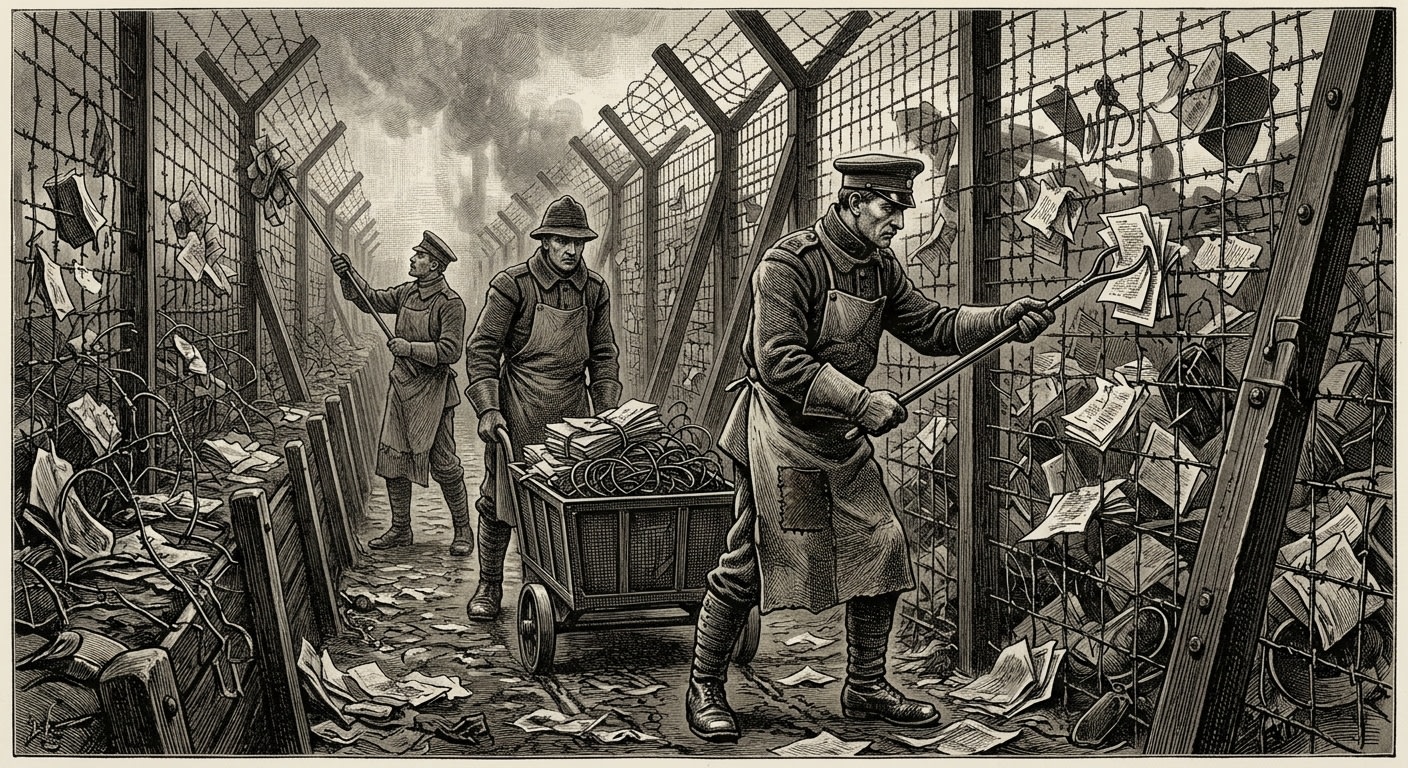
Paper hangs from it in profusion: ration tags, transit chits, confession receipts, quarantine slips, dead men's permit strings, blank issue squares, half-burned rail manifests, and the occasional school catechism blown in from Taghouse Row (Unregistered) and caught at throat height like a joke made by wind. These are the Orchard's fruit. They prove that the Synod's first answer to the wilderness was paper, and its second answer, discovering that paper could be stolen, forged, soaked, eaten, traded, and misunderstood, was wire.
The local proverb says, “No tag, no dawn.” It is vulgar, efficient, nearly Doctrine. A valid tag gives the bearer a path through lanes that would otherwise slice him into evidence. An expired tag gives him a story. No tag gives him to the Orchard.
#On Planting the Thorn
The Wire Orchard began after A.S. 67, when Synodal surveyors claimed the old garrison at Przemyśl and discovered that the western Carpathian arc could not be defended by stone alone. Stone holds heights. Stone commands roads. Stone consoles officers. It does little against deserters, smugglers, forged convoys, pride-cults, refugee floods, and the unhelpful human habit of seeking gaps in any system that proposes to eat them.
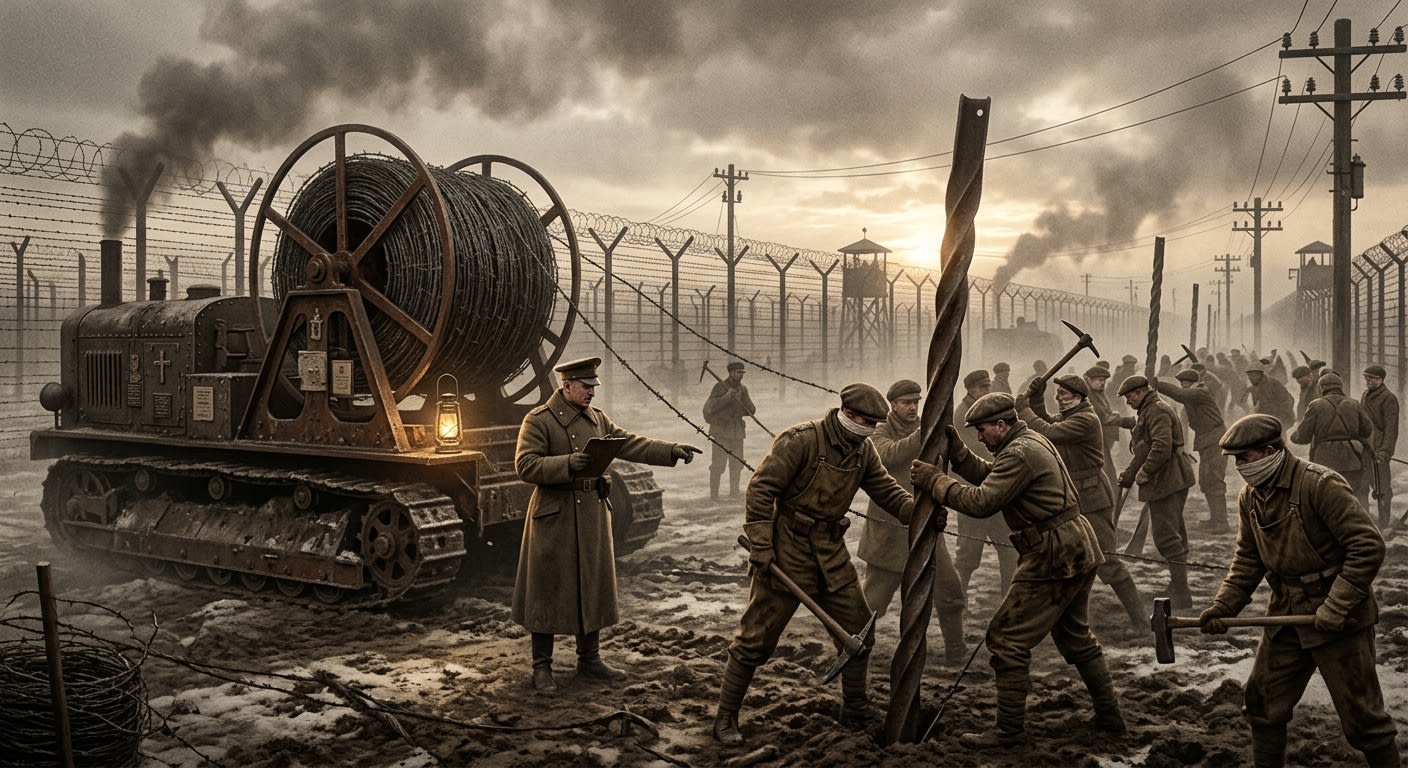
The first defensive wire was ordinary: posts, strands, bells, crude current, warning placards written in three languages and obeyed in none. The bastion had an intact rail spur and a wagon causeway; both had to be screened. The Great Retreat had taught Strasbourg that bodies moving west carry hunger, rumor, infection, sons who should still be counted as soldiers, priests who have forgotten which prayers remain legal, and officers who have misplaced the distinction between retreat and interpretation. Przemyśl became the gate where motion had to become legible.
Legibility required pain. The earliest fence cut hands and caught cloth. That proved insufficient. Men can bear scratches when the alternative is artillery. By A.S. 72 the grid had bells attached to tension lines. By A.S. 75, first full extension: two miles of electrified barb, flood-ditch, patrol trench, tower angles, and paper stations set in the old orchards and scrub east of the walls. By A.S. 92, under Concordat consolidation (Unregistered), the Orchard had expanded to three miles and received its first permanent Logistics-Penance ward.
Early provincial accounts describe the Orchard as a “temporary field entanglement retained after local success.”
Corrected. Forty-seven construction writs authorised Przemyśl's perimeter works between A.S. 64 and A.S. 72. Temporary works do not receive permanent stamp halls, dynastic sealwright contracts, corpse-recovery schedules, or three competing devotional offices for men cut in half by infrastructure.
The name came from soldiers before clerks could ruin it. At sunrise, the barbs held frost; at noon, paper; at dusk, blood drying black. Bodies caught in the strands hung bent over the wire like harvest ladders left after picking. Wardens began saying they were going out to reap. Records objected to the phrase because it implied yield. Tithes objected because yield had not been assessed. Doctrine approved the metaphor once it became punitive.
The old fruit trees were not wholly removed. Some remain inside the outer lanes, twisted, dead, wrapped in rust-iron, their branches incorporated into anchor points where metal was scarce and haste abundant. A few still blossom in thin years. The blossoms are cut by maintenance patrols before the petals fall into signal coils. Sentiment is permitted at Przemyśl only when insulated.
#On the Lanes of Permission
The Orchard is not a wall. A wall denies passage. The Orchard grants passage in portions, at hours, through gates, under witnesses, after payment, and with the full spiritual generosity of a knife deciding where to enter. Its genius is selective harm. A wall treats the innocent and guilty alike. The Orchard teaches the innocent to keep receipts.
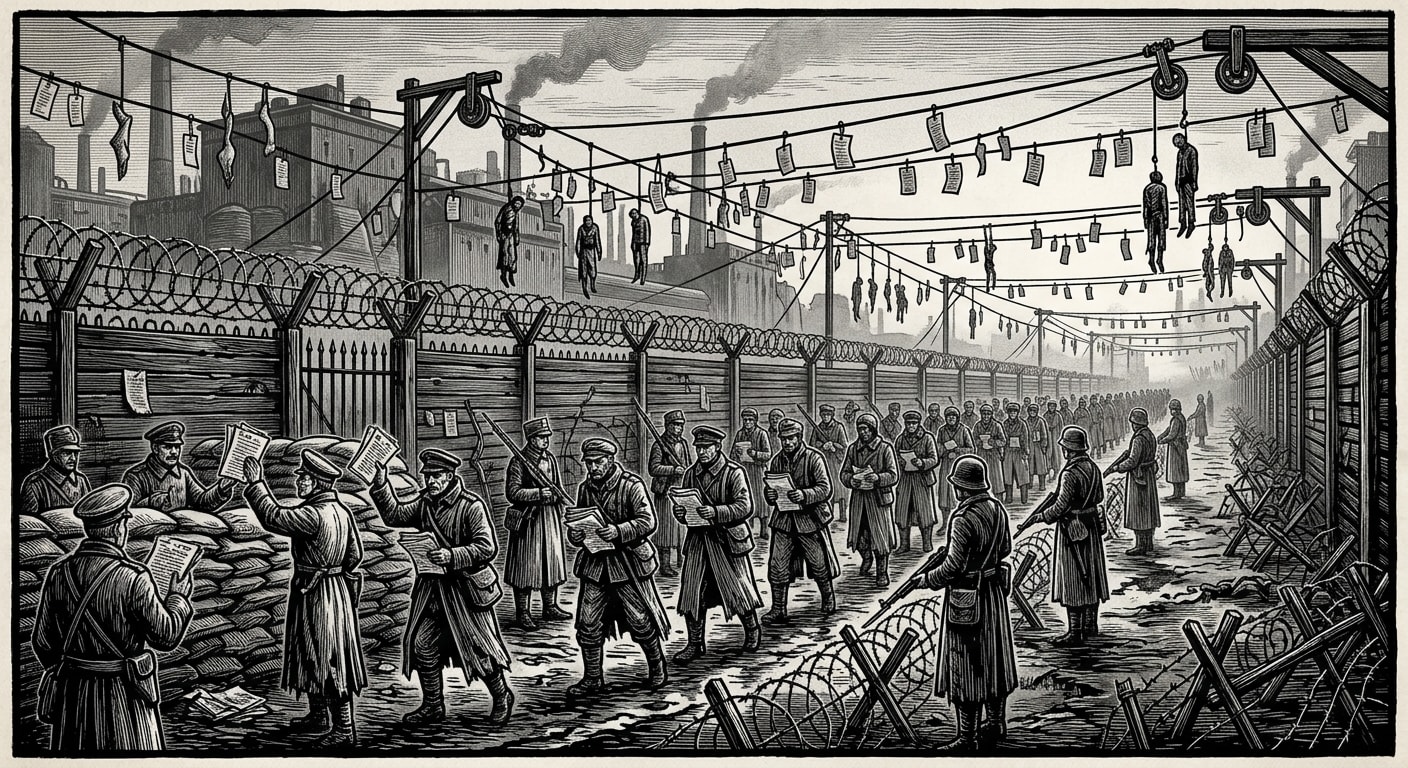
Three principal lanes cut through it from west to east. The Rail Lane (Unregistered) runs beneath steel gantries from the Rail-Throat Yards (Unregistered) to the forward spur. The Wagon Lane (Unregistered) slants south through flood-ditch gates and mud checks, wide enough for artillery carts, narrow enough that one dead mule can become a theological delay. The Pilgrim-Screen (Unregistered), hardly worthy of the word lane, is a rope-guided foot passage between tag posts where refugees, shrine petitioners, wounded men, reclassified civilians, and unfortunate goats are counted by hand.
Each lane contains tag teeth: iron combs set at shoulder and waist height. A correct permit passes flat against the body. A missing tag catches the comb, rings a bell, and, in the older sections, triggers a hook-line. These hook-lines were reduced after A.S. 113 because they removed too many shoulders from people later found to have merely misfiled their extensions. The Bureau did not apologise. The Bureau issued replacement shoulder categories.
Between the lanes lie the groves proper: kill zones, patrol mazes, abandoned service paths, decoy gaps, false safe corridors, and what Wardens call the polite hollows, where the wire lowers itself enough to invite climbing and then rises, by pulley or mischief, once weight touches the inner strand. Engineering denies any self-adjusting mechanism. Wardens do not deny it. Wardens simply keep their hands away.
The Orchard Ring inside the wire serves as its working court: gallows posts, tool racks, current sheds, salvage benches, and Warden towers. Tower Nine, called the Orchard Eye, overlooks the eastern grids and cross-files with half the bastion's nightmares. Its missing patrol log of A.S. 199 remains denied by Records and remembered by every Warden who did not sign the denial. I have seen the empty hook where the log hung. Emptiness, properly labelled, is evidence.
The Underwire (Unregistered) runs beneath it all: culverts, drain galleries, root cellars, half-collapsed trenches, cable ducts, and smuggler cuts where the Gleaners, tag-runners, antibiotic traders, and identity brokers move under the iron religion above. Officially these tunnels are sanitation access. Officially many things at Przemyśl are clean. The Underwire proves the contrary with admirable dampness.
#On Tags, Fruit, and the Arithmetic of Existence
The ration tag (Unregistered) is the Orchard's sacrament. It bears name, number, date of issue, date of expiry, permitted lane, food class, labour class, confession status, and a wax seal whose colour can elevate or doom a household before breakfast. A tag says a body may pass through iron without being converted into a lesson. The statement lasts until the date changes.
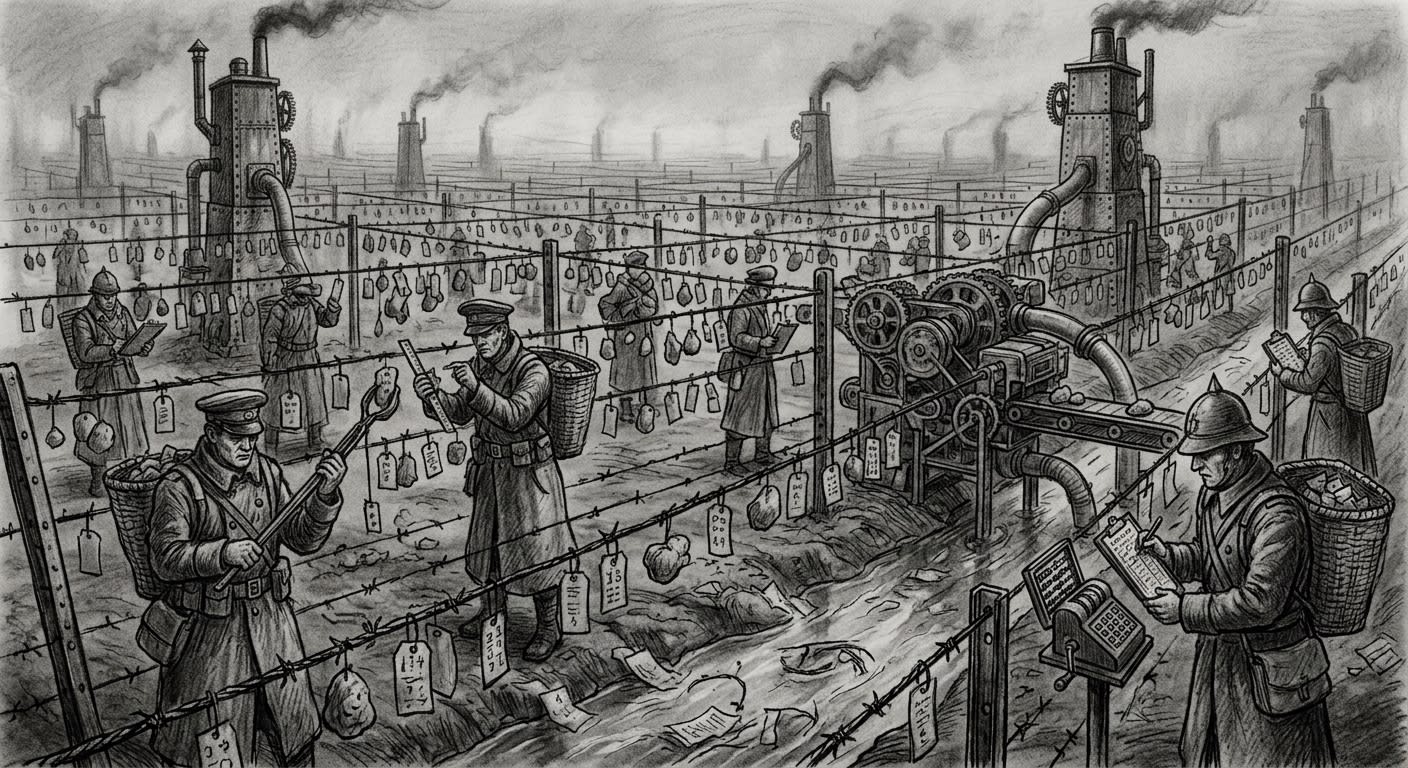
Expired tags are supposed to be surrendered at Taghouse Row. They are not. People keep them in boots, sleeves, hair knots, bread sacks, prayer books, mattress seams, children's cuffs, and the wet little pockets stitched inside funeral veils. A dead husband's old tag can buy a half-bowl in a sympathetic barracks. A child's tag, still valid after the child has died, can feed the living until the audit finds the ghost in the soup. A clean labour tag can be shaved, smoked, re-stamped, and sent east on another wrist. At Przemyśl, identity is not fluid. Fluidity implies water. Identity is wax.
The Orchard harvest recovers these tags each dawn. Wardens move along the strands with hooked poles, leather gauntlets, brass shears, and receipt satchels. They cut bodies down when bodies can be reached and collect paper when paper has survived. The dead without tags are logged as Uncounted Contact. The tagged dead are returned to the Chapel of Counting, where the tag is read aloud before the corpse is assigned a next office. The tag often arrives cleaner than the body. This causes theological comfort among the kind of men who should be kept from children.
Paper-fruit is not decoration. The hanging tags confuse hostile optics, mask wire depth, foul the sightlines of Crownguard Titans, and deny clean reflective planes to Mirror-Lords when properly dirtied. After Glass Rain in A.S. 194, Circular 192-M required all unnecessary reflective surfaces in the Przemyśl sector to be dulled, veiled, scratched, or insulted. The Orchard complied by becoming uglier. It does this naturally.
The tags also sing. This is not Orison's preferred verb, which is how I know it is the correct one. Wind through paper and wire produces a hiss like whispered names. Most are explainable: slotted paper, loose wax, strip tension, current vibration. Some are less cooperative. Patrols have reported hearing names not present on the day's rolls, names not yet entered, names of men still sleeping in Barrack-Ash (Unregistered) who wake with wax in their ears and a bruise at throat height. Bureau of Bells filed the matter as Wire-Hymn Resonance (Unregistered), Category Two Localised Acoustic-Administrative Disturbance. Records filed it under Pending because Records prefers its ghosts alphabetised.
#On the Men Who Tend It
The Orchard Wardens maintain, patrol, prune, reap, deny, and worship the grid with the grim tenderness of gardeners whose flowers bite back. They are not ordinary soldiers, though they enjoy ordinary soldiers' capacity for boredom, gambling, and describing terror as weather. A Warden must know current by sound, wire age by colour, tag forgery by wax bloom, and the difference between a man caught by accident and a man placed deliberately to draw a patrol into a blind hook.
Training begins at the inner nursery (Unregistered), a fenced practice yard where new Wardens learn to move between live strands while wearing a tag at wrist, throat, and boot. The boot tag matters. Men crawl. Men lose arms. Men become horizontal paperwork. A Warden who forgets the boot tag learns humility in the infirmary, assuming the infirmary has not been closed for fumigation, budget review, or mercy surplus.
Their tools are named with domestic affection: mother-hook, widow-shears, priest-pole, little candle, blue comb, lamb's tooth. This is frontier speech, the old rite by which men make tools less likely to kill them by giving them names soft enough for kitchens. The mother-hook pulls bodies down. The widow-shears cut wire under load. The priest-pole tests current by sacrifice of a copper filament. The little candle is a hand-lamp used to inspect wax seals snagged in barbs. Lamb's tooth removes flesh from knots where prayer has failed and the morning quota remains.
The Wardens answer formally to Provost-Marshal Vanna Rook (Unregistered) and practically to the Orchard itself. Rook can order a lane closed. The Orchard decides whether closure holds. Rook can send patrols into the eastern groves. The groves decide whether maps are still valid. Call it operational humility, which the Bureau does not teach because the Bureau fears any virtue it cannot invoice.
ORCHARD WARDEN INCIDENT NOTE — SECTOR EIGHT, A.S. 197 Patrol entered for routine tag recovery after auditory report: child voice repeating “extension granted.” Returned with █ personnel, though departure roll lists █. Recovered tags included three dated beyond the current calendar. Current Bureau position: ink contamination / forward-dated forgery. Tags are held in a sealed drawer beneath the Chapel of Counting. Drawer knocks at Second Peal.
The Wardens despise the Stamp Hall clerks and cannot work without them. Clerks despise the Wardens because Wardens return tags torn, bloodied, burned, chewed, or attached to limbs not matching the file. The quarrel is old, healthy, and almost liturgical. When the Orchard goes quiet, clerks stop mocking Wardens. When clerks stop mocking Wardens, wise men check the current.
#On Paper Plague and Marking the Flesh
The Orchard's faith in paper cracked in A.S. 112, during the Paper Plague at Bastion-Przemyśl, when two hundred refugees entered the western perimeter under falsified identities. The passes were correct. The route marks were plausible. The seals had the stale shine of handled authenticity. Eighty-seven died in the resulting lockdown, and the forward ammunition depot spent three days under a terror more bureaucratic than military: everyone had papers, and nobody believed paper.
This was not the Orchard's failure alone. Records blamed Settlement. Settlement blamed the refugees, many of whom were dead, imprisoned, or conveniently vanished. War blamed Records because War prefers enemies with desks when enemies with claws are unavailable. Heraldry blamed paper, which proved the most useful accusation because paper could not defend itself. The Compulsory Marking Decree of A.S. 113 followed within the year, requiring bodily tri-marks for civilians, soldiers, clerks, ward personnel, pilgrims, penitents, and the condemned at forward checkpoints.
The Orchard changed after that. Tags remained necessary, but flesh became the backup ledger. Gate combs were lowered to catch wrist plates. Lane inspectors carried pigment charts and brand keys. The Geometry Brand-Smith Corps tripled, and the phrase “paper purity” acquired a scar under it. A body now had to agree with its document. When they quarrelled, the wire settled the matter while offices debated jurisdiction.
A.S. 119 brought the Angle Riots elsewhere along the Line, when mis-marking taught fourteen hundred civilians that geometry can be both exact and wrong. Przemyśl watched with professional interest and tightened its lanes. By A.S. 147, Form 14-G on anomalous flesh geometry had become a familiar nuisance in Orchard offices: brands drifting, angles swelling, marks responding to cold, classifications changing after the bearer passed the first gate but before the second. In every case the Orchard demanded a choice. Let the doubtful through, or let the wire eat the doubt.
This is why the Orchard carries so many categories for partial persons. A man whose papers are true and marks false is not the same problem as a man whose marks are true and papers false. A woman whose tag belongs to her dead sister but whose wrist brand is her own has committed fraud, grief, survival, or all three. A child born in the holding pens before census confirmation has no mark, no tag, and a mother who will claw an Assessor's face if told the infant is administratively premature. The lanes do not care. The Wardens sometimes do, which is why Wardens require rotation before pity learns the map.
The Underwire thrives on these quarrels. Brand paint, false wrist plates, dead men's tags, smudged pilgrim triangles, condemned-class cover strips, soot to age new paper, vinegar to lift old wax — all pass through culvert stalls beneath the Orchard. The most expensive commodity is no longer a blank tag. It is a plausible inconsistency: the sort of flaw a tired inspector will recognise as human rather than criminal. Perfection draws Purity. A good forgery limps.
#On Atheron at the Wire
The enemy opposite the Orchard is Atheron, Sin-General of Pride, whose dominion in the eastern Carpathian highlands announces itself by height, polish, rank, spire, and the pure ceremonial stupidity of assuming that altitude constitutes argument. The Orchard is ugly by necessity. This makes it one of the Synod's better answers to him.
Atheron's servants prefer clean lines of sight, polished surfaces, recognisable hierarchy, banners that command knees, ranks that ascend, towers that teach inferiority to stone. The Wire Orchard offers rust, rags, snagged paper, false depth, mud, dead rats tied to poles, and a quantity of administrative shame sufficient to sand the shine from any young officer's soul. Against the Crownguard Titans, the paper-fruit breaks banner sightlines. Against Mirror-Lords, the dirtied tags and tarred wire deny flattering reflection. Against the Sun-Spear Legion, the crooked lanes make radiance waste itself on empty hooks and old receipt packets.
This has not made the Orchard safe. Safety is a rear-area word, like upholstery. In A.S. 195, the Spire-Crusher advanced toward the eastern grid and made the bastion look small. The Orchard pylons bent outward before its forward pier touched them, as though the iron itself wished to bow. Provost-Marshal Rook doubled the eastern current. Tags ignited. The wire turned blue. For twelve minutes, Pride stopped at the fruit of bureaucracy. Then the tower lengthened over the wire, because Atheron is a poor guest and an excellent enemy.
The Nine-Hour Rubric broke the Spire-Crusher's forward pier. Afterward, Wardens spent three days cutting down tags fused into glass by heat and pride-light. Some bore names never issued. Some bore rank marks above the bearer's station. One tag listed Bastion-Przemyśl itself as probationary personnel, lane access pending. Doctrine ordered it burned. Records copied it first. This is why Records remains useful, despite its many sins against narrative pace.
The Orchard learned from Atheron, which is the sentence no Bureau wants printed and every Warden knows by hand. After A.S. 195 the eastern strands were hung lower in some sectors, higher in others, making a straight-backed advance difficult and a bowed advance embarrassing. Rag Standards (Unregistered) entered the grid in greater numbers. Polished tags were banned. Officers were ordered to remove mirrored buttons before dawn inspection. Three refused and were assigned to Orchard maintenance, where pride meets tetanus in a useful theological arrangement.
#On Disasters Below the Fruit
An Orchard of wire requires current. Current requires power. Power requires engines. Engines require seals. Seals require men willing to kneel among hot pipes and sing at rubber, wax, brass, pressure, and death until all five agree to remain in their places.
The Split-Ring Disaster of A.S. 164 belonged to the lower works feeding the western pylons, but the Orchard felt it first as silence. Seventeen engine pits failed over nine hours after a senior mechanic abbreviated the cleansing verse on four gasket repairs, leaving residual wax in grooves where pressure later found its little chapel. Forty-three men died. The western pylon feed failed. The wire went slack in sectors three through seven. For eleven hours, Przemyśl possessed an Orchard that looked intact and could not bite.
This was the closest the bastion came to being a drawing of itself.
Atheron did not breach that night. The official explanation credits rapid Warden response, emergency lantern screens, and the grace of the Creator. The unofficial explanation, spoken in engine chapels and never near an auditor, is that a few unlicensed mechanics kept one auxiliary current line alive by bypassing the rite sheets entirely and humming the old under-verse used before Operational Classification 7-G. Those mechanics saved the wire and later signed documents confessing that they had not done what kept everyone alive. This is how the Synod rewards competence: it makes competence lie in approved ink.
Przemyśl training manuals once stated that the Split-Ring Disaster “confirmed the sufficiency of full-sequence compliance in all critical seal contexts.”
Corrected. The disaster confirmed that omitted sequence kills men, that delayed stock kills men, that overlong process kills men, that undocumented improvisation may save men, and that the Bureau will punish every fact except the one that fits on a card.
Operational Classification 7-G formalised the Gasket-Hymn Mechanic craft and turned undocumented repair into sabotage. The Orchard benefited. It also suffered. Every emergency now arrived already accused. A Warden hearing a strand die in sleet had to summon a licensed mechanic, verify wax, witness verse, note torque, and pray the enemy admired paperwork enough to wait. The enemy did not. The mechanics adapted. They invented field notes, false times, pre-sung wax, sympathetic Bell-Accountants (Unregistered), and signatures applied by men who had died but whose handwriting remained excellent.
The Counterfeit Wax Plague of A.S. 178 found Przemyśl waiting. Fourteen suppliers were immured. Workshops burned. Stock destroyed. Within six months, counterfeit wax returned, now better sung, worse sealed, and twice as expensive. The Orchard held. The Bureau called this enforcement success.
#On the Harvest and the Erased
Dawn harvest is the Orchard's most famous office and least honest ritual. It begins before first full light, when the wire is still silver with frost and the tags have not yet warmed enough to curl. Wardens move in pairs. One pole, one shears. One reads, one records. One watches the body, one watches the wire behind the body, because the dead at Przemyśl have been known to serve as decoys for the living, and the living have been known to envy the dead their completed paperwork.
The harvest separates bodies into tagged, untagged, partial, hostile, uncertain, and administrative nuisance. Tagged bodies go to the Chapel of Counting. Untagged bodies go to ditch-pits unless Purity wants them. Partial bodies are measured by weight and probable narrative. Hostile bodies are burned under field rite. Uncertain bodies wait in Barrack-Ash with sacks over their faces until someone important loses patience. Administrative nuisance covers every corpse whose tag belongs to somebody still alive.
The Erased (Unregistered) haunt the harvest most. These are persons without current tags: deserters, misfiled refugees, escaped labourers, prisoners whose transport columns lost a page, widows travelling under dead husbands' permissions, children born between census windows, men released from hospitals without existence reissued, and poor devils who believed a valid yesterday could purchase a today. The Orchard takes them without rancour. Wire is not cruel. Cruelty requires imagination. Wire has policy instead.
Some Erased survive in the Underwire, trading routes, names, scraps, antibiotics, and the little bright lies by which one more day may be smuggled past a clerk. The Gleaners cut bodies down before official harvest when family payment can be raised. They return tags to widows, burn forged papers, sell clean wire, and guide deserters under dead lanes. They are criminals. They are merciful. This contradiction offends only those who imagine law has ever held a monopoly on virtue.
The Bureau tolerates the Gleaners until it does not. Purges arrive at irregular intervals, usually after an audit discovers too many bodies recovered privately and too few lesson-corpses available for public arithmetic. Arrested Gleaners are charged with theft of Synodal property, the property in question being tags, wire, bodies, or occasionally names. The sentence varies. The principle does not.
#On the Current Silence Between Strands
As of A.S. 201, the Wire Orchard holds. This is not comfort. A gallows also holds.
Its current problems are numerous enough to require their own choir. Tower Nine's denied logbook remains absent. Wire-Hymn Resonance has increased during dry wind. The eastern groves produce forward-dated tags after storms. The Underwire carries more traffic than sanitation can explain. A.S. 199–201 patrol returns show slight discrepancies in personnel counts. The missing stamp die in Taghouse Row has forced three emergency revalidation drives, each of which produced more expired persons than the previous count admitted possible. Atheron's heights remain visible on clear mornings. Pride does not tire. It rehearses.
Provost-Marshal Rook wants greater harvest authority beyond deserter classification. Archivist-Prelate Odran Kelle wants expanded confession indexing tied to lane access. Sealwright-Master Joryn Malk wants exclusive wax blank supply extended another decade. The Orchard Wardens want wire, gloves, antibiotics, and permission to ignore anyone whose boots are clean. Of these requests, the last is wisest and least likely to be granted.
The Orchard's central doctrine remains unchanged. A man is not permitted through because he is hungry, faithful, frightened, wounded, innocent, useful, young, old, beloved, decorated, repentant, or correct. He passes because the paper says he may pass and the wire has been instructed to believe the paper. If the wire begins to doubt the paper, all Europe will hear the hiss.
At dawn the tags flutter. At noon the stamp halls sweat. At dusk the eastern ridges lift their black crowns and the wire answers with its thin metallic psalm. The Orchard bears fruit for the Ledger.