
#On the Siege Engine That Mistook Height for Argument
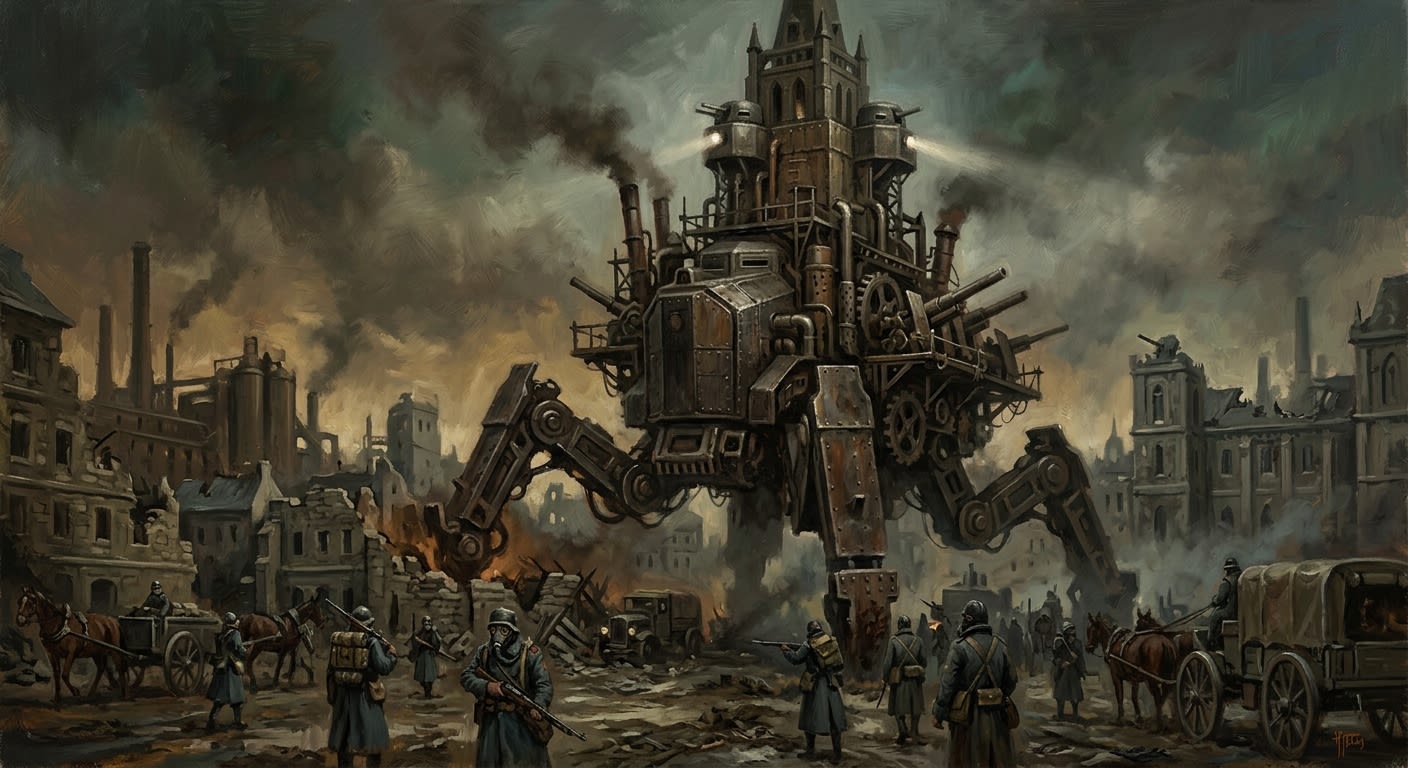
The Spire-Crusher is Atheron's siege colossus, which is the Bureau's polite way of describing a mobile tower that advances upon a fortress, grows taller with each mile, and expects masonry to feel shame. Against most enemies this would be absurd. Against Pride, absurdity is merely doctrine before the stamp dries.
It was first seen in the autumn campaign of A.S. 195 opposite Bastion-Przemyśl, along the Sagittal Line, though the Bureau of War insists earlier descriptions of “walking towers” in Carpathian field reports refer to hallucination, fog, grief, and faulty range glass. The Bureau of War is wrong with admirable discipline. The early reports are clear. The witnesses simply lacked the misfortune of a proper noun.
At first sighting, the Spire-Crusher measured three hundred and forty feet from base to crownline. By the time it reached the outer wire, it measured nine hundred. It did not sprint, lurch, batter, belch, roar, or display any of the vulgar energies by which common siege engines announce their insecurity. It proceeded. It rose. It made the fortification before it seem smaller with every step.
The common soldier calls it a tower. The engineering officer calls it a vertical assault platform. The theologian calls it an embodied syllogism. I call it Atheron's joke, because every part of it says the same thing: if one is above, one is superior; if one is superior, resistance is impertinence; if resistance persists, increase the height until impertinence becomes invisible.
#On Its Construction, If Construction Is the Word
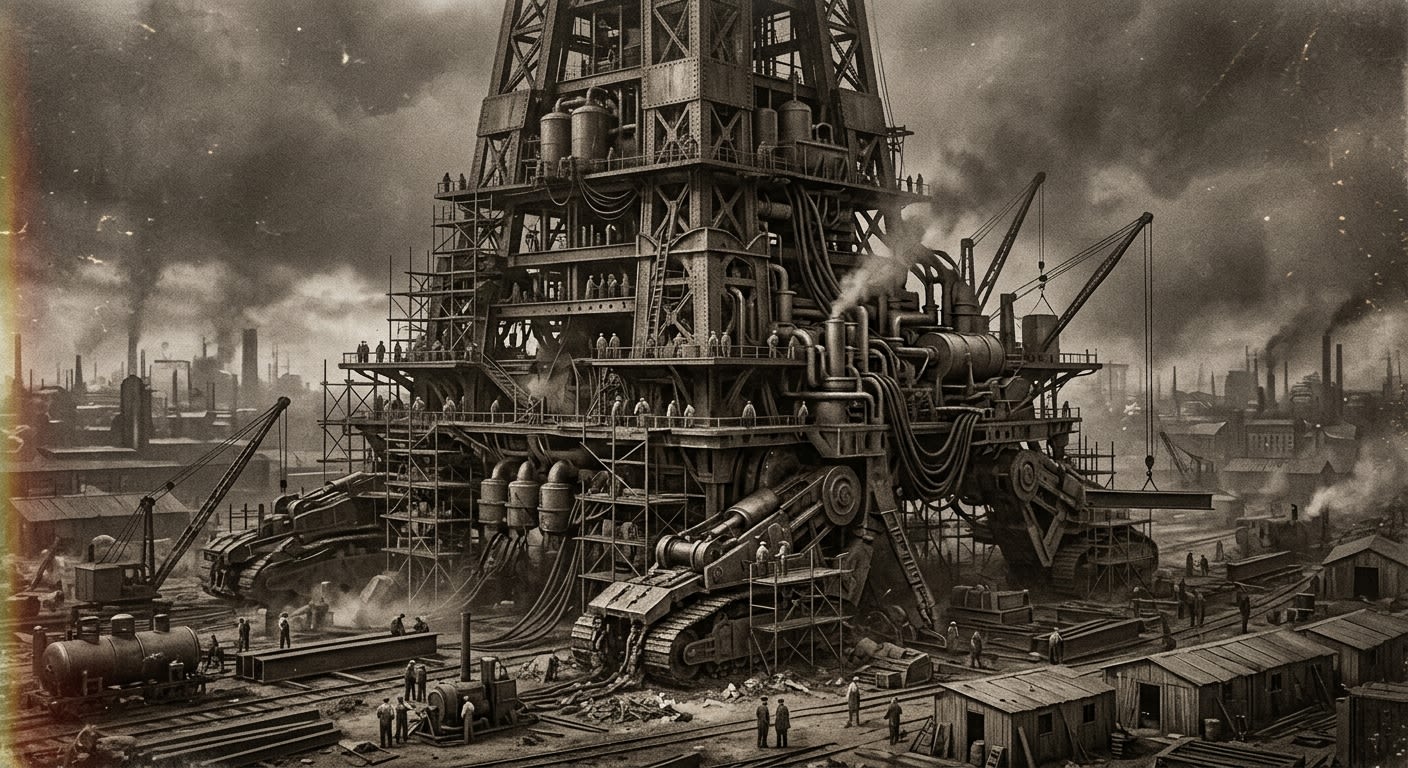
No reliable account describes the Spire-Crusher's assembly. This annoys Engineering, which believes all structures begin with survey, foundation, scaffold, complaint, budget overrun, and denial. Atheron's machines do not indulge this sequence. They appear already asserting themselves.
The first confirmed sighting came from Orchard Tower Nine at dawn. Fog lay in the eastern saddle. The sentry, Corporal Tamen Voss, filed that a dark line had appeared above the ridge “like a chapel steeple walking behind a curtain.” His superior charged him with poetic excess, then looked through the glass and rang the alarm bell so hard the clapper cracked. This is why officers should read poetry. It improves survival.
At three hundred and forty feet, the thing resembled a black siege tower of old design elongated past sanity: four broad legs, a tapering shaft, galleries stacked like court balconies, banners descending from each tier, and a crown of needle-spires at the summit. The legs did not stride in the animal manner. They advanced by extension. One forward pier sank into the ground, the whole tower leaned without toppling, the rear pier shortened, the front pier lengthened, and the structure drew itself ahead like a monument refusing its plinth.
The material remains disputed. Field glass showed black stone, iron ribs, and panels polished enough to catch dawn. Shell fragments recovered after destruction contained basalt, bone-lime, fused brass, traces of human hair, and a mineral the laboratory described as “self-important.” That word was removed from the final report. I restore it because accuracy is among my vices.
No crew was seen. No furnace smoke. No engine heat. No chains. No cogs. No visible labour. The Spire-Crusher moved by permission granted to itself. This offends natural philosophy, military doctrine, and me personally.
The first emergency bulletin identified the Spire-Crusher as a “captured Synod siege engine corrupted by infernal agency.”
Withdrawn. The Synod has never built anything so confident. Our engines leak, scream, demand choir crews, and require seventeen stamps before turning left. The Spire-Crusher possessed no such civic humility. It was Atheron's own work, or Atheron's own boast given scaffolding.
#On the Advance to the Wire
The Spire-Crusher began approximately seven miles east of the outer Orchard, in the broken saddle below the Ebon Heights. Its course was direct. Too direct. The terrain between the sighting point and the wire contains ravines, scree, old shell pits, collapsed mule roads, and three minefields whose maps disagree with one another in the manner of clerks defending pensions. The tower crossed all of it without deviation.
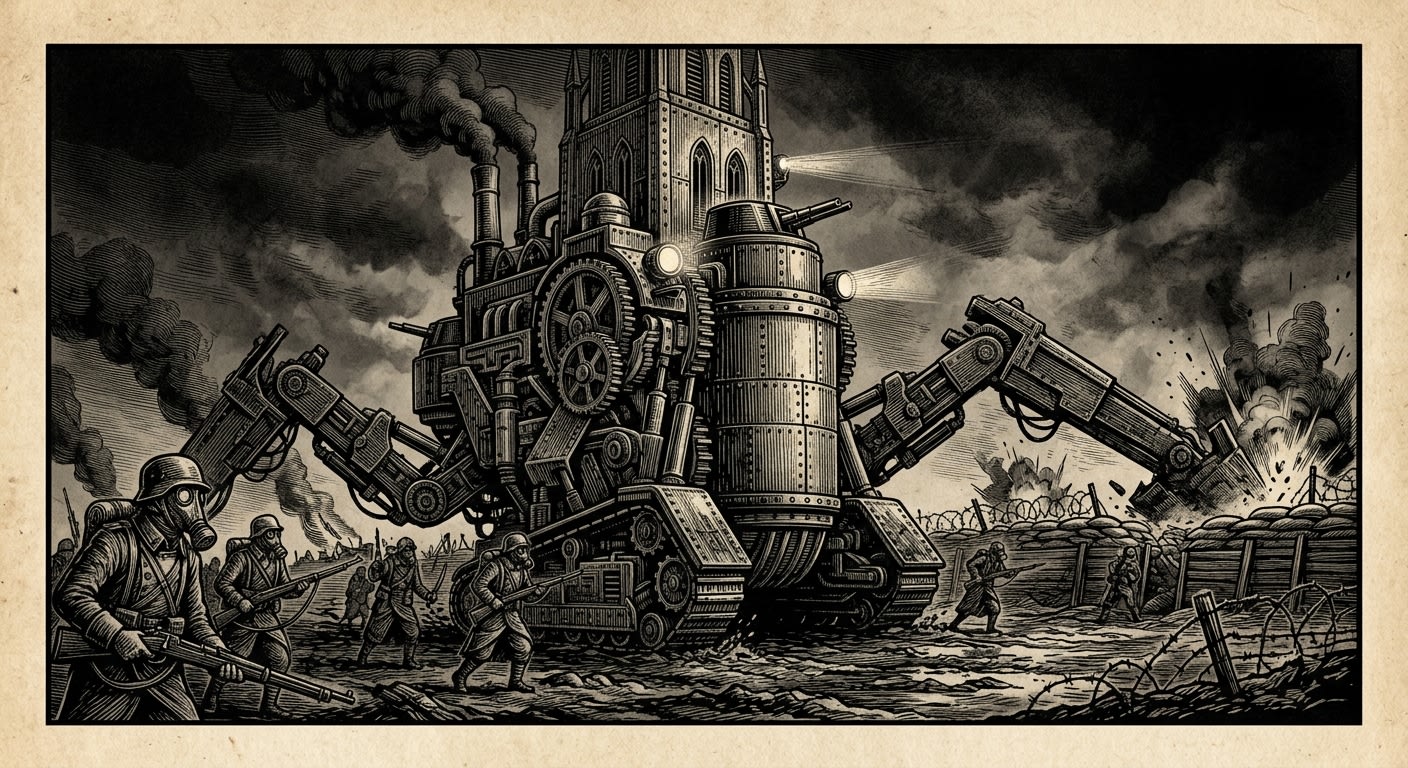
Where the ground rose, the tower rose higher. Where the ground fell, the tower did not descend. Its lower sections lengthened into the depression, its upper galleries remained level, and the whole impossible body maintained the stately composure of a bishop ignoring a beggar. By the third mile it had reached four hundred and eighty feet. By the fifth, six hundred and ten. At the sixth mile the summit entered low cloud and emerged above it, crowned in sunlight while the battlefield below remained grey.
This was the first wound.
Men on the walls looked up and saw the enemy standing in weather denied to them. Przemyśl's garrison, accustomed to wire, mud, ration tags, and the useful ugliness of survival, found itself beneath a thing that made the bastion appear provisional. The Wire Orchard hissed. The tower grew. The old Rationalist stone of the inner wall, which had survived A.S. 67, A.S. 92, the siege-winters, the Glass Rain, and every administrative insult piled upon it, looked suddenly childish. A toy fort. A boy's crenellation. A mistake in scale.
Atheron's host advanced beneath it in ordered files: Crownguard at the fore, Sun Spear ranks to either side, and at least two confirmed Mirror-Lords moving among thaw pools below the eastern slope. The Spire-Crusher did not shield them in the ordinary sense. It drew the eye upward so perfectly that lower threats became footnotes. During the second hour, three forward batteries failed to engage a Sun Spear detachment because their spotters kept reporting the tower's height instead of the detachment's range.
The phrase “height fixation” appears in the after-action report. This is insufficient. A candle flame fixes the eye. A pretty novice at Vespers fixes the eye. The Spire-Crusher indicted altitude itself. Men did more than look. They stood accused of being below.
#On the Nine-Hour Rubric
The destruction of the Spire-Crusher is known at Przemyśl as the Nine-Hour Rubric, because soldiers prefer names that sound less like panic and more like procedure. The name is useful. It lets survivors pretend that what happened followed a rubric. It did not. It followed mud, terror, luck, anger, and the bureaucratic miracle by which ammunition that had been declared insufficient for training became suddenly sufficient for salvation.
The first barrage opened from Battery Saint Ulrich at 6:12 by the tower clock. The shells struck the lower galleries and vanished into ornamental dust. The Spire-Crusher grew by nine feet during the salvo. Major Cestian Rell ordered the guns elevated. The second salvo struck mid-shaft. Stone peeled away in banners. Beneath it stood more shaft.
By the second hour, every heavy gun on the eastern salient had joined. Platforms Casimir (Unregistered), Ulrich, Martyrs' Teeth, and the Orchard Eye fired in overlapping sequence. Ammunition crews moved in relays until their hands bled through gloves. Bell crews below Platform Casimir struck the Humility Sequence without pause. In the fifth hour, Sun Spear fire entered through ventilation slits and blinded the bell-men beneath their instruments. They kept striking from memory.
MEDICAL ANNEX — PLATFORM CASIMIR, A.S. 195 Bell crew recovered after hour nine: ████ alive, ████ dead, ████ sight unrecoverable. Hands of surviving ringers found split to bone at knuckle and palm. One ringer, name withheld by family petition, continued striking the Humility Sequence against his own helmet after removal from the bell pit. Duration: ███ minutes. Statement: “Keep it lower.”
The third hour produced the first visible wound. A shell from Martyrs' Teeth struck the westward face at approximately five hundred feet and opened a triangular gap. Through that gap witnesses saw a staircase spiralling upward around an empty core, full of figures facing outward, hands folded, heads raised. None moved when the next shell erased the gap.
By the sixth hour the tower measured nine hundred feet and stood at the outer wire. It bent the pylons outward before touching them, as if the Orchard itself were attempting to bow. This detail caused more distress among the Orchard Wardens than the casualties. Men can die. Wire must not kneel.
Provost-Marshal Vanna Rook (Unregistered) ordered the eastern Orchard current doubled. The wires brightened blue. Ration tags hanging from the barbs ignited one by one, each little paper authority curling into ash. The Spire-Crusher's forward pier entered the charged field and stopped.
For twelve minutes, nothing advanced. Then the tower grew again.
Its pier lengthened over the wire instead of through it. The base rose clear of the charged strands. The lower galleries lifted. The shadow crossed the ditch. The inner wall fell under it.
Major Rell ordered all batteries to fire at the same mark: the point where the forward pier narrowed below the lowest gallery. An engineer named Sister-Adjunct Hilde Marek (Unregistered) calculated the angle on a blood-stained requisition form because every range slate in the battery had cracked. The form survived. It is now held in the Chapel of Counting as a probable relic, though Bureau of Relics authentication remains pending, delayed, needless to say, by the form's refusal to stay flat.
The final salvo began at the eighth hour and fifty-third minute. Seven minutes of fire. Thirty-eight heavy shells. Four hundred and twelve secondary rounds. Two bell sequences. One battery crew singing the filthiest anti-Atheron song known to the salient.
At the ninth hour, the forward pier broke.
#On the Forty Feet of Rubble
The collapse should have buried the eastern salient.
A nine-hundred-foot tower falling across the wire ought to have pulverised the ditch, the Orchard Ring, Tower Nine, Taghouse Row, and several propositions in geometry. It did none of these. It folded downward into itself with obscene discretion. Galleries vanished into lower galleries. Spires slid into shaft. The crownline dropped as if pulled through the body by a string. Dust rose. Stones struck. Men screamed because men are sensible when architecture commits blasphemy.
When the dust cleared, the rubble measured forty feet at its highest point.
Forty.
The Bureau of Engineering measured it twelve times. The final measurement, ratified after argument, prayer, and a fistfight between two surveyors of different schools, reads: forty feet, sufficient tolerance, further precision doctrinally unhelpful.
The rubble consisted of black stone, twisted iron, banner cloth, ash, bone dust, and thousands of small stair fragments no longer than a finger. No bodies were found. No intact gallery. No mechanism. The Spire-Crusher, having failed to make the bastion kneel, refused to provide explanatory debris.
Several stones continued to grow after collapse. The effect was slight: a quarter inch over six hours, always upward. Engineering placed iron caps on the stones and weighted them. The stones dented the caps. Purity ordered the fragments buried in separate pits under ash. Records objected to uncatalogued burial. The argument lasted two days.
The sky-fixation persisted for three days. Men looked up at the empty space where the tower had been. They flinched when clouds moved. They judged parapets by imagined height. One private refused to enter a trench because “below” had become, in his words, “a confession.” He was beaten, treated, shriven, and returned to duty in that order, which tells you everything about the Line's pastoral priorities.
An early public bulletin stated that the Spire-Crusher was “reduced to rubble by the unambiguous superiority of Synod artillery.”
Corrected. Synod artillery, bell discipline, wire current, ash smoke, obscene song, accident, stubbornness, and the enemy's own structural arrogance all contributed. Superiority is Atheron's word. We borrow many things from enemies. We need not borrow their stupidest noun.
#On Its Meaning to Atheron
The Spire-Crusher was a weapon, yes, but crude tactical utility was never its principal office. A weapon that needs nine hours to cross seven miles while inviting every heavy gun in a mountain fortress to rehearse upon it is, by crude tactical standards, an extravagance. Atheron is fond of extravagance because utility without ceremony disgusts him.
Its purpose was diminution. The tower's growth was an assault upon scale, and scale is the secret alphabet by which Pride writes theology. A wall that has held for a century can become a toy in one morning if a taller argument stands before it. A gun crew that has endured siege-winter, hunger, Mirror contact, Sun Spear burn, and the provost's cooking can hesitate if the enemy makes their battery feel like a child's stool. Men do not surrender only because they are beaten. They surrender because the world has been arranged to make resistance seem socially embarrassing.
This is Atheron's genius. Damn him for it.
The Spire-Crusher took the oldest dream of siegecraft — to rise above the wall — and purified it of all practical modesty. Towers have always sought height. Ladders, hoists, rams, galleries, artillery platforms: every engineer since Cain first looked at his brother and imagined structural advantage has wanted a higher angle. Atheron removed the angle and kept only the higher. The machine did not need to enter the fortress. It needed the fortress to enter into comparison and lose.
The destruction of the Spire-Crusher did not humiliate Atheron in the way human commanders hoped. Pride does not learn humility from defeat. Pride learns that the stage was inadequate, the witnesses were unworthy, the instrument insufficiently exalted. Since A.S. 195, observers in the Ebon Heights have reported three new foundation silhouettes along the high eastern ridges. One is already taller than the old tower's first sighting height. The Bureau of War calls these “unconfirmed structural developments.” Soldiers call them sons.
Atheron may send another. He may send seven. He may send none, content that Przemyśl has already learned to look upward when clouds gather. Pride wastes nothing, least of all failure.
#On Countermeasures Against Vertical Dominion Engines
The approved countermeasures against a Spire-Crusher are ugly, loud, repetitive, and best administered before the tower becomes interesting.
First: deny the gaze. Observation crews are to work in rotations of ninety seconds, reporting measurements by number only, with no descriptive adjectives permitted. “Five hundred feet” is acceptable. “Majestic,” “impossible,” “beautiful,” “terrible,” and “larger than our walls” are punishable under the Height-Fixation Advisory. The punishment begins with a slap and may, under combat conditions, remain at that refreshingly direct level.
Second: lower the mind. Humility Sequence bells, vulgar marching songs, ration inventory recitations, mud-work details, and the forced comparison of the tower to ordinary household objects have all proved useful. One Przemyśl battery survived the seventh hour by chanting, “Big chimney, bad chimney,” until the final salvo. The chant is doctrinally impoverished and tactically sound. The Bureau of Doctrine has approved it for emergency use while refusing to print it in the hymnal, a mercy to typography.
Third: strike the narrowing. The Spire-Crusher's growth distributes mass upward and attention outward, but its lower piers must still translate arrogance into contact with the ground. Every measured advance showed narrowing below the first gallery. Fire there. Fire again. Continue firing after visible effect. Continue firing after despair. Continue firing after the tower appears to have grown around the wound. Pride hates repetition because repetition implies labour, and labour belongs to those below.
Fourth: foul the surface. Ash smoke reduced Sun Spear interference during the Nine-Hour Rubric and dulled the tower's reflective galleries. Kitchen soot remains approved. Burned requisition forms remain effective and emotionally satisfying. Polished brass is forbidden on all exposed platforms during Spire alerts. Officers who object on ceremonial grounds should be placed beneath the object of ceremony and invited to admire their reflection while shells arrive.
The fifth measure is confession after victory. This is the most neglected and the most necessary. A garrison that destroys a Spire-Crusher is immediately vulnerable to Atheron's second lesson: you toppled the tall thing; perhaps you are tall now. After A.S. 195, three battery captains requested elevation in rank within a week of the Rubric. Two used phrases later found in captured Pride-litanies. One stood on the rubble while making the request. He had to be dragged down. He wept, not from pain, but from the indignity of being level with other men.
Victory over Pride is contaminated at the rim. Wash the cup before drinking.
#The Ratification
The Spire-Crusher is destroyed. Its rubble lies buried in separated pits beneath ash and argument. Its measurements remain in the Bureau of War's files. Its height remains in the garrison's neck muscles, in the habit of looking upward before dawn.
Atheron lost the machine and kept the posture. That is the enemy's economy.
If another Spire-Crusher comes, it will be taller. Pride never repeats itself at the same elevation.