

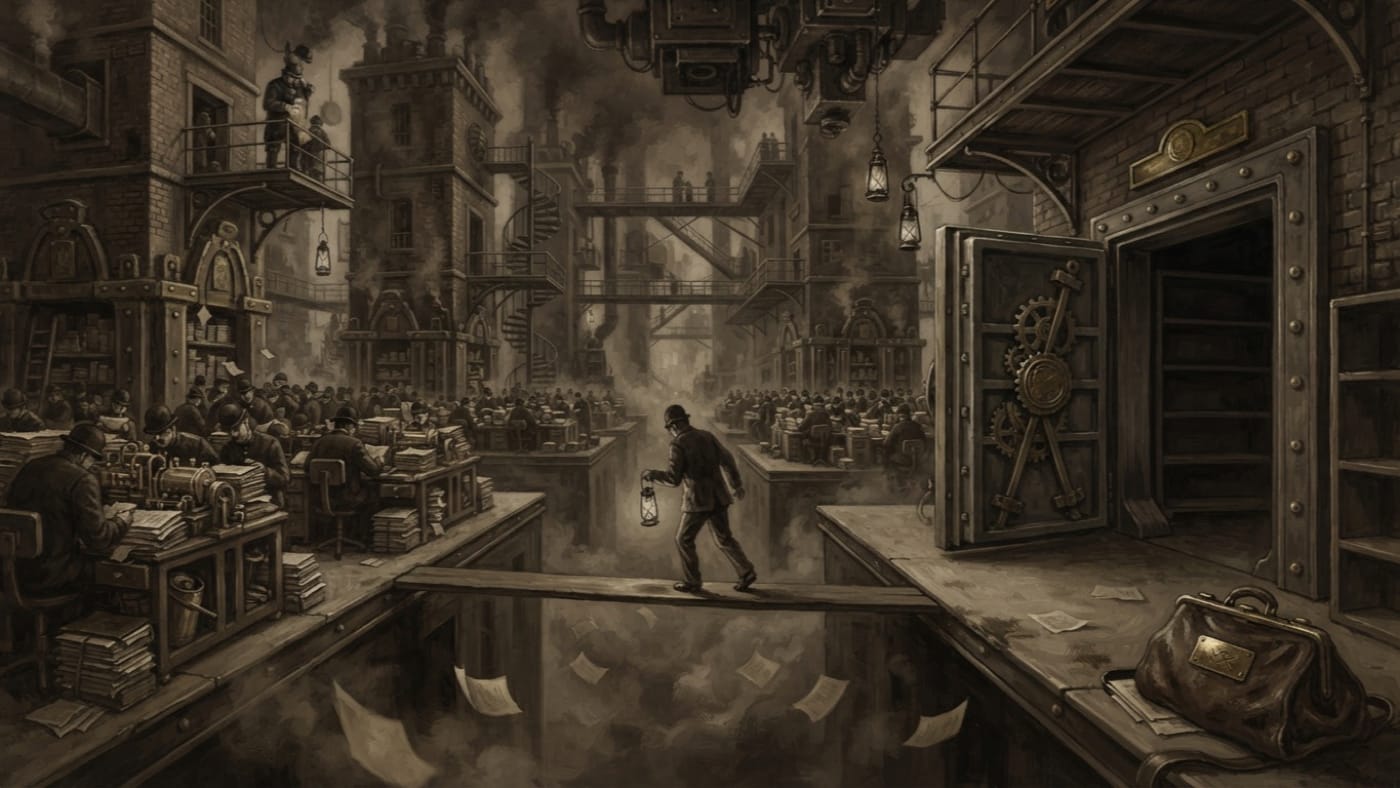
#On the Missing Stock
In late A.S. 199, which the common reckoning calls 1909, a batch of blank master-permits disappeared from the Hall of Seals at the Latchford Permit-Yards. That sentence is the entire public record. I have read it in four separate files, and it has not grown longer in any of them. The record gives no day, month or hour of discovery, and it gives no count of forms. The batch had a size, but the ledger does not state it. No one is recorded carrying the forms out, and no one is recorded carrying them back.
The title of this entry speaks of one permit. That is a grammatical economy, for which I accept the responsibility and refuse the liability. What vanished was plural, and its number is unknown.
The official inquiry attributed the loss to inventory fatigue. The dossier on Prefect Mavren Tull records that the inquiry then closed. Both statements are accurate. At Latchford a closed inquiry and an unsolved loss share one cabinet without quarrel, as a ledger and its errors always have. I find no reopened file, no fresh commission and no sworn search. Anyone who tells you the matter remains under active investigation is selling something, and in Latchford that something is usually a minute.
#On the Authority of an Unwritten Form
Latchford stands on the Danubian reach of the Sagittal Line, and it governs passage by window. A traveller needs papers. The papers need a window, and the window needs a stamp issued against the Master Gate Clock. A traveller who misses the window joins the Unwindowed: lawful in name and stationary in fact, eating what the ration lanes allow and waiting where the Wardens can count them.
Joint Yard Command divides this machinery between two Bureaus. Prefect Tull of the Bureau of Records holds the blank permit stock. Quarter-Commander Hesta Brune of the Bureau of War holds convoy priority. One officer decides what paper exists, and the other decides what moves. Neither power implicates its holder in the loss, and this entry implicates neither officer.
The yard profits when three objects are confused, so I keep them apart. A forged minute-slip is false paper imitating true paper. A counterfeit master-seal is a different object and a different offence, and it counts among the yard's red lines. A genuine blank master-permit is true stock, ruled and cut in custody, lacking only a name and wax. The disappearance concerns the third object alone. It establishes no stolen seal, no mould, no press and no master document capable of breeding copies.
That third object frightens Records most. A forger has to imitate the Bureau. Whoever holds the Bureau's own blanks has nothing left to imitate except the ink.
#On Papers Before Their Orders
The Minute Market lies beneath the Clerklofts and above the drainage canals, and it sells minutes. A Latchford minute is purchased permission, such as a window extended, a stamp hurried or a draft sweep deferred. It has no settled exchange rate with the second hand of any clock. Over the years the Market's slips had progressed from crude to competent and then to a well-handled weariness, which is the quality that persuades a clerk. Irregular stamps had surfaced at the yard before 199. I will therefore not name that year as the birth of all anticipatory paper.
The Market's own account of the period after the disappearance reports a change in its trade. The slips grew cleaner and bolder. Some carried windows before those windows were announced. Some named routes and inspections that the yard later produced exactly as the paper had stated. Ordinary forgery copies the law after the fact. These papers arrived first and waited for the law to reach them.
The Market account preserves one specimen, confiscated late in 199:
CONFISCATED MINUTE-SLIP, LATE A.S. 199 Window: Third Convoy Pulse, south ford lane. Stamp time: ███████, one bell before official posting. Carrier: widow with two feverish children. Gate action: accepted. Ledger action: delayed, then reconciled. Disposition of originating runner: not found. Disposition of clerk who accepted slip: promoted, then transferred, then removed from roster.
The clerk's career completed a liturgical arc in three administrative verbs. The record gives the widow no name and no destination. I give her none either.
The record supports a sequence: blanks disappeared, and afterwards slips appeared that anticipated authority. It does not support a connection between the two. Nothing in the record shows that this slip, or any other, was written on the missing stock. Nothing explains how a paper learns the hour of a posting before the posting is made. The queue has its explanations. The queue also has its fevers.
#On Nuisance and Precaution
Yard Command Circular 199-14 described Old Sable's operation as a common black-market nuisance. Those are the Circular's words, and that is the Circular's position. It is not the inquiry's finding and it is not the name of the disappearance. The Circular should be allowed to own its sentence outright.
Yard Command Circular 199-14: Old Sable's operation is a common black-market nuisance.
Corrected as to adequacy, not as to text. The Circular says exactly this, and the quotation stands. In the same year, the yard lost a batch of its own blanks and later confiscated a slip that preceded its own posting. A common nuisance is a matter for the sweepers. This one has kept senior officers occupied with locks.
The precautions come from separate files, and they do not share a date. The Old Sable file records that Prefect Tull locks the blank permit stock inside his private sleeping cell. The Minute Market account places the practice among the consequences of 199. Tull's own dossier says it does not know when the practice began, or whether it began before the loss or after it. I follow the dossier. The custodian of the yard's paper keeps it within reach of his pillow, and the start of that arrangement is not recorded.
The night sweeps intensified after the disappearance. Records at the Hall of Seals say the lanterns burned counting-bright earlier and for longer. The record does not say whom the sweeps sought or whether they had anything to do with missing forms.
The cages belong to a later page. On the seventh of Corvus, A.S. 200, the Master Gate Clock drifted five minutes. Half the papers in the settlement became temporarily invalid, and Latchford's tribunal processed forty-seven cases in a single bell-hour. Quarter-Commander Brune requisitioned additional holding cages. The Market account remembers the cages together with the trouble of 199. The dated requisition belongs to Corvus. No public record proves that the missing blanks moved the Clock or that the Clock consumed the blanks. Two events remain two events, however the queue prefers to tell them.
#On the Courts Receiving the Paper
Latchford's permit court, the Yard Tribunal at Latchford, judges permits, standing and failures of the gate clock. Lorn's rail court, the Yard Tribunal of Lorn, is a different bench in a different city. It received some of the same trouble by a longer road.
After the late-199 disappearance, the Lorn Tribunal extended its jurisdiction to minute-fraud, anticipatory stamping, pre-authorised windows and a category that Records calls prospective validity contamination. That last term describes papers that become true before the office responsible for making them true has decided to do so. Latchford's slips had begun to appear among Lorn's exhibits. The extension of jurisdiction proves that the paper spread. It does not merge the two courts, and it does not tell either court where the paper came from.
Street suspicion settles on Old Sable, and the published files qualify that suspicion with care. In their wording, no evidence admissible before the Yard Tribunal connects him to the disappearance. That sentence does not say the file is empty, and it does not say he is guilty. It says what a bench may receive. Sable remains a suspect whose penmanship is excellent and whose person is uncertain. He has never been confirmed in daylight.
The Bureau of Shadows knows of him and has not moved against him. Its reasons, its reporting lines and any link it has to the missing stock are absent from every file I hold.
#On the Discrepancy Remaining
The status of the matter can be stated as of A.S. 201. The Minute Market is active. No recovery of the blanks has been recorded or announced. The thief has not been named. Who or what Old Sable is remains unsettled. Slips that anticipate authority still circulate beneath the boards and still turn up in Lorn's exhibit trays. The inquiry remains closed, and inventory fatigue remains its finding.
An administration that controls movement through paper has lost a quantity of its own paper, and it does not know the quantity. It has answered with a lock, a lantern and a cage. It has offered no account of where the blanks went.