
#On the Court That Hears the Iron Before the Man
The Yard Tribunal of Lorn sits between the Manifest Basilica and the Needle, in a soot-brick hall built low enough that passing freight makes the plaster tremble during testimony. This was not an engineering failure. It was design. A witness should feel the schedule in his bones while explaining why he interrupted it.
Other courts hear crimes against persons, estates, oaths, relics, districts, or the Creator. The Yard Tribunal hears crimes against motion. Its docket concerns derailments, false manifests, unsung procedure, switch refusal, bell-disobedience, payroll spur loss, cargo disappearance, tunnel passage, worker obstruction, cantor error, master-manifest fraud, and those accidents which cannot remain accidents because the Line has already invoiced the dead.
The Tribunal is officially a safety court. The phrase is true with the usual Synodal deformity. It preserves safety by assigning blame quickly enough that trains may move again before grief accumulates into labour organisation. It punishes the guilty, the negligent, the unlucky, the politically useful, and the unrepresented in descending order of convenience. It produces verdicts with the cadence of a dispatch hymn: charge, witness, measure, stamp, sentence.
#On the Founding After the Silent Derailment
The Tribunal was born from the A.S. 112 Silent Derailment, when forty-one night-crew men routed a munitions train onto a siding that every manifest denied existed. The train struck slag wall at full dispatch speed. No useful scream entered the record. Every switch had been thrown correctly. Every measure sung to specification. Every manifest stamp was genuine. The siding was real. The paper refused it.
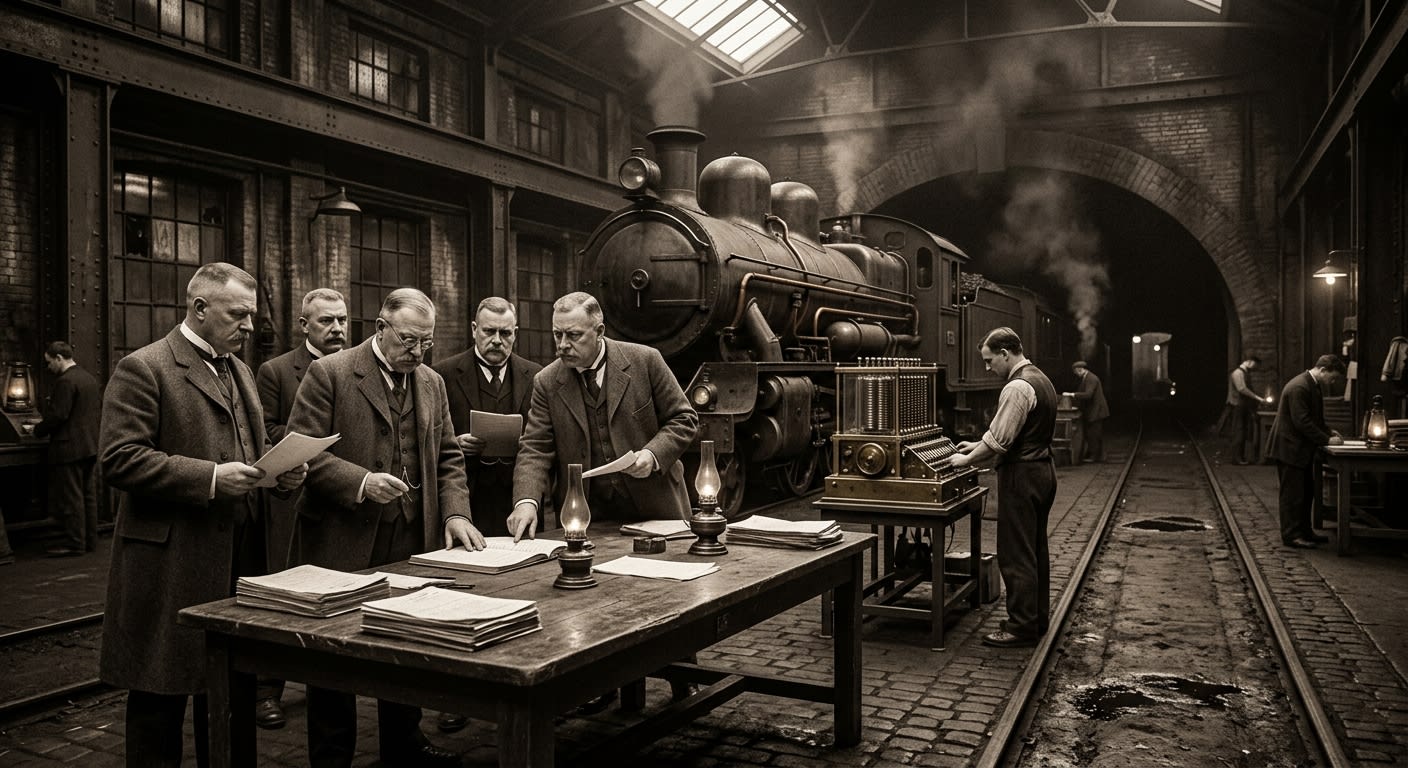
Bureau of Records filed terrain reclassification error. Bureau of Bells founded sung procedure. Yard Command founded the Tribunal, because a catastrophe without a court is merely a wound, and wounds are dangerous until someone writes a title above them.
The first hearings took place in a converted freight weigh-house near Cantor Walk. The dead were represented by a Records clerk, two widows, and a pile of grease-black gloves. The clerk spoke longest. The widows were reprimanded for interruption. The gloves, being wiser than all present, said nothing. By the end of the session the Tribunal had established its oldest doctrine: where manifest, measure, and iron disagree, the court shall determine which one was loyal after the fact.
Early Lorn commemorative plaques described the Yard Tribunal as “the instrument by which the dead of A.S. 112 received justice.”
Corrected. The dead received names, a memorial register, and a recurring inspection fee levied on the living. Justice was deferred pending operational requirements, where it remains in excellent company.
By A.S. 115 the Tribunal held a permanent hall. By A.S. 119 it had acquired oath-collars for repeat unsung offenders, a black bench for manifest fraud, a bell cage for cantor testimony, and a rail section from the Silent Derailment fixed above the chief judge’s seat. The rail rings once each morning when the court opens. No hammer strikes it. The Bailiffs insist the sound comes from temperature shift. Bailiffs must be allowed their little poems.
#On the Hall, Its Doors, and Its Useful Acoustics
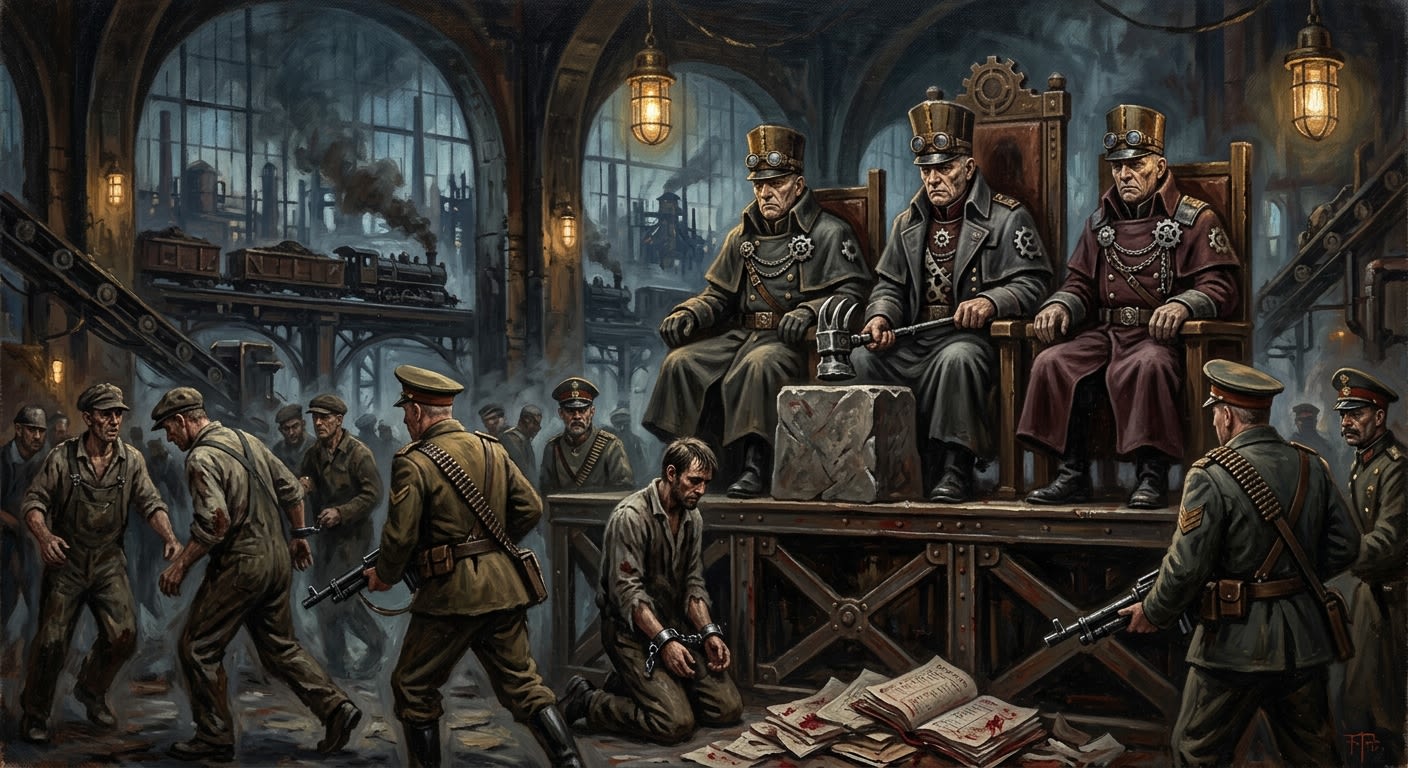
The Tribunal Hall is narrower than dignity requires and longer than mercy permits. Freight tremor enters through the floorboards. Coal grit gathers in the witness grooves. The walls are lined with retired switch rods, cracked bell plates, broken coupler hooks, cancelled manifests, and the brass tags of men sentenced to corridor labour. At the eastern end stands the black bench, riveted from old signal-gantry plate and polished by sleeves, sweat, and the bureaucratic pleasure of seated authority.
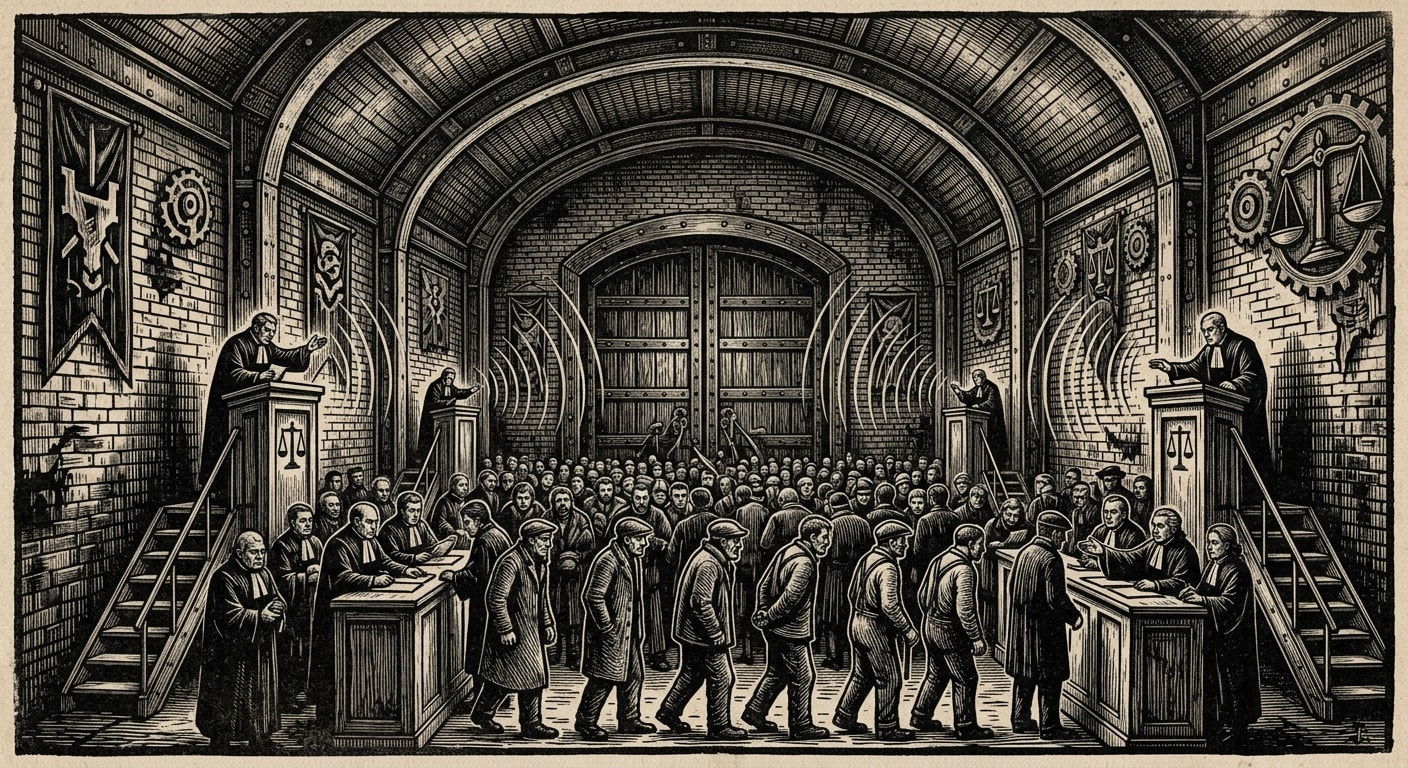
There are three doors. The public door admits workers, widows, foremen, cantors, clerks, provosts, and any citizen willing to stand long enough to become evidence. The Records door opens behind the bench and smells of paper, wax, and expensive cowardice. The iron door leads downward into holding cells known as the Brake Rooms, where accused switchmen wait within earshot of passing trains and may meditate upon the liturgical beauty of compliance.
Above the bench hangs the dead rail of A.S. 112. Beneath it sit three adjudicators: the Yard Judge, appointed by Palatine Command; the Records Assessor, appointed by Prefect Halden Wry; and the Bell Examiner, appointed by Sister-Calder’s office. A War observer attends when cargo mattered. A Purity observer attends when speech grew interesting. A Union witness attends when the Thrown Hand can force its way inside without being arrested in the corridor.
The hall’s acoustics are praised in official reports. Every spoken word carries clearly to the clerks. Every whisper at the back rolls forward along the iron roof ribs and returns sharpened. The design punishes murmuring better than any sermon. Lorn respects architecture that informs.
#On Charges and the Grammar of Blame
The Tribunal’s charge sheet is a catechism of industrial anxiety. Unsung Procedure covers any act requiring certified measure that occurred without proper voice, with wrong voice, in wrong order, at wrong volume, under wrong witness, or in a silence later deemed meaningful. Manifest Discordance covers discrepancies between cargo, paper, route, seal, and arrival. Switch Neglect covers mechanical failure, human error, frost-lock denial, sabotage, and those occasions when the point moved correctly and the train nonetheless chose apostasy. Schedule Injury covers delay measured in wagons, not minutes. Yard Sedition covers organised refusal, excessive caution, union chalk, and laughter during safety litany.
A worker charged with Unsung Procedure may defend himself by proving that the measure was sung, that the measure was unnecessary, that the measure was corrupted by bell fog, that a superior ordered haste, that the switch housing lied under hand, or that the dead man had already signed the caution ledger. The last defence is strongest and rarely available, since dead men develop poor filing habits shortly before the wheel passes.
Cantors face Bell-Censure rather than ordinary conviction unless bodies are numerous, widows loud, or Sister-Calder temporarily unable to bury the matter in the Missed Measures book. Manifest clerks are disciplined through Records channels, which means they vanish into transfer, correction, demotion, or promotion depending on whose stamp embarrassed whom. Switchmen, being physically present when iron commits its theatre, stand closest to the rope.
Yard primers state that Tribunal procedure applies equally to all persons whose actions affect rail safety.
Corrected for adult readers. Procedure applies equally at the moment of inscription and unequally at the moment of consequence. Ink is democratic. Punishment has preferences.
#On the Judges and Their Instruments
The current Yard Judge is Magistrate-Provost Anselm Krett, a man with a square beard, a scar across one eyelid, and the vocal temperature of an iron stove after midnight. Krett began as a provost sergeant. He distrusts theories, unions, widows who speak without invitation, cantors who cry, clerks who smell of perfume, and anyone who says “systemic.” This makes him beloved by Yard Palatine Odrin Kessel, tolerated by Records, and hated by every worker who has watched him convert an accident into a manageable person.
The Records Assessor keeps the Paper Balance: a paired frame holding the manifest in one tray and the outcome slip in the other. It is ceremonial, since paper weighs very little and outcomes weigh as much as the court decides. The Bell Examiner keeps a pitch fork, two tuning plates, and a portable throat gauge used to determine whether a cantor’s voice fell below authorized measure. The Union calls the throat gauge “the little gallows.” It is not wrong.
The Bailiffs of the Yard wear grey coats with black cuffs and carry switch-hook staves. Their chief, Bailiff-Captain Sable Rook, is unrelated by verified blood to Old Sable, a fact announced so often that it has become suspicious by repetition. Rook knows the Hush entrances beneath the Tribunal and denies this knowledge in sentences polished smooth by practice.
BAILIFF LOG — SEALED UNDER KESSEL WRIT, A.S. 200 Accused manifest runner taken through Brake Room Three. Iron door opened without key at second bell. Runner stated: “The Yard has already heard me.” Dead rail above bench rang below floor level. Disposition: runner absent; bailiff report accepted after revision; Brake Room Three renamed Storage Annex C.
#On Old Sable and the Imported Market Beneath Procedure
The Tribunal wants Old Sable hanged after a trial long enough to confiscate his ledgers. This desire is understandable and already compromised. Sable is a Latchford minute-broker by principal territory, not a Lorn citizen, which makes his presence in Lorn evidence more insulting. His market sells minutes, windows, forged slips, route intelligence, and mercies official time refuses to price; its papers travel through boards, drainage, crawlspaces, Clerklofts, Hush entrances, and the low moral ceiling under which all logistics cities eventually find themselves crouching.
Yard Tribunal notices name him a black-market nuisance when speaking publicly and an infrastructural threat when requesting funds. His slips have entered evidence in thirteen proceedings, been rejected in nine, accepted accidentally in three, and vanished in one. The vanished slip had crossed the Records table, received an exhibit tag, and left behind a clean rectangle in the dust. Judge Krett fined the court clerk for improper exhibit fixation. The clerk paid. The slip remained gone.
After the late A.S. 199 blank master-permit disappearance, Tribunal jurisdiction expanded into minute-fraud, anticipatory stamping, pre-authorised windows, and what Records calls prospective validity contamination. The last phrase means Sable’s papers sometimes become true before the office that should make them true has decided to do so, a Latchford technique now appearing in Lorn exhibits with indecent confidence. Theology has broken on smaller rocks.
The Tribunal cannot try Sable because it cannot produce him. It cannot ignore him because every forged minute insults the schedule. It cannot admit dependence because Lorn’s pressure valves are mostly illegal, and a court that prosecutes its pressure valves must be ready to hear the boiler scream.
#On the Switchmen’s Union and the Lawful Use of Delay
The Tribunal’s quarrel with the Switchmen’s Union is intimate, fiscal, devotional, and nearly marital in its bitterness. The Union says the hand that throws may refuse if the hymn is false. The Tribunal says refusal injures schedule unless approved by proper authority. The worker asks who approves when authority is the danger. The Tribunal answers by calling the next case.
Slowdowns produce the finest legal theatre in Lorn. A caution interval becomes obstruction. A grease inspection becomes sedition. A widow-fund stoppage becomes conspiracy to starve the Line. Union advocates arrive with Crushed Book extracts, tool logs, witness chalk, and men whose fingers end too early. Cantors arrive with Missed Measures. Records arrives with corrected manifests. The bench receives all, blesses what serves throughput, and files the rest under human texture.
The present A.S. 201 slowdown has made the Tribunal hungry. Kessel wants named agitators. Sister-Calder wants cantor authority reinforced. Wry wants manifests obeyed even when they contradict events. The Union wants arrears paid, blame shared, and the right to stop a dangerous throw without being collared for piety’s inconvenience. No party says the true sentence aloud: the yard is frightened of itself.
#On Verdicts, Sentences, and the Mercy of Useful Men
Tribunal sentences are tailored to keep bodies near the work they understand. A manifest forger may lose fingers if poor, license if skilled, and title if protected by a superior whose protection has expired. A switchman convicted of negligent throw may receive lash, corridor labour, wage seizure, oath-collar, or reassignment to night frost points where repentance can be measured in toes. A cantor whose failed measure killed men may be silenced for a season, sent to forward trench choirs, or entered into Sister-Calder’s book and left alive as warning furniture.
Death sentences are rarer than pamphlets claim. Dead workers do not throw. Dead clerks do not stamp. Dead cantors do not certify. Lorn prefers living punishment: labour under stigma, wage under lien, name under watch, body under schedule. The condemned man remains useful. Utility is the most durable mercy in the Heartlands fringe.
There are acquittals. They occur when blame would damage a better office. A switchman may be cleared if convicting him would expose a Bell Marshal’s altered measure. A clerk may be cleared if convicting him would expose Records correction practice. A cantor may be cleared if convicting her would strengthen the Union. The acquitted leave through the public door under stares that feel like verdicts. Lorn knows innocence by its smell: paper, sweat, and someone else’s protection.
#On the Present Court
As of A.S. 201, the Yard Tribunal sits daily and sometimes through the night. The Payroll Spur scandal has swollen its sealed docket. The Hymn-Phase Slip has made its certainties tremble. Tower Nine’s lamps blink in sequences no judge wishes entered into testimony. The Hush Tunnels carry witnesses away faster than bailiffs can requisition maps. Inquisitor-Regent Veyl Hark is said to be reviewing bell codes, payroll logs, Union oath-notes, and the sealed reports on the Silent Derailment. Lorn listens for her arrival the way a debtor listens for boots on the stair.
The Tribunal prepares by polishing benches, revising admissibility rules, expanding the Brake Rooms, and insisting that all ordinary business continues. This is the Synod’s classic posture before institutional humiliation: dust the altar, hide the knives, rehearse confidence.
The dead rail still rings each morning. The judges still sit. The workers still arrive in coal-stiff coats with chalk rubbed from their wrists. The cantors still defend the measure. The clerks still produce paper that explains why the paper was always correct. The trains pass close enough to shake testimony from timid mouths.
When the freight thunder passes, the court resumes. It has heard the iron. Now it may, if time permits, hear the man.