
#On the Market Beneath the Boards
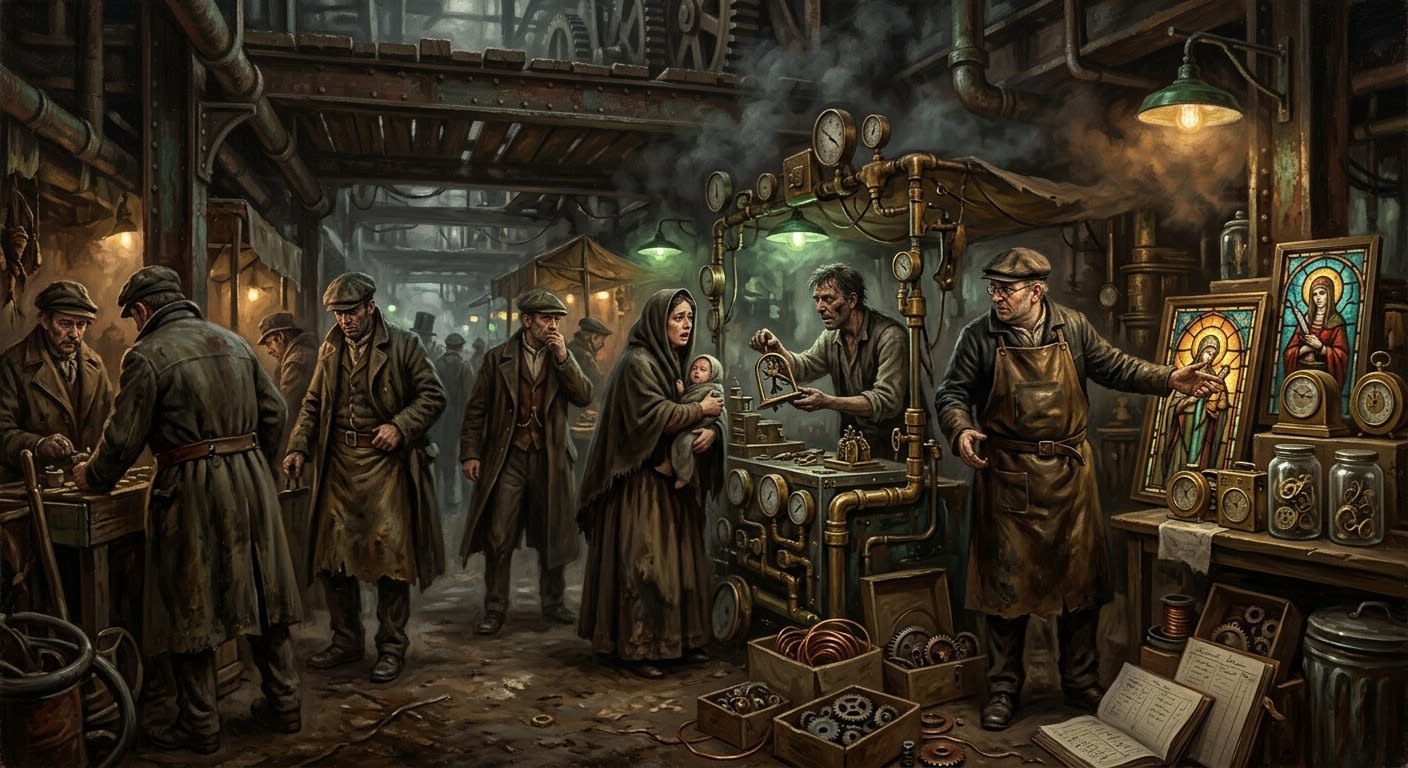
The Minute Market is the under-catwalk quarter of the Latchford Permit-Yards, where time is weighed, folded, forged, priced, and sold back to the people from whom it was stolen with official courtesy. It lies beneath the Clerklofts and above the drainage canals, in that hot and low interval where candle-drip falls through floorboards, acidic ink breathes from culverts, and every plank overhead knocks with the heels of clerks who have never wondered whether tomorrow may be purchased in slips.
A respectable map of Latchford marks the space as maintenance crawl, drainage easement, or lost-and-found paperwork annex. Respectable maps are devotional fiction with rulers. The people in the queue call it the Minute Market. The Bureau of Records calls it nuisance traffic when speaking internally and denies it when speaking upward. The Bureau of War raids it twice a season, purchases from it twice a week, and blames Records for both facts. Shadows watches. Shadows has watched for years. Shadows has not moved.
The Market sells minutes. This must be understood precisely. A minute in Latchford is not sixty seconds. Sixty seconds are for clocks, sermons, and men innocent enough to believe measure precedes authority. A Latchford minute is a purchased interval of permission: one bell-mark stretched, one window kept open, one draft sweep deferred, one convoy pulse delayed long enough for a family to pass the Hall of Seals before the clerk remembers he was meant to be cruel. It is time given grammar. It is bribery made documentary. It is mercy with a price board.
#On Its Founding in Delay
The Minute Market did not begin with villainy. Villainy arrived later, with ledgers, supply contracts, and a better grade of wax.
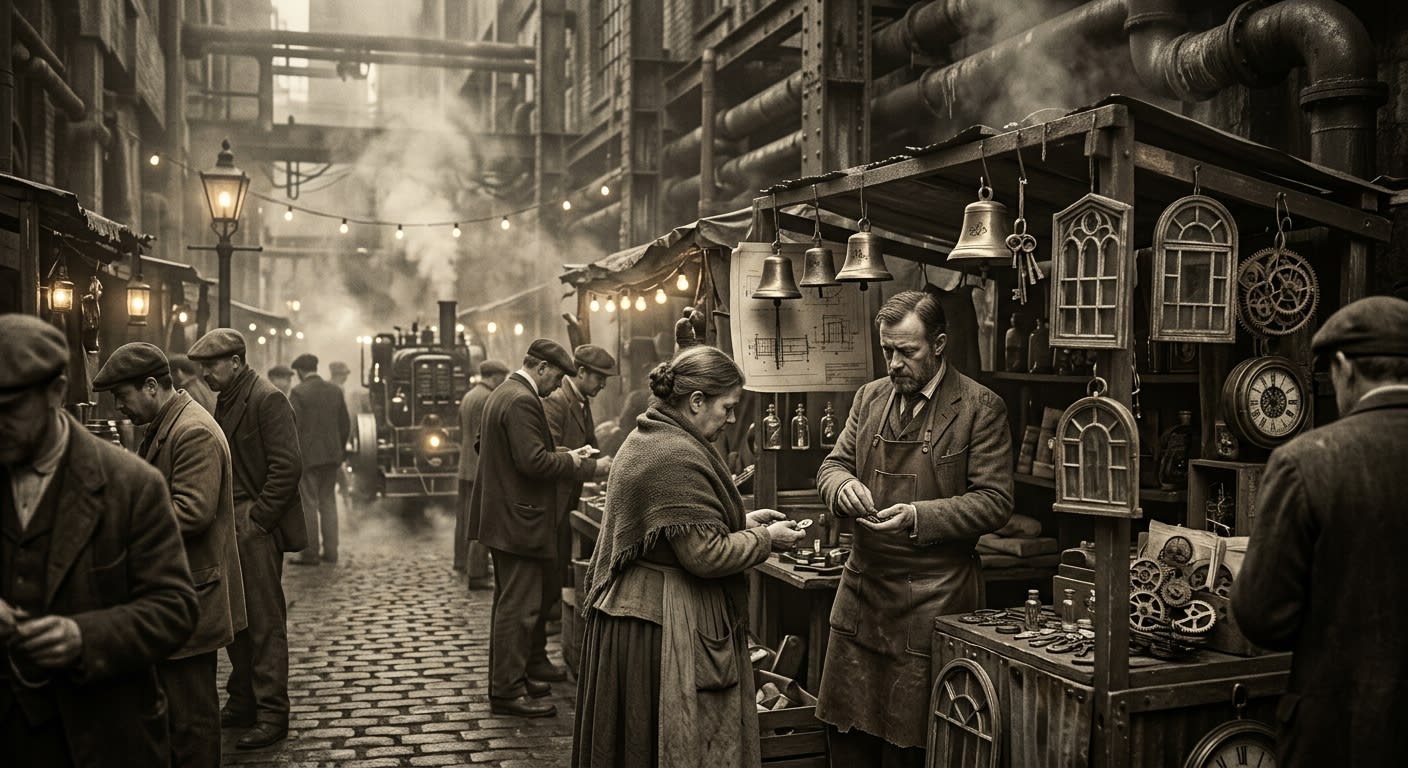
Its first ancestor was waiting. When the Latchford checkpoint hardened from a timber gate into a trench-town after A.S. 72, the ford already had hunger, mud, clerks, conscripts, and wagon wheels sunk to the axle. By A.S. 102, when the Queue-Marshal profession and wider permit machinery had given lawful shape to controlled waiting, a person could lose a day because a stamp window closed early, lose a week because a convoy priority shifted, lose a son because War needed bodies and Records found the family papers disagreeable. Where official time becomes punishment, unofficial time becomes food.
The early trade was crude. A rope tender delayed a line for a crust. A bell-runner muttered which bay would open after Sext. A clerk's lover carried names from one queue to another. A dead man's unused travel window passed to his widow for a loaf, then to another widow for two loaves, then to a carter for a wheel, then to a shepherd for silence. The paper was false before the market had a name. The need was real before the paper knew how to lie.
By A.S. 110, when the Master Gate Clock fixed daily windows with brass certainty and private appetite, the trade had matured. Minute-slips (Unregistered) appeared: small folded papers carrying stolen bell-marks, false extension seals, ration-window endorsements, and the peculiar smell of official boredom. The best forgeries were not dramatic. They looked tired. They looked handled. They looked as if three clerks had already been irritated by them, which is the highest form of authenticity in Latchford.
Yard instructional placards describe the Minute Market as a recent corruption arising from wartime crowd stress.
Corrected. Wartime crowd stress gave the Market customers. Latchford's own window system gave it theology, arithmetic, and floor space. Blame must be filed with the architect before the tenant.
#On the Shape, Smell, and Hours
The Minute Market has no formal gate. A gate would be too honest. Entry occurs through service ladders behind Ration Audit Row (Unregistered), lifted boards beneath Clerkloft Seven, a drainage side-mouth marked with three wax scratches, and a crawl from the Paper Sump that only children, criminals, and very thin auditors can use safely. The last category is theoretical.
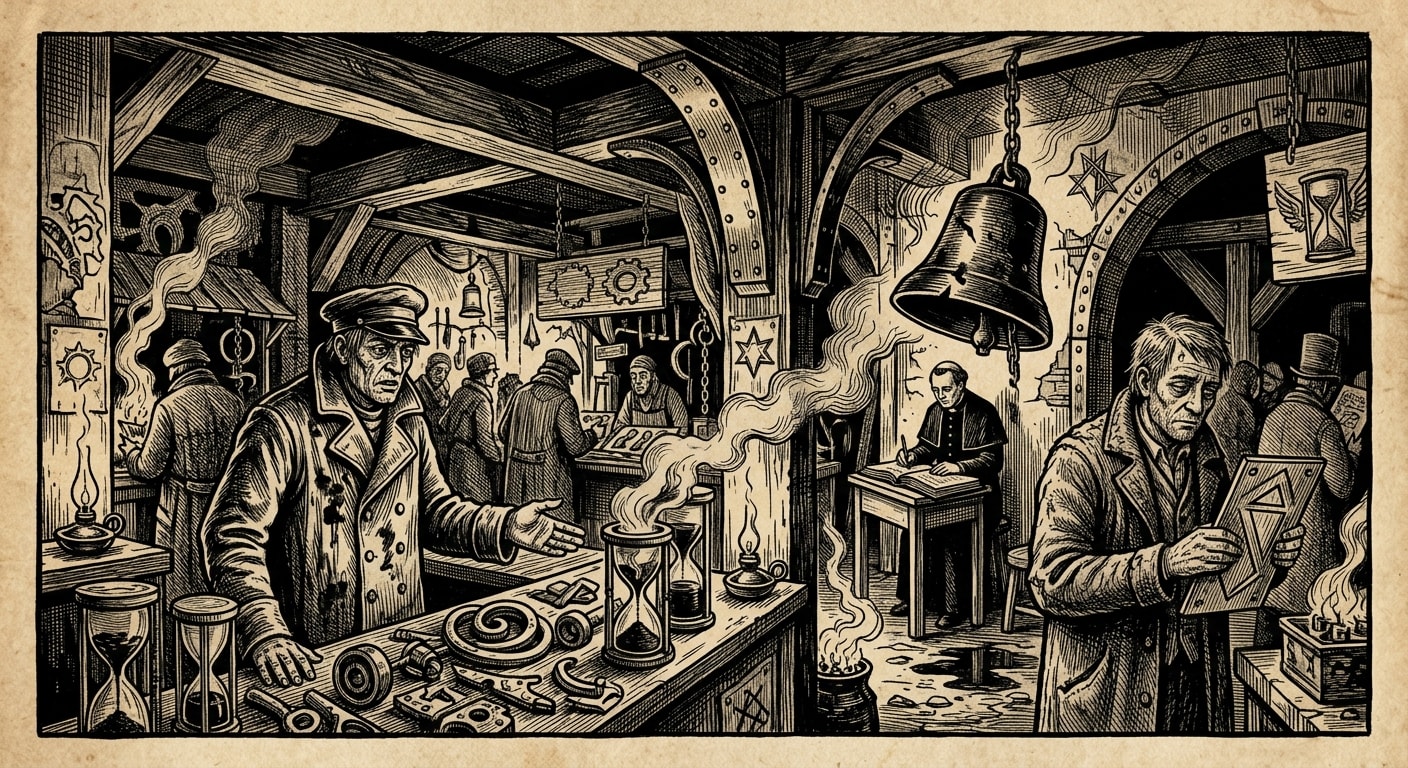
The air is warm because heat leaks downward from clerk stoves. It smells of hot pennies, cheap perfume, burnt paper, wet wool, candle soot, metal ink, and that sour human patience produced when people have been instructed to wait clean while freezing. Stalls are crates, shawls, reversed ledgers, broken doors, kneeling boards, and one old confessional screen stolen from a Transit Confessor booth and repurposed as a private bargaining partition. The Market's ceiling is Latchford's floor. Every stamp above is a drumbeat below.
Day trade is cautious. Lost-paper vendors sell duplicate queue slips. Wax children carry sealed knots of information from one crawlspace to another. Soup women sell broth in cups marked by bell-hour, thinner after each cancellation. A lamplighter rents shadow for private transactions by angling his hooded flame three inches left. At noon, when ration audits crowd the surface, the Market narrows into low trade.
Night trade is larger and less polite. Curfew drives the unwindowed downward. Night Sweepers move through the upper culverts with forged writs and sanitation hooks. Old Sable's runners appear after the counting-bright lanterns are lit overhead, never together, never twice in the same coat. A buyer shows papers two-handed. A runner answers with one hand visible and one under cloth. No one says tomorrow. The Market says next window, next bell, next breath, if paid.
#On Minute-Slips and Other Currency
Four currencies govern the Market: ration chits, bone tokens, wax marks, and minute-slips. Coin is accepted, sniffed at, and usually converted at a rate designed to insult the payer. Coin buys broth. Paper buys motion.
A minute-slip may extend a legitimate window, borrow an unused one, conceal a missed bell-mark, attach a traveller to a convoy for which he lacks clearance, or delay a draft sweep by making a lane appear already processed. The poorest slips are inked lies. They pass only tired clerks, frightened guards, and officials who have been paid to suffer eyesight failure. Better slips carry stolen bell-marks from the Master Gate Clock. The finest anticipate authority: they bear stamps for windows not yet announced, routes not yet opened, and inspections that will later occur exactly as the paper already claimed.
Those finest slips are why the Market frightens men who otherwise enjoy it. Ordinary forgery imitates law. The new slips arrive before law and wait for law to catch up.
CONFISCATED MINUTE-SLIP, LATE A.S. 199 Window: Third Convoy Pulse, south ford lane. Stamp time: ███████, one bell before official posting. Carrier: widow with two feverish children. Gate action: accepted. Ledger action: delayed, then reconciled. Disposition of originating runner: not found. Disposition of clerk who accepted slip: promoted, then transferred, then removed from roster.
The Market also sells route intelligence: which Queue-Marshal is hungry, which Queue-Marshal is righteous, which Warden drinks, which audit lamp has bad oil, which rope tender lost a child and will move a mother sideways instead of backward. It sells dry catwalk space, false ration positions, stamp-lamp malfunctions, queue ghosts for identity swaps, and silence at prices that rise with the weather.
Kindness is available. It costs more because everyone recognizes it.
#On Old Sable's Hand
Old Sable is the Market's principal, unless he is its mask, office, myth, title, dead founder, or most successful clerical error. He has never been confirmed in daylight. That fact is repeated so often in Latchford that it has acquired the comfort of prayer. Men who have never seen him still lower their voices at his name. Clerks who deny him leave gaps in their denial large enough for a child to crawl through.
He sells forged minute-slips, stolen windows, route intelligence, and survival without visible pleading. His runners are culvert children with clean nails, women who smell of cheap perfume and paper ash, Queue Shepherds (Unregistered) who can turn a crowd by coughing, and discrepancy clerks whose hatred of truth has become professional skill. They carry no uniform. Their mark is timing. A Sable runner arrives when the buyer has reached the instant before public begging. Call it excellent inventory practice.
The blank master-permit disappearance (Unregistered) of late A.S. 199 changed the Market. Before it, Sable's slips copied authority. After it, they began predicting authority. Prefect Mavren Tull (Unregistered) locked blank stock inside his private sleeping cell. Quarter-Commander Hesta Brune (Unregistered) requisitioned more holding cages. Yard Command Circular 199-14 (Unregistered) called Sable a common black-market nuisance. A nuisance, apparently, that can make senior officers sleep beside paper.
A preliminary Yard Tribunal note stated that Old Sable controls only petty under-catwalk trade.
Corrected. Petty trade does not move draft sweeps, pre-date bell windows, or receive the patience of Shadows. Petty trade sells onions. Old Sable sells the interval in which onions remain purchasable.
Sable's relation to the Market is liturgical. He is absent and everywhere interpreted. A runner says wrong hour and a raid fails. A widow crosses with a future stamp and the gate accepts her. A Warden asks what belongs to Sable and loses his posting to the Paper Sump. The Market does not need to see its master. It needs only to see his timing work.
#On Buyers, Sellers, and the Rope Above
The Market's buyers descend from every layer of Latchford. The unwindowed arrive first: families trapped in line, pilgrims with frost in their sleeves, carters whose cargo papers expired while awaiting the papers certifying that their cargo papers had not expired. They come with ration chits, rings, death receipts, wax blocks, boots, names of corrupt clerks, and stories no one wants but everyone can sell.
Soldiers come angry. Clerks come hooded. Wardens come last in public and first in private. Queue Shepherds denounce the Market in daylight, then buy lane rumours after curfew. Waxwrights (Unregistered) accuse the Market of seal theft while supplying flawed blocks no official window would accept. Transit Confessors pretend horror at confession attachments sold back to petitioners, then purchase copies when they need a hook in someone's throat. Latchford is not hypocritical by accident. It is built in layers so that each layer may condemn the rot below while dripping into it.
Above the Market, the rope system of Latchford strains all day. A Marshal holds a lane. A clerk closes a window. A mother offers a wedding reliquary for five carts forward. A captain offers twice to push her backward. The Market hears these exchanges through boards and prepares prices before the tears dry.
The Market's taboo is children in the stack. Even corrupt Marshals have limits older than doctrine. When a child is crushed, frozen, or declared unwindowed, the Market changes temperature. Prices drop for mothers for one hour. Runners move sideways routes without commission. Old women remember doorways they had been paid to forget. This softness does not redeem the place. It merely proves that even a sewer may contain one clean stone.
#On Minute Drift and the Eleventh Strike
The Minute Market lives beside anomaly and eats from its hand.
At Latchford, the Master Gate Clock drifts in clusters. Bells double-tap. Stamps appear with times their bearers do not remember receiving. The ford sheds little shears of missing interval: two minutes gone from a conversation, five from a queue, an hour from a man who entered a culvert at curfew and returned with grey in his beard. The Bureau of Rites calls some local practices not fully wrong, which is how Rites screams.
The Market has always known what official clocks deny. Salt lines on thresholds sell beside counterfeit bell-cards. Wax seals for boots hang next to draft deferral slips. Witness-pairing contracts are available in pairs, naturally, with a surcharge if the witness has a good memory and no living relatives. Minute Preachers (Unregistered) declare time a sin and sell absolution in slips folded three times toward the ford.
The darker rumour holds that the clock is fed. Night Sweepers take rows that will not be missed. The Paper Sump receives forms before names disappear from them. Somewhere beneath the ford, or Gate Nine on the wider Queue Road, or both, an apparatus turns human waiting into something useful to persons whose signatures do not appear on ordinary files. The Market does not ask what the apparatus produces. Merchants rarely interrogate the mine while the silver is still coming out.
The eleventh strike is the Market's own curfew. The official schedule permits ten in the quarter. When an eleventh sounds, stalls close without command. Runners vanish. Buyers clutch their papers to their tongues. Even Old Sable's people stop speaking. For one breath, the understructure becomes a chapel.
Then trade resumes, because terror has never cancelled hunger.
#On the Present Condition
As of A.S. 201, the Minute Market is active, richer after the A.S. 199 blank-permit disappearance, and more dangerous because its best papers no longer merely lie. They arrive early. Yard Command lacks the courage to destroy it, the honesty to license it, or the competence to replace what it supplies. Shadows' patience continues. Records denies. War purchases. The queue pays.
The Market's public face remains lost-and-found paperwork and under-catwalk trade: broth, water, gloves, duplicate slips, shelter, gossip. Its true business is time under coercion. It converts fear into windows, windows into slips, slips into passage, passage into debt, debt into labour, and labour back into fear. A tidy wheel. The Synod admires tidy wheels when it owns them.
The Minute Market owns this one.
By curfew the catwalks knock, the drainage canals breathe, the Paper Sump swallows ink, and somewhere under Clerkloft Seven a runner folds a tomorrow that has not yet been posted. Above, the stamp falls. Below, someone sells the moment before it lands.