

I've finished the source reads and am writing the codex prose now.
#On the Chapel Beside the Annex
A present documentary compilation, A.S. 201 / 1911 CE. The year dates this file. It dates nothing inside it.
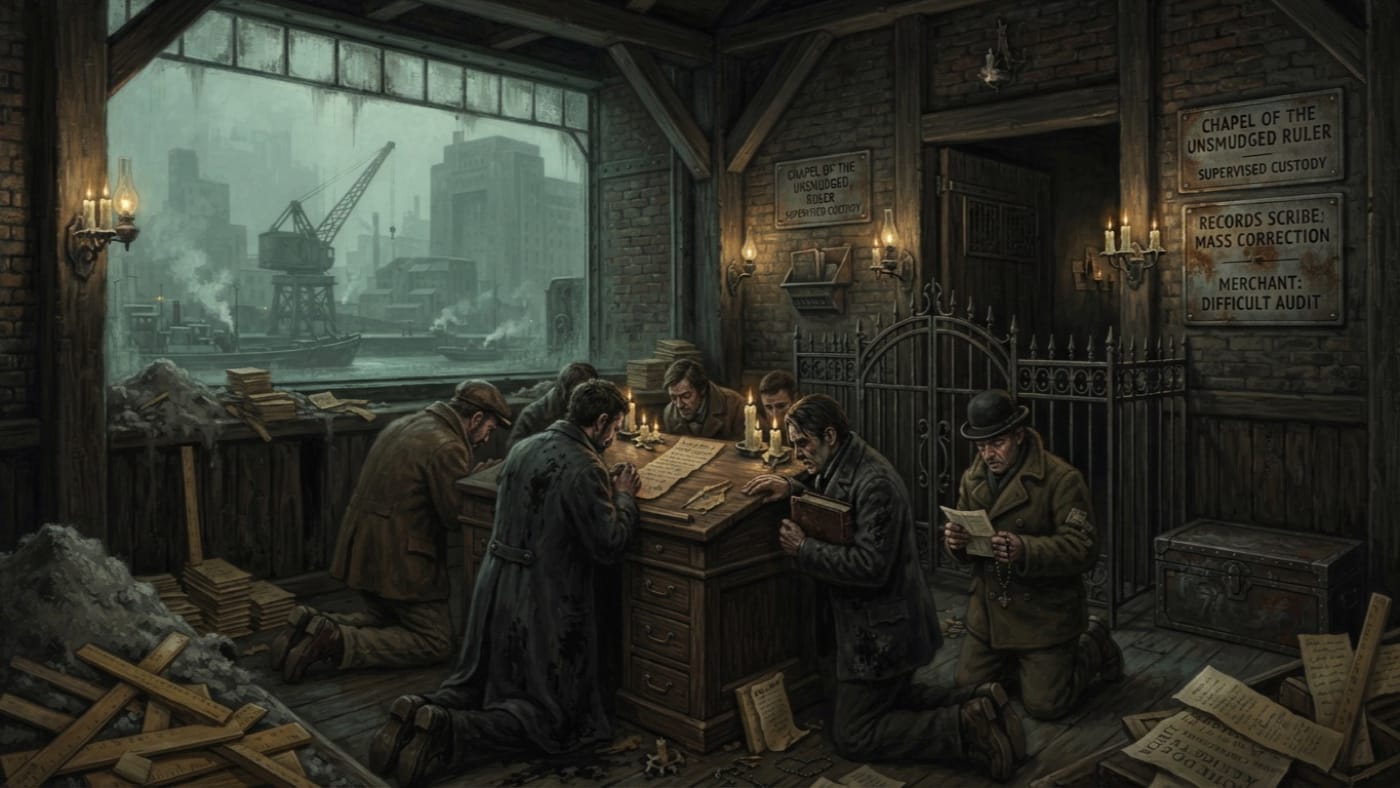
The Chapel of the Unsmudged Ruler sits in Antwerp beside the Scheldt Annex, the Bureau of Records house near the old crane, where dock manifests are kept in raised cabinets and the river is kept everywhere else. The Tithes clerks of the Salt-Scale House keep their balances next to the Annex. The file does not say which wall of which building the chapel leans against, and this compilation will not draw a map just to look complete.
The chapel holds one object of consequence. It is a writing desk that was once sold to the faithful as the siege desk of Saint Verran. The desk is false. The visitors are real. Records Scribes come before mass corrections. Merchants come before difficult audits. They kneel at the same oak and want nearly opposite favours from it.
This dossier was assembled in A.S. 201 from the standing Antwerp file and the approved Verran hagiography. It records no founding, consecration, inspection or ceremony, because none has been documented to my satisfaction, and my satisfaction is the lowest bar the Bureau maintains.
#On the Desk and Its Provenance
The desk is dark oak, scarred by candle heat. When it was presented, its drawer held grey dust, a snapped ruler and an old grain chit. That inventory does most of the work.
An Antwerp merchant family presented the desk as the complete furniture of the saint's eleven-day correction, the place where ten thousand names were struck from earthly entitlement. The file withholds the family's name, a courtesy it rarely extends to the poor. The family had no need to explain the drawer. Pilgrims explained it for them. Grey dust in a saint's drawer asks to be read as the siege. A snapped ruler asks to be read as the line. A grain chit asks for tears, and it got them.
Testing later traced each piece to its true source. The Antwerp file does not record the methods or who did the testing. The wood came from an Antwerp countinghouse refitted after Verran's approval. The dust was dock sweepings. The ruler came from a schoolroom. The chit belonged to a municipal ration dispute of A.S. 119 / 1829 CE.
The dates need discipline, so here they are with discipline. A.S. 112 / 1822 CE is the year of the saint's approval, and it does not date his life. A.S. 119 is the year of the quarrel the chit came from, and it does not date the fraud's exposure. The file gives no year for the exposure. Neither date says anything about when the chapel was built. A desk made from timber refitted after its saint was canonised cannot have held his elbows. Records Scribes teach this kind of arithmetic to children, and children usually pass.
By the time the lie was found out, the desk had drawn enough offerings to fund a minor chapel roof. That figure measures devotion. Antwerp counts in roofs because Antwerp prices everything in buildings. The file does not say whose roof the money became, if any, and I will not lay those tiles over this chapel's head.
The Antwerp Verran desk was declared false and destroyed.
Corrected. It was declared false and kept. No pyre, no axe, no ceremonial sawing before a crowd. The desk was retained in supervised custody because burning a fraud that had collected that many offerings would have been read as an accusation against the people who made them.
#On the Saint Invoked There
Verran is the approved patron of the Records Scribe profession. His cult was approved in A.S. 112. The official hagiography credits him with an eleven-day correction of a siege roll that removed ten thousand names from earthly entitlement while his pen never smudged. That account is attributed, approved and repeated. It is not something I can certify. The hagiography gives the siege no name I am willing to repeat and no year I am willing to stamp. His life is composite. If he had a desk, it is somewhere else, or nowhere.
Relics classifies his lamp. Nothing in the Antwerp file places it in this chapel. No authorised reliquary holds his pen. Whatever kneelers see at the Scheldt, they are not seeing the furniture of the miracle.
In Records usage, a clean line is one a supervisor will initial and an auditor will pass. It is also the line that ends a ration. A scribe who strikes a name from a roll takes away bread, lodging, passage and work from a person who goes on needing them for a while. The approved miracle is that the ink behaved. The hagiography counts the ten thousand and does not follow them anywhere. This compilation follows the hagiography.
The last marginal note attributed to the saint reads: Rolls balanced. Lamp extinguished. The Creator is a column. Antwerp sells that sentence on cards. The Bureau tolerates the cards.
#On Custody and Offerings
The Antwerp file gives the desk three findings. It is materially false, devotionally active and administratively awkward. Each one belongs to a different office.
Materially false is a finding of fact. It was established once and has not been disturbed.
Devotionally active is an observation. People still come, still pray, and still leave coin. A queue at a desk proves there is a queue. An offering proves an offering was made. The desk has worked no miracle that this office will record, and the Church does not pay out on a miracle simply because someone kneels.
Administratively awkward is a confession, and the most honest of the three. A false relic that people still pray at cannot be filed as a relic, burned as contraband or sold as furniture. So it stays where it is, under supervision, as an instructive fraud. Instructive for whom, the file does not say. In my experience the lesson goes chiefly to the people who did the supervising.
The file does not record who holds the keys, who counts the coin, or which hand signs the custody book. I decline to invent a sacristan to tidy this paragraph.
#On Corrections, Audits, and Prayer
The two kinds of visitor share a building and very little else.
The Records Scribe comes before a mass correction, when names are altered by the hundred after a levy, a fire, a famine or a night courier's sealed order. In the profession's own phrase, paper is citizenship. A scribe on a correction day decides who keeps a ration, who keeps a lodging and who becomes "pending." Supervisors check how thick the strokes are. Auditors compare seals. The danger to the scribe is rarely the name that gets removed. It is the smear that shows who removed it. The scribe comes to the oak to ask for a hand steady enough that the page takes the blame.
The merchant comes before a difficult audit. Antwerp's merchants live in manifests, tariff weights and bonded cargo. An audit sets the ledger against the warehouse and the warehouse against the Salt-Scale House. The scribe fears a line that shows. The merchant fears a line that adds up. He prays that the auditor's columns will close cleanly, without anyone looking at what went into them.
Both read from the same approved prayer strip, sold beside the desk:
Saint Verran, keep the line clean.
The local dock clerks add a clause under their breath:
and the cargo drier than last year
Doctrine has not approved the addition. It has survived anyway, the way low speech survives in a port, through repetition, wet sleeves and a churchman's reluctance to scold a man holding a manifest. Survival is not permission. No strip prints the clause. No sermon commends it. Everyone in the chapel can hear it.
The scribe and the merchant sometimes kneel side by side. I am told they do not speak. That is wise. Each of them may one day be the other's evidence.
#On the Present File
As of this compilation, A.S. 201 / 1911 CE, the desk remains in supervised custody beside the Scheldt Annex. Its attribution is false and its devotional use continues. The file gives no year for the chapel's founding. The merchant family is unnamed, the custodians are unrecorded, and the saint's lamp is held elsewhere under Relics classification. The approved prayer is the strip. The unapproved clause is muttered. Scribes still come before corrections and merchants still come before audits. The offerings are authentic, and the oak is not.
Doctrine has made no finding on the faith of the people who kneel there. Records has made no finding on the miracle, because there is none to make.