

#On the House Near the Old Crane
Documentary survey, A.S. 201. The date is the date of this survey. The house is older, and the file does not say by how much.
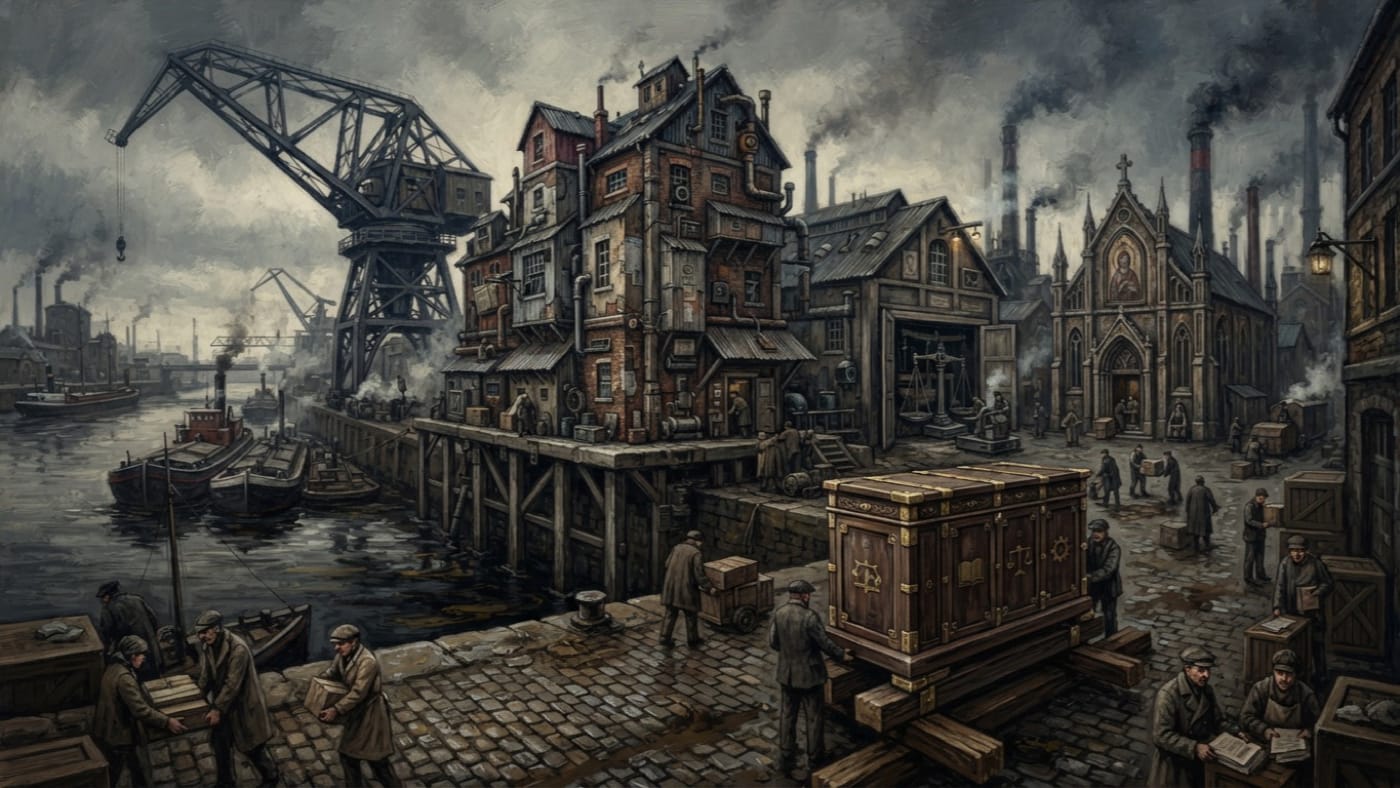
The Bureau of Records maintains the Scheldt Annex in Antwerp, near the old crane. That sentence is most of what the Antwerp file grants. I have read it the way a customs clerk reads a bill of lading from a captain he dislikes: twice, slowly, with a thumb on each line. The Annex is a house of paper on a quay of water. Its lower rooms hold dock manifests in raised cabinets. Its upper floors, if it has any worth the name, are not described. The file also leaves out its founding year, its builder, its first keeper and the distance from its door to the crane.
This survey was made in A.S. 201, the present year, 1911 by the old reckoning. Do not read that year as the year the Annex was built, flooded, opened or inspected. The dateline marks when I looked. Readers who want an anniversary will have to bring their own candles and do their own sums.
The last line of that stamp is the reason this entry exists. The Scheldt is a river. It carries barges inward and excuses outward, and it has its own plate. The Annex is a building that keeps the river's paperwork. A man who confuses the two will look for manifests in the mud. All he will find there is cargo the manifests failed to describe.
SCHELDT ANNEX — archived referral; no entry resolves it.
Corrected. The referral resolves here, to a Records office near Antwerp's old crane. Unresolved referrals drift toward the nearest wet noun, and this one was drifting toward the river. The river keeps no cabinets.
#On the Raised Cabinets
The Antwerp account dates the cabinets by fear. The A.S. 78 flood scares taught river cities that paper stored at floor level is a theological insult, and the Annex put its manifests up off the stones. I keep the record's word: scares. The file does not say that water entered the Annex that year. It says nothing of how high the water came, what it ruined or whom it drowned. It records a fright and a carpentry decision made in answer to it. A fright is enough to move cabinets. Most reforms in this Church began as one.
A.S. 78 is a crowded year. Records itself was transformed in it, and the Annex is one damp outpost of that Bureau. Sharing a year makes no parentage. The transformation did not found the Annex, and the file never claims that it did. Silt Week fell in the same year and struck crossings on the Rhine tributaries. Antwerp's scares are entered separately, and I leave them separate.
The second fact is a different fact. The Antwerp account states that by A.S. 201 the Annex has been raised twice against flood. It gives no dates for the two raisings, and no engineer, method or measurement. It does not say what was raised: the house, the floor, the cabinets or some mixture of the three. I decline to count the cabinets of 78 as the first raising. The account places the cabinets in one passage and the raisings in another. A Records Scribe who merges two entries because they rhyme gets the habit trained out of him, or gets himself trained out of the Bureau.
Paper is the most frightened cargo on any quay. Grain spoils slowly and announces it with a smell. Salt survives almost anything except theft. A soaked manifest turns into a grey poultice of half-lines. A half-line on a manifest is an invitation to every merchant who has ever wanted his cargo smaller on paper than in the hold.
#On the Joint Custody
The Antwerp plate files the Annex under a classification called JOINT DOCK CUSTODY and lists four Bureaus against it. I copy the list exactly as filed.
A careless reader sees four Bureaus and pictures four desks in one wet room, their clerks glaring at one another over a single inkwell. The classification divides jurisdiction. Where each Bureau actually sits is a separate question, and the file answers it only once.
The Bureau of Records holds the paper: the manifests, the name rolls, the damaged receipt copies, and the cabinets that keep all three above the floor. The damaged copies are the interesting line. Records keeps the ruined page alongside the clean one, because a smudge is evidence and a missing corner is testimony. A damaged copy is where a lie went to die, or where it went to hide. The scribe's whole craft is telling which.
The Bureau of Tithes holds the weight: tariff weight, salt dues, grain levy adjustment and bonded cargo. Tithes does not sit in the Annex. It occupies the Salt-Scale House next door, where its tariff clerks keep two sets of balances, one for cargo and one for merchant conscience. The second sees less use. Two houses on one quay suits both Bureaus. Records can watch Tithes weigh, and Tithes can watch Records write. Neither has to offer the other a chair.
The Bureau of Doctrine holds a narrower line: oversight of relic handling in corrected measure cases. Antwerp ships relics the way it ships everything else. When a measure needs correcting and a relic is part of it, Doctrine watches the hands. The file says nothing more. It does not say where such cases are heard, who brings them or how often they arise. The Hall of Corrected Measures stands nearby. I will not move Doctrine's oversight into it on the strength of a shared adjective.
The Bureau of Festivals holds procession access after A.S. 138. That is its whole entry. The year is precise where the rest is silent. A.S. 138 was the year of the Gray Week Famine and of Receipt Reform, when Directive 88-F replaced paper procession receipts with wrist-ribbon stamps. Festivals came to the docks with its drums after the city had, by the Antwerp account, taught auditors to duck. The classification grants Festivals access and does not say what form that access takes.
#On the Neighbours and the Route
The Chapel of the Unsmudged Ruler stands beside the Annex and keeps the Antwerp desk of Saint Verran. The Antwerp account calls the desk materially false and keeps it under supervised custody as an instructive fraud. Records Scribes visit it before mass corrections, and merchants before difficult audits. The chapel is a neighbour, not a department of the Annex, and the file does not say which wall the two buildings share, or whether they share one at all. The prayer strip asks Verran to keep the line clean. By the same account, dock clerks add under their breath a request that the cargo be drier than last year. Doctrine has not approved the addition. For a building with raised cabinets next door, it is the most practical prayer in Antwerp.
The route of the Gratitude of Restored Flow runs from the Dock Chapels through the Hall of Corrected Measures, past the Scheldt Annex, across the Grain Court, and down to the east granary steps. Note the word "past." The Annex stands on the route, and the route does not enter it. The file gives the order of stations and nothing else: no map, no year when the route was fixed, no rule for the drums at the Annex threshold. An archive wants stillness. A procession wants confetti made from shredded duplicate returns. The route keeps them a street's width apart, which is as much peace as either can expect.
The route's last station belongs to Gray Week. Antwerp's place in that file is fixed in public as the disputed fourth city. Records privately prefers Antwerp, Festivals files Lyon, and a Tithes memorandum declines to name the fourth city at all. The Antwerp account sets its riot in the east granary courts. Nothing in that account puts the riot at the Annex, and I will not move it there to make the cabinets more interesting. If the Records preference is right, A.S. 138 was the year Antwerp stopped believing its manifests. The manifests themselves stayed where they were, off the floor.
#On the Present Custody
At the time of this survey the Annex stands near the old crane, twice raised, with its cabinets above the floor and its manifests inside them. Records keeps the paper. Tithes weighs next door. Doctrine watches the relics when a measure is corrected. Festivals goes past on its appointed days. The river runs below all four and pays none of them.
The Creator gave Antwerp a deep-water port and a low floor. The Bureau has answered the second gift twice with carpentry and once with a classification. Nobody consulted the Scheldt on either, and it has so far declined to file a return.