
#On the City That Counts Its Saints by Warehouse
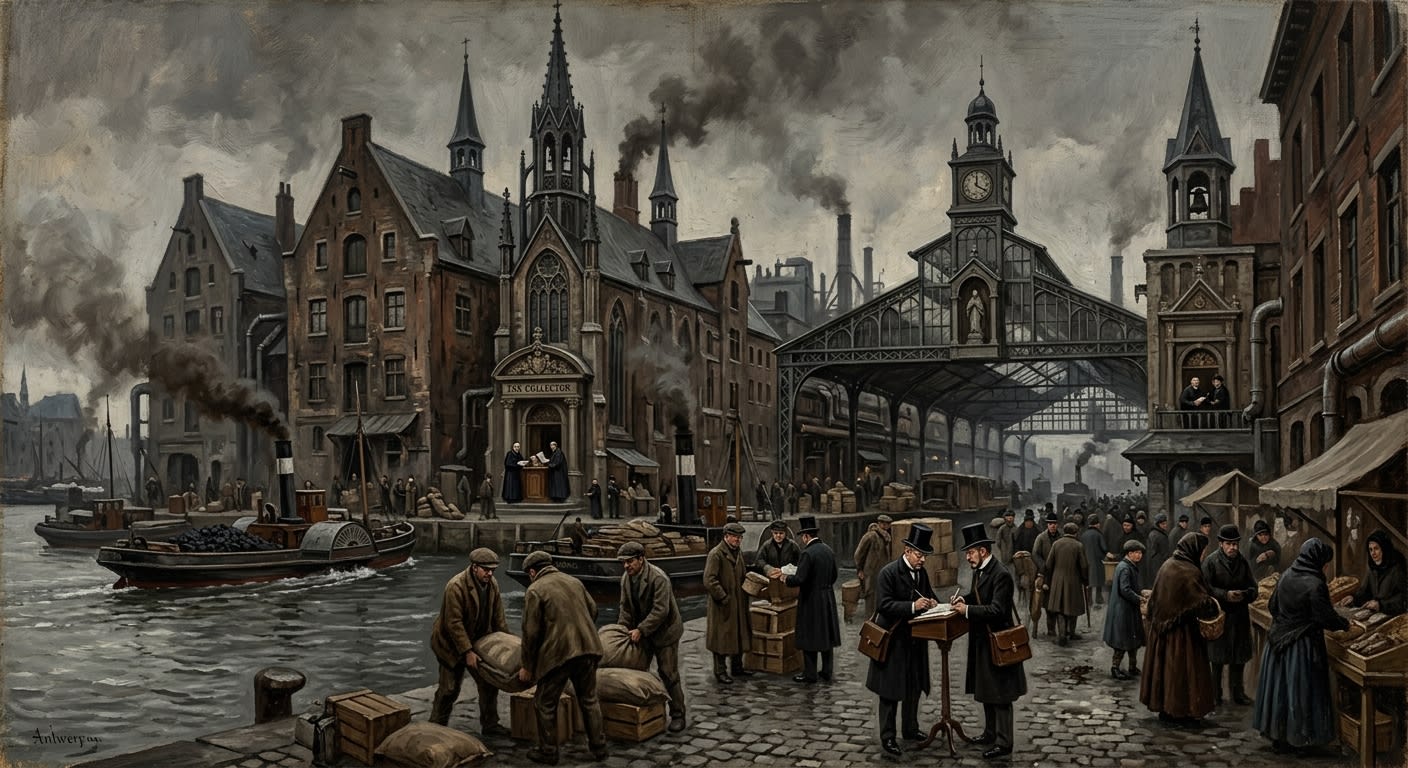
Antwerp is a Low Country port of the Scheldt, a city of cranes, bales, brine, countinghouses, wet bells, rope-cellars, dock chapels, diamond scales, famine receipts, merchant lies, and that northern gift for making greed look like municipal prudence. It sits in Zone 1, safely west of the Sagittal Line, too useful to be indulged, too rich to be trusted, and too near the independent Dutch shadow to be left alone with its own arithmetic.
The city is not Dutch, which it repeats with the irritation of a man standing beside a wealthier cousin at a funeral. It is Synodal, Belgian, Scheldt-bound, commercially devout, and spiritually damp. Its docks feed inland stores toward Ghent, Bruges, Candlewick, Cologne, and the northern rail arteries. Its chapels bless cargo. Its customs clerks bless themselves before opening merchant ledgers, which shows wisdom. A demon may steal a soul. A merchant may steal the label.
Antwerp matters because it has been three things in succession and all three still quarrel in its streets: Rationalist theatre, Synodal warehouse, and counting wound. In A.S. 27, during the years before the Treaty of Regensburg, a bishop was mocked there by Rationalist lecturers who measured relic bones with calipers and called the performance courage. In A.S. 112, an Antwerp desk fraud attached itself to Saint Verran with such profitable affection that the Bureau chose custody over denial. In A.S. 138, during the Gray Week Famine, Antwerp became the fourth city nobody wished to name.
#On the Rationalist Stage
Before the Synod wrapped Antwerp in seals, Antwerp wrapped itself in cleverness. The early Rationalist academies loved port cities because cargo teaches blasphemy faster than books. A crate arrives from Lisbon bearing oranges, a pamphlet, a bone, a lens, and a sailor who has seen three priests drunk before noon; by dusk some apprentice with ink on his fingers believes he has outgrown revelation. Ports ferment doctrine badly. Antwerp fermented it with civic pride.
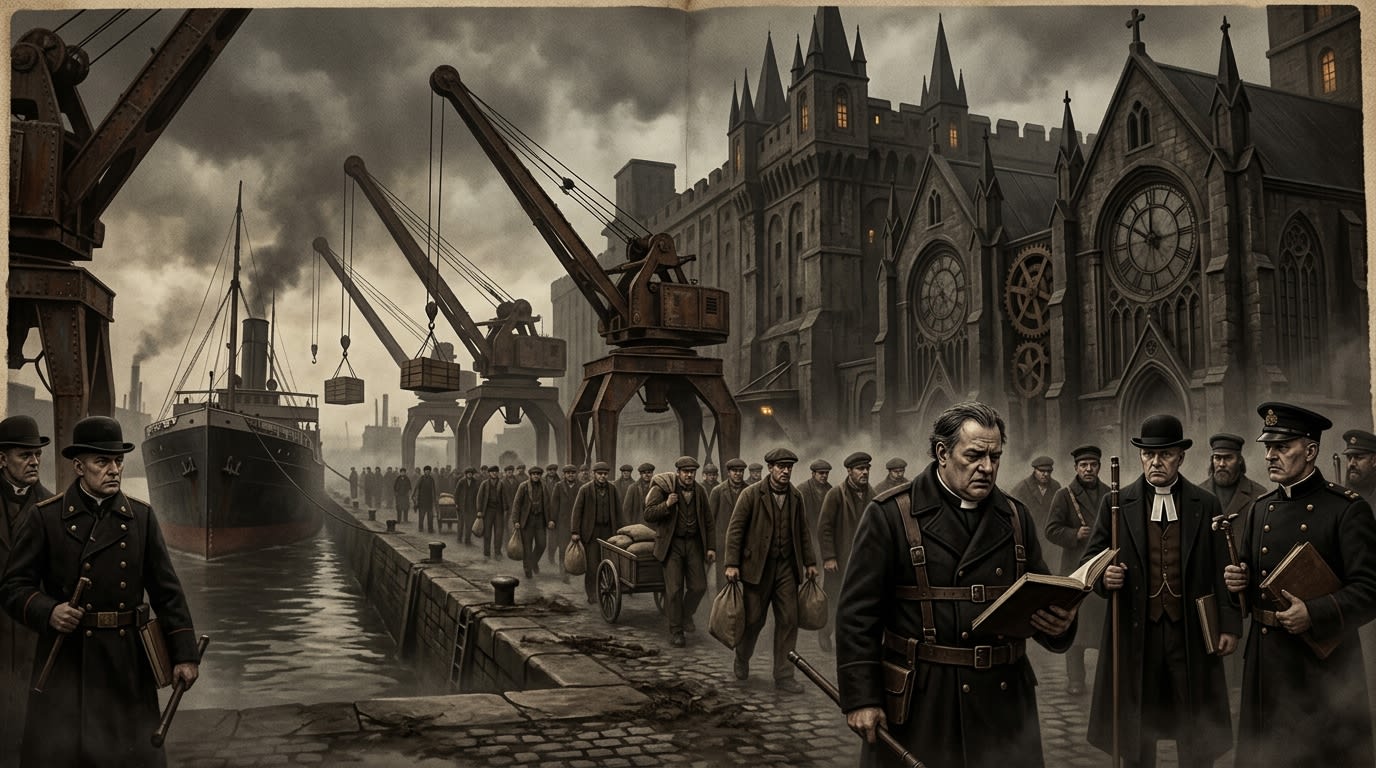
During the Atheist Wars, when Europe still pretended its convulsions were separate emergencies, Antwerp supplied one of the humiliations cited at the First Council of Cologne. A bishop — Records gives his title, withholds his name, and thereby performs a kindness it would deny having — was brought into a merchants' hall under promise of disputation. Rationalist demonstrators placed reliquary fragments on a counting table, measured them with calipers, weighed them on diamond scales, marked the results on a slate, and asked whether sanctity could survive numerical variance.
The bishop answered poorly. The crowd laughed well.
The incident travelled to Cologne in letters carried under episcopal seal. Kratz saw its value at once. A burned chapel stirs grief. A mocked bishop stirs ambition. Men who can endure martyrdom will still lose sleep over laughter. Antwerp's offence was theatrical rather than sanguinary, and theatre is sometimes the better knife. The Bureau of Doctrine later used the episode in seminary instruction under the heading On the Limits of Public Disputation With Men Who Own the Room.
Older Antwerp civic histories describe the merchants' hall incident as a free exchange of views between clergy and civic philosophers.
Corrected. The bishop was invited into a staged ridicule, the relics were handled without lawful custody, and the calipers were later entered as profane instruments. Free exchange is what cowards call ambush when the tablecloth is clean.
The hall survived. Naturally. Buildings involved in sin tend to survive long enough to invoice their own penance. It is now the Hall of Corrected Measures, a Records-supervised countinghouse where grain weights, relic shipment seals, diamond scales, and merchant oaths are verified beneath a painted text: MEASURE OBEYS MEANING. The merchants paid for the painting. They negotiated the gold leaf down by seven percent.
#On Dock, Scale, and Chapel
Antwerp's body is a ledger arranged around water. The Scheldt carries barges inward and excuses outward. Along the quays stand tariff chapels, rope sheds, countinghouses, fish halls, grain stores, amber rooms, diamond cutters' garrets, sail-lofts, and narrow little shrines crammed between commercial fronts like saints hiding from rent. The city smells of wet hemp, coal smoke, stale beer, river mud, salted herring, oiled wood, and paper kept too long near water.
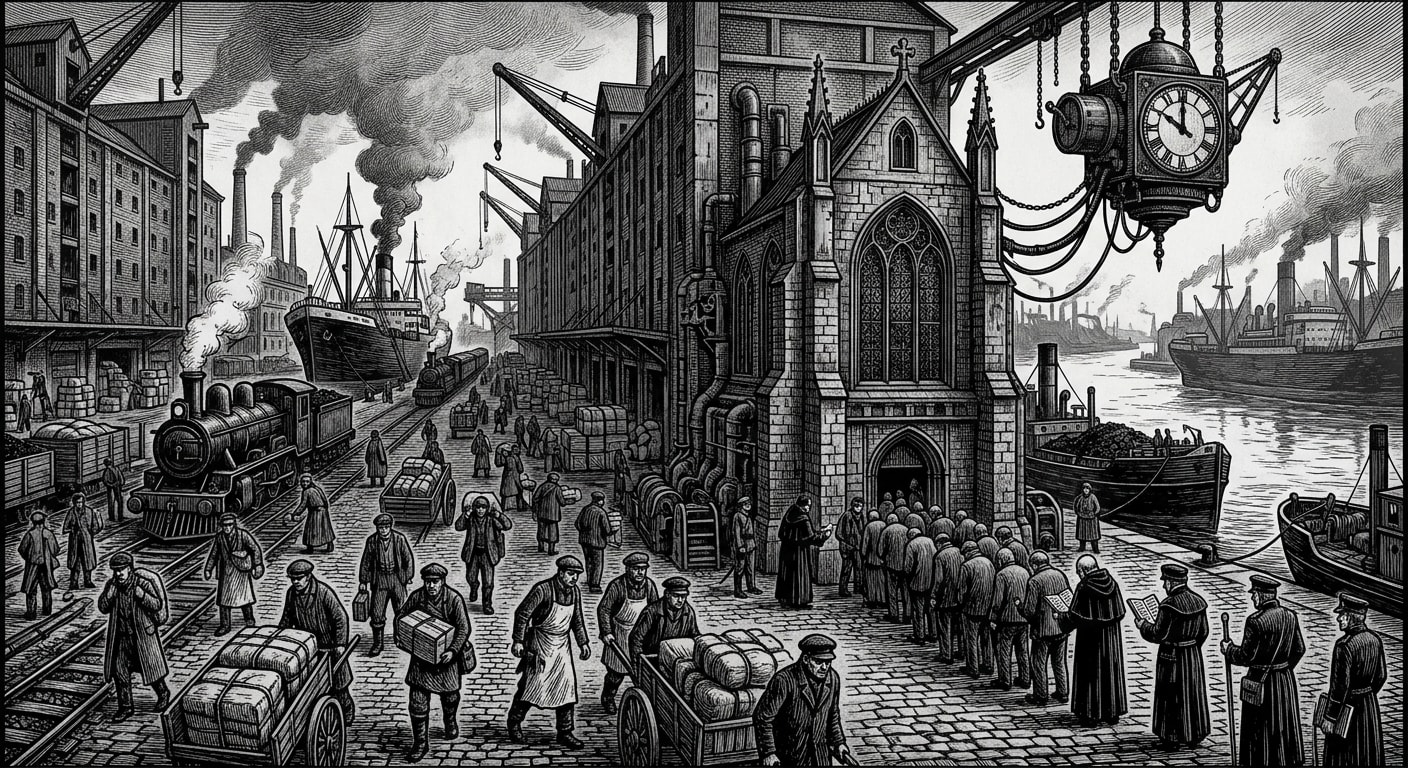
The Bureau of Records maintains the Scheldt Annex near the old crane. Its lower rooms hold dock manifests in raised cabinets after the A.S. 78 flood scares taught river cities that paper stored at floor level is a theological insult. The Bureau of Tithes occupies the adjacent Salt-Scale House, where tariff clerks keep two sets of balances: one for cargo and one for merchant conscience. The second sees less use.
A city's piety can be read by what it blesses in public and what it hides behind shutters. Antwerp blesses ships publicly. It blesses scales privately. A new beam balance receives a sprinkle of ash-water and a Latin sentence so brisk it might be mistaken for accountancy. Diamond scales receive no public rite, because the cutters insist precision is its own devotion and because any priest standing too close to unmounted stones becomes a security problem.
The dock chapels are small, blackened, practical, and rich in votive hooks. Sailors leave rope knots, snapped buckles, ledger corners, broken seals, and little glass beads said to frighten river fog. Grain porters leave splinters from loading pallets, a custom condemned six times because it attracts mice and tolerated six times because porters who feel heard carry sacks with less riotous imagination. Merchant widows endow candles after profitable storms and call it gratitude. The Bureau calls it recoverable revenue.
The city is wealthy in the irritating way of ports: wealth everywhere, poverty under it, paperwork over both. Its guilds have learned Synodal obedience without surrendering the older Antwerp art of delay. A request for manifest inspection produces tea. A demand for full warehouse access produces keys, apologies, a broken latch, and three men looking for the man who has the other key. By the time the door opens, the contraband has become a rumour with invoices.
#On the Desk of Saint Verran
Antwerp's strangest relic embarrassment concerns a desk.
After the A.S. 112 approval of Saint Verran, patron of Records Scribes, provincial devotion multiplied faster than scrutiny. Pens appeared. Line-stained nibs appeared. Splinters appeared. A merchant family in Antwerp presented a complete writing desk said to have belonged to the saint during the eleven-day siege-roll correction that cut ten thousand names from earthly entitlement. The desk was dark oak, scarred by candle heat, and fitted with a drawer containing grey dust, a snapped ruler, and an old grain chit. Pilgrims wept. Records frowned. Tithes opened a stall.
Testing later proved the grain false. More precisely, testing proved the desk's wood came from an Antwerp countinghouse refitted after Verran's hagiographic approval, the dust from dock sweepings, the snapped ruler from a schoolroom, and the grain chit from an A.S. 119 municipal ration dispute. The merchant family expressed shock with the competence of professionals. The desk had already received enough offerings to fund a minor chapel roof.
The Antwerp Verran desk was declared false and destroyed.
Corrected. It was declared materially false, devotionally active, and administratively awkward. It remains under supervised custody as an instructive fraud, which is to say a relic whose lie has acquired too many receipts to be cheaply killed.
The desk now sits in the Chapel of the Unsmudged Ruler beside the Scheldt Annex. Records Scribes visit before mass corrections. Merchants visit before difficult audits, which is vulgar but understandable. The prayer strip sold beside it reads: Saint Verran, keep the line clean. Local dock clerks add, under breath: and the cargo drier than last year. Doctrine has not approved the addition. Doctrine has heard worse.
CHAPEL CUSTODY NOTE — ANTWERP, A.S. 167 At first bell, drawer found shut and sealed. At second bell, drawer open. Contents: one fresh line of black ink across inner base; no pen present; dust undisturbed except beneath line. Night watchman stated he heard “ten thousand small scratches.” Watchman reassigned after repeating number without prompt.
Fraud becomes dangerous when it learns to behave like truth. Antwerp has always known this. The Bureau merely gave the knowledge a chapel.
#On Gray Week and the Fourth Name
The Gray Week file stains Antwerp more deeply than its citizens admit, which is why they admit nothing with magnificent civic unity.
In A.S. 138, open grain audits broke into riot in Strasbourg, Marseille, Munich, and a fourth city whose name slides between Records and Festivals like a fish through wet hands. Festivals says Lyon. Records says Antwerp. A sealed Tithes memorandum says the fourth requires no naming due to reconciliation hazard. That phrase is Antwerp wearing a veil.
The Antwerp version begins at the east granary courts after eleven days of ration narrowing, bone-broth distribution, and warehouse rumours. The open audit arrived with clerks, escorts, portable scales, household return forms, and the serene death wish of men who believe hunger will wait while columns are ruled. Dock porters had already counted the barges. Fishwives had counted the sacks. Bakers had counted the absent flour. Children had counted how many candle stubs could be boiled before the smell became too much. The official count insulted the unofficial arithmetic.
Cobblestones followed.
The Ledger Prefect assigned to the Antwerp audit vanished for fourteen hours and reappeared in a cooper's shed wearing a tariff placard around his neck and fish scales pasted to his cheeks. Unlike the Strasbourg Prefect, he kept his sash. This detail has encouraged Antwerp to deny participation. No true Gray Week city, they say, would have left the sash. I find the argument provincial, legalistic, and almost persuasive, which marks it as a lie with better tailoring than usual.
Three grain stores were opened. Two contained less than their manifests promised. The third contained correct grain under incorrect ownership. That discovery caused the worst violence, since hunger can forgive emptiness faster than mislabelled abundance. By night, receipt slips burned in the dock square, two escort wagons had been overturned into the river mud, and a clerk from the Salt-Scale House was forced to read warehouse names aloud while the crowd answered with the number of missing sacks.
The Synod's response was silence, then choreography. Receipt Reform A.S. 138 followed. Synod Directive 88-F replaced paper procession receipts with wrist-ribbon stamps. The Receipt-Procession Pageant Captain was born from famine's embarrassment. Antwerp's first gratitude march was scheduled six months after the riots under the title Civic Thanks for Restored Flow. Flow meant grain, traffic, obedience, and blood pressure. The title was admired by no one except its author, who was promoted.
#On Processions, Ribbons, and Present Custody
Antwerp after Gray Week learned to celebrate with its sleeves rolled up.
The Festival routes run from the Dock Chapels through the Hall of Corrected Measures, past the Scheldt Annex, across the Grain Court, and down to the east granary steps where the crowd once taught auditors to duck. Pageant Captains adore Antwerp and fear it. The streets are narrow enough for counting, rich enough for bribery, wet enough to spoil paper, and musical enough to hide three unauthorized refrains inside an approved hymn before the second drum turn. Lantern escorts hold the edges. Ribbon Runners work the wrists. Children chase confetti made from shredded duplicate returns. Their parents clap on time and watch the grain doors.
Antwerp's present authorities maintain the posture expected of loyal cities. They send tithes. They certify manifests. They host Records inspections. They fund dock chapels, route repairs, flood cabinets, and correction schools for children whose handwriting inclines toward Dutch spacing. They produce merchant delegations that bow in Strasbourg and return home to debate whether the bow should be depreciated as travel loss.
Its loyalties are real. Its evasions are also real. The Bureau is mature enough to value both. A perfectly obedient port would be dead by winter, because trade requires a thousand little sins greased into motion before noon. A faithless port would be worse. Antwerp occupies the golden middle: devout when watched, useful when trusted, profitable when suspected, and almost honest when afraid.
As of A.S. 201, the city remains under ordinary Synodal custody with enhanced Records and Festivals observation. The Scheldt Annex has been raised twice against flood. The Verran desk continues to attract scribes with clean hands and dirty assignments. The Gratitude of Restored Flow fills the streets each Ashwane with ribbons, drums, sealed bread baskets, and the old dock families standing where their grandparents threw stones. The fourth city is not named in public.
Antwerp hears the omission and smiles like a merchant weighing a saint.