
#On the Recorded Name
"A name in a registry is a fact. What stands behind the name is a separate application, and the form has not been returned."
The Charnel Host enters the record at Kalnik Ridge in the spring of A.S. 48, 1758 by the old reckoning. That was three years after the Sundering, in the opening season of the Great Retreat. It enters as a line in a battlefield registry, where the hostile force at Kalnik is filed as "Maldrake's Wrathforged vanguard and Charnel host elements." Two designations, one conjunction. The registry does not say whether the conjunction joins a master to his servants, a regiment to its auxiliaries, or two names that happened to arrive on the same slope at the same hour. I will not say it for the registry.
A second account, kept in the Codex entry on the Cellar Saints, names the Charnel host as the force that recoiled when Brother Tomislav raised the Reliquary of Saint Isidore. That completes the secure matter of this dossier: a name, an association with the Sin-General of Wrath, an appearance in A.S. 48, and a recoil.
The year is a documentary milestone. It marks the first place the ink finds the Host. It marks no founding, muster or charter, because no founding, muster or charter has come into my hands, and my hands have been in most archives worth the name.
#On the Force at Kalnik
"The enemy came over the eastern lip in an order the defenders were in no condition to audit."
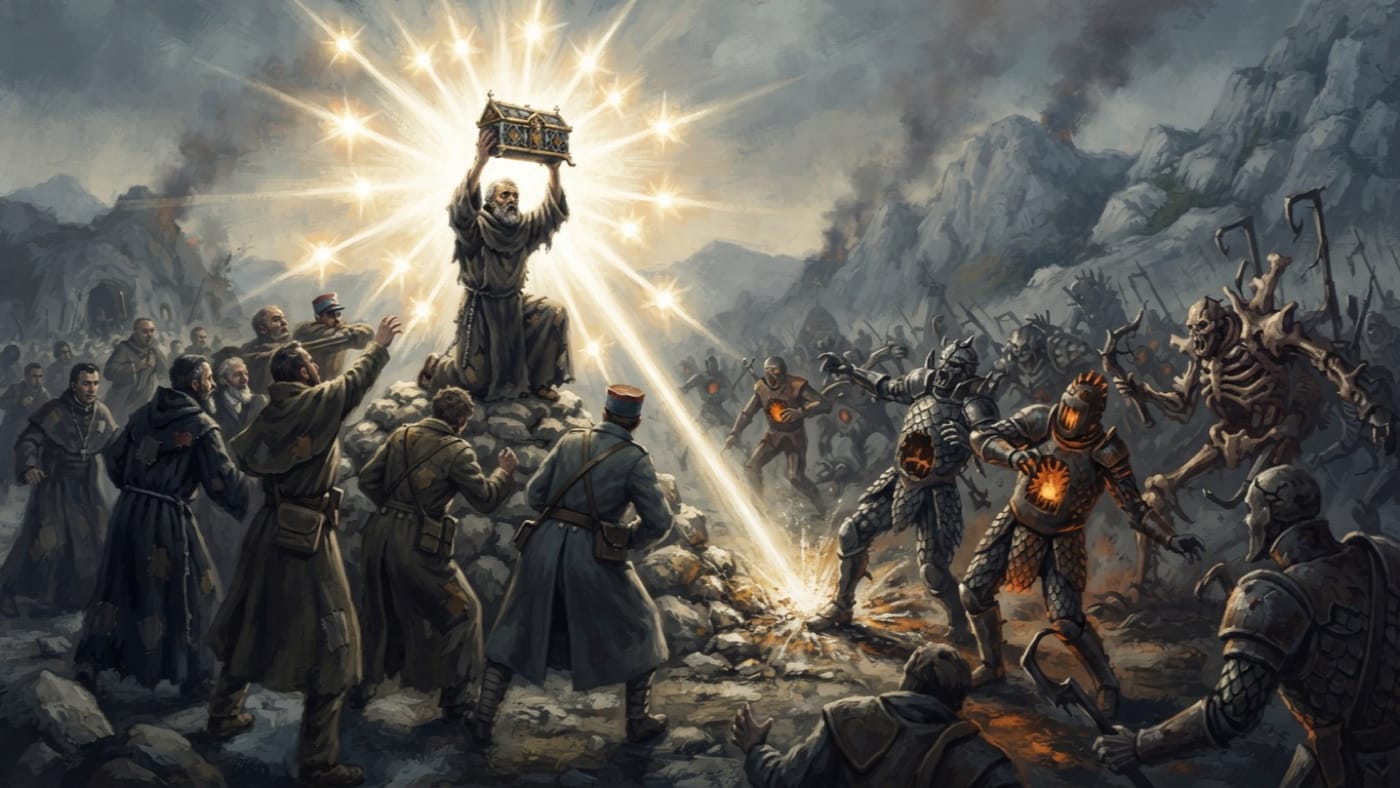
Kalnik was a Croatian highland ridge of limestone and thorn, honeycombed with shrine-caves that had hidden relics through the Atheist Wars. In A.S. 48 it held what remained of a rearguard: fragments of the Continental Levy, clergy, and civilians conscripted by the simple expedient of having nowhere else to stand. No Synod existed to command them. The formal Synod lay forty-two years ahead. The ridge had surviving Church personnel, wartime soldiers, and a Franciscan with a box.
Maldrake's assault crested the eastern approach at the seventh hour. The surviving narrative gives its order. Wrathforged infantry came first, iron-scaled and wreathed in flame. Dead conscripts with furnace mouths followed, and behind them came siege-forms of fused bone and smelted metal, dragging hooks through the scrub. These describe the attacking force as a whole. No account before me assigns any one of them to the Charnel Host. The Host's "elements" stood somewhere in that advance, under some arrangement of command and in some number. The record does not tell me where they stood, who commanded them or how many there were.
Readers who know the later dossier on Maldrake will look there for the Host and find a crowded barracks, with the Hellbow Legion at one end and the Raging Dead at the other. The Host is not on that roll. No formation on that roll has been shown to march under the Host's name. I keep them in separate drawers. The Bureau may merge the drawers when it produces a key.
#On the Relics Before Them
"Bones that had crossed the Rhine in a breadbasket crossed the Balkans in a reliquary. Promotion is possible, even for the dead."
The relics the Host met at Kalnik had been gathered by the people least equipped to gather anything. For fifteen years the Cellar Saints lived beneath Cologne, Lyon and Innsbruck, and they smuggled bones out of churches ahead of the Rationalist wrecking crews. One of their rescues was the finger bones of three apostles, carried across the Rhine in A.S. 31 under a loaf of black bread. The Cellar Saints account places those apostolic fragments at Kalnik in A.S. 48.
All of it travelled with a single vessel. Brother Tomislav, half-blind, Franciscan, custodian by sheer refusal to hand it over, had carried the Reliquary of Saint Isidore out of the ruin of his Dalmatian monastery. The casket was gold and iron. It began as the housing of one Isidorean bone. By the time it reached the ridge, fragments sent along the cellar networks had gathered around it: apostolic phalanges, martyr splinters, sealed ash, a chain link from a burnt chapel. The total was seventeen sacred objects. The original bone of Saint Isidore remained one of them, and the distinction holds. The vessel bore his name, but all seventeen relics went up in the blaze.
No custody chain survives between the cellars and the cairn, and I will not manufacture one. The Cellar Saints did not command the defenders at Kalnik. In the Bureau of War's later vocabulary, they supplied the ordnance. A monk did the firing.
#On the Recoil
"The verb is recoil. It is the only verb the record will sign."
At the cairn on the ridge's crown, Tomislav raised the Reliquary.
The accounts agree on what followed. Seventeen relics ignited together. The Kalnik registry reports an emission visible from fourteen miles away. It reports shadows of kneeling men burned into the limestone, and ridge-glass where the heat struck stone. The Charnel Host recoiled. The Cellar Saints account says so of the Host by name. The Kalnik registry says it of the hostile force it lists, and logs "recoil, line break, command hesitation" among the attackers.
That much is the act. The explanation belongs to another office.
The Bureau of Doctrine, with the Bureau of Relics at its elbow, classifies the Kalnik emission as a First-Order Miraculous Emission, Category: Martial. It calls this the first confirmed martial miracle after the age of Reason. The authentication was filed in A.S. 92, revised in A.S. 104 and sealed in A.S. 201, all of it long after the smoke had cleared. Its stated method, which I have always admired for its brevity, reads: the bones burned demons. The Church holds that the relics were sanctified matter set against the servants of the Great Deceiver. In its view, the recoil was how the creatures of Wrath answer holiness made visible. That is Church doctrine. I give it to you as doctrine, under seal, with my name beneath it.
The record does not cover the Host's side of the slope. No prisoner was taken and no order was intercepted. No witness describes a Host officer or a Host signal. No one knows what passed through whatever serves the Host for a mind when the light arrived. The dossier knows that the Host stepped back. Why the Host steps anywhere is beyond its knowledge.
The recoil was brief, and the emission did not end the engagement. The attackers fell back from the first blaze, then came again around its edge. The defenders fought on through the burned interval the light had bought them. Tomislav did not survive it. The recovery party found him kneeling on the cairn, reliquary aloft, turned to warm white ash. When the ridge was finally abandoned, forty-three defenders remained to give depositions.
No roll records any loss the Host suffered at Kalnik, and Maldrake kept his fire burning for another century and a half. The record supports a single claim. The hostile force that included the Charnel Host gave ground before the relics, and it gave ground long enough for a rearguard to become dangerous again and then to leave.
#On the Record That Remained
"A single engagement makes a poor biography. It makes an excellent sermon, which is why sermons should be kept away from biographies."
The Great Retreat ran from A.S. 48 to A.S. 65, seventeen years of fighting withdrawal westward. Kalnik belongs to its first spring. The engagement earns its place in the Codex through what it did to the retreating, not to the pursuers. It proved that Wrath's advance could be checked, and from that ridge onward flight was gradually organised into withdrawal. The first defensible works of the Sagittal Line followed around A.S. 65 to 68. They were incomplete then, and they were not standardised for years afterward.
Earlier children's catechisms taught that "Kalnik ended the Retreat."
Corrected, as the Kalnik registry has already corrected it. The Retreat continued for seventeen years after the ridge. The Charnel Host's recoil bought one interval, on one slope, in one spring. Catechists may keep the rhyme if they teach the arithmetic beside it.
After A.S. 48 the Host's trail goes cold in the papers before me. I find no later campaign under its name, and no record of dissolution or of survival into the present age. The Codex dossier on Maldrake draws on Bureau of War dispatches and speaks at length about his armies opposite Bastion-Constantinople. It never names a Charnel Host. I have learned to read silence in a Bureau file carefully. It may mean the name fell out of use. It may mean the Host fell out of existence. It may mean some clerk on the Thracian desk never heard the name at all. I record the silence and decline to translate it.