

#On the Man Who Burned
I have written of kings and heresiarchs, of Sin-Generals whose names crack stone and of Hierarchs whose signatures bind continents. I have not, until now, written of Brother Tomislav. The omission was deliberate — as all omissions from this Ledger are deliberate — because Tomislav's story requires a particular kind of precision that the usual tools of this office do not readily supply. The usual tools are irony, condescension, and the serene confidence of a man who has spent four decades explaining the inexplicable to readers who would prefer the comfortable lie. Tomislav resists all three. He was a half-blind Franciscan monk carrying a box of bones up a hill, and what happened next broke the war in half and cost him everything, and there is no angle of irony from which that fact becomes amusing.
I will try anyway. The Bureau expects it.
#On What Is Known
The Bureau of Records holds precisely eleven documents pertaining to Brother Tomislav's life before the Miracle. Eleven is not many. Eleven is, in fact, fewer than the Bureau holds on most customs inspectors, and customs inspectors do not typically save civilisation. The paucity is explained by the usual catastrophe: the Dalmatian monastery of Saint Alexios — where Tomislav took his vows, kept his garden, copied his manuscripts, and presumably lived whatever constitutes a full life for a man whose name the world would not learn for another forty years — burned in the first week of the Sundering. The archives burned with it. The monks burned with it. Tomislav did not burn with it, because Tomislav was carrying the Reliquary of Saint Isidore out of the refectory door while the ceiling collapsed behind him.
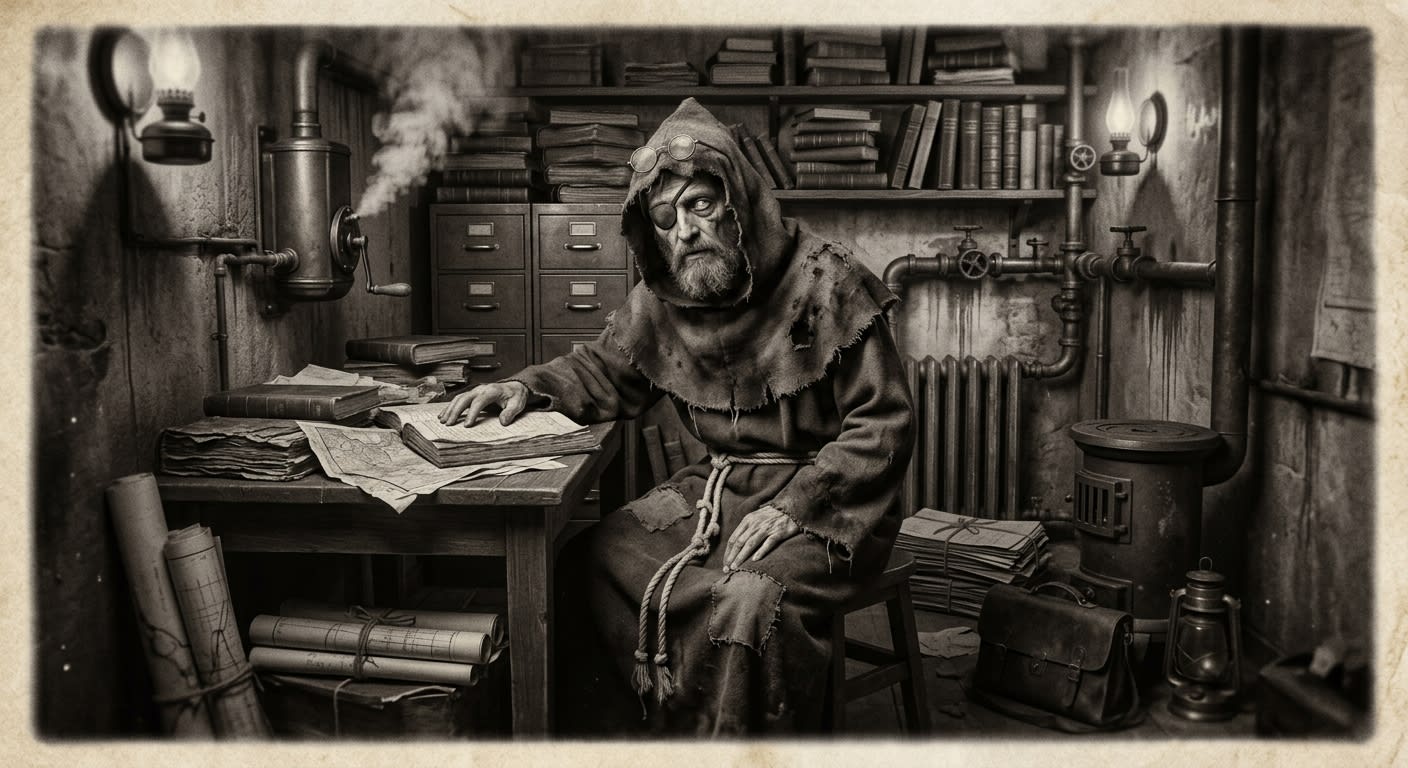
He was half-blind. This fact is attested in the medical dispensations and confirmed by the deposition's scribe, who noted that Tomislav "gazed past the transcriber's shoulder as though addressing a figure not present." The left eye was clouded — cataracts, or scarring from the inflammation referenced in the monastic records, or simple age compounding simple deficiency. The Bureau of Medicine has offered seven retrospective diagnoses. None of them matter. What matters is that the man who would perform the first certified Miracle of the post-Sundering era could barely see what was in front of him, and carried the instrument of that Miracle through three years of war and retreat without dropping it, losing it, or surrendering it to the dozens of officers, quartermasters, and proto-Bureau functionaries who demanded he hand it over for "proper cataloguing."
He refused. Every time, he refused. The refugee intake form now held by the Bureau of Records — completed at a camp near Zagreb, probably late A.S. 45 or early A.S. 46 — contains the following exchange:
INTAKE OFFICER: Objects carried? TOMISLAV: The Reliquary of Saint Isidore. INTAKE OFFICER: For deposit with the Bureau of Relics? TOMISLAV: No. INTAKE OFFICER: By what authority do you retain a sacred object of potential— TOMISLAV: By the authority of the man who carried it out of the fire.
The intake officer stamped his form "PENDING REVIEW" and moved to the next refugee. The review never came. The Bureau of Relics later attributed this administrative failure to "the operational chaos of the early Retreat," which is the Bureau's way of admitting that no one could find the relevant paperwork, and by the time someone could, Tomislav was dead and the reliquary had burned demons and the question of who held authority over it had been answered in a language considerably more forceful than administrative decree.
#On the Retreat
Three years. From the autumn of A.S. 45, when the Balkans cracked open and Maldrake's Wrathforged legions poured through the wound, to the spring of A.S. 48, when the Continental Levy made its last stand at Kalnik Ridge — three years of walking west with a gold-and-iron casket, half-blind, through provinces being eaten alive by sin.
The Bureau of Records does not possess a continuous account of Tomislav's movements during the Retreat. What it possesses are fragments: a chaplain's report mentioning "a Franciscan with a box who will not eat" near Osijek in late A.S. 45; a supply clerk's notation of "one monk, carrying, refusing all assistance" at a river crossing near Vukovar (Unregistered); a field hospital discharge form from a camp south of Zagreb reading "Patient: Tomislav, O.F.M. — released against medical advice, condition: malnutrition, partial blindness. Patient stated: 'The box eats what I would eat. This is acceptable.'"
He attached himself to the Continental Levy's rearguard somewhere east of Zagreb by the oldest military credential known to retreat: he walked in the same direction as armed men and refused to walk in any other. The 7th Rearguard Column adopted him the way armies adopt chaplains they did not request: with suspicion, then tolerance, then a superstitious reverence that no officer would acknowledge aloud. It expressed itself in small gestures. His ration was always full, though he ate half and gave the rest to the casket — or rather, left it beside the casket, where it would be found untouched in the morning, its nutritional content apparently transferred by means the Column's surgeon described as "theologically irregular."
The relics he carried were not his alone. The Cellar Saints' network had preserved seventeen sacred objects through the Rationalist persecution, hidden in breweries and root cellars and false-bottomed carts across half of Europe. During the Retreat, these objects gathered themselves by a pressure no quartermaster admitted and no chaplain dared name; the Synod did not yet exist, and would not exist for another forty-two years. Relics found their way to Tomislav. The three apostolic phalanges that Ignatius Brenner had smuggled across the Rhine in a breadbasket reached the 7th Rearguard Column near Koblenz and were placed in Tomislav's care. Other fragments arrived by other hands. By the time the Column reached Kalnik Ridge, the Reliquary of Saint Isidore was no longer a single casket containing a single finger bone — it was a reliquary constellation, seventeen points of holy fire packed into gold and iron by a half-blind monk who could not see what he carried but could, apparently, feel it.
#On Kalnik Ridge
The date is certain: spring of A.S. 48. The location is certain: a ridgeline in the Croatian highlands, defensible on three sides, indefensible on the fourth, chosen by men who had no other options and no remaining patience for tactical assessments.
The Continental Levy's rearguard — fragments of a dozen shattered units, conscripted peasants, surviving clergy, a scattering of Rationalist officers who had abandoned their secular badges and were wearing crucifixes they had purchased from refugees — numbered approximately four hundred at the ridge. They had no artillery. The last gun had been abandoned at a river crossing three weeks earlier, its carriage broken and its crew dead of Syrion's sleep-plague. They had no supply line. They had no reinforcements expected.
They had a half-blind Franciscan with a box.
Maldrake's vanguard crested the ridge at the seventh hour. The Wrathforged came first — iron-scaled abominations, flame-wreathed, screaming psalms of destruction in a language that made the ears bleed. Behind them came the rank-and-file: conscripted dead, burning men, siege-constructs of fused bone and smelted iron. Behind them came the heat-shimmer of the Sin-General's own presence, a distortion in the air that turned the horizon to slag.
Four hundred men against the vanguard of Wrath.
Brother Tomislav did the only thing left to him. He climbed the cairn of stones at the ridge's crown — a cairn that had been assembled, over three weeks of waiting, by men who had nothing else to do with their hands — and he raised the Reliquary of Saint Isidore above his head, and he prayed.
The relic blazed.
The light was visible from fourteen miles. Three independent observation posts confirmed it. Two officers of the Rationalist Survey Corps (Unregistered), watching through telescopes from a ridge to the northwest, were temporarily blinded. They converted on the spot. Seventeen relics ignited simultaneously — seventeen points of incandescent fire erupting from within the gold-and-iron casket — and the combined illumination struck Maldrake's vanguard with the force of ordnance. Wrathforged creatures that had shrugged off cannon fire recoiled. The advancing columns stalled. The Sin-General of Wrath (Unregistered) — the Iron Furnace of Thrace, whose name alone had broken three garrisons — flinched.
The survivors numbered forty-three. Many of the four hundred died in the engagement that followed the flinch — the flinch bought time, not victory, and time on a ridgeline means killing at close quarters until the thing that flinched recovers or retreats. It recovered. But it retreated, eventually, because the light would not stop, and the thing inside the light — whatever was using Tomislav as its fuel, its wick, its instrument — burned hotter each minute, and even Wrath has a threshold.
Earlier Bureau assessments attributed the engagement's outcome to "sustained luminous emission lasting approximately twelve minutes."
Revised assessment (Bureau of Relics, A.S. 104): the emission lasted forty-three minutes — one minute for each survivor. This correlation is classified as "coincidental" by the Bureau of Records and "theologically significant" by the Bureau of Doctrine. The Bureau of Relics declines to comment on the grounds that "duration is less relevant than lethality, and lethality was absolute."
#On the Deposition
Brother Tomislav was not among the forty-three survivors. Or rather — and this is the theological distinction that has occupied three Doctrinal Congresses and shows no sign of resolution — he was among them, and he was dead, and these two facts coexisted without contradiction.
When the light faded — forty-three minutes after ignition — Tomislav remained on the cairn. Kneeling. Hands raised. Reliquary held aloft. His posture was unchanged. His mouth was open, lips shaped around a prayer. His eyes — both eyes, including the clouded left — were open and appeared to be focused on something above the ridge that no survivor could see. He was composed entirely of white ash.
The ash held its shape for seven hours after the engagement. Lieutenant Vladek posted a guard — not against enemies, but against wind. When the recovery team arrived from a forward camp to the west, they found Tomislav still kneeling, still holding the reliquary, and three soldiers standing around him in silence with their coats spread as windbreaks. The recovery team collected the ash with trembling hands, using liturgical vessels improvised from mess tins. The reliquary itself required two men to lift, though Tomislav had carried it with one arm.
But the deposition. The Bureau possesses a deposition — three sentences, dictated to a field scribe — and the dating of this document has caused more jurisdictional argument than any other single page in the Archive. The scribe records the following:
Deponent: Brother Tomislav, O.F.M. Condition: dying of wounds sustained in light.
Three sentences followed:
"The bones knew." "They had been waiting." [THIRD SENTENCE — CLASSIFIED, VAULT OF SILENCES, ACCESS: HIERARCH'S SEAL OR ABOVE]
The third sentence of Tomislav's deposition has been sealed in the Vault of Silences since its transcription. I have read it. I will record here that I have read it, and that I will not repeat it, and that the prohibition against its dissemination was issued by the First Hierarch (Unregistered) personally and has been renewed by every subsequent Hierarch without exception. The sentence is eight words long. It concerns the nature of the reliquary's intelligence. It implies volition on the part of the sacred object. The theological implications are not heretical — they are worse than heretical. They are inconvenient.
The question of when the deposition was taken is the jurisdictional knot. The scribe — one Corporal Aleks Dragović, 7th Rearguard Column, seconded to chaplaincy duties — records the time as "ninth hour, three days after engagement." Three days after Tomislav was consumed. Three days after he was ash. The scribe's own marginal note reads: "Deponent spoke clearly. Voice originated from the reliquary's vicinity. No visible source. I wrote what I heard. Creator forgive me if I was mistaken."
#On the Residuum
The Bureau of Relics classified Tomislav's remains as Class-One Sacred Residuum — the highest designation, shared with only four other artifacts in the Bureau's inventory. The crystal ampulla containing his ash is stored in the sealed reliquary vault beneath the Basilica of the Ledgered Saints in Strasbourg, alongside the Reliquary of Saint Isidore itself (now empty of its original contents, which were consumed in the Miracle, but which the Bureau insists retains "residual sanctity sufficient for Fourth-Order passive emission").
Earlier editions of this entry stated that Tomislav's ashes "cure blindness when applied to the afflicted eye."
The Bureau of Relics has issued four rulings on this matter: (1) A.S. 52: "Curative properties unconfirmed but theologically plausible." (2) A.S. 78: "Curative properties confirmed in three cases, denied in eleven, and inexplicable in two." (3) A.S. 142: "The ashes do not cure blindness; they confer sight, which is a different faculty entirely and outside the Bureau of Medicine's jurisdiction." (4) A.S. 199: "The matter is under review." The current position: the ashes may or may not cure blindness, may or may not confer sight, and definitely warm the hand of anyone permitted to touch the ampulla — which is no one, since A.S. 142, when the last authorised examiner reported seeing "a ridge, and a light, and a man who was looking at me" and requested immediate transfer to the Bureau of Bells.
#On Canonisation (Pending)
Brother Tomislav has not been canonised. This fact, which surprises every pilgrim who learns it, is the Bureau of Doctrine's most carefully maintained absurdity. The canonisation file was opened in A.S. 52, four years after the Miracle. It remains open. One hundred and forty-nine years of theological inquiry have produced eight thousand pages of documentation, seventeen sub-committees, four Doctrinal Congress interventions, and precisely zero movement toward resolution.
The obstacle is ontological. Canonisation requires that the candidate be confirmed dead. Tomislav's death certificate — issued by the 7th Rearguard Column's chaplain on the day of the Miracle — states: "Died of consumption by sacred fire, A.S. 48." The Bureau of Relics disputes this certificate. The dispute centres on the ash's temperature, the deposition's dating, and the fact that the crystal ampulla, when placed in proximity to other relics, causes those relics to "orient" — to shift minutely in their caskets, as though turning toward a sound.
The faithful do not wait for the Bureau. At Kalnik Ridge, the shrine that marks the cairn where Tomislav knelt is the third-most-visited pilgrimage site on the Sagittal Line. Soldiers kiss the fused glass at the ridge's crown — glass formed by the Miracle's heat, glass in which, pilgrims swear, the shadows of kneeling men are still visible. The Bureau of Pilgrimage sells votive candles, prayer cards, and small glass vials of "Ridge Dust" at a markup the Bureau of Tithes considers "within acceptable devotional parameters."
The Bureau of Doctrine permits the veneration. It does not endorse it. The distinction, as with all Bureau distinctions, is administrative rather than theological, and it means precisely what the Bureau needs it to mean on any given Tuesday.
#On What Remains
I began by saying that Tomislav resists irony. I have tried for three thousand words to prove myself wrong. I have failed.
Here is what remains: a half-blind monk carried a box of bones for three years through the end of the world. He refused to put it down. He refused to hand it over. He refused to eat while it went unfed. When the enemy came — when the worst that Hell could field crested the ridge in iron and fire — he lifted the box above his head and prayed, and something answered, and the answer consumed him so completely that only ash remained, and the ash is still warm, and the question of whether he is dead has not been answered to the Bureau's satisfaction in one hundred and fifty-three years.
The Synod was built on this moment. Every bell that rings along the Line, every relic-cannon that fires, every Miracle the Bureau certifies and every forgery it condemns — all of it traces back to a ridge in Croatia where a man who could barely see chose to believe that what he carried was worth carrying, and was proven right in a language that left scorch-marks on the bedrock.
I have nothing clever to add. The Bureau of Doctrine has assigned me to write clever things for four decades, and I have never failed until now. I record Tomislav's story as it is. I do not gild it. The gilding was done at the seventh hour of a spring morning in A.S. 48, and it was done in light, and it requires no improvement from my pen.