
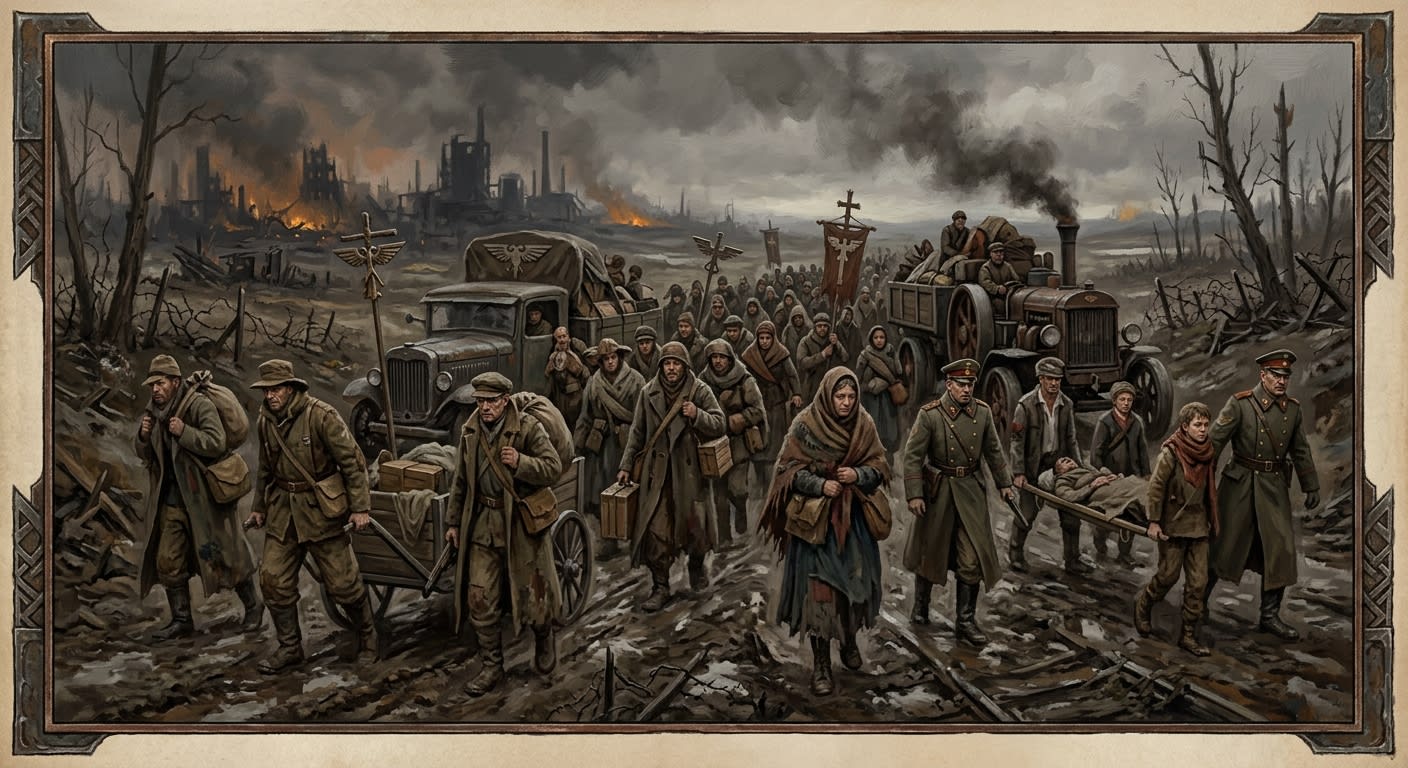
#On the March That Refused to Admit Its Name
The Great Retreat lasted from A.S. 48 to A.S. 65, though honest men place its first scream at the Sundering of A.S. 45 and its last cough somewhere under the first mud ramparts of the Sagittal Line. The Bureau of War calls it a fighting withdrawal. The Bureau of Doctrine calls it the Strategic Pilgrimage of the Faithful Westward. Refugees called it walking because the alternative was being eaten.
Names matter. Names also arrive late, perfumed, and dressed for ceremony. During the Retreat itself there was no Great anything. There were columns, carts, relic-cases, sick children, cold horses, smashed caissons, bishops with bleeding feet, Rationalist officers trying to remember prayers, and roads whose ditches filled faster than burial parties could dig.
The retreat moved westward from the eastern wound. Hungary, Serbia, Bulgaria, Romania (Unregistered), the broken Balkans (Unregistered), and the roads behind them became a geography of abandonment. Maldrake’s fire pressed the rearguards. Morwen’s spite-sicknesses entered the camps with the gentleness of wet cloth. Kargath’s hunger followed the columns by way of empty fields, stripped barns, and children who stopped crying because the body hoards its last calories against sound.
#On Kalnik and the Proof of Fire
A rout becomes history only after it receives a miracle.
At Kalnik Ridge in A.S. 48, seventeen relics blazed against the Charnel host. Brother Tomislav raised the Reliquary of Saint Isidore; apostolic bones carried through the Cellar Saint networks flared; Maldrake’s vanguard recoiled; and every powdered inheritor of Reason learned, in one incandescent minute, that faith had neglected to remain symbolic.
The Retreat did not end at Kalnik. Seventeen more years of hunger, rear-guard butcheries, river crossings, fever camps, bridge fires, and wet graves remained. Kalnik changed the grammar. Before Kalnik, the columns fled. After Kalnik, they withdrew under sign, which is the same motion with better banners and more survivable morale.
Popular sermons describe Kalnik Ridge as the point where the Great Retreat turned into victory.
Corrected. Victory remained unavailable. Kalnik proved only that the enemy could be made to recoil. The faithful converted this into hope, and hope into marching speed, and marching speed into another day alive.
#On Vienna and the Discipline of Abandonment
Vienna held briefly. Its cathedral spires and crypt-hoarded relics flared when the advance approached, and for six months the city shone like a lamp placed before a slaughterhouse. The garrison fought with the peculiar courage of men who understand that the wall behind them is merely the next road west. Refugees packed the churches. Quartermasters issued half-rations. Priests absolved by queue number.
Then the light guttered.
The garrison withdrew in good order, carrying what bones it could salvage and burning what could not be borne. This phrase, “in good order,” must be preserved because it is one of the few mercies Records has granted those men. Disorder would have been understandable. Panic would have been human. Good order was liturgical defiance: a city dying without granting the Enemy the satisfaction of seeing it stumble.
Vienna Withdrawal Annex, sealed witness page: The reliquary inventory omits ████████████ objects known to have left Saint Stephen’s crypt (Unregistered). Garrison-Prior ████████████ signed three manifests after his recorded death. One cart arrived west carrying bells wrapped in altar cloth and no horses. The cart was warm.
Vienna became a wound behind the march: empty streets, shattered glass, relic smoke, and the memory of a capital that had failed to remain one. Later, the Synod would reclaim it, tour it, tax it, and sell approved devotional prints of its ruins. At the time, it was simply another proof that survival requires sacrilege performed with clean hands.
#On the Roads
The Retreat’s roads became moving towns made of panic, hunger, and paperwork written on whatever had not yet been burned.
Refugees walked beside oxen, artillery, chapel carts, wounded Rationalist guards, monks carrying bones, widows carrying ledgers, children carrying younger children, and soldiers carrying expressions borrowed from corpses. Every bridge became a tribunal. Every granary became a riot with hinges. Every parish kitchen became a court of last appeal, presided over by women with ladles and men with muskets and priests who had discovered that charity without enforcement lasts until the first sack of flour opens.
Disease behaved with admirable organisation. Cholera in wagon trains. Typhus in winter camps. Dysentery in supply depots. Trench-fever in any ditch whose name survived long enough to be misspelled. Between eight and twelve million souls died during the Retreat by the Bureau of Records’ conservative accounting. The true number is higher. Records knows. Records prefers numbers that can fit inside official grief.
The Retreat invented half the Synod before the Synod possessed the decency to exist. The Mercy Ward began because unattended sickness made cities riot. The Mothers of Plenty hardened out of ration panic. Gatewardens began as soldiers with clubs at choke points. Erasure Notaries emerged from duplicate ration fraud and phantom households. The Litany-Engineers learned that engines answered song. Institutions later called these origins charters. The roads called them habits that kept people alive.
#On the Prague Collapse
In A.S. 61, twelve Litany-Engineers tunnelled beneath a Rationalist observatory in Prague during the Retreat and chanted until their throats bled. At dawn the observatory folded into the earth. Three Engineers survived. Nine were classified as consumed by the work.
The Bureau of Engineering files the event as controlled structural dissolution, sanctioned. Doctrine files it as Providence, Applied, Category One. I file it as evidence that the old world’s instruments were most useful when buried under their owners.
The Collapse matters because it proved the Retreat had ceased to be simple flight. The faithful had begun to use the wreckage of Reason as raw material: observatories into graves, engines into reliquary drives, universities into paper mines, philosophical certainty into kindling. The West was learning to survive by digesting its enemy’s tools and baptising the teeth.
#On the Birth of the Line
By A.S. 65, retreat ran out of west.
The first Line was a sequence of refusals: Königsberg damp and lake-mist, Brest at the Bug, Przemyśl in the Carpathian passes, Sibiu among Saxon walls, Irongate over the Danube gorge, Shipka in pass and mountain, Constantinople at the Bosphorus. Later maps made it clean. Later committees named the vertebrae. Later War officers spoke of continental defence architecture as though some genius in Strasbourg had drawn the Line before the ditch existed.
Lies of that sort are useful and should be polished weekly.
The truth is better. The Line was built by fleeing armies that stopped, local militias that refused to move again, surviving clergy who planted reliquaries in mud, engineers who sank foundations where bodies already lay, and peasants whose westward road had ended under their own boots. They dug because there was no road left. They prayed because there was no sleep. They held because the alternative had spent twenty years acquiring teeth.
Certain triumphal histories imply the Sagittal Line was planned as a unified system before A.S. 65.
Amended. The Line was ratified after it had begun holding. As usual, bureaucracy arrived after courage and charged a fee for recognition.
#On the Festival Wound
The Bureau of Festivals traces its most useful terror to the Retreat. In A.S. 52, among ruins and half-rations, a priest declared a Feast of the Unbroken Wall because a barricade had survived three days of Maldrake’s shelling. The soldiers cheered. The priest was promoted. The lesson passed into policy: joy could be rationed, timed, and deployed like ammunition.
By A.S. 58, Augustinus had folded festival governance into the Charter of Prescribed Observance. By A.S. 72, the Bureau of Festivals possessed a seal, a budget, and enemies. The Retreat had taught the Synod that despair is not private. Despair deserts, mutinies, blasphemes, and opens gates. Celebration, placed under licence, can keep a man praying for one more watch.
This is why Founding Salvos, ash carnivals, mourning processions, saint-days, ration feasts, and victory pageants all smell faintly of wet wool and old fear. The Festival calendar is the Retreat’s wound taught to clap on command.