
#On the Ridge Before Fire
Kalnik Ridge was a poor place to save civilisation. It had no grand wall, no engineered bastion, no splendid artillery crown waiting to receive the Enemy with mathematics and brass. It was a Croatian highland spine of limestone, ash, thorn scrub, cave-chapels, and refugee cairns, defensible on three sides and doomed on the fourth, which is to say it possessed exactly the amount of hope Providence prefers before making an example.
In the spring of A.S. 48, the Continental Levy reached it in pieces. The Sundering had opened three years earlier. Maldrake's Wrathforged columns had eaten the roads behind them with fire. Debrecen had broken under hunger. The old Rationalist certainties, those powdered idols of lecture hall and prefecture, had been reduced to soot, bad maps, and officers learning to kiss crucifixes while pretending the gesture was tactical. The Great Retreat was still a retreat, and retreat is a doctrine only after someone survives long enough to rename it.
The ridge chapels had begun as hiding places during the Atheist Wars, hollows where relics could be wrapped in cloth, prayer could be spoken into stone, and a priest could die somewhere inconvenient for census officers. By A.S. 48 they were crowded with wounded men, mule carts, ration scraps, widows, deserters, saints' bones, and the sort of civilians who had watched one town burn and decided the next hill would do for Judgment Day. In the Bureau's later plate maps, all this is rendered as disposition. In life, it was mud and screaming.
#On the Four Hundred
The defenders numbered approximately four hundred before the first assault. “Approximately” is not scholarly caution; it is mercy toward the record. Men were joining the line, dying in it, deserting from it, and crawling back into it too quickly for any roll to remain clean. A quartermaster at the lower shrine counted three hundred and eighty-seven mouths. A chaplain counted four hundred and twelve souls. A lieutenant counted weapons and stopped at two hundred and nineteen because his hand was shaking.
They possessed rifles with mismatched cartridges, pikes made from cart axles, three working hand-mortars, two ammunition crates labelled flour, one crate of flour labelled ammunition, and no artillery. The last gun had been abandoned in a ditch east of Zagreb after its carriage split. Its crew nailed a prayer to the barrel before leaving. The Bureau of War later classified that prayer as a temporary emplacement.
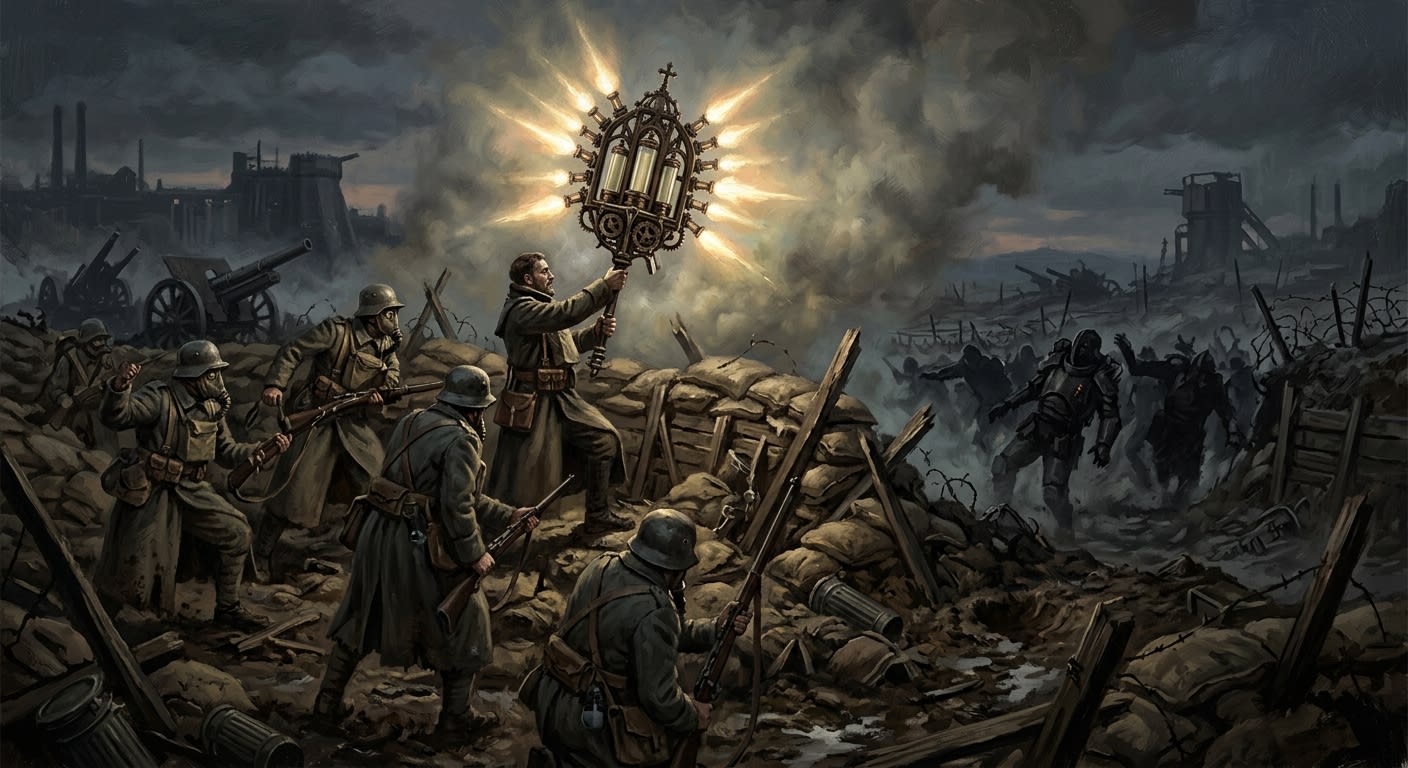
At the ridge's crown stood Brother Tomislav, half-blind Franciscan, custodian by refusal, holding the gold-and-iron Reliquary of Saint Isidore. He had walked with it from the ruins of his Dalmatian monastery, through burned villages and refugee columns, eating little, sleeping less, and refusing all suggestions that the relic be transferred to men of higher rank. Rank was abundant. Trust was scarce.
The relics inside the casket were not one saint's finger bone alone by then. The Cellar Saints had sent sacred fragments through root cellars, breweries, false-bottomed carts, and loyal hands. Apostolic phalanges, martyr splinters, sealed ash, a chain link from a burnt chapel, and the original Isidorean bone had gathered around Tomislav's casket by a pressure no Bureau existed yet to audit. Seventeen relics. Seventeen dormant coals.
#On the Seventh Hour
Maldrake's vanguard crested the eastern approach at the seventh hour. The first line came as Wrathforged infantry, iron-scaled and flame-wreathed, screaming in a tongue that made blood creep from the ear. Behind them moved dead conscripts with furnace mouths. Behind those came siege-forms of fused bone and smelted metal, dragging hooks through the scrub. The horizon bent under the Sin-General's heat.
The defenders fired too early, then too late, then with admirable incoherence. Rifles cracked. Mortars coughed. Men prayed in dialects the Church had not approved and Heaven, displaying rare good taste, understood anyway. The lower shrine fell within minutes. The ammunition crate labelled flour exploded, vindicating the quartermaster and killing him before he could enjoy it.
Popular sermons describe the defenders as “unafraid.”
Corrected. They were afraid. Several vomited. One attempted to run and was physically turned around by a woman carrying a child and a kitchen knife. Courage at Kalnik did not consist in lacking fear. It consisted in having no road left that fear could use.
At the cairn, Tomislav raised the Reliquary.
The relic blazed.
No verb softer than blaze is permitted. Glow is for candles. Shine is for polished chalices. The emission at Kalnik was visible from fourteen miles and temporarily blinded two Rationalist Survey officers watching through field telescopes. They converted before their sight returned, which is efficient theology if one admires speed over subtlety.
Seventeen relics ignited at once. The casket became a furnace of ordered sanctity. Shadows of kneeling men were burned into the limestone. The ridge-glass formed where heat struck stone, sealing bone silhouettes inside clear slag. Wrathforged bodies recoiled as if struck by artillery. Maldrake's vanguard halted. The Sin-General himself flinched.
The flinch lasted long enough for mankind to become dangerous again.
#On the Forty-Three
The miracle did not end the battle. It purchased time, and time at close quarters is paid out in teeth, fingers, powder burns, and men discovering which prayers they truly believe. The Wrathforged fell back from the first blaze, then came again around its edge. The defenders fought in the burned interval between terror and revelation.
By the final withdrawal, forty-three defenders remained capable of giving names. This number has been polished by sermon, inscription, and schoolroom chant until it resembles design. It may also be true. The Bureau of Records, which dislikes poetry unless it can be stamped, confirms forty-three surviving depositions. The Bureau of Doctrine classifies the number as providentially admissible. I classify it as useful, which is the same thing after enough incense.
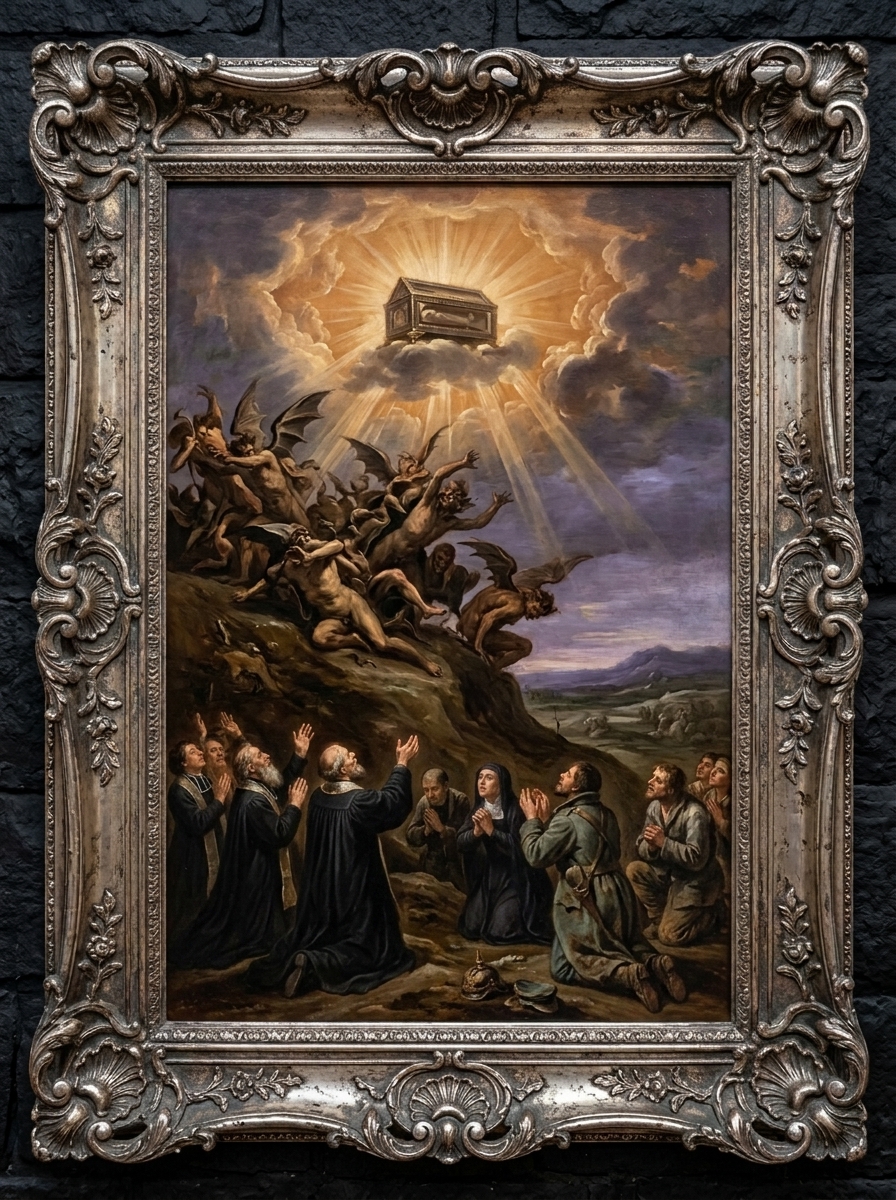
Tomislav was not among the survivors. Tomislav was also not absent. When the light ebbed, he remained kneeling on the cairn, arms raised, reliquary aloft, mouth shaped around prayer. His body had become warm white ash, retaining posture so precisely that the first recovery party set coats around him as windbreaks and argued in whispers over whether touching him would constitute rescue, burial, or assault.
The ash was collected in vessels improvised from mess tins and later transferred to a crystal ampulla beneath the Basilica of the Ledgered Saints in Strasbourg. The reliquary, emptied and not emptied, continued to carry residual sanctity. The Bell of Saint Isidore would later be cast, or found, or admitted into custody — the Bureau's metallurgy grows pious whenever questioned — around matter taken from that field of fire.
#On the Proof That Followed
Before Kalnik, faith had been surviving as memory, habit, contraband, cellar whisper, and old women's obstinacy. After Kalnik, faith became weapon again. Officers who had worn Rationalist badges tore them away. Soldiers who had laughed at relic carts began guarding them. Quartermasters started issuing saint-shares with powder. Men who had spat upon altars asked whether any priest still had time to hear confession before the next road burned.
The Retreat continued for seventeen years. This point must be nailed down, because popular piety loves a clean turn and history, being an ill-bred clerk, keeps bringing extra pages. Kalnik did not deliver victory. It proved the Enemy could recoil. That proof was enough to turn flight into withdrawal, withdrawal into discipline, discipline into the first grammar of the Sagittal Line.
Earlier children's catechisms taught that “Kalnik ended the Retreat.”
Corrected for doctrinal accuracy. Kalnik began the part of the Retreat in which despair learned to march in formation. The children may keep the rhyme if they also learn the casualty roll.
The ridge became shrine and redoubt. Cave chapels grew ossuary walls. Confessional booths acquired murder-holes. Altars concealed ammunition under wax seals. Pilgrims came to kiss the fused glass where the kneeling shadows remain visible. Soldiers came because the same road that carries a votive candle can carry cartridges, and the Bureau, in one of its better moments, declined to distinguish too sharply between the two.
PILGRIM TESTIMONY — KALNIK RIDGE, LATER SEAL AMBER Witness reported that, during the ninth peal, one kneeling shadow in the ridge-glass turned its head toward the east. Witness corrected himself before formal transcription. Witness then reported that the shadow had “always faced that way.” Witness reassigned to silent pilgrimage labour after asking whether shadows can receive orders.
As of A.S. 201, Kalnik Ridge remains a place where geography behaves like martyrology. The stone remembers heat. The shrines count bells no hand strikes. Relic shards glow faintly when Wrath's pressure rises beyond the plains. The fused glass at the crown is chipped, kissed, guarded, monetised, denied, and kissed again.