
#On the Descent
"Heroism, when practiced in basements, looks remarkably like cowardice. The Bureau assures you the resemblance is superficial."
The Treaty of Regensburg was signed in A.S. 30 with ink the Bureau has since determined to be mixed with bile, though whether the bile belonged to the signatories or to Providence is a matter the Bureau of Doctrine has classified as "irrelevant, given outcomes." On that day, the Rationalist Republic claimed sovereignty over the continent. Cathedrals were shuttered. Bells were melted for cannon. The Holy See of Vienna was dissolved at swordpoint, and the Archbishop signed with his own blood — a detail the Rationalists called "symbolic" and which the Bureau calls Exhibit One.
The faithful had two choices: recant or vanish.
Those who recanted were entered into the First Black Census — a register of the compliant, which is to say a register of the terrified, which is to say the largest document the Rationalist Republic ever produced and the only one the Bureau of Records preserves in its entirety, because cowardice on that scale deserves archival immortality. Those who vanished went downward. Into cellars beneath Cologne where the brewing vats still stood and the air tasted of hops and fear. Into mountain caves above Innsbruck where the wind through the passes sounded, to frightened ears, like plainchant. Into the sealed catacombs of Lyon, where the bones of Roman Christians lined the walls and the living pressed themselves against the dead for warmth, for company, for the simple comfort of proximity to something the Rationalists had not yet managed to classify as "superstitious debris."
They called themselves nothing. The name came later — applied by the Bureau of Doctrine in the first decade of the Synod, when the need for founding mythology outpaced the supply of actual founders.
Cellar Saints.
#On the Inhabitants of the Dark
"We have saints because we need them. That the need preceded the sanctity is a matter for theologians, not historians, and I am neither — I am a clerk who writes in the margins of both."
The Cellar Saints were chiefly shelter households and lay workplaces — butchers and bakers, parish clerks and midwives, mothers, fathers, and children — yet their wider network also carried messages and aided resistance. One elderly sexton, Gregor of Trier, reportedly descended with a broom and emerged with the same broom fifteen years later. Their civilian center should not erase the surviving bishops, relief clergy, and couriers who worked beside them.
Their organization, such as it was, grew from parish geography. The faithful in a given district knew their priest; the priest knew which cellars had stone foundations deep enough to muffle hymns; the cellars' owners knew which neighbours could be trusted and which would sell a name for a ration card. Networks formed along these contours — loose, overlapping, fragile as wet paper and held together by the same material: trust, which is faith's domestic cousin and the only currency the Rationalists never thought to regulate.
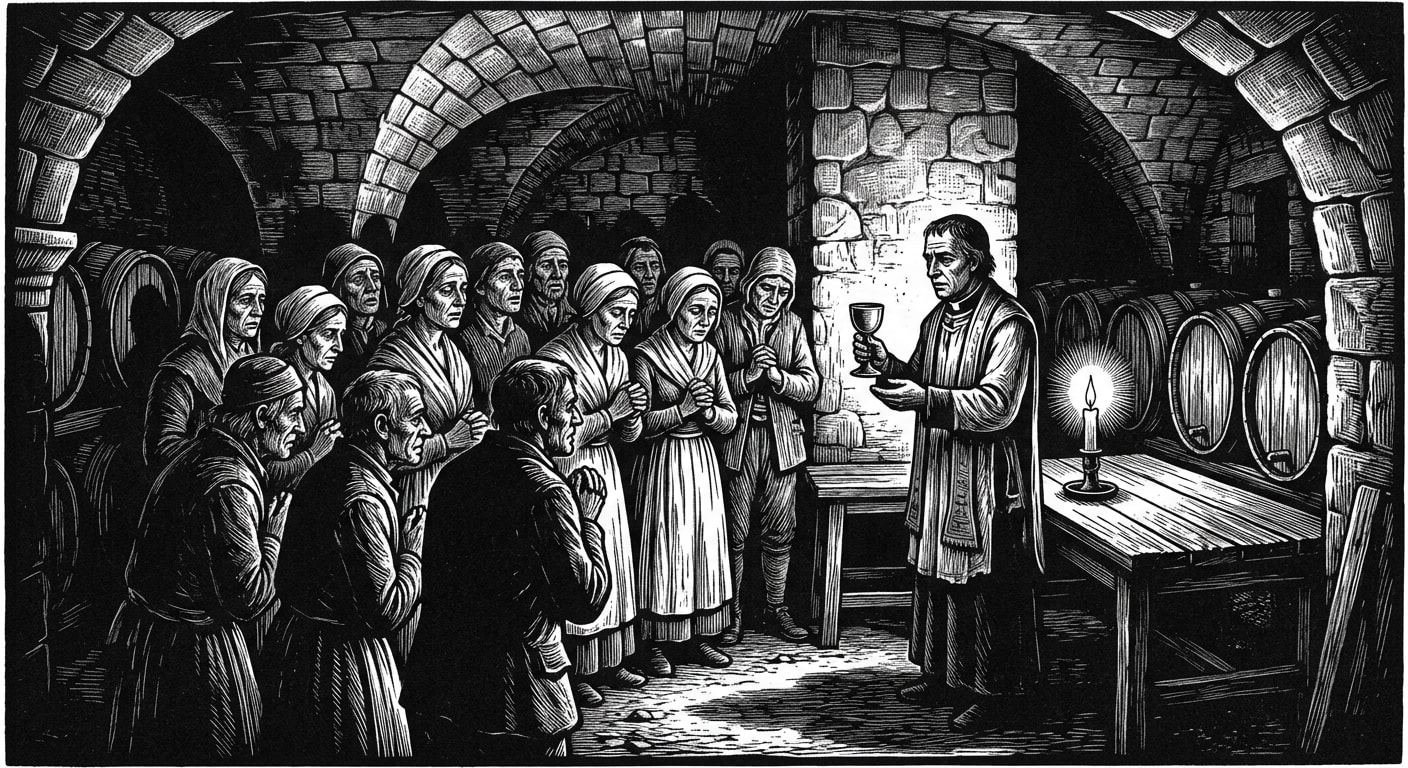
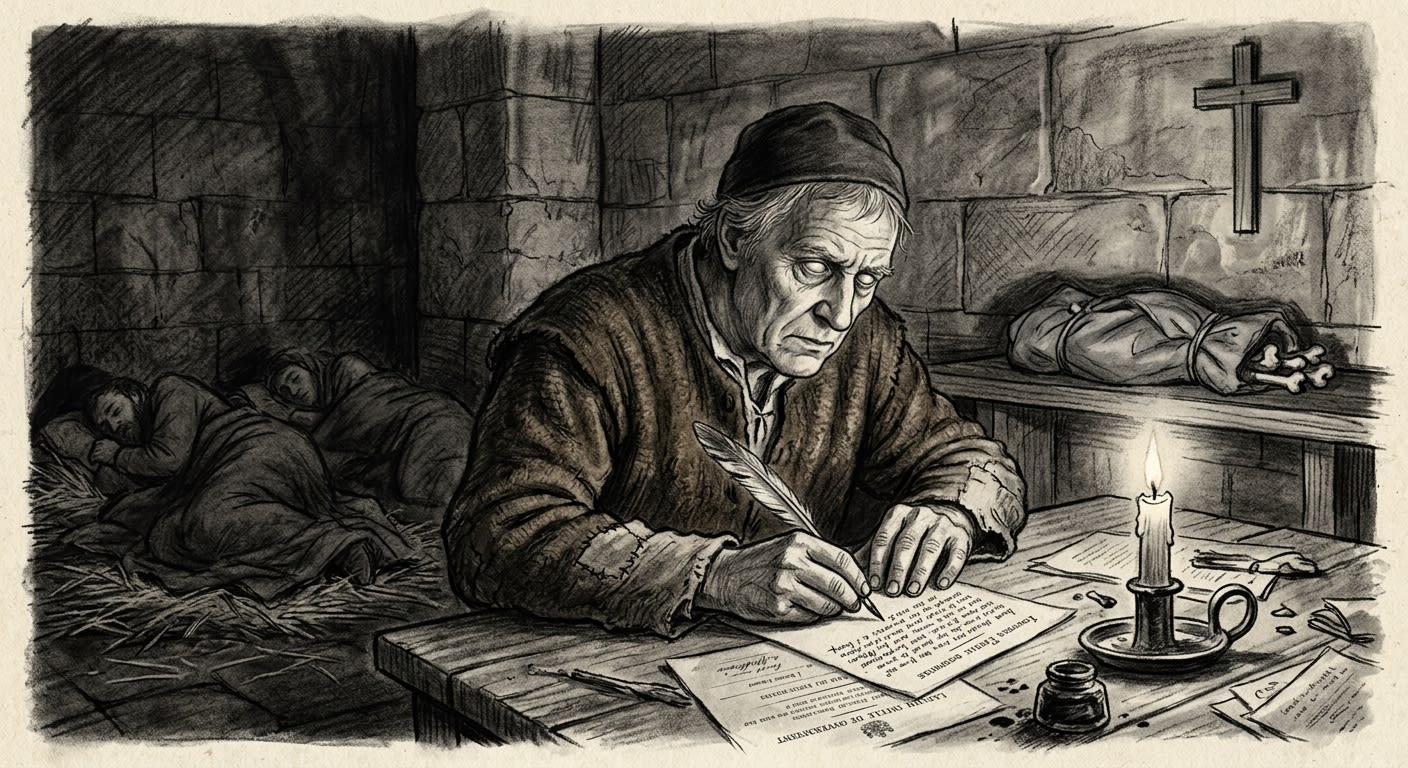
The largest confirmed cell operated beneath the Brewers' Quarter in Cologne, where a defrocked canon named Father Wernher organized weekly communion for up to sixty souls using sacramental wine he brewed himself from stolen grain and what he described in his journal as "the blessing of desperation, which ferments quicker than yeast." Father Wernher's journal — forty-seven pages of cramped script on the back of Rationalist census forms, the irony of which he noted with exhausted satisfaction — is the single most complete primary source for the Cellar Saint period. The Bureau of Records keeps it under glass in Strasbourg. Visitors are permitted to view it on the Feast of Saint Ignatius, which is to say once per year, which is to say more often than the Bureau of Records views its own conscience.
In Innsbruck, the faithful retreated into the alpine caves above the treeline, where Rationalist patrols would not follow because the Rationalist Republic, for all its vaunted love of natural philosophy, had a marked aversion to natural altitude. The Innsbruck communities survived on goat milk, root vegetables, and a rotation of prayer so disciplined that the Bureau of War has since studied it as a model for watch schedules. They baptized their children in snowmelt. They buried their dead in cairns and marked them with scratched crosses that the wind erased within a season, so that even the dead left no evidence for the census-takers.
In Lyon, the catacombs provided what the living world denied: permanence. The Roman-era tunnels beneath the Presqu'île had been sealed since the fourteenth century — or rather, sealed from above, which is a distinction the Lyonnais faithful exploited with the ingenuity of people whose alternative was the pyre. They entered through a canal culvert whose grating a sympathetic locksmith had loosened, passed through a Roman drain, and emerged into galleries the Rationalists did not know existed because the Rationalists, for all their devotion to measurement, measured only what they expected to find. The Lyon community maintained a library — forty-one books saved from the desecrations, wrapped in oilcloth, stored in niches that had once held Roman funerary urns. The books included three psalters, a missal, two volumes of Aquinas, and one copy of a Rationalist pamphlet annotated in the margins with rebuttals so precise and so vulgar that the Bureau of Doctrine has classified them as "theology."
#On the Relics They Saved
"A man who carries bones across a border is either a saint or a criminal. The distinction is jurisdictional."
The Cellar Saints preserved more than prayer. They preserved relics — and in doing so, they preserved the material foundation upon which the Synod would build its empire of ink and fire.
When the Rationalist desecrations began in earnest — A.S. 5 onward, accelerating through the Atheist Wars and reaching a frenzy after the Treaty of Regensburg — the wrecking crews came for the churches. They came with crowbars and inventories. They came with the systematic precision of accountants dismantling a firm, which is what the Rationalists believed the Church to be: a firm, a going concern, a ledger that could be closed by cancelling its assets. They stripped altars. They smashed reliquaries. They consigned bones to what the Rationalist press called "purification fires" and what the faithful called blasphemy and what the Bureau of Doctrine now calls "the provocation that required one hundred and fifty-six years of retaliation."
The Cellar Saints smuggled what they could. In the hours before the crews arrived — tipped off by sympathetic constables, or by the sound of the wagons, or by the simple knowledge that a church whose steeple had been requisitioned for surveying equipment was a church whose contents were next — the faithful entered through side doors and vestry windows and carried out what their arms could hold. Chalices wrapped in aprons. Icons hidden beneath firewood. Consecrated hosts secreted in tobacco tins.
And bones. Always bones.
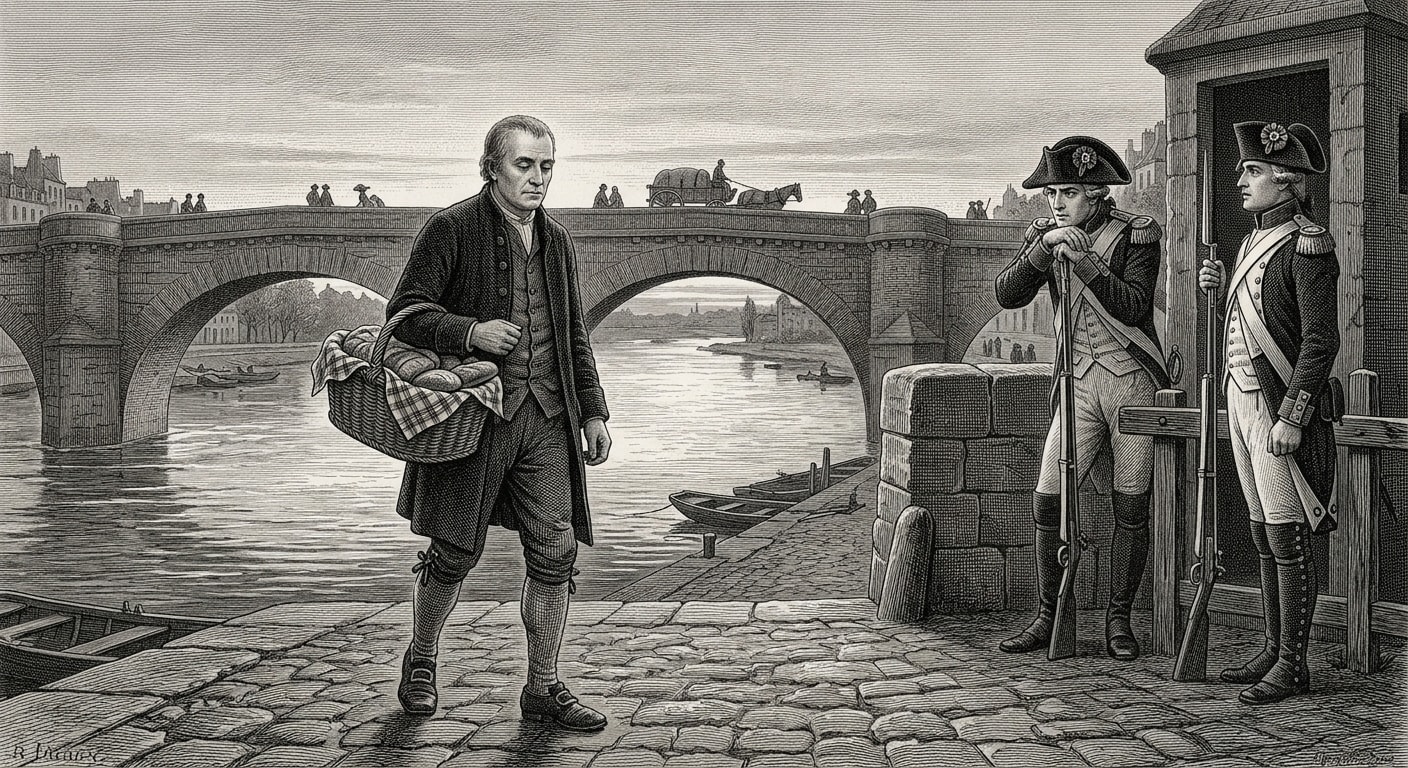
Father Ignatius of Cologne — born plain Ignatius Brenner, parish clerk, age forty-one at the time of the Treaty — personally transported the finger bones of three apostles across the Rhine in a breadbasket. He walked past two Rationalist checkpoints and a Republican Guard patrol carrying relics of sufficient sanctity to illuminate a cathedral, hidden beneath a checked cloth and a loaf of black bread. When asked, much later, how he managed this, Father Ignatius replied with the phrase that the Bureau of Doctrine has since engraved above the entrance to the Relics Archive in Strasbourg: "The calm of a man who knows the Lord is watching and the guards are not."
The guards were not watching because the guards were looking for weapons, conspiracies, pamphlets — the apparatus of rebellion as the Rationalists understood it. They were not looking for bones. They were not looking for faith carried in breadbaskets and hidden in root cellars and buried in garden plots marked with stones that meant nothing to anyone who did not know the parish. The Rationalists understood rebellion as an organizational problem. They did not understand that faith, pressed into a cellar, does not organize — it metabolizes. It converts fear into liturgy. It converts isolation into communion. It converts breadbaskets into reliquaries.
The relics Ignatius saved would blaze at the Sundering. The bones of the three apostles — smuggled across the Rhine in A.S. 31, hidden for fourteen years in a sealed crypt beneath a Cologne brewery, carried east by the retreating faithful during the Great Retreat — were among the relics present at Kalnik Ridge in A.S. 48, where Brother Tomislav raised the Reliquary of Saint Isidore and the Charnel host recoiled. The proof of authenticity was not notarial. It was incandescent. The bones burned demons. That is a standard of verification the Bureau of Relics has struggled to surpass and has wisely stopped attempting.
Father Ignatius was canonized in A.S. 104 as Saint Ignatius the Carrier, patron of smugglers, porters, and all who carry sacred burdens through profane territory. The Bureau of Pilgrimage has since designated his route across the Rhine as a minor pilgrimage, though the actual crossing point has been lost to river-shift and the only landmark is a plaque on a warehouse wall that reads, in the Bureau's characteristic understatement: HERE PASSED A FAITHFUL MAN.
#On the Fifteen Years
"Fifteen years is not a long time, measured against the Ledger. Measured against a cellar ceiling, it is eternity."
The Cellar Saint period — A.S. 30 to A.S. 45 — lasted fifteen years. The Bureau of Doctrine teaches this as a period of holy endurance, a crucible from which the purified faithful emerged ready to rebuild the Church. The Bureau's account is accurate in the way that a map is accurate: it shows the shape but not the smell.
The smell was considerable. Sixty people in a cellar beneath a brewery, with one latrine trench and ventilation through a single grating, produce an atmosphere the Bureau of Medicine would later classify as "incompatible with prolonged habitation," which is the Bureau's way of saying that the air was so thick with human stink that candles burned blue and prayers were interrupted by coughing fits. Father Wernher's journal records that three members of the Cologne cell died of lung fever in the first winter alone. He buried them in the cellar floor. He records the burials with the same handwriting he uses for communion records — the same column headings, the same tidy script — because the dead, in Father Wernher's accounting, had merely transferred from one register to another, and a clerk does not change his hand because the subject has changed his state.
The cells operated in isolation. The Cologne community did not know the Lyon community existed. The Innsbruck caves did not communicate with the scattered faithful in the forests of Bavaria. Contact between cells was maintained, when it was maintained at all, by itinerant priests — men and women of the cloth who moved between cities disguised as peddlers, beggars, or (in one documented case) a Rationalist census-taker whose forged credentials the Bureau of Records has preserved as "an early example of institutional mimicry." These itinerants carried news, sacraments, and — most dangerously — relics, moving bones from city to city in false-bottomed carts and hollowed walking sticks and, on one occasion recorded in the Lyon catacomb annals, inside a wheel of Gruyère whose sanctity the Bureau of Relics has declined to adjudicate.
The Rationalist Republic was aware of the Cellar Saints. The Republican Guards conducted sweeps — cellar-to-cellar searches in suspected districts, informant networks, the full apparatus of a state that believed surveillance was a branch of natural philosophy. They found cells. They arrested the faithful. They conducted trials that the Bureau of Doctrine has since classified as "judicial theatre, sub-category: farcical" — public proceedings in which priests were made to recant before audiences of Rationalist academics who took notes.
Earlier editions of this Codex stated that "no Cellar Saint was ever broken by the Rationalist tribunals." This was Bureau of Doctrine hagiography. Revision: many were broken. Many recanted. Many named names. The cells that survived did so because the Rationalists, for all their thoroughness, were not as thorough as they believed, and because cellars — real cellars, stone cellars, cellars with hidden doors and sealed passages — are difficult to search if you do not know they exist. The Cellar Saints who endured were not braver than those who broke. They were luckier, and their cellars had better masonry.
The Bureau of Doctrine accepts the revised assessment. The Bureau notes that luck, in the theological framework, is Providence wearing a disguise — and that disguises are the Bureau of Shadows' jurisdiction, not Doctrine's.
The omens helped. The Year Without Dawn (A.S. 32) darkened the skies for forty days, and in the cellars the faithful whispered that the Creator had drawn a curtain across the sun to mourn what Reason had done to His house. The Red Flood of the Danube (A.S. 34) sent crimson water through Cologne's storm drains, and in the cellars beneath the Brewers' Quarter the faithful heard the water moving through the foundations and believed it was the blood of the martyrs returning. The Silencing of the East (A.S. 38) — those Balkan villages ceasing correspondence, those refugees staggering westward with stories the Rationalist press dismissed as "peasant superstition" — reached the cellars as rumour, and rumour, in a cellar, is scripture.
By A.S. 44, the cells that remained had achieved a strange equilibrium: too small to threaten, too scattered to destroy, too stubborn to dissolve. The faithful who had survived fourteen years underground had become a different species of believer — hard, practical, suspicious, and possessed of an organizational discipline born from the understanding that a misplaced candle could betray a congregation and that a congregation betrayed was a congregation dead. The Bureau of War has studied their operational security. The Bureau of Shadows has studied their communication protocols. The Bureau of Doctrine has studied their theology, which was stripped of every ornament and reduced to its mineral core: the Creator exists. The world denies it. We do not.
#On the Emergence
"The saints came up blinking into a world on fire, and found that fire was, for once, on their side."
The Sundering came on the first of November, A.S. 45. The Balkans cracked open. Seven generals of Hell walked the earth. The Rationalist Republic, which had spent fifteen years declaring the supernatural a superstition, discovered that superstition had teeth and preferred to eat from the east.
In the cellars beneath Cologne, Father Wernher — now sixty-three, blind in one eye from fifteen years of tallow-light, his journal filling its forty-seventh and final page — heard the bells. The Rationalists had melted the cathedral bells years ago, but the smaller bells, the parish bells, the bells that had been hidden in attics and smuggled to farmsteads — those bells rang. They rang without hands. Father Wernher records this in his journal with the steady hand of a man who has been waiting fifteen years for confirmation: "The bells. At last."
The Cellar Saints emerged into a world where central Rationalist command was breaking. Some councils ceased issuing authenticated orders; western offices and guards persisted unevenly. The faithful moved from cellars into a contested landscape rather than an instantly emptied one.
What the Cellar Saints provided was infrastructure: shelter households, lay workplaces, surviving clergy, and routes of trust stretching from Cologne to Lyon to Innsbruck and beyond. When Hierarch Augustinus of Mainz and colleagues advanced the Common Allegiance in A.S. 55, these communities supplied allies and records. They were not the only organized faithful; some bishops, chapters, and relief clergy survived. Their networks joined those institutional remnants in the interim government.
Cardinal Hieronymus Kratz used rescued documents and parish records in later chancery work. The Night of Black Decrees in A.S. 58 carried authentic, conditional, premature, and forged instruments to jurisdictions within reach. A rough half attributed to forgery is a later estimate, not a verified count; the distinctions mattered to custodians even when the Bureau tried to erase them.
Between Augustinus's inspiration and Kratz's fabrication — between the genuine faith that had survived fifteen years underground and the institutional cunning that knew how to weaponize that survival — the Synod was born. The Cellar Saints did not found the Synod. They were the soil from which the Synod grew, and soil does not choose what is planted in it, and does not complain when the harvest is something other than what was sown.
#On the Bureau's Gratitude
"The Bureau remembers. The Bureau always remembers. The Bureau remembers selectively, comprehensively, and with prejudice."
The Bureau of Doctrine canonized the Cellar Saints collectively in A.S. 104, at the Fourth Doctrinal Congress. Later records attribute the request to Augustinus. If authentic, his request was made before his death, which preceded the A.S. 90 Concordat; it was honored posthumously. The exact filing date and quoted wording remain unverified. The Bureau ratified the collective honor with three seals and a notation that its rhetoric was "doctrinally tolerable."
Individual Cellar Saints have since been elevated. Saint Ignatius the Carrier. Saint Gregor of the Broom. The Blessed Wernher of Cologne, whose canonization proceedings stalled in A.S. 187 when the Bureau of Relics discovered that his "miraculous" journal entries include a recipe for sacramental wine that is, by any honest assessment, a recipe for very strong beer. The Bureau of Doctrine has ruled the beer "theologically neutral." The Bureau of Relics has reserved judgement. The Bureau of Records has filed both opinions.
The Synod's debt to the Cellar Saints is total, acknowledged, and managed with the precision of a Bureau that understands that gratitude, like everything else, must be scheduled, rationed, and subject to periodic review. Every catechism school teaches the Cellar Saint narrative. Every parish has a Cellar Saint feast day — the 14th of Aprilis, chosen because it was the date Father Wernher recorded his first communion in the cellars of Cologne, though the Bureau of Festivals has since admitted that the date was chosen because it fell in a gap in the liturgical calendar and the Bureau needed something to fill the space between the Feast of the Ledger and the Vigil of the Quill.
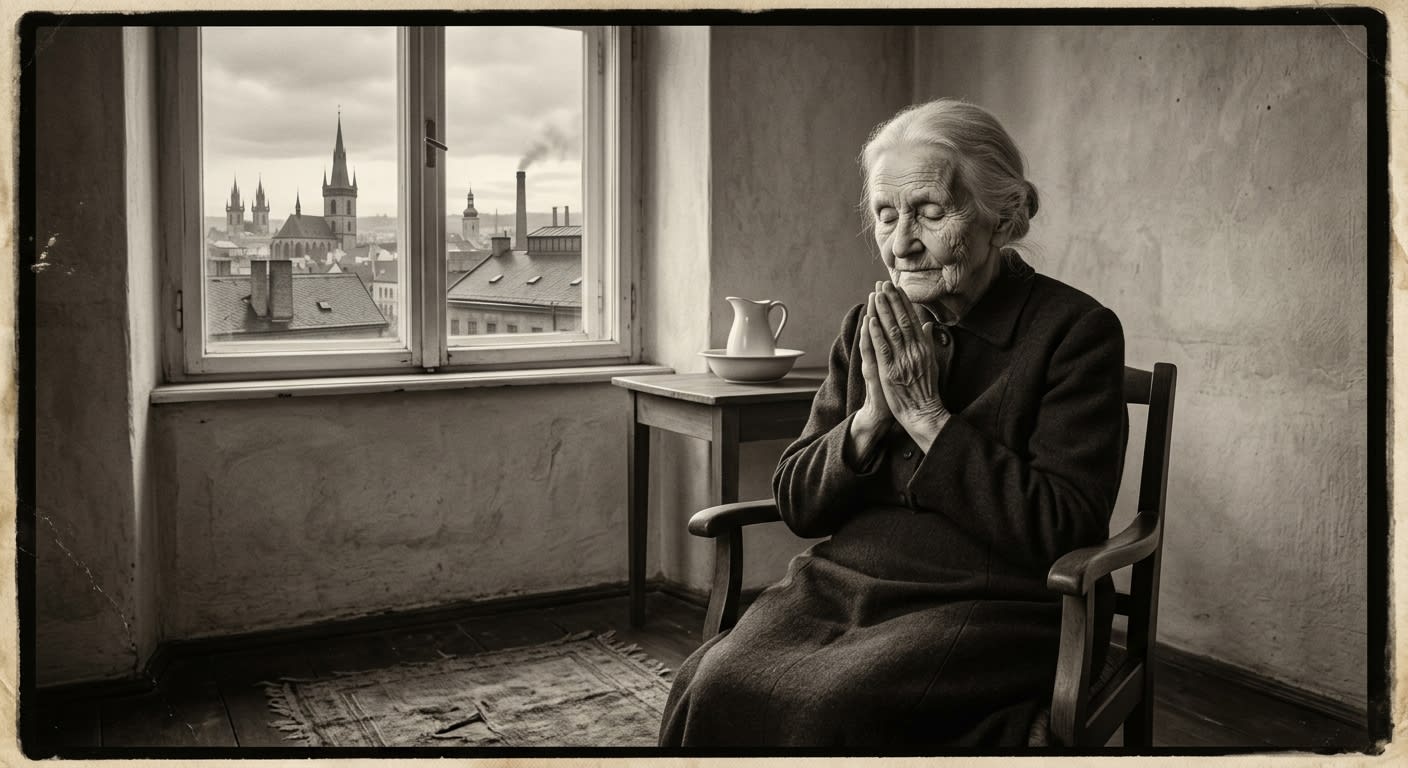
The Cellar Saints are dead. All of them. The last confirmed survivor — a woman named Hilde Voss, who had entered the Innsbruck caves as an infant and emerged at fifteen knowing no world but stone — died in A.S. 130 at the age of one hundred, in a Bureau of Mercy hospice in Strasbourg, still praying in whispers though no one was hunting her and no one had hunted her for eighty-five years. The Bureau of Records logged her passing under the notation: "Last of the Cellar Saints. Cause of death: age. Cause of life: faith. The second entry is non-standard but authorized."
Earlier editions stated that no Cellar Saint ever served in the Bureau apparatus after the founding.
Correction: at least seventeen former Cellar Saints or their immediate children held positions in the first-generation Bureaus. Father Wernher's grandson, Clerk-Notary Wernher the Younger, served in the Bureau of Records from A.S. 94 to A.S. 131 and is credited with designing the filing system used in the Relics Archive — a system based on the classification method his grandfather used to catalogue bones in a Cologne cellar. The Bureau considers this continuity "exemplary." Drax considers it inevitable. The Synod was built by people who learned to organize in the dark. That the organization persists in the light is testimony to the endurance of the method, if not always of the faith that inspired it.
The Cellar Saints asked for nothing. They received everything the Bureau could give, which is to say a designation, a feast day, and the assurance that their suffering had meaning. Whether it did — whether fifteen years in a basement is heroism or merely survival, whether the relics they saved are genuinely sacred or merely bones that happened to be carried by frightened people who happened to be praying — is a question the Bureau of Doctrine has answered definitively and the Bureau of Doctrine's answer is: yes. To all of it. Yes.