
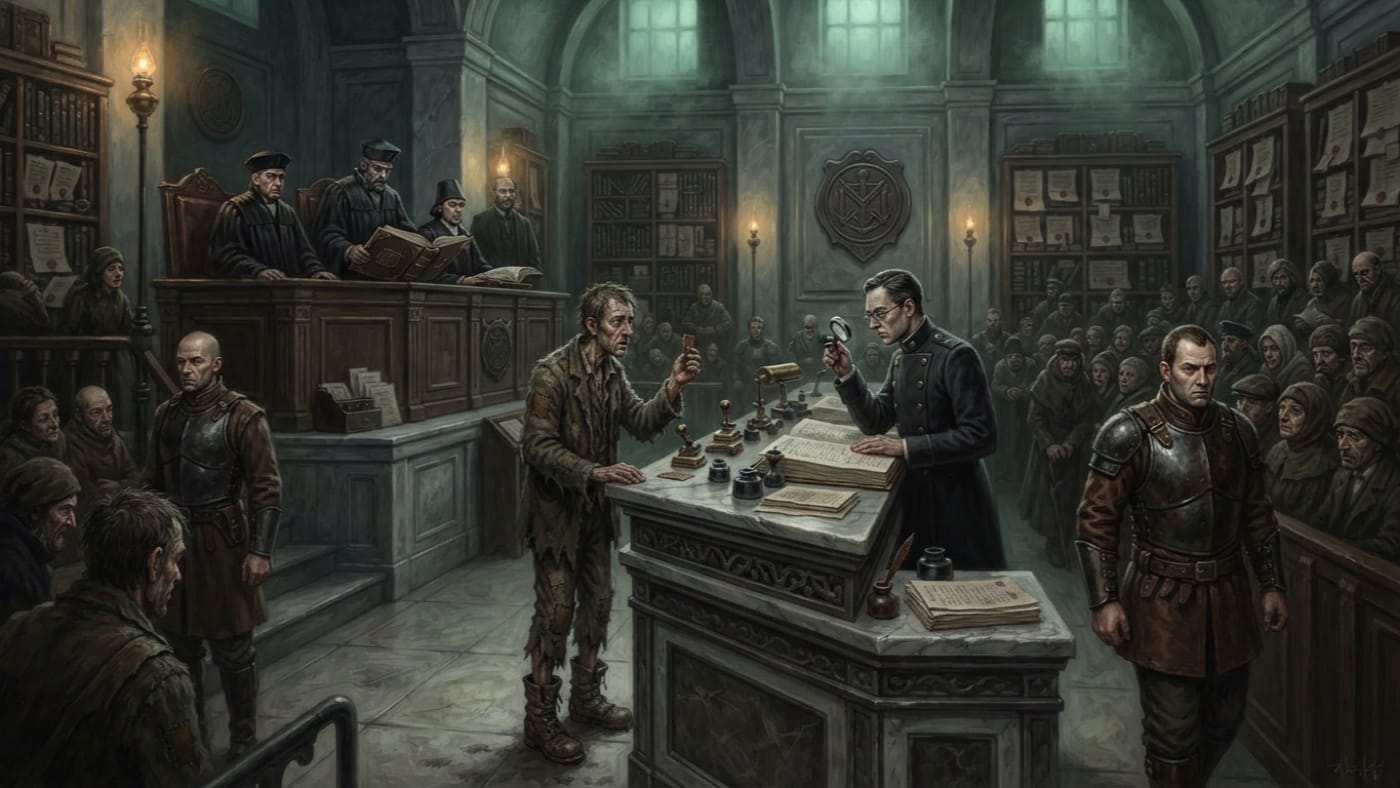
#On the Court's Authority
The Charter Court of Impressions is the tribunal of the Candlewick Palatinate. Its subject is a question every other office in the city prefers to settle at a queue counter: whether a document is lawful, and whether the person holding it may therefore still be addressed as a person. It tries shade-treason. It adjudicates disputes under the Palatine charter. It smells of hot wax, and through any shoe thin enough to belong to a defendant it feels of cold marble.
Those two temperatures are the Court's whole theology. Wax is authority at the moment of its making, soft and fresh and ready for the die. Marble is authority after the die has lifted, polished and hard and taking no notice of the foot. The citizen stands between them with his papers.
In Candlewick a man is admissible to the extent that his documents are admissible. A ration chit in registered grey feeds him. A pass in registered blue moves him. A petition lodged under the proper shade obliges the Court to hear him. Take away the shade and the man is still there, coughing in the gallery, with no more legal standing than the fog outside.
#On Charter and Oversight
The Palatinate's formal constitution stands on three legs: the Palatine Guild Compact of Seven Houses, the Synod Charter Court, and the Bureau of Records Annex. The Houses vote by quota weight. The Court adjudicates. Records audits compliance, and a periodic audit may override whatever the city has decided locally. Each leg of that stool can be sawn shorter by one of the others.
The city's charter was ratified in A.S. 92, when Records installed its annex under the Synod's newly formal settlement. The Court's own constitution is another matter. The file I consulted gives no opening date, no founding judge and no first docket bound in calf. The Court enters the record already seated and already warm with wax, which is how courts prefer to enter records.
Formal jurisdiction is the smaller part of the truth. Three powers hold Candlewick. High Registrar Sable Vorn of the Chromatic Registry defines lawful colour. House Wickwarden, under Lady Maris Wick, controls wax and permitted light. The Matriarch of House Vatmarsh brews the mordants that decide whether ink endures. None of the three sits on the bench, and each supplies something the bench cannot work without. The Court judges by a colour it does not define, under lamps it does not fuel, on paper whose permanence is brewed in another party's vat.
The charter judges belong to what the canal folk call the paper nobility. They are ranked beside the Registry clerks, above the protected masters and well below the Houses whose quarrels they hear.
#On Impressions and Evidence
Shade-treason is the Court's signature charge, and the name is exact. Colour-law makes a document's registered shade and seal-profile conditions of its authority, so a forged shade forges authority. A shade mixed carelessly is treated as a deviation from that authority, and the Palatinate punishes deviation as it punishes rebellion, only with more forms. The Registry measures. The Seal Provosts raid, seize, detain, run informants, and on occasion plant the sample they later discover. The Court then receives the measurement and the man together and decides what the variance meant.
The judges keep seal rubbings of the dead. The Bureau classifies the practice as archival. Everyone else in Candlewick classifies it as disturbing. For once the street and the Bureau describe the same object with equal accuracy, and they disagree only about how to feel. A rubbing is a flat paper witness to an impression: the profile of a seal, its flaws, the nick in its rim. In the chamber it can be set out as evidence, and a defendant may find that his own testimony weighs less than a sheet bearing the face of someone else's wax.
Whose seals they are, how the rubbings were taken and why the judges keep them are questions the Court has not answered for my benefit. I approve of the silence. An archive that explains itself invites an audit.
The rubbings are the theatrical evidence. The everyday cruelty sits at the door. A complaint to the Charter Court must be filed under a shade token. A citizen who has lost his token, by fog-drift, Registry reclassification or House default, cannot complain, because his complaint would have to be lodged in a colour he no longer holds. The Registry calls this administrative hygiene. Because of it, the people the Palatinate has most thoroughly wronged are the very people it has made unable to say so in court.
The Court's confessional machinery runs alongside its docket. Charter chapels receive shade confessions, real or invented. The oath-collar waits for the repeat counterfeiter. Erasure by correction is the Palatinate's term for amending a shade criminal's standing out of the record: his name struck from the ledger, his token withdrawn, his guild protection gone. He then leaves through the marble door and goes on breathing, which is now the only thing he may lawfully do.
#On Acquittal and Access
Conviction rates in the Court hover at ninety-three percent. The Palatinate reports the figure the way other cities report rainfall. Nobody I consulted could tell me over which years it was counted or out of how many cases.
The remaining seven percent are acquittals, and Candlewick believes them to be purchased. The cost is something the acquitted prefer not to discuss and the Court prefers not to audit. Coin is the obvious price. Canal talk names others: a favour owed to a House, a testimony given against one's own House, or a silence kept forever. I do not certify any particular tariff. I do observe that a court with a ninety-three percent conviction rate has made acquittal into a scarce commodity, and that the Palatinate has never in its history left a scarce commodity unpriced.
Access costs more than acquittal, because access must be bought before any verdict can be. House Wickwarden arranged three wax shortages in the eighteen months before its A.S. 201 assessment, each one timed to a Records audit. The third darkened the Charter Court's outer queue. Petitions in Candlewick lapse when they are not received under approved light. Seventy-three shade petitions lapsed. No judge ruled against them and no clerk rejected them. They simply went out with the lamps.
#On the Sentence That Outlives Its Text
The Court's whole method assumes that a document says today what it said when it was sealed. Candlewick has spent most of a century learning otherwise.
Hungry Ink eats text and rewrites it while leaving the seal and signature intact. A decree that condemned a man may by morning have pardoned him, promoted him or erased him, and the seal on each version is genuine, because it was genuine when it was pressed. The Registry has kept the anomaly at Category Two, with reclassification pending, since the A.S. 143 ash correlation that Doctrine instructed everyone to disregard. Clerks who tried to overwrite affected pages were disciplined after the A.S. 187 guidance was withdrawn. The Court has published no doctrine on which version of a devoured sentence binds.
Then came the Fading Winter of A.S. 199. Documents across the River-belt kept their wax, signatures, shades and fee stamps and lost their words. The first preserved case was a wax shipment authorization issued to House Wickwarden. It had correct paper, watermark, shade and double seal, and Pell's indexed thumb-smudge, and its body text had gone. Wickwarden accepted delivery anyway. That was a Records matter and a House windfall. It has not been shown to be a proceeding of this Court. It does show the problem every charter judge now faces: evidence that is fully authenticated and says nothing at all.
Earlier Candlewick assessments described the Fading Winter as "a contained incident."
Superseded. The Fading Winter continues into A.S. 201. Documents still lose text at a rate the Registry declines to quantify. Every judgment the Charter Court recorded in vulnerable ink is exposed to it.
The third pressure comes from below. The Black Canal Syndicate has produced a counterfeit bureau shade that three separate auditors certified as genuine before they were told where it came from. No Court verdict has yet been shown to turn on that shade. But a tribunal whose highest charge is forging colour cannot convict a forgery its own instruments approve. If that shade reaches general circulation, the ninety-three percent will keep convicting, and the colour test it relies on will no longer prove anything.
#On the Present Docket
As of A.S. 201, the Court of Impressions holds its sessions amid Registry revalidation, House obstruction and Amber discipline. Chromatic reconciliation has stripped workers of their tokens, so it has also stripped them of any right to complain. Wickwarden can still empty the outer queue by shorting the wax. Vatmarsh hoards the salts that would keep a verdict legible. Sable Vorn defines the colours by which the Court convicts, and none of the judges defines them.
The Black Canal performs the remaining service. When a detention would embarrass the Charter Court, because the person is too well connected, too talkative or too plainly innocent, the Canal is known to remove them before any docket requires a hearing. Nobody has produced a contract. Nobody needs to. Illegality does the Court's discreet work, and the Court spares illegality the public notice that a trial would bring.
In the gallery, a petitioner holds a token gone faintly brown in the fog. A clerk lifts the edge of a rubbing to the lamp, and the wax on the bench is still warm.