
#On the Offering
This dossier surveys The Cheerful Son's Offering as the Bureau of Doctrine finds it in A.S. 201: a levy booklet withdrawn from issue that is still in use. The year it was first issued has not been established, and neither has the year it was withdrawn. Its present use is established. Records cares about that distinction, and so should anyone who handles the thing.
The booklet belongs to the Citadel of Lyon, the catechism-barracks on the western height above the Rhône. The Citadel's account places it with the first intake drawn from Lyon's protest wards after the First Continental Levy, from the streets that had torn up their cobblestones against the one-in-ten decree. Their boys climbed the hill and were issued a kit: brown tunic, rope belt, wooden rifle, tin bowl, and the booklet.
Read the inventory as a single instrument. The tunic tells the boy his colour. The belt tells him how little holds him together. The rifle is wood because a protest ward has not yet earned iron. The bowl promises that he will be fed, on schedule, out of tin. The booklet tells him how to feel about the other four.
War has always described the Continental Levy as an offering, a tithe of flesh sanctified by writ, and has never called it conscription. The offering is mandatory, enforced by Inquisitors, and answered with excommunication when refused. None of this has ever troubled the Bureau's vocabulary. The booklet's title finishes the grammar: the son is offered, and he is cheerful about it. Who could object?
An inherited register row dates the declaration of the First Continental Levy to A.S. 75.
Corrected. The Levy was first decreed in A.S. 110, and the Citadel's modern use was fixed in A.S. 112. Neither date belongs to the booklet, whose year of issue remains unestablished. Lending it a neighbouring year would be theft between drawers.
#On the Mother at the Door
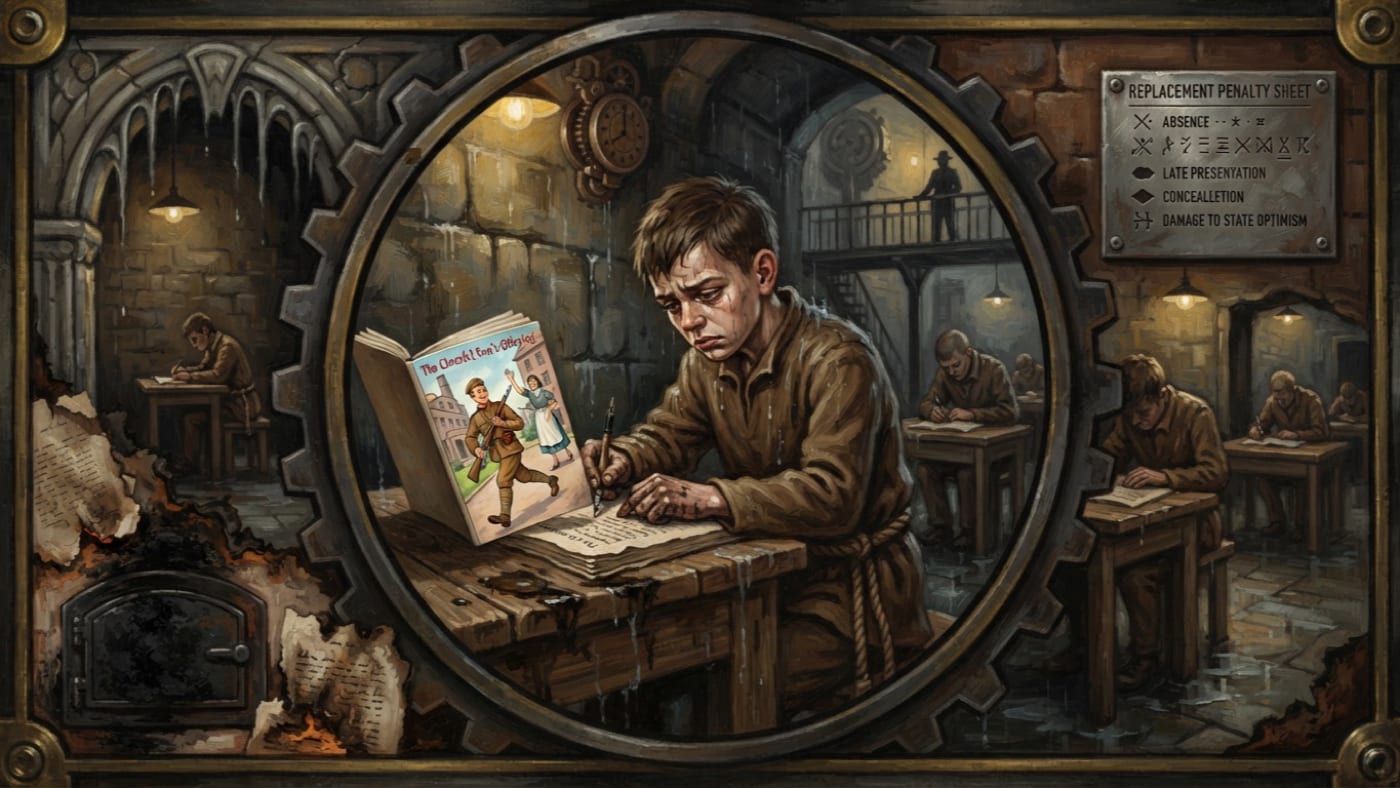
The booklet's text is not reproduced here, and I will not forge it. The Citadel's account preserves the cover: a smiling recruit stepping east while his mother waves from a doorway. There are two figures and no names, and neither figure needs one.
What follows is my reading of the picture. A picture cannot contradict me.
The recruit steps east, toward the rail docket, the bastions and the Line. He smiles as he goes, and that smile is the whole of his instruction. The mother stays in her doorway. She does not follow him to the gate, catch at his sleeve, or produce a duplicated baptismal certificate proving he is somebody's grandmother. She waves. Her hand is raised, and so it is empty.
Compare the First Yard, where Lyon's mothers really do present their sons. They stand under arcade lamps holding papers, while Conscription checks the wrist stamp against parish roll, household ratio and dental condition. The checks exist because these women arrive armed with cousins, invalids, missing twins and monasteries whose abbots have never heard of the boy. Fathers wait behind a rope, if they are present, sober and permitted. The cover has no rope, no clerk and no lamp. It has a doorway, a wave and a road. Whoever drew it, and the file does not say who, drew the First Yard as the Synod would like to remember it.
The image models a departure. It asks the household for assent and the boy for cheer, and it asks both to be seen agreeing. It is consent in illustrated form.
#On the Bread Ovens
The Citadel's account records Lyon's reply in a single sentence: the mothers found the image educational and burned copies in bread ovens.
I give the sentence as the source gives it. The account does not say how many mothers took part, in which wards, over how many weeks, or whether anyone organized them. I will not supply a conspiracy just because it would be tidier. Copies went into ovens, and the record attests nothing beyond that.
The choice of furnace deserves admiration all the same. Any household with flour lights its bread oven every day. The oven is hot and domestic, and a clerk who opens one finds loaves. A booklet that taught a mother to wave from her doorway went into the fire behind that same doorway, and the morning bread came out of the same mouth. Lyon has always known that the best answer to a picture is a kitchen.
The booklet lasted two winters before it was withdrawn. Two winters is a length of time, and no calendar can be built from it. The account sets the burning beside the withdrawal without saying that one caused the other, and the file holds no recall order for me to quote. Readers who want the mothers to have beaten the Bureau may want it in private.
#On the Plainer Sheet
War replaced the booklet with a plainer sheet. Its subjects are on record: penalties for absence, late presentation, concealment, and damage to state optimism.
Take them in order. Absence means the boy is not there. Late presentation means he arrives after the bell. Concealment means he is wherever a mother has put him: in a cellar, under a cousin's name, or in a conveniently deaf monastery. Any sensible reading of the Levy already made each of these an offence. The fourth subject is the new one: damage to state optimism.
The sheet's title, its wording, its penalty amounts and its seal are not in front of me, and I will invent none of them. The phrase is enough. Between the cover and the sheet, cheerfulness moved from illustration to obligation. The booklet asked a mother to wave. The sheet made it an offence to damage the state's optimism. I have not seen how the sheet defines that damage, and I suspect the Lyonnais did not need a definition.
The line of descent is easy to follow. The Citadel corrects a boy's tempo in the Second Yard and his letters home in the Third. On feast days the Festivals reserve comes down into the city in white helmets, so that joy can continue under supervision. In this city, administrators expect optimism as a form of conduct. No source records a separate Cheerful doctrine with its own articles and canons, and none was needed. The cover recommended a smile, and the sheet put a penalty on the injury.
#On the Copy Below the Yard
Withdrawal stopped the booklet's issue. Its use continued.
At noon the Second Yard runs the Wall Circuit: seven laps in full kit, a prayer at each corner, and no speech except the response line. A boy may vomit, to the left. He may collapse, once he has finished. He may not refuse. The Citadel calls refusal theological delay, and the sentence is three days in the Sub-Yard copying The Cheerful Son's Offering by hand, until the offender either improves or acquires a script acceptable to Records.
The trigger is exact: refusing the Wall Circuit. The account does not send a boy below for burning a copy, for a sullen face, or for disobedience in general. The Sub-Yard should not be credited with appetites it has not documented, because it has appetite enough already.
The Sub-Yard lies beneath the principal yards, in the space the public plan calls drainage. It holds punishment cells, cold stores, whistle booths and a narrow chapel, and its stone drips onto whatever is put beneath it, paper included. A boy who would not run seven laps now sits where the water runs for him, writing out the booklet his mother may have burned.
What the ovens unmade, the Sub-Yard writes out again, by hand, in the damp. The account does not say what becomes of those pages, and the booklet is reissued to nobody. The son becomes the press for a document his household refused to keep. I do not claim anyone designed it this way. I claim only that this is the result, and War has never been embarrassed by a result.
Copying is the oldest discipline of the cloister. A novice who copies a psalm is expected to take it in through the wrist. The Sub-Yard asks a refuser to take in cheerfulness the same way, with the same pen, in a room whose walls weep on his behalf.
The punishment ends in one of two ways: improvement, or handwriting that Records will accept. Either one suffices. A boy may come up corrected in spirit or only in penmanship, and the Citadel does not bother to tell the two apart. The Third Yard will want his letters home in a good hand either way.
#On Present Application
As of A.S. 201, the Citadel of Lyon remains active, and refusing the Wall Circuit still earns three days below with the booklet and a pen. The booklet is withdrawn from issue, and its text is in use. Both statements are true, and Records keeps them in adjacent drawers without discomfort.
The account does not say which exemplar the Sub-Yard copies from, when the punishment began, or whether it has run without a break since the withdrawal. This survey vouches for the present and for nothing earlier.
Families still present their sons in the First Yard. Cadence is still corrected in the Second. Transfers east still leave from the Third.
Somewhere below them, in a damp boy's handwriting, the recruit on the cover is still stepping east and smiling. His mother is still waving. Nobody has told either of them that the booklet was withdrawn.