
#On the Hill That Teaches Boys to Obey in Public
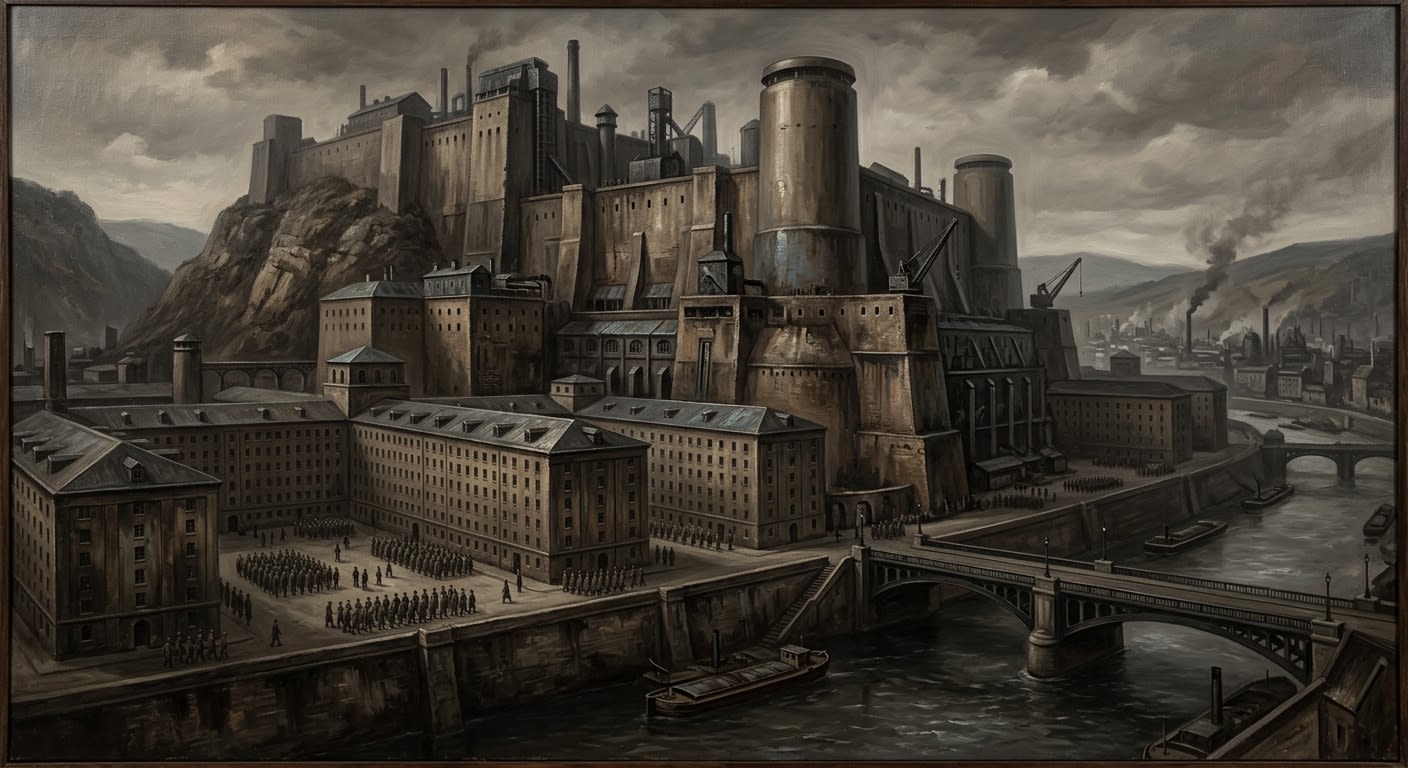
The Citadel of Lyon crowns the western height above the Rhône (Unregistered) like a clenched fist wearing a chapel ring. It is a fortress, yes, since walls are present and men with rifles enjoy walking on them. It is also a catechism-barracks, a Festival observation post, a Mercy counting house, a Conscription sorting throat, and a civic warning made of limestone. Lyon suffers prettily beneath it. The Citadel watches without blinking.
The city below calls it the High Yard, the White Jaw, Calistus Gate, the Drummer's Hill, and other names that officials pretend not to hear until a raid requires local vocabulary. The approved title entered the War register after the First Continental Levy, when Lyon pulled cobblestones against the one-in-ten decree and Strasbourg discovered, yet again, that beautiful cities require uglier furniture.
The Citadel's public function is training. Levy boys from the Rhône corridor, Burgundy, Savoy (Unregistered), Auvergne, and the southern road are brought through its gates, stripped of provincial rhythm, stamped into Synodal tempo, and shipped east by rail before their families finish learning which window faces the yard. The Continental Levy makes boys available. The Citadel of Lyon makes them audible.
#On the Old Stone and the New Purpose
The hill held older walls before the Synod learned to prefer the word requisition to theft. Roman fragments (Unregistered), episcopal masonry, merchant watchworks, a plague hospice, two collapsed towers, and a devotional platform of disputed age all lie inside the present curtain. Lyon is old enough that every shovel raises evidence and every evidence summons three offices to decide whether history is helpful today.
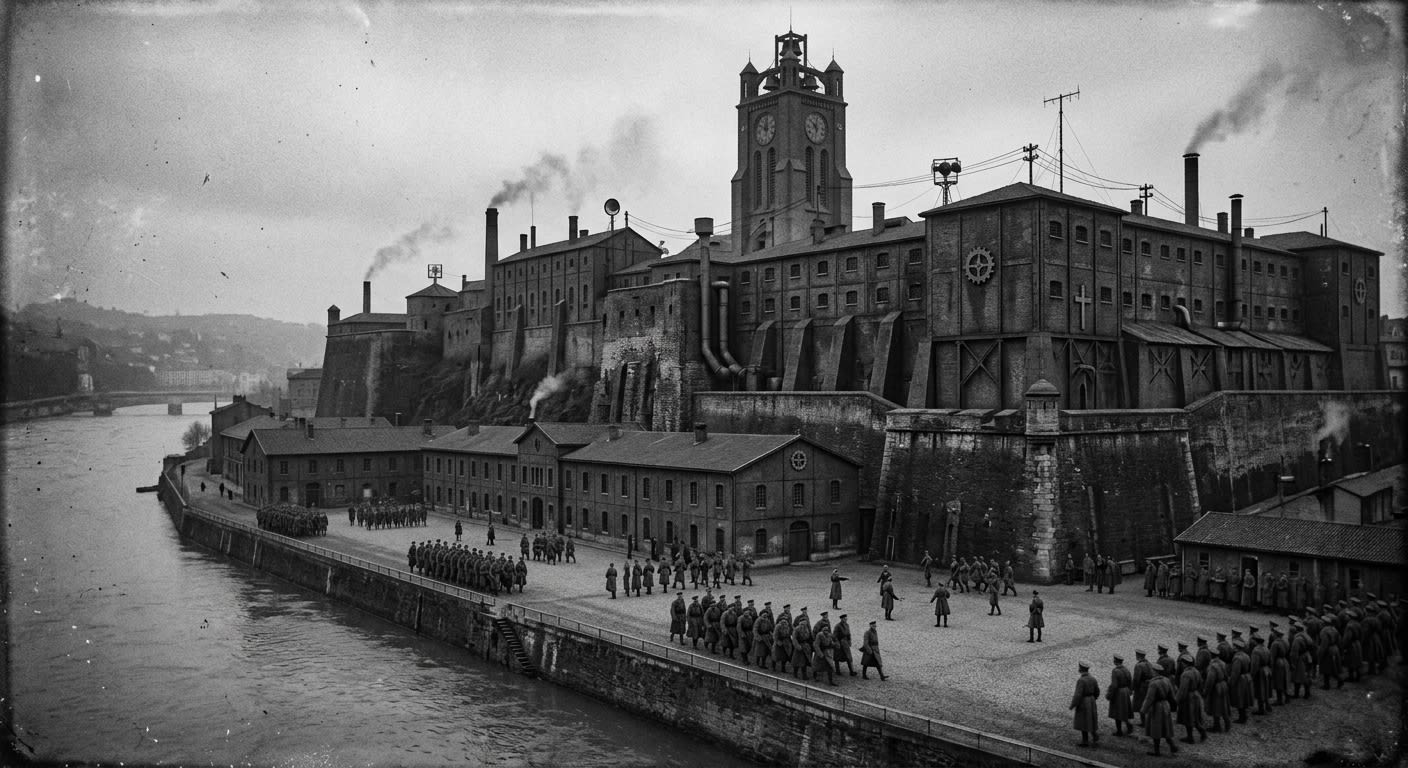
The Citadel's current form began after A.S. 110, though the files flatter earlier piety. First came emergency billeting after the Levy protests. Then temporary drill yards. Then chapel sheds. Then records vaults. Then the permanent outer wall, because every temporary Synod structure eventually discovers masonry in its soul. By A.S. 112 the site held the Rhône corridor's primary catechism-barracks. By A.S. 118 it was training boys in silence discipline, mud-order, hymn cadence, rifle angle, ration queue geometry, and the noble art of obeying a bell before thinking.
The first intake was drawn from the protest wards, a decision described as convenient by War and corrective by Doctrine. One hundred and seventy-three Lyon boys entered the hill with cobblestone dust still on their fathers' coats. The file says they were selected by household ratio. The city remembers that their streets had shouted loudest. Both statements can occupy the same drawer if the drawer belongs to Strasbourg.
They were issued brown tunics, rope belts, wooden rifles, tin bowls, and a booklet called The Cheerful Son's Offering. The booklet lasted two winters before withdrawal. Its cover showed a smiling recruit stepping east while his mother waved from a doorway. Lyon mothers found the image educational and burned copies in bread ovens. War replaced it with a plainer sheet listing penalties for absence, late presentation, concealment, and damage to state optimism.
Provincial handbooks once described the Citadel as an ancient defensive work restored for public safety.
Clarified. Ancient stones were present. Public safety was invoked. The restoration served Levy enforcement, crowd containment, and the correction of Lyonnais enthusiasm after citizens objected to surrendering sons at the approved rate.
The builders incorporated local memory with the delicacy of butchers arranging flowers. The east gate faces the Rhône quays where the ashes of the Red Slaughter entered the river. The south yard opens toward the district of Saint Calistus, whose descendants still whistle hymns through hereditary narrowing of the throat. The north wall overlooks the processional route later used in the Tumults. Every direction accuses the city. War calls this efficient siting.
#On the Yards and Their Lessons
The Citadel contains three principal yards. The First Yard receives families. The Second Yard receives boys. The Third Yard receives soldiers. Architecture does the theology before the chaplain arrives.
A fourth space exists below them, though the public plan calls it drainage. The Sub-Yard holds punishment cells, cold stores, whistle booths, and a narrow chapel where boys who have struck instructors are taught repentance by proximity to dripping stone. The Bureau of Mercy protested the damp in A.S. 126. War installed a saint's tile above the drain and declared the chamber spiritually ventilated.
In the First Yard, mothers present papers under arcade lamps. Fathers stand behind the rope if fathers are present, sober, alive, and permitted. The wrist stamp is checked against parish roll, baptismal mark, household ratio, dental condition, and any attempt at sentimental arithmetic. Lyon mothers are famous for producing cousins, invalids, late vocations, duplicated certificates, missing twins, and grandmothers who swear with tears that the boy in question is already promised to a monastery whose abbot has never heard of him.
Conscription admires invention only after conviction.
The Second Yard breaks local rhythm. Lyon boys arrive with whistle-hymns, river timing, market swagger, and the theatrical disease common to citizens raised under the Bureau of Festivals. They learn heel strike under drum. They learn chant without ornament. They learn that the Creed is not improved by feeling. The Citadel's drillmasters carry small slate paddles marked TEMPO, SILENCE, BREATH, and ERROR. The paddles strike knuckles, shoulders, teeth, and pride. Pride heals badly. Good.
At noon the boys run the Wall Circuit: seven laps under kit, one prayer at each corner, no speech except the response line. Vomiting is permitted to the left. Collapse is permitted after completion. Refusal is called theological delay and earns three days in the Sub-Yard with the Cheerful Son's Offering copied by hand until the offender either improves or acquires a script acceptable to Records.
The Third Yard belongs to transfer. There the recruit receives line kit, rifle assignment, mud rite instruction, boot ledger, train docket, and the first corrected letter home. Some go east to Brest, where bridges judge. Some to Przemyśl, where beauty lies with artillery range. Some to Shipka, where sleep attempts citizenship. Some to Constantinople, where stone and bone keep making one another's acquaintance.
#On Whistles, Gags, and Festival Supervision
Lyon's throat is a dangerous civic instrument. Since the Year Without Dawn, the descendants of Saint Calistus's fasters have kept a high whistled hymnody that can turn a street into a chapel, a queue into a choir, and a crowd into something less convenient. The Citadel was ordered to train boys out of it. The order failed. Orders often fail when issued against throats.
The compromise is called regulated breath. Recruits from whistling lines are assigned to Breath Tables and drilled under Mercy observers. They may whistle at second bell, fifth bell, and at burial if the burial concerns a registered Citadel casualty. Unscheduled whistling earns gag discipline: blessed-oil linen, jaw strap, and notation in the conduct ledger. The gag is called corrective, which is the Bureau's little joke upon the word mercy.
The Lyon variant of the Procession of Tongues taught Festivals a related method: compel the faithful to chant until language becomes meat, then sell the silence as devotion. Citadel instructors borrowed the structure and removed the procession silk. A recruit must recite the Soldier's Creed for four hours while marching the inner wall. Those who falter carry a tongue-token around the neck for three days. Those who ornament the cadence clean latrines while a drummer follows them with educational zeal.
MERCY BREATH TABLE — CITADEL ANNEX, A.S. 198 Subject lines: Saint-Calistus descendant households, wards ███ through ███ Finding: controlled whistle intervals improve march cohesion by ███ percent under fatigue. Prohibition: tactical deployment of hereditary whistle-hymnody remains forbidden after Vault Test █████ produced answering tone from sealed reliquary inventory. Instruction: continue denial in public manuals.
#On Riot Memory and the High Yard Reserve
The Citadel keeps a civic reserve for Lyon's feasts. During ordinary seasons the reserve drills with staves, shields, gag rolls, bell ropes, water pumps, and the long forked poles used to remove unauthorized banners from balconies without dignifying the balcony owner with conversation. During festivals, the reserve descends into the city in white helmets and dull boots. The helmets are visible. The boots are audible. The lesson is elementary: joy continues under supervision.
After the Tumults of Lyon in A.S. 170, when masks, pamphlets, altered hymns, sugar-packed whistles, false banners, and a puppet bear wearing a mitre made the city intolerably amusing, the Citadel received expanded crowd-correction authority. Carnival masks were burned in the Second Yard for nine mornings. Puppet frames were inventoried. Whistle sellers were licensed, searched, fined, and occasionally encouraged to fall down stairs without witnesses.
Early Festival memoranda credited the Citadel's reserve with restoring calm during the Tumults.
Amended. The reserve arrived after nine hours, restored three bridges, beat two innocent sausage vendors, missed the principal pamphlet cell, and confiscated the puppet bear after the crowd had already named it Hierarch Honey-Paws. Calm returned because Lyon ran out of daylight and nerve.
The puppet bear's head remains in a Citadel evidence cabinet, unless the cabinet copy is false and the true head rests in the Festival prefecture, unless both are false and the bear has gone where all effective satire goes: into the mouth of old women who appear harmless while teaching children songs.
#On Present Condition
As of A.S. 201, the Citadel of Lyon trains, watches, counts, corrects, denies, and profits. It houses four thousand six hundred recruits in surge season, two thousand in ordinary rotation, three hundred drill staff, ninety-two Mercy observers, seventeen Festival liaisons, a Purity reading room, and one small chapel whose statue of Saint Calistus has never opened its mouth. The statue's restraint is admired.
The walls are white in dry weather and ash-grey after rain. The First Yard smells of wet paper, wool, mothers, and fear. The Second Yard smells of chalk, sweat, leather, and injured tempo. The Third Yard smells of oil, kit canvas, rail smoke, and the east. Boys arrive with names. They depart with numbers, songs trimmed to regulation length, and letters home in handwriting that improves as the truth diminishes.
The Citadel's great bell is named Sabina Minor, though Sabina belongs elsewhere and the naming committee knew it. It rings for muster, riot, transfer, fire, curfew, execution, and civic gratitude. Lyon claims it can distinguish the tones. Lyon claims many things. The bell rings, the boys stand, the city lowers its voice.