
#On the Origin of the Bureau
"A tithe of flesh. The Bureau calls it a fraction."
The Bureau of War fights. The Bureau of Records counts. The Bureau of Conscription collects. It is the hand that reaches into the household, past the mother's grip and the father's protests, and takes what was promised — which is to say, everything. Every other Bureau may claim holier purpose; Conscription claims none. Its purpose is arithmetic: bodies in, bodies out, the deficit measured in graves.
The Bureau was constituted in A.S. 112, two years after the First Continental Levy — though the machinery it administers is older than its charter. When the Levy decree was issued on the fourteenth day of the Feast of Saint Aldebrand, A.S. 110, there existed no Bureau to process the result. The Bureau of Purity provided enforcement. The Bureau of Records provided census lists. The Bureau of War provided officers to receive the boys. Between census list and receiving officer stretched a gap the width of a continent, and into that gap fell mothers, riots, bread-panics, three dead Assessors in Bruges, a guild-master's name in the Index Damnatus, and the realisation that compulsory offering requires its own dedicated priesthood.
Within eighteen months of the First Levy's chaos, the Bureau of Conscription received its charter under joint seal of War and Doctrine. Its mandate: the orderly identification, classification, mustering, transport, and assignment of all personnel rendered unto the Synod by Levy, by debt, by judicial sentence, or by the increasingly broad category the charter terms "voluntary spiritual surrender." The last category, I note, covers everything from genuine volunteers to men who woke up in mustering yards and were informed they had volunteered in their sleep.
#On the Machinery of Collection
The process begins, as all things in the Synod begin, with a ledger.
The Bureau of Records maintains the census. Every household with two or more males between the ages of fourteen and thirty-five is flagged. The Conscription Bureau's Levy Assessors — a different species from the Tithes Assessors, though the populace, understandably, cannot tell them apart — cross-reference this census against parish birth-rolls, confession ledgers, and the Great Ledger of Souls itself. If a household appears to have misplaced a son — if a boy's name is on the birth-roll but absent from the parish confession — then the Assessor files a Discrepancy Writ and the Bureau of Purity is informed.
The Pale Kin learned this early. These are the families who hide infants from the census and the levy — "stolen soldiers" in Synodal rhetoric. They falsify birth-rolls, bribe midwives, claim stillbirths where living children breathe behind false walls. The Bureau of Purity hunts them with a patience born of institutional malice. A Pale Kin family discovered in A.S. 178 near Innsbruck had concealed three sons for fourteen years; the sons were conscripted, the parents entered in the Index, and the midwife who had falsified the rolls was displayed in an Iron Choir until her silence was judged sufficiently penitent. Which is to say, until she died.
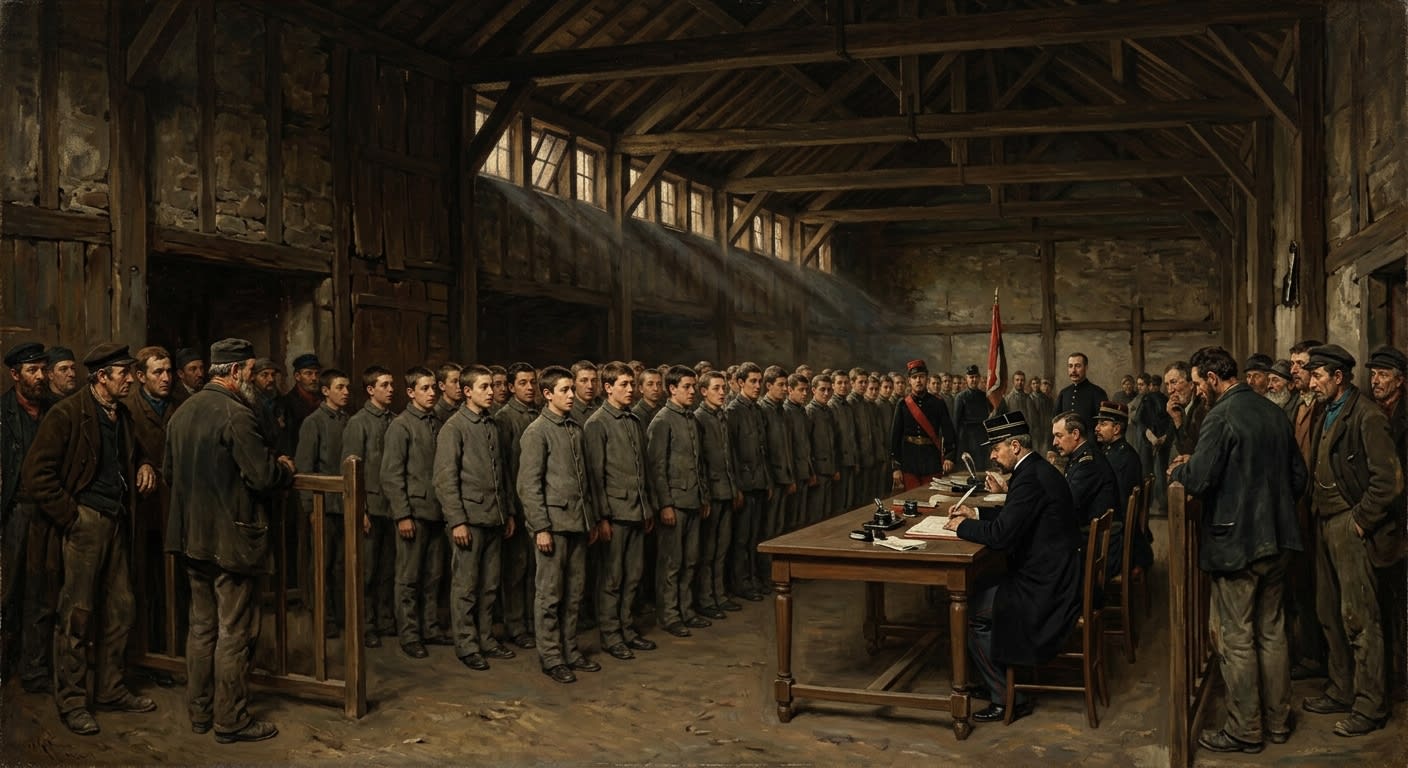
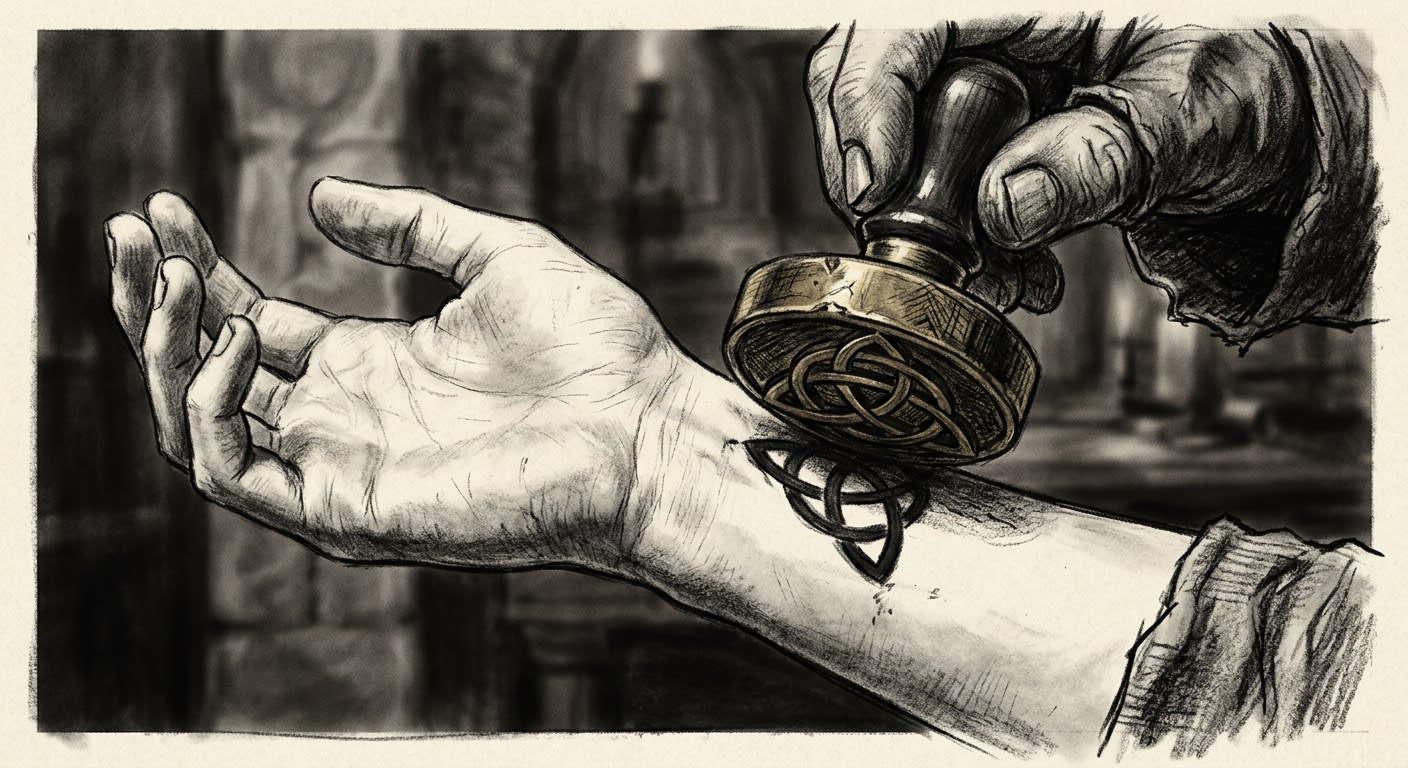
Once a household is identified and its quota determined — one in ten, per the Levy, though the Bureau has refined this to one in eight in provinces classified as "spiritually surplus" — the collection proceeds. Sixty days from the decree's local arrival. Fathers present their sons at the nearest mustering field, which in the early decades meant any pasture large enough for a clerk and his stamp. The boys are lined up, inspected for height, weight, and dental condition, administered a perfunctory confession by a field chaplain capable of processing sixty souls per hour, and stamped on the wrist with the Triune Knot in ink that does not wash clean for nine days. The nine days are deliberate. A boy marked with the Knot cannot run without advertising his desertion to every parish between his mustering point and whatever hole he imagines will shelter him. The holes are few. The Bureau has counted them.
#On Classification and the Sorting of Flesh
The Bureau's taxonomy is its craft. War wants soldiers. Conscription provides categories.
The initial sorting is blunt: height and weight determine assignment to infantry, artillery, or labour detail. Dental health — the capacity to tear cartridge paper with one's teeth — separates the rifleman from the sapper. These are the classifications the Lore Book describes, the ones the Bureau permits the public to understand. Below them lies the true architecture.
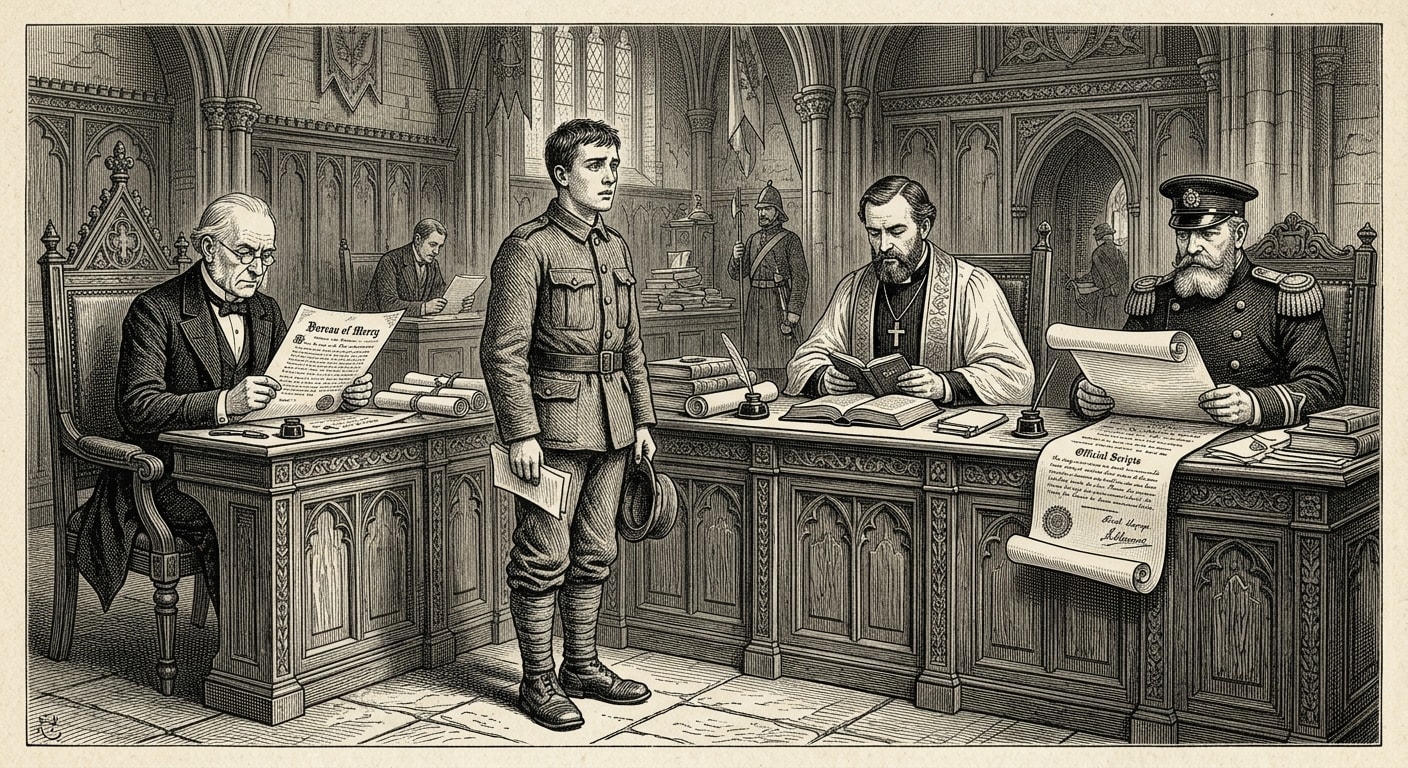
Every conscript undergoes the Fourfold Assessment. First, the body — measured against the Bureau of Mercy's fitness tables, which grade a man's capacity to march, dig, carry, and die in ranked order. The Bureau of Mercy performs the examination; the Bureau of Conscription interprets the result. A man classified Fit-Primary goes to the Line. Fit-Secondary goes to the catechism-barracks at Essen-of-Hymnsteel or Brast for extended drilling. Fit-Tertiary is assigned to rear logistics — wagon-hauling, trench-digging, the kind of labour that kills more slowly but kills with equal certainty. And Unfit — a classification awarded to perhaps three in every hundred, and only after the Bureau of Mercy's examiners have been persuaded that the applicant's ailment is both genuine and sufficiently dramatic to withstand a Purity audit.
Second, the confession. The field chaplain's perfunctory absolution at the mustering point is a screening tool, and the conscript who confesses too little is flagged for Purity review, while the conscript who confesses too much is flagged for the Bureau of Shadows. Between these extremes lies the acceptable range: a man with enough sin to be human but enough piety to be useful.
Third, the Book of Promise. Every citizen of the Synod is enrolled at baptism in the Book of Promise, their futures written in quotas — one child for the levy, one for the choir, one for the ledger, one for the ash-pits. The Bureau of Conscription cross-references a conscript's Promise assignment against his actual presentation. A boy promised to the choir who arrives at the mustering field has a bureaucratic discrepancy in his soul, and bureaucratic discrepancies must be reconciled. Usually the reconciliation involves reclassifying his Promise — a procedure the Bureau of Records performs with a single stamp and approximately zero theological reflection.
Fourth, the Trial of Loyalty. Before any recruit reaches the Line, he kneels at the civic tribunal, under the eyes of wardens and neighbours, and recites oaths from the prescribed catechism. He must weep at the correct line. Failure to produce tears at the designated moment is noted. Families who hesitate in their applause are reported. The recruit is measured for resonance of soul as much as fitness of body — if he vibrates off-tempo, if he sings one note awry, he is culled. Sometimes quietly reassigned to ash labour. Sometimes less quietly.
#On the Garrisons and the Baptism of Mud
The raw levies arrive at training garrisons. The largest are at Metz, Stuttgart, and the Citadel of Lyon — great camps of timber barracks and open trenches where the boys are transformed from frightened peasants into something the Bureau classifies as soldiers. The Bureau of War, which administers the garrisons, is careful about this word. "Soldier" implies a completed process. The Bureau of Conscription prefers "material in transit," which is more honest and more useful, since transit is an ongoing condition and the destination keeps moving further east.
The Bureau of War initially projected a training period of six months before deployment to the Balkan front.
Training was reduced to nine weeks. The Sin-Generals did not observe the Bureau's preferred timeline. The word "training" was subsequently redefined in Bureau documentation to include "active combat experience under field conditions." The Bureau of Conscription endorsed this redefinition with what I can only describe as bureaucratic enthusiasm.
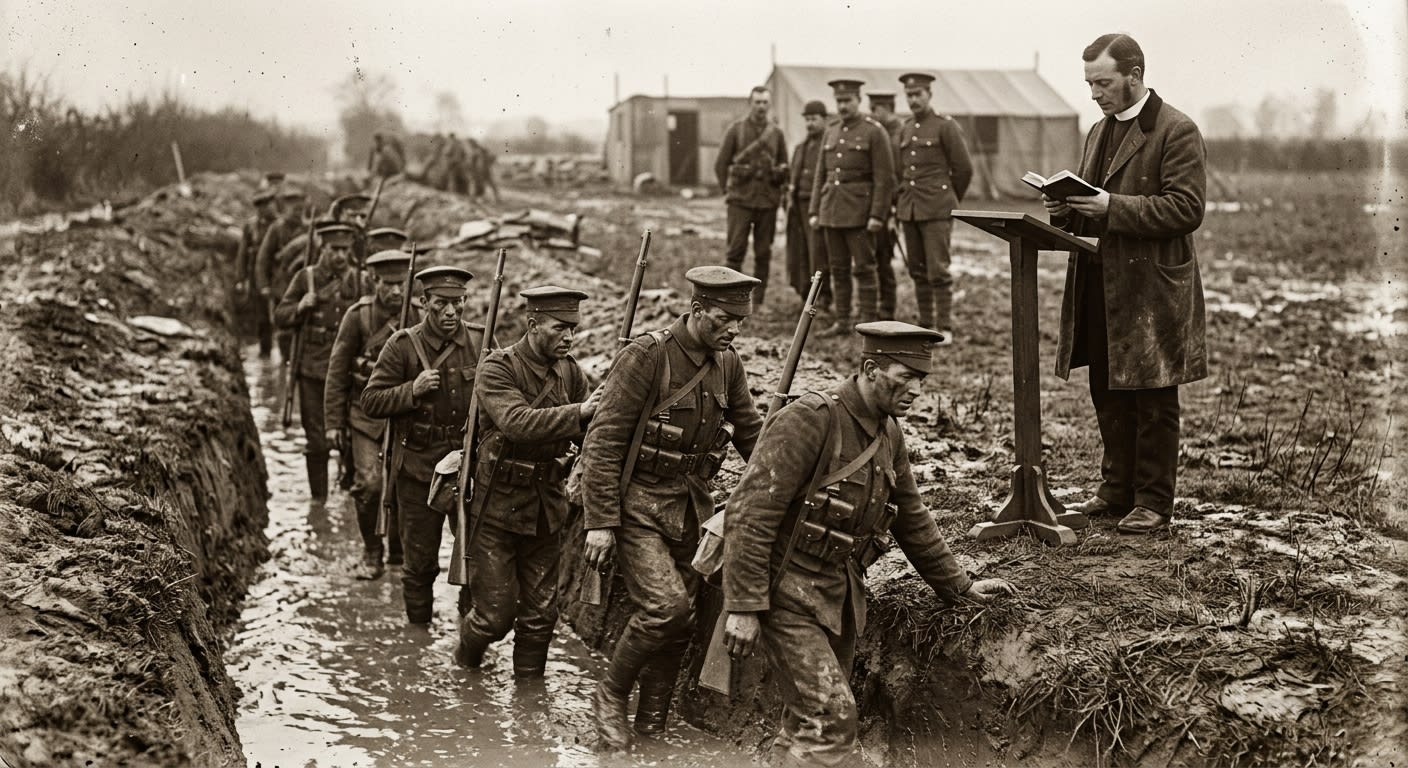
Each recruit is baptised. The The Bureau of War invented the rite; the Bureau of Conscription processes the paperwork. The conscript is marched into a flooded trench, submerged to the chest, and held there while a Tribune-Chaplain reads the Litany of First Earth. When he emerges, caked and gasping, he is pronounced a soldier of the Faith. The mud is not washed away for three days. It dries to a grey crust on the skin, and the Bureau considers this crust a sacrament. The Bureau of Conscription considers it a completed processing step and stamps the conscript's transfer document accordingly.
The catechism-barracks at Essen-of-Hymnsteel drill hymn-frequencies into the bone. At Brast, the chrismole furnaces burn day and night, and the recruits learn to march in time with the furnace-rhythm — a cadence that will keep them alive in the Line's bell-schedule, where every hour is somebody else's property. Farm-hands from Aquitaine. Fishermen's sons from the Dalmatian coast. Apprentice stonemasons from the Rhine valley with their hands still chalked white. Vintners' boys from Burgundy who had never held anything sharper than a pruning hook. The Bureau of Conscription does not record where they came from. It records where they went.
#On the Quota and Its Theology
The Continental Levy demands a tenth of every household's sons. The Bureau of War calls each renewal a "Continuation of the Original Grace," and the Bureau of Conscription calls each renewal an updated quota allocation — which is the same thing, expressed in language that admits what it means.
Quotas are set by province, adjusted by census return, and modified by the Bureau's own projections of attrition. A province that has lost heavily in the current campaigning season may receive a reduced quota — or an increased one, depending on whether the Bureau of Doctrine has classified the losses as "purifying sacrifice" or "punitive visitation." The first classification suggests the province has done well and deserves respite. The second suggests the province has done poorly and deserves to do better. Both classifications are applied retroactively, and the distinction is made by clerks who have never visited the province and who determine its spiritual condition by cross-referencing its tithe payments against its confession frequency.
The Bureau maintains regional offices at every major mustering centre — the Northern Conscription Office at Bastion-Königsberg, the Central Processing Yard at the Palatine Switchyard of Lorn, the Southern Intake at Saffron Bastion — and smaller depots in every city of meaningful population. Each office processes incoming quotas against outgoing casualty reports with a precision that the Bureau of Records envies and the Bureau of Mercy finds indecent.
Tour-of-duty assignments are the Bureau's second great instrument. A man conscripted for the Line serves until the Bureau releases him — which is to say, until death, disability, or a bureaucratic miracle I have never personally witnessed. Tour lengths are theoretically five years. In practice, the Bureau renews tours as the front demands, and the front demands without ceasing. A conscript who survives five years at Bastion-Constantinople is informed that his tour has been "extended by grace" and that the extension carries a partial indulgence that will reduce his time in Purgatory by an amount the Bureau of Doctrine refuses to specify. The conscript, standing in mud up to his shins, is expected to find this reassuring.
Transfers between bastions are administered with a speed that depends entirely on the Bureau's internal assessment of the transferee's value. Three members of an inspection team at Bastion-Constantinople who requested reassignment to Bastion-Brest had their transfers approved with unusual celerity — a detail I found notable, and which the Bureau of Conscription found unremarkable, and which the Bureau of Shadows found interesting enough to send me a note about. The note was blank. The note is always blank.
#On the Civic Cut
The Bureau of Conscription does not begin its work at the mustering field. It begins at the cradle.
The entire apparatus of civilian life within the Synod is, when viewed from the correct angle — which is to say, the Bureau's angle — a system for pre-processing future conscripts. The Lore Book calls this the Civic Cut: grinding every citizen until their rhythm matches the bells, their hunger mirrors the ration, their loyalty anticipates the catechism. By the time a boy reaches the mustering field, he has been marching in formation since he could walk. He has eaten in cadence since the age of five, trained in the Quiet Spoon discipline where to scrape a bowl is heresy and to clatter a utensil is treason. He has recited his parents' debts like psalms in the Procession of Receipts. He has played at saints and sinners in the Festival catechisms, pelting mock-heretics with sanctioned stones and learning that violence, correctly directed, is praise.
The Bureau does not call this conscription. The Bureau calls it harmonisation, which is a word that means "making a person into a component" and sounds considerably more pious.
The Festival of Ash Debts completes the circuit. Families present their ancestors' ashes in exchange for bread; those who cannot produce ashes are branded debtors and conscripted directly. The dead leverage the living. The family line becomes collateral. A man who has burned his grandfather's bones for bread cannot refuse when the Bureau arrives for his son — the transaction has already been made, the ink already dry, the ash already consumed. I attended one such festival. The smoke was so dense it blotted the sun. I wept — for the perfection of the system, you understand. The perfection.
#On the Present Condition
In A.S. 199, during the Fading Winter that struck the Candlewick Palatinate, a batch of Hungry Ink rewrote fourteen conscription orders across the River-belt. The affected orders changed the conscripts' destinations from Bastion-Przemyśl to a village that does not appear on any map the Bureau has published. Three of the conscripts were delivered there before the error was caught. The village, per the Bureau of Records, does not exist. The conscripts have not been recovered. The Bureau of Conscription has filed the loss under "administrative variance, non-recoverable."
This incident is unusual only in its specificity. The Bureau loses men constantly — to the front, to desertion, to the Pale Kin's false stillbirths, to the occasional mustering clerk who stamps a transfer to a destination he cannot pronounce and does not question. The system is vast. The system is imprecise. The system works because precision was never the point. The point is volume: sufficient bodies delivered to sufficient bastions at sufficient intervals to maintain a line that has not moved in decades and that the Bureau of War insists is on the verge of moving forward.
The Levy Seventh Renewal (A.S. 185) ████████ the quota from one in ten to ████████ in provinces classified under Martial Edict ████. The provinces affected include ████████████, ████████, and the entirety of ████████████████. The Bureau of Doctrine's ratification bore ████ seals instead of the customary two. The additional seals have not been explained. ████████████ households have been processed under the revised quota as of A.S. 200.
The Bureau of Conscription employs, at last count, eleven thousand clerks across seventeen regional offices and four hundred provincial depots. Its Levy Assessors travel the same roads as the Bureau of Tithes' Assessors, and the peasants who see them coming cannot distinguish between the clerk who takes their coin and the clerk who takes their children. Both wear grey. Both carry ledgers. Both are, in the eyes of a Rhineland farmer, the same indistinguishable hand of Strasbourg reaching into his house and taking what it will.
The Bureau's clerks are themselves conscripts, in a sense. No one applies to work for the Bureau of Conscription. One is assigned — transferred from Records, or Mercy, or occasionally Purity when a Purity clerk demonstrates insufficient zeal for interrogation but admirable precision with a counting-rod. The assignment is considered permanent. Bureau of Conscription clerks do not transfer out. They serve until retirement or until the Bureau determines that their handwriting has deteriorated beyond the threshold of acceptability, at which point they are reclassified as "field-eligible" and processed through the same mustering apparatus they spent their careers administering.
There is a joke in the Bureau's corridors — the only joke the Bureau tolerates, because it was written by a clerk who subsequently died at Bastion-Irongate and whose death therefore sanctified his humour: "The Bureau of Conscription does not end lives. It begins them. Elsewhere."
Earlier editions of this entry stated that the Bureau of Conscription was founded in A.S. 110, simultaneously with the First Continental Levy.
The Bureau was constituted in A.S. 112 to resolve the administrative disorder caused by the Levy's execution without dedicated processing infrastructure. The two years between decree and Bureau are classified "preliminary operations" and were, in every respect, indistinguishable from a disaster. The Bureau of Conscription considers this correction a matter of institutional pride. It prefers to be remembered as the solution, not as the absence that made the solution necessary.