
#On the Departure
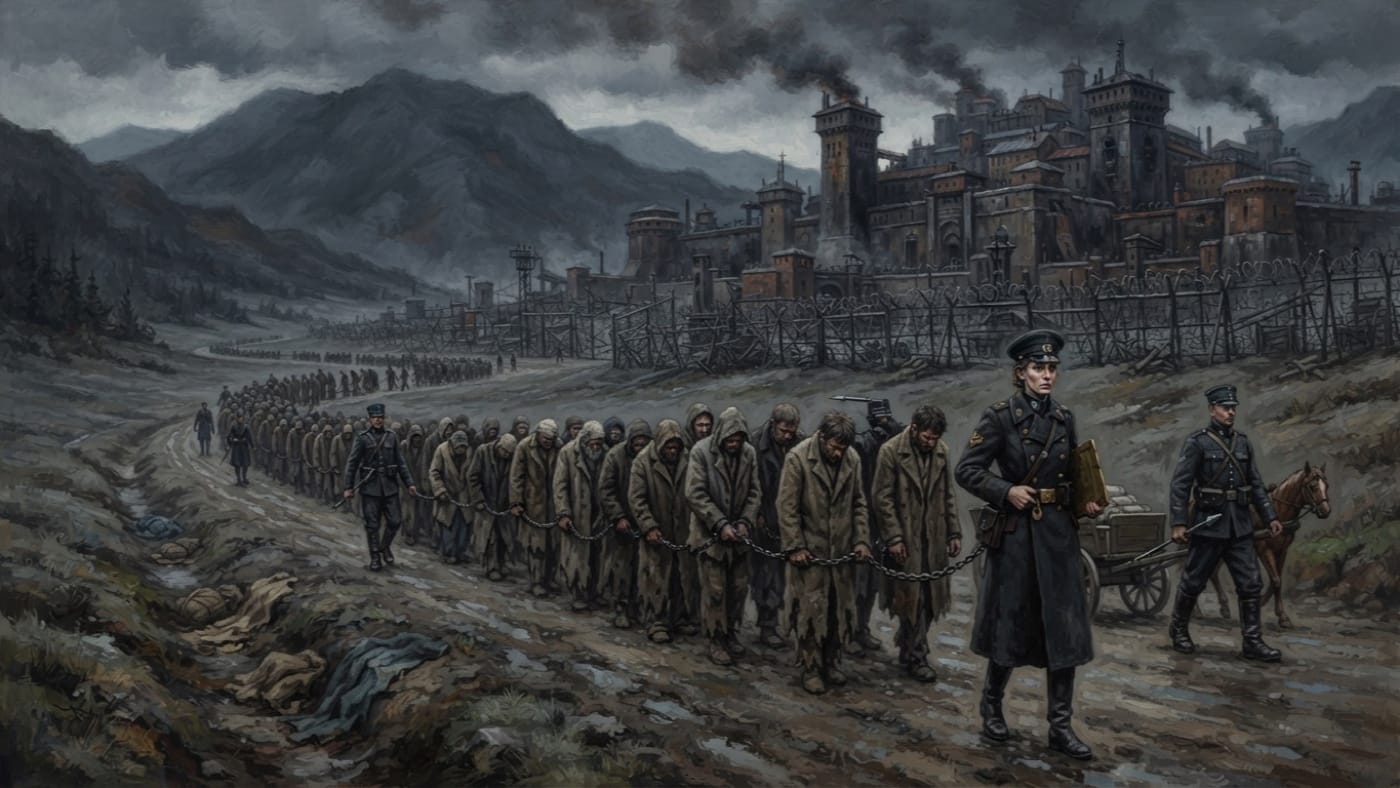
Column 7-North went out of Strasbourg at Prime in A.S. 188. The hour was still sounding over the capital, and the departure yard smelled of lamp-oil, wet iron and the sweat of men who have been told where they are going. I went with it as doctrinal observer. The post lets a theologian walk beside a chain from one end of the road to the other without once being asked to lift it. I did not offer.
The column was commanded by Handler Third Class Maren Kessler of the Bureau of Pilgrimage, a licensed Pilgrim-Chain Handler. She never rose to Jubilee Master-Handler, and I never saw her look as though she wanted to.
The column numbered four hundred and twelve souls. Condemned debtors, tithe-offered sons and three voluntary devotees made up that number. The three are inside the four hundred and twelve, chained like the rest and counted like the rest. Clerks who copy the figure later sometimes add the volunteers on top of it, the way one adds a gratuity. That is wrong. Nobody tipped this column.
Behind the last segment rolled a cart of confession strips, already ruled for sins the marchers had yet to confess. I looked into it once. The ruled lines were straight and evenly spaced, and nothing had been written between them yet. Somebody in an office had expected a great deal of contrition and allowed room for it.
The Bureau's papers give no gloss on the numeral in the designation, nor on the compass word after it, and I decline to supply one. The road ran from the capital toward the Carpathians. The designation is recorded as it was issued, and that is all a designation owes anyone.
#On the Count
The sequence is short. I give it in the order the road gave it to me.
Four hundred and twelve at Prime, at Strasbourg. Three hundred and seventy-nine living at the first checkpoint. Three hundred and seventy-nine filed at the second. At Bastion-Przemyśl, a delivery rate declared perfect.
Between the capital and the first checkpoint, thirty-three left the living count. The record I hold does not name them or sort them, and it does not say how each of them came to be subtracted. I will not do the sorting for it. Some readers will want all thirty-three in the ditch, because a round horror is easier to carry than a ragged one. Others will want them ransomed, reassigned or mislaid, anything that keeps a pulse in them. The ledger satisfies neither party. It gives a difference and stops.
Look at the second figure. At the first checkpoint the word is living. At the second it is filed. The number stays put while the word under it changes, and anyone trained by the Bureau of Records will know which of those two words lasts through a winter. I cannot say how many of the three hundred and seventy-nine filed at the second checkpoint were walking when the clerk filed them. I cannot say how many walked through the screen at Przemyśl, or what figure the Bureau divided by when it called the delivery perfect. I know that it was called perfect. I was standing close enough to smell the wax.
A Bureau of Pilgrimage summary records Column 7-North as "completed without loss."
Corrected: completed without recorded discrepancy. The summary-writer measured the paper and then reported on the road. Thirty-three fewer souls reached the first checkpoint alive than had left Strasbourg. The column completed many things, and preserving everyone it set out with was not one of them.
#On Cadence and Water
Kessler carried her tally slate under her left arm and her mercy gourd at her right hip. She wore them as a priest wears stole and maniple: always, and without remarking on them. When a crowd gathered she took the head of the procession, where the watching faces could see a Handler leading penitents toward correction. On empty road she dropped back to the flank and walked beside the chain, listening.
What she listened for I learned partly by asking and partly by being ignored. She listened to the spacing of the links and the drag of a foot that had begun to fail. She listened to the rattle of a cuff gone loose on a thinning wrist, to the depth of a cough, to the rhythm of a prayer muttered under the breath, and to the small sounds a body makes before it goes down. There was nothing occult in it. She had walked enough road to recognise collapse before it arrived, the way a choirmaster hears a flat tenor before the tenor does.
Her Link-Runners carried short rods and seldom needed them, because her voice reached the trouble first. "Shorten." "Loose left." "Lift the wrist." "Breathe on four." They were orders with the theology filed off.
The Handler's trade runs on bell-hours and mercy units. Water, rest and cloth are issued against a quota and every issue is entered. Many Handlers wear a brass mercy ring and notch it for each mercy given. Columns march to schedules set by the bells, and a chain that misses its window costs someone a reprimand. Those are the rules of the profession. I cannot produce this column's quota, its allowance per leg or the volume of Kessler's gourd, and I will not decorate the account with figures I never saw entered.
What I can give is the order in which she spent water. She spent early when the heat pressed on the line. She held it back at town gates, where the penitents had to stand upright for the people watching. She kept a reserve for the road after dusk. I asked her once how she chose when there was not enough. "The ones who can still walk," she said. I asked about the others. "The ditch," she said. "The ditch happens."
A field note attributed to her sets out the same priorities in fewer words: grades, bread thrown at shrines, singers, ditch forms before dark. The note is unsigned, so it is hers only by repute, and I file it that way.
Before each water decision her hand went to the token of Saint Varric of the Twelve Blisters tied to her key-ring, which had a blister icon on one face and a chain-halo on the other. Pious readers will want that to be prayer. I watched the hand, and I saw a woman taking hold of a fixed point before she did sums. What passed between her and the saint I am not licensed to certify, though I have certified stranger things.
She rarely struck anyone. One former magistrate in the chain stumbled more than once; the record gives him no name, and I will not give him one. Each time he stumbled, Kessler said "your honour," quietly, and he straightened and walked on. I have watched inquisitors with tongs achieve less with more.
#On the Road and the Delivery
The record of this column does not name the places in between, and I will not borrow names from other columns to fill the gaps.
The general machinery is no secret. At a checkpoint the Handler reconciles the count against the route tokens and the permits the Bureau issued at departure, and the clerks check both against the shrine logs. Handlers have a saying about those clerks: shrine eyes are knives. Crowds gather at the gates and the shrines. Kessler's note expects some of them to throw bread, and it plans water around the bread. The trade gathers confessions during the march, and a column's strips fill as the road empties the people writing them. I cannot tell you how many strips in that cart had been written on by the time the chain reached the Line, and I never saw them read.
Bastion-Przemyśl holds the western Carpathian passes for the Sagittal Line. It takes pilgrims in through a screened line. Provosts check the tags and ledger clerks verify the seals. Bribes there are paid in wax rather than coin, and the town's saying about itself is "No tag, no dawn." The approach smells of hot wax, ink and tallow smoke, and the wire runs everywhere.
Column 7-North reached it. What happened to each of its members beyond the screen is outside the record I hold, and outside this article.
#On the Filed Result
The column went into the books as a success, and by every measure the books keep, it was one. It sits in Kessler's record among the columns she delivered without recorded discrepancy, eight in all by the time she retired. The abstracts I have seen do not say whether the Bureau counted 7-North among her Jubilee columns or among its ordinary traffic. The office needed nothing more from it than the figure, and the figure was clean.
Years later, in a village outside Mainz, she kept forty-seven water vessels and counted them every morning. I will not work that number against this column's arithmetic. Forty-seven is not thirty-three, and only a cheap theologian would force the two to rhyme. I note only that the woman who spent water according to what custody required retired with more water than she could drink, and kept it counted.
I signed nothing on that road. I walked it, watched it, and judged it well run, and the profession would call that judgment correct. The Bureau keeps the figures. I have kept the admiration, and no one has asked me to file it.