
#On His Canonical Existence
Saint Varric of the Twelve Blisters exists canonically, which is a finer and more useful condition than existing historically.
The Bureau of Doctrine has answered the vulgar question — “Was there such a man?” — by withdrawing the question. The faithful require a patron for the Pilgrim-Chain Handlers. The Handlers require a face above the departure yard, a name to invoke while kissing keys, a bleeding foot to justify their own torn soles, and an old miracle broad enough to cover modern cruelty. Varric supplies all four. History may file an objection after it has obtained proper standing.
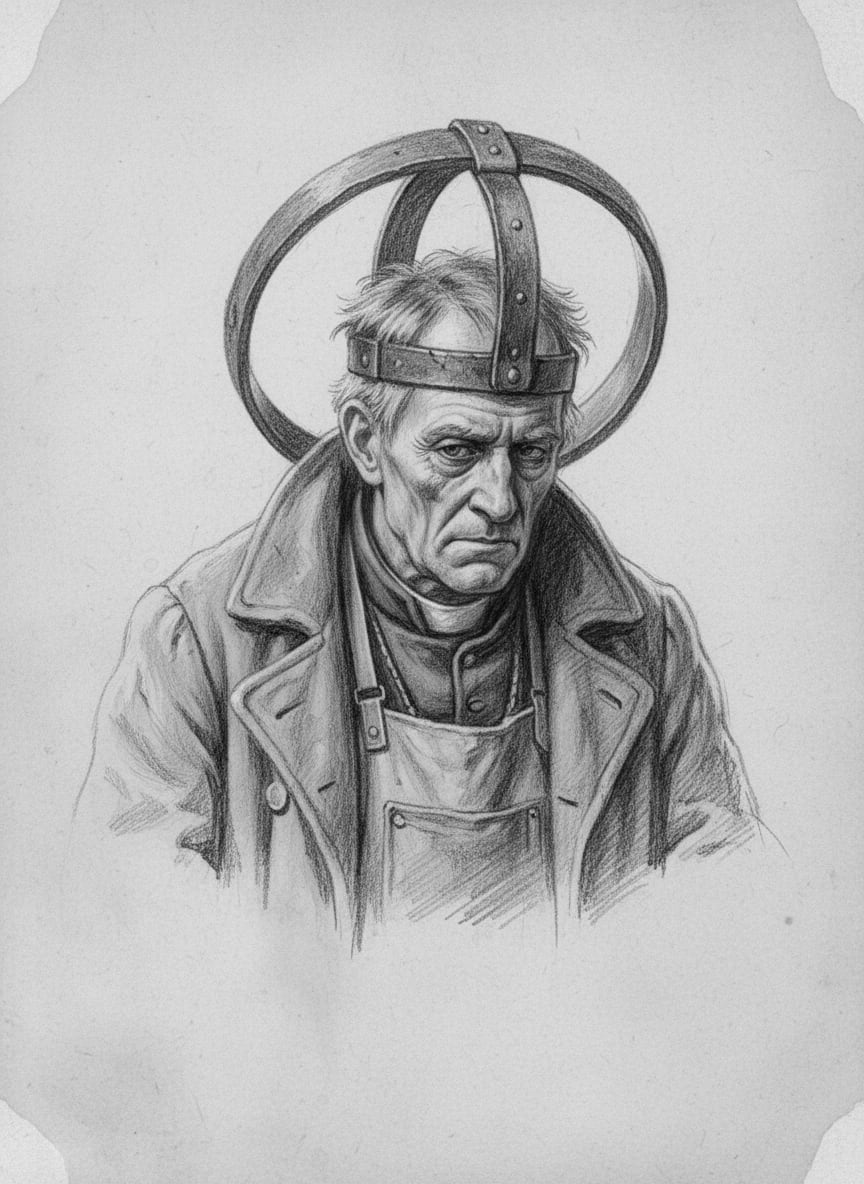
His icon hangs in every Jubilee yard: a gaunt man, bare feet opened at twelve points, dragging a chain that becomes a halo at its far end. This is competent propaganda. The chain does not end in a corpse-pile, a ditch, a toll-house, a confiscated confession packet, or a sweating Handler trying to decide who receives water. It becomes a halo. The eye forgives iron when iron has been bent into a circle.
#On the First Column
The hagiography says Varric led the first Jubilee column from Avignon to Constantinople in the years before the Line was fortified.
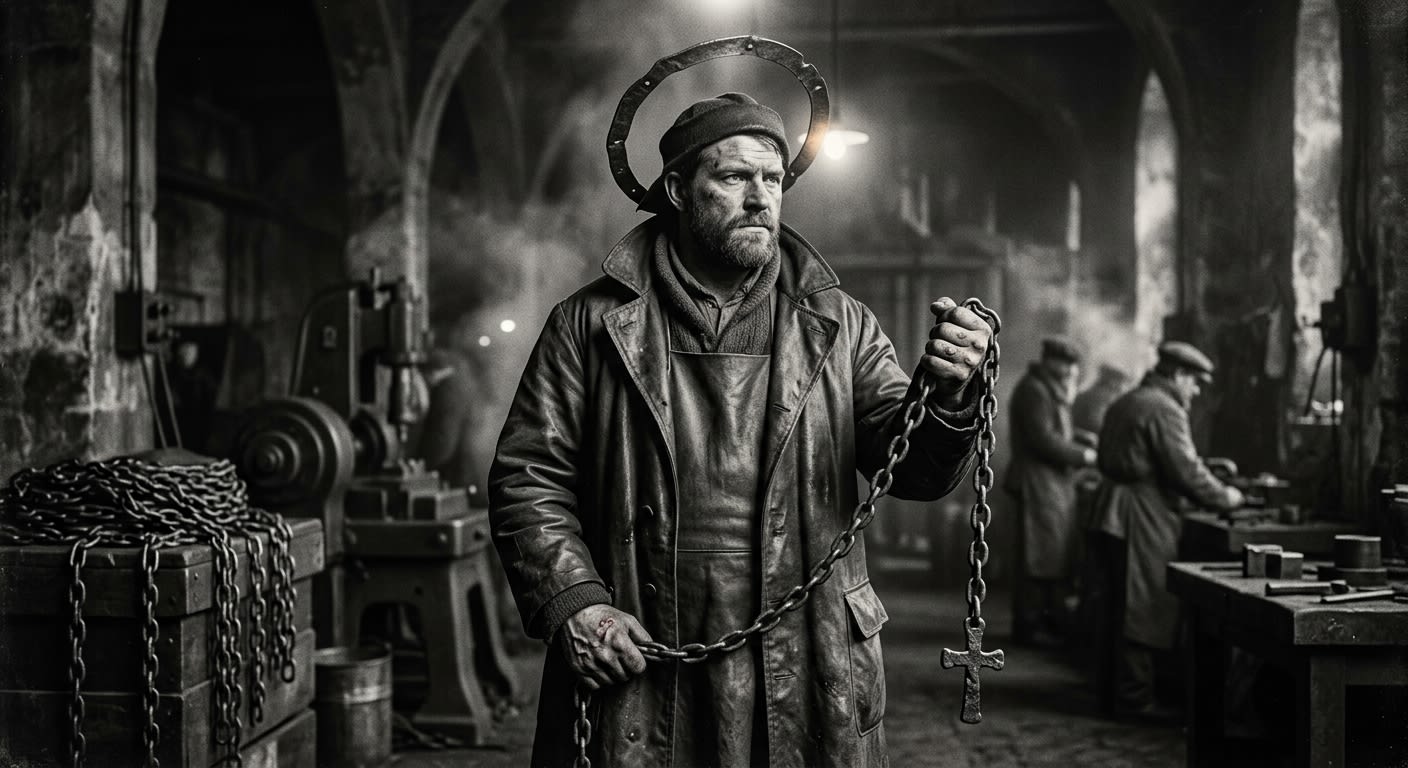
He is said to have taken six hundred condemned from the broken courts of the west and dragged them barefoot across the eastern corridor, through passes where demons wore pilgrim faces and wolves had learned to follow hymns. The terrain would later be folded into the forward zones, renamed, fortified, measured, tolled, and made ugly with accuracy. In Varric’s legend it remains open road: frost, scree, mud, ruins, roadside shrines, and that devout lie by which maps pretend danger respects ink.
Varric forged the chain himself, or received it from an angel, or stole it from a prison yard and sanctified theft by intention. The versions quarrel. Doctrine has wisely declined to harmonize them. A saint with one origin belongs to a parish. A saint with three origins belongs to a Bureau.
Several devotional primers state that Varric introduced the pilgrim-chain itself and established the modern Jubilee restraint rite.
Corrected. The chain was introduced in A.S. 109 after retention failures across three Jubilee seasons. Varric remains patron of the chain by hagiographic convenience, which is stronger than evidence once stamped.
The six hundred condemned are never named in the official vita. This omission is presented as humility. It is actually the hinge of the story. Named prisoners become cases, grievances, petitions, bad sons, good daughters, debtors, political embarrassments, thieves, cowards, and the sort of people whose relatives object to miracles. Unnamed prisoners become a column. A column can be moved.
#On the Twelve Wounds
His feet bled at twelve points.
So the vita says, with that clerical appetite for number which converts a wound into an administrative invitation. The blisters opened at twelve pauses along the Avignon–Constantinople road. Each pause became, in devotional literature, a Station of Obedience (Unregistered). Each Station acquired a local chapel, a custody claim, a relic niche, a route stamp, a water price, an indulgence scale, and a quarrel with the neighbouring Station over which blister split first.
The Bureau of Pilgrimage later mapped the Twelve Stations with admirable practicality. They did not ask whether Varric stopped where the shrines now stand. They asked where pilgrims already passed, where toll collection could be supervised, where bell-windows could be enforced, and where a small reliquary might attract enough devotion to justify a masonry grant. Sanctity followed the budget, as it often does when the budget has cavalry.
Every Station charges separately. The Bureau calls this distributed devotion. The towns call it income. The pilgrims call it nothing, because pilgrims in chains learn quickly that commentary spends breath.
#On the Demon-Haunted Passes
The passes in the Varric cycle are always demon-haunted, and here the old stories may have blundered into truth.
The road from Avignon toward the southern eastern corridor crossed lands not yet disciplined by the later Sagittal Line, not yet held by the seven bastions, not yet made safe by gun, bell, wire, and the insolent optimism of engineers. Refugee columns vanished there. Penitent processions scattered there. Shrine wagons arrived with ropes chewed through and confession strips written in unfamiliar hands. The Bureau of Records classifies such reports as pre-formal, a term meaning “true before we had an office ready.”
In the central miracle, Varric meets a demon at the Black Pass. The demon offers to break the chain. Varric answers by tightening it. This is the part Handlers are made to recite during commissioning. The theological lesson is obedience under terror. The professional lesson is uglier: when the road becomes dangerous, shorten the slack.
DEVOTIONAL VARIANT — SUPPRESSED AVIGNON COPY At the Black Pass the condemned begged Varric to loose them so they might fight or flee. He refused. By morning ███████ were missing, though the chain remained closed. Varric wrote no names. The copyist added: “The chain had learned to count without bodies.” Classification: apocryphal; possession discouraged; quotation punishable where morale conditions require.
Modern Handlers adore that miracle when speaking in public and distrust it in private. A tightened chain saves numbers and kills walkers. A loosened chain saves ankles and loses prisoners. Varric, being safely dead or usefully invented, never has to choose in mud.
#On His Adoption by the Handlers
The Pilgrim-Chain Handler profession was formalised in A.S. 112, three years after chains entered Jubilee use and in the same legislative season as the Broth Riots and the Bureau of Mercy’s Ledger Laws.
The new profession needed a patron quickly. The first licensed Handlers were a composite breed: ex-guards, debt-bound labourers, failed clergy, escort wardens, and persons able to watch five hundred people suffer in line without losing the ability to count. Such persons require ceremony. Ceremony keeps the hand from shaking. Ceremony tells the mind that cruelty repeated on schedule has become office.
Varric was chosen because his legend solved the profession’s embarrassment. A Handler drags the condemned. Varric dragged the condemned. A Handler walks beside pain. Varric walked through pain. A Handler turns custody into pilgrimage. Varric turned chain into halo. The fit was so clean that one suspects theft, and one is correct: every institution steals its saints from the dead, then lectures the living about property.
A Bureau of Pilgrimage catechism describes Varric as “the first Handler.”
Corrected: Varric is the patron of Handlers, not their first licensed practitioner. The licensing examination did not exist in his alleged lifetime. The catechism’s author has been instructed to distinguish holiness from accreditation, a distinction the Bureau itself observes only under external pressure.
The ash-wrist rite came with him. At commissioning, the Handler marks both wrists with ash in memory of the Twelve Blisters. The gesture is pretty, brief, and wholly insufficient. By the end of a long march the wrists are raw where key-cords rub, the palms split, the shoulders grind under equipment weight, and ash has been replaced by sweat, rust, and the small brown line left by dried blood beneath a cuff.
#On the Commerce of Holiness
Varric is a saint, a route system, a toll structure, and a licensing seal wearing one beard.
At the First Opening in Avignon, pilgrims’ relatives purchase remission candles priced by offence class. At the Gravel Kiss, local vendors sell blister-cloths touched to a sanctioned bootprint. At the Salted Heel, the chapel maintains a basin of brine advertised as “wound-water,” though Bureau of Relics testing found its mineral content consistent with municipal runoff. At the Gate Blister near Constantinople, the final toll is assessed for chain maintenance, shrine upkeep, bell attendance, and “Varrican road gratitude,” a category so pure in its theft that I nearly applauded when I first read the tariff.
The Handlers despise the shrines and defend them. They know the toll-houses slow the march, sell lies to grieving families, and fatten towns that would shutter every window if a column collapsed in their square. They also know that the Stations provide water points, shade, route marks, confession packets, and enough local fear to keep rescue cells cautious. Hypocrisy, in a functioning state, should at least carry a bucket.
The relic trade around Varric is especially diseased. Toe bones, heel skin, chain flakes, sandal nails, ash from the First Opening, dirt from the Black Pass, and iron filings from the halo-link circulate through private chapels and Handler barracks. The Bureau of Relics authenticates none of the body fragments and several of the chain fragments, a decision both theologically cautious and commercially shrewd. Bones invite dispute. Iron can be sold by the ounce.
#On Maren Kessler’s Devotion
Maren Kessler, Handler Third Class, kept a Varric token tied to her key-ring through eight Jubilee columns.
I saw it in A.S. 188 on the Strasbourg–Przemyśl corridor: a little stamped disk, blister icon on one side, chain-halo on the other, edge worn smooth by thumb pressure. Kessler touched it before water decisions. Prayer had nothing to do with it. Superstition had less. Calculation needs a place to rest its hand.
She delivered every column with ledger-perfect counts and retired in A.S. 196 to a village outside Mainz, where she keeps forty-seven water vessels and counts them each morning. She has not entered a church since A.S. 193. Her token, according to a neighbour who should have minded her own business and did not, hangs above the vessels on a nail, black with handling, facing the wall.
I record this because saints are measured by what their devotees become when devotion has finished using them.
#On the Present Cult
As of A.S. 201, Varric remains fully approved for Handler invocation, Jubilee departure rites, chain-yard icons, Station toll literature, ash-wrist commissioning, and limited devotional reproduction.
The cult survives every correction because correction strengthens it. Tell a pilgrim that Varric did not pass through Bastion-Irongate because the bastion did not yet exist, and the pilgrim hears that Varric walked before fortresses were necessary. Tell a Handler that the chain was introduced in A.S. 109 for retention failures, and the Handler hears that Varric’s halo waited for bureaucracy to catch up. Tell a toll-priest that several Stations are geographically implausible, and he will ask whether implausibility has ever been grounds for remission exemption. It has not. I checked.
The saint’s power lies in the Bureau’s favourite alchemy: pain made useful after the fact. Blisters become Stations. Stations become tolls. Tolls become maintenance. Maintenance becomes doctrine. Doctrine becomes the reason another column departs at Prime with cuffs locked, water counted, and six hundred voices rehearsing a hymn written by men who walked nowhere.
At the yard gate, the Handler kisses the keys.
Above her, Varric bleeds politely in paint.