
#Of Jubilee and Iron
"Sanctity is motion." — Bureau of Rites, Standard Directive, A.S. 94
The Jubilee is not a festival. I begin with this correction because the word has acquired, in the comfortable parishes of Zone 1, a certain carnival softness — coloured pennants, discounted indulgences, children waving flags along the processional route as the blessed pass by in white. The blessed do pass by. They are chained at the wrist. The white is the lime-dust they have been walked through since dawn. The children wave flags because the Bureau of Bells has instructed them to wave flags, and because the alternative — watching in silence — has been classified as "insufficient participation" since A.S. 142, when a village in the Rhineland corridor failed to applaud a passing column and was assessed a collective fine that bankrupted three guilds.
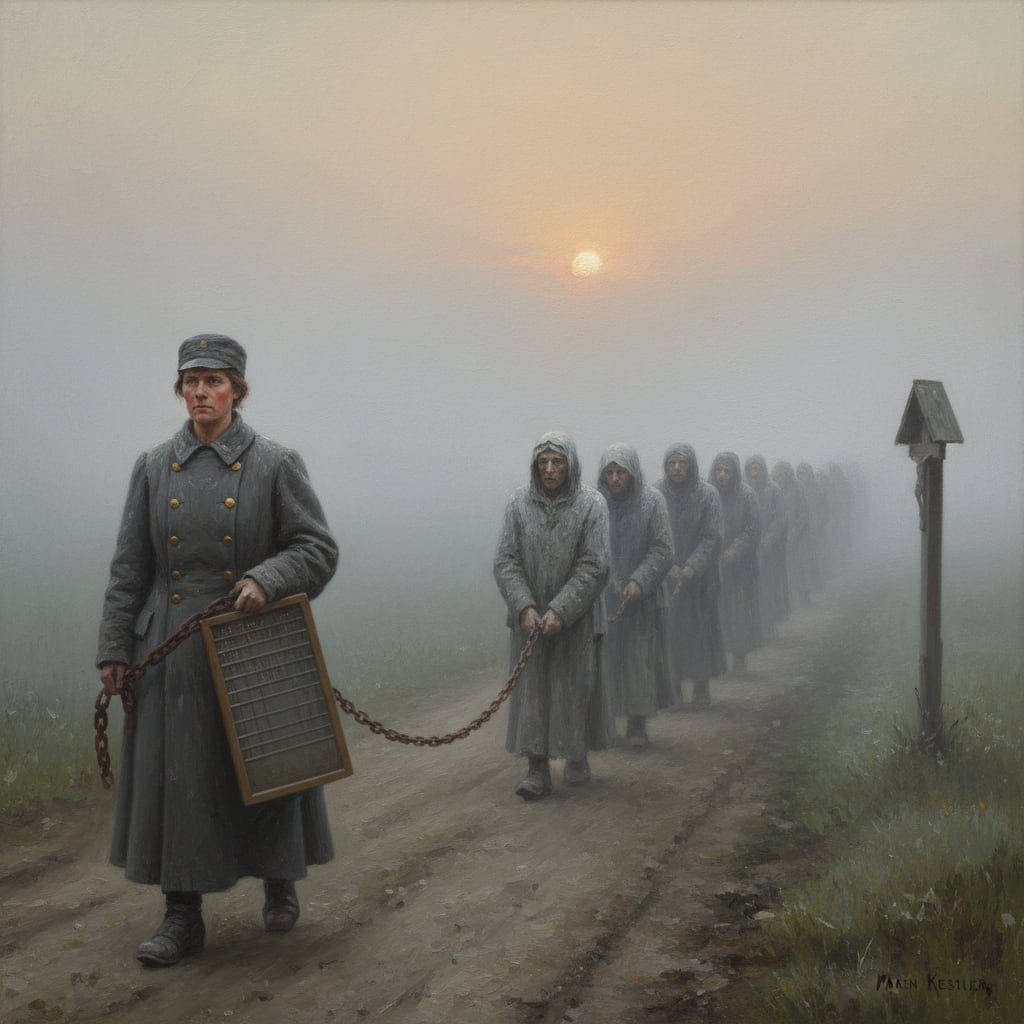
The Pilgrim-Chain Handlers are the men and women who walk beside the chains. Their title is formal: Jubilee Escort Warden, Penitence Conveyer, Chain Rite Officer, depending on which Bureau has filed the paperwork. The soldiers call them Linkmen. The pilgrims — when the pilgrims still have voices — call them Road-Whips, or Sanct-Butchers, or nothing at all, because by the third day of marching the pilgrims have learned that naming your captor does not improve the water ration.
I have walked behind a chain column. Once, on the Strasbourg–Przemyśl corridor, in the Jubilee of A.S. 188, as an observer attached to the Bureau of Doctrine's Audit Secretariat. The column numbered four hundred and twelve souls at departure. It numbered three hundred and seventy-nine at the first checkpoint. It numbered three hundred and seventy-nine at every subsequent checkpoint, because the Handler commanding that column — a woman named Maren Kessler, whose competence I will describe in due course — understood that the number filed at the first shrine must be the number filed at the last, and that the gap between the living count and the ledger count was a problem to be managed with ink, not with theology.
#On the Chain Itself
The chain (Unregistered) is not a metaphor. It is iron. Forged in the Bureau of Engineering's contracted foundries — the same foundries that produce shackle-links for the trench-line prisoner details and ankle-irons for the Bureau of Purity's mobile courts — the pilgrim-chain is a single continuous run of links connecting each member of the column at the wrist. Standard configuration is single-file for road marches, paired for bridge crossings, and what the Handlers call "centipede" for urban processionals where the public must see the maximum number of penitent faces per linear yard of street.
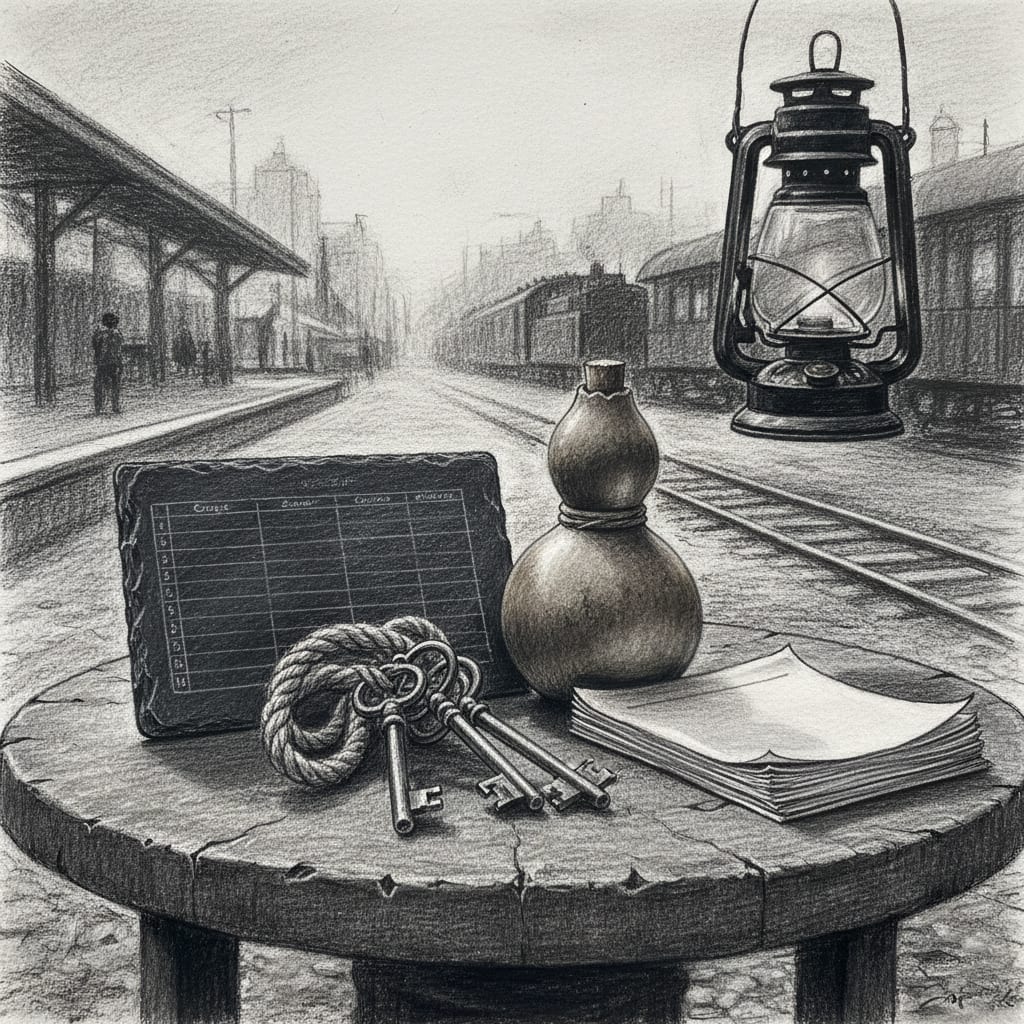
Each pilgrim wears a wrist cuff — not a manacle in the prison sense, though the distinction would require a theologian to articulate and a blacksmith to deny. The cuff is stamped with the pilgrim's route tag: name, offence class, destination shrine, and a serial number that corresponds to a line in the Handler's tally slate. The cuffs are locked with ranked keys. A Link-Runner carries the lowest-rank keys — sufficient to adjust a cuff's tightness, nothing more. The Chain Keeper holds mid-rank keys for segment disconnection. The Handler carries the master set, and the master set does not leave the Handler's person. It is tied to the wrist at night. It is kissed at morning inspection. If it is lost, the Handler's career ends. If it is stolen, the Handler's career ends and the Bureau of Purity arrives with questions that have no comfortable answers.
The pilgrims themselves are drawn from three sources: the condemned (heretics, debtors, apostates whose sentences include "penitential transport"), the volunteered (souls offered by their families in exchange for reduced tithes or commuted sentences), and the genuinely devout (rare, increasingly rare, and the Handlers treat them with the same suspicion they treat all anomalies — a willing pilgrim is either mad, an informant, or planning something).
#On the March
A column departs at the Bell of Prime — the first bell of the liturgical day — from a departure yard maintained by the Bureau of Pilgrimage in whichever city has generated sufficient condemned to fill a chain. Strasbourg's departure yard is behind the Cathedral of the Concordat, in a cobbled square the locals call the Iron Garden. The square smells of rust and old urine and the particular flavour of fear that seeps from four hundred people who have just been told they will walk for thirty days.
The Handler opens the day with a prayer that functions as an order. The prayer names the route, the destination, the expected cadence, and the mercy quota — the precise number of water stops, rest pauses, and bandage distributions allocated for the day's march. These are counted. They are logged. Every cup of water poured from the Handler's mercy gourd is entered on the tally slate with the recipient's tag number, and the slate is inspected at every checkpoint by a Route-Stamper whose only concern is that the numbers agree.
The cadence is everything. A column moves at the pace of its slowest member, and the slowest member moves at the pace of the Handler's patience. A skilled Handler — and Kessler was skilled in the way that a surgeon is skilled, which is to say her competence was inseparable from her capacity for measured cruelty — sets a rhythm that keeps the chain taut without snapping it. Too fast and the weak collapse, the chain jerks, and the whole column stumbles into a pile of iron and screaming flesh that takes an hour to untangle and costs three bodies. Too slow and the schedule slips, the checkpoints are missed, the bells at the destination shrine toll for an empty road, and the Bureau of Bells files a discrepancy report that generates more paperwork than the deaths would have.
The march follows the Pilgrim Roads — a network of sanctified routes maintained by the Bureau of Pilgrimage, marked with shrine-posts at each bell-hour's distance, and patrolled by the same Route-Stampers who inspect the mercy tallies. The roads pass through towns that have learned to treat the columns as they treat weather: unavoidable, occasionally destructive, and best observed from behind closed shutters. The towns that line the corridor between Strasbourg and the eastern bastions have grown accustomed to the sound of four hundred sets of feet and four hundred sets of chains moving through their market squares at dawn, and the shopkeepers have learned to display their wares on the side of the street the column does not use, because a chained pilgrim who smells bread will lunge for it, and a lunge in a chain column is a wave that does not stop until someone falls.
#On the Checkpoints and the Confession Harvest
Every shrine along the route is a checkpoint. The column halts. The Handler presents the tally slate. The Route-Stamper counts heads. The numbers must match. They always match, because the Handler has spent the miles between shrines ensuring they match — adjusting the slate where the slate can be adjusted, adjusting the column where the column must be adjusted, and relying on the ancient bureaucratic principle that a number written in confident ink is more real than a body lying in a ditch.
At each shrine, the pilgrims are offered confession. "Offered" is the Bureau's word. The pilgrims kneel on stone, still chained, and speak their sins to a shrine-priest whose primary function is to transcribe, not to absolve. The confessions are gathered on strips — thin sheets of vellum pre-ruled for efficient recording — and bundled into packets that travel with the column to its destination, where the Bureau of Records files them according to a system I have described elsewhere and do not intend to describe again, because describing it once cost me a week's sleep and a friendship with a Records clerk who felt I had been insufficiently appreciative of the filing methodology.
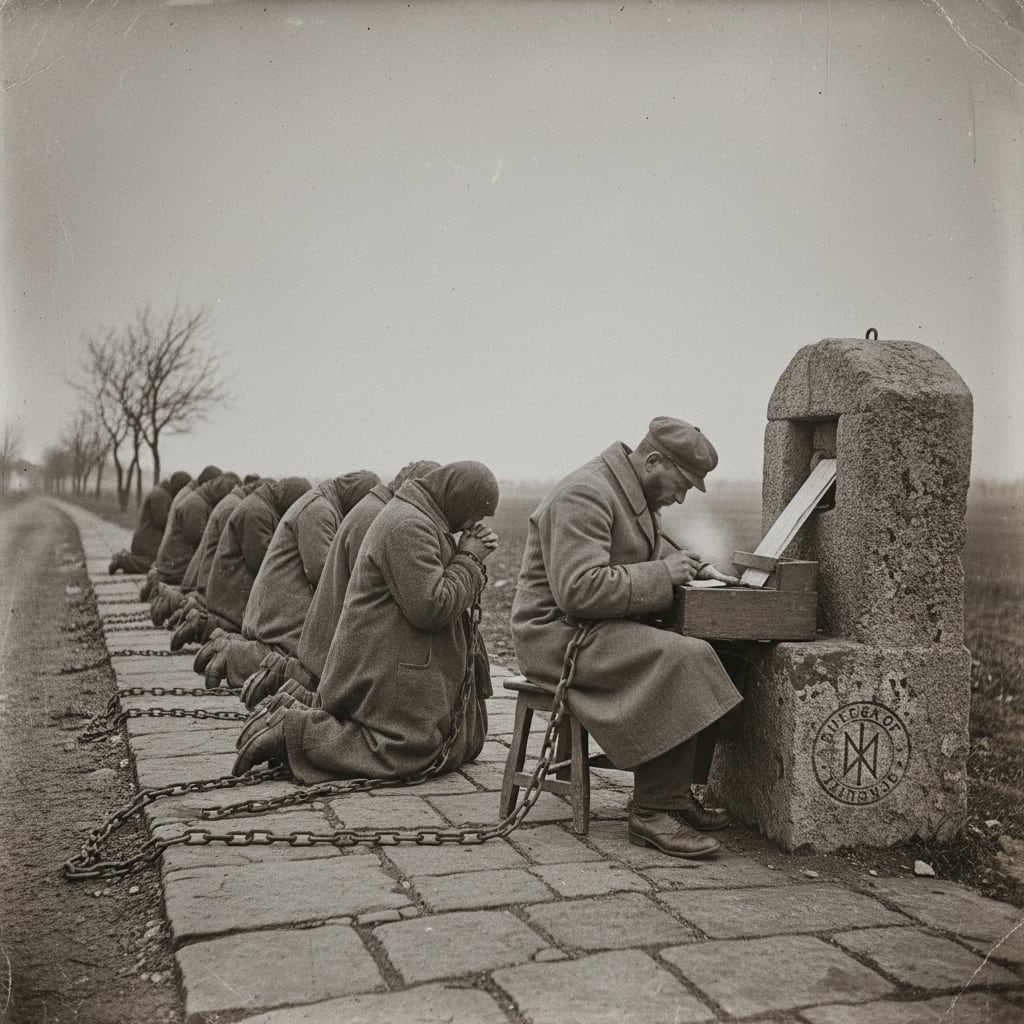
The handlers are not priests. They are not authorised to hear confession, grant absolution, or perform any sacramental act. Their role at the shrine is logistical: ensure the pilgrims kneel, ensure they speak, ensure the strips are collected and sealed. If a pilgrim refuses to confess, the Handler notes the refusal on the tally slate. A refusal at one shrine is a mark. A refusal at three shrines is a transfer to the Bureau of Purity's attention, which is a transfer from which pilgrims do not transfer back.
#On Saint Varric of the Twelve Blisters
The profession's patron is Saint Varric of the Twelve Blisters, whose icon hangs in every departure yard and whose legend is recited at every Handler's commissioning. The icon shows a man dragging a chain that transmutes, at its far end, into a halo. The man's feet are bare and bleeding. His expression is serene. The chain is very long.
Saint Varric — if he existed, and the Bureau of Doctrine has answered this question with the word "canonically," which means the question is no longer a question — is said to have led the first Jubilee column from Avignon to Constantinople in the years before the Line was fortified, walking barefoot across terrain that would later become Zone 5 (Unregistered), dragging six hundred condemned through demon-haunted passes by nothing more than faith and an iron chain he had forged with his own hands. His feet bled at twelve points. The twelve points correspond, in the devotional literature, to the twelve Stations of Obedience (Unregistered), which the Bureau of Pilgrimage has helpfully mapped onto twelve shrines along the Avignon–Constantinople route, each charging a separate toll.
An earlier edition of this entry identified Saint Varric's route as passing through Bastion-Irongate.
Bastion-Irongate did not exist during the period attributed to Saint Varric's pilgrimage. The route has been revised to "pre-fortification eastern corridor, designation pending." The twelve shrines continue to charge their tolls regardless.
The Handlers invoke Varric at morning assembly. They kiss their keys. They mark their wrists with ash — a gesture that mimics the blisters, though the Handlers' blisters are real enough without mimicry, because iron chain and summer sun and thirty days of marching produce blisters that no hagiography needs to embellish.
#On the First Jubilee Flight and the Road-Mercy Scandal
The chains were not original to the Jubilee. The first Jubilees — A.S. 94 through A.S. 108 — were unchained processions in which the condemned walked freely under oath and escort, trusting in the sanctity of the road and the vigilance of the guards. The sanctity held. The vigilance did not. Thousands of "pilgrims" vanished into sympathetic towns, swelling heretic cells from Zürich to Kraków, and the Bureau of Pilgrimage's delivery statistics collapsed so thoroughly that the Bureau of Records — never an institution to let another Bureau's failure go unremarked — published a comparative analysis showing that the Jubilee's penitent-retention rate was lower than the Bureau of Mercy's soup-kitchen attendance rate, and that both were lower than the desertion rate of the Bureau of War's conscript battalions, which at least had the excuse of being shot at.
The chains were introduced in A.S. 109. The Handlers were formalised as a licensed profession in A.S. 112, the same year the Bureau of Mercy codified its Ledger Laws after the Broth Riots, because A.S. 112 was the year the Synod discovered that every problem could be solved by counting something and punishing the discrepancy.
The scandal produced the mercy quota system that persists to this day: every unit of water, every minute of rest, every strip of bandage is pre-allocated by formula, logged on the tally slate, and verified at checkpoints. The formula accounts for column size, route distance, season, and a variable the Bureau of Pilgrimage calls "spiritual resilience coefficient" and the Handlers call "how many we expect to lose." The formula has not been revised since A.S. 141. The routes have grown longer. The columns have grown larger. The formula has not.
#On the Bellway Harmonisation
The Jubilee routes were aligned to the Bureau of Bells' acoustic network during the Harmonisation of A.S. 148 — a bureaucratic achievement that the Bureau of Bells considers one of its finest and the Handlers consider one of their worst. Before the Harmonisation, a column moved at its own pace, arriving at checkpoints when the road permitted. After, every column was required to reach designated shrine-posts within specific bell-windows — the tolling of a bell at the origin shrine triggering a countdown that the column must satisfy by reaching the next shrine before its bell fell silent.
The system is elegant on paper. The Bureau of Bells can track every column's progress acoustically, without riders or signal-fires, simply by listening for the sequential tolling of shrine-bells along the route. A column that falls behind schedule produces a gap in the bell-sequence. A gap triggers an inquiry. An inquiry triggers the Bureau of Purity. The Handlers learned quickly that a missed bell was worse than a dead pilgrim, because a dead pilgrim could be explained with ink, and a missed bell could not be explained at all.
█████████████████ [REDACTED — Bureau of Bells, Operational Security] █████████████████ acoustic tracking of Jubilee columns was used during the A.S. 170s to identify and neutralise three heretic rescue operations that had been intercepting columns between shrine-posts. The method of identification is classified. The method of neutralisation is ██████████. The rescue operations ceased.
#On Chain-Sickness and the Handler's Cost
A Handler who works five Jubilees is a veteran. A Handler who works ten is a ruin.
Chain-sickness is not in the Bureau's medical lexicon. The Bureau of Mercy's physicians do not recognise it. The Handlers recognise it the way soldiers recognise shellshock — by the symptoms they cannot name and the Bureau will not fund. The key-checking compulsion: testing the locks twelve, fifteen, twenty times a day, long after the column has been delivered and the chains have been returned to the depot. The counting: footsteps, breaths, heartbeats, the ticking arithmetic of a mind that has spent years reducing human suffering to numbers on a slate. The flinching at hymns, because hymns on the road are forced from broken throats and a Handler hears the forcing long after the Jubilee ends. The water-hoarding — veterans who cannot pass a well without filling a vessel, who sleep with a gourd beside their pillow, who flinch when someone spills a cup.
The Handlers know what they are. The profession attracts ex-guards, failed clergy, debt-bound labourers "laundered" into legality through Jubilee service, and — most dangerous — true believers who see the chains as sacrament and the suffering as divine arithmetic. The true believers do not develop chain-sickness. The true believers sleep soundly. The rest drink, or count, or stare at walls, or request transfer to gate-work where the only chains are on the doors and the only screaming comes from outside.
A previous edition of this entry described the Pilgrim-Chain Handler profession as "a vocation of sacred correction, uniting discipline and mercy in the service of the Jubilee rite."
The description was supplied by the Bureau of Pilgrimage's Public Information Office. It has been replaced with: "A profession." The Bureau of Doctrine has approved the revision. The Bureau of Pilgrimage has filed a formal objection. The formal objection is in the appropriate ledger, which is to say it is nowhere anyone will read it.
#On the Ditch
Every route has ditches. The Bureau of Pilgrimage does not call them graves. They are "roadside reclamation points," and the bodies deposited in them are not dead pilgrims but "penitents whose journey was completed by divine acceleration." The paperwork for a ditch-deposit is a single form — Form 17-C, Cessation of Ambulatory Penitence — signed by the Handler, countersigned by the nearest shrine-priest, and filed with the column's tally slate at delivery. The form does not ask how the pilgrim died. The form asks only whether the death occurred "within scheduled parameters."
The Handlers carry the forms pre-filled. The date and the tag number are left blank. Everything else — the cause ("spiritual completion"), the disposition ("roadside consecration"), the notification status ("next of kin informed per standing directive," which means no one is informed, because the next of kin filed the pilgrim onto the chain in the first place) — is printed in advance, because the Bureau of Pilgrimage discovered long ago that requiring Handlers to write the word "spiritual completion" three hundred times per Jubilee was an inefficient use of ink.
The ditches are consecrated in bulk by a shrine-priest riding the route after the column has passed — a man on a donkey with a censer and a bell, blessing the dead at a trot, because the next column is a day behind and the ditches must be sanctified before they are filled again. The consecration is genuine. The Bureau of Rites has confirmed this. The dead, having been walked to death in chains for sins they may or may not have committed, rest in holy ground that was holy for approximately four hours before the next Jubilee column's casualties were added to it.
The Synod calls this mercy. The Handlers call it the job. The pilgrims — those who survive — call it nothing, because survivors of the Jubilee chain do not speak of the road, and those who do speak of the road are not believed, and those who are believed are silenced, and the silence is filed in the appropriate ledger, and the ledger is sealed, and the seal bears the stamp of the Bureau, and the Bureau endures.