
#On the Raised Ways
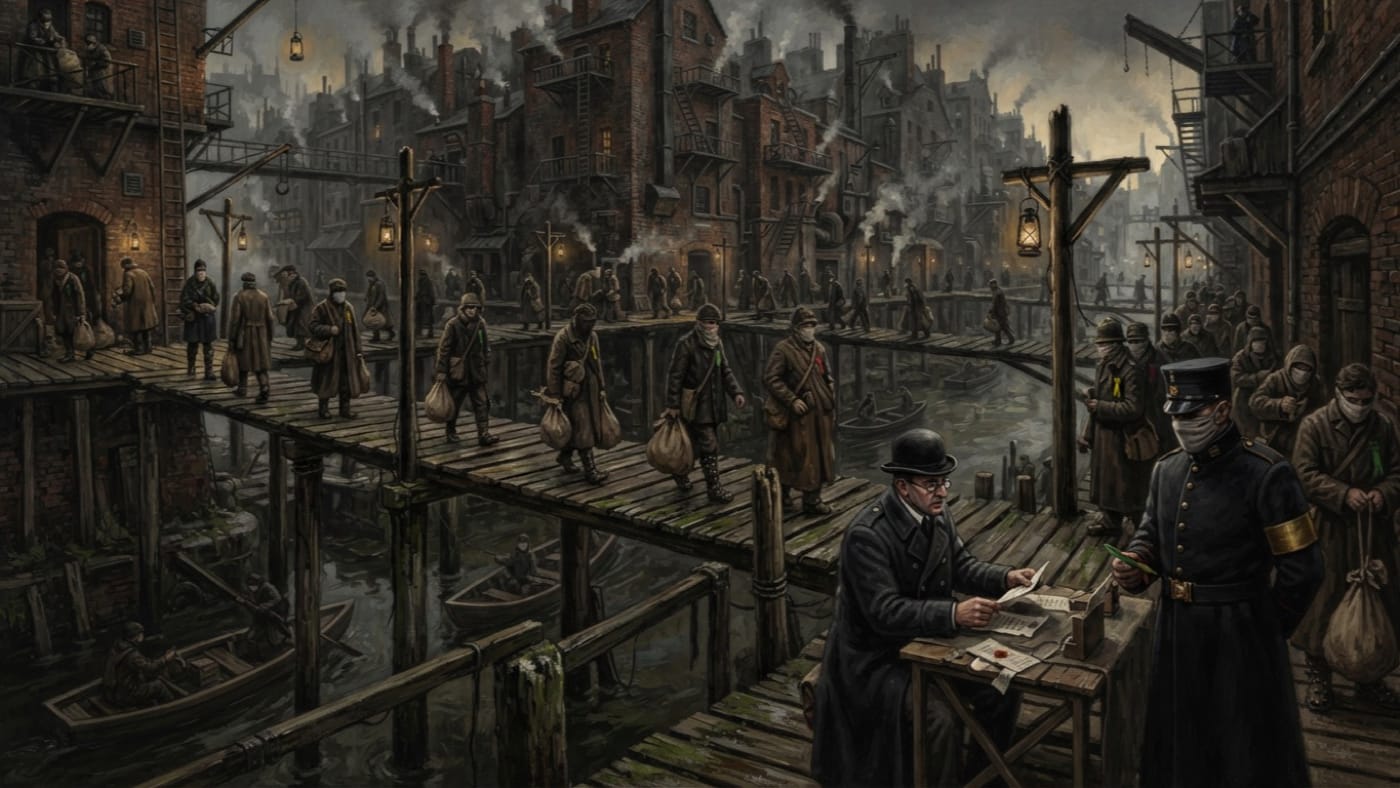
The Coughwalks are a ward of Candle-Sump built out of planks. That is the whole of the civil engineering, and I state it first so that no reader arrives expecting arches. The other seven wards of the Candle-Sump District sit in the wet, on it, or under it. The Coughwalks stand a little above it: plank roads carried over the flood line, so that a person may cross the lowest quarter of Lower Vire without wading through what the Ash-Sluice crews wade through for wages.
A little above. The phrase is exact. The planks lift the boot clear of the water, and they leave the lung exactly where it was. Damp climbs the posts. Mildew works the boards from beneath, and so the ward smells of mildew and boot-leather in roughly equal measure, the second being the smell of the first being walked on. My published assessment of the district called the air here "merely unpleasant rather than actively injurious." I stand by merely. It is a relative term, and in the Sump every term is measured against the canal.
#On Footing and Passage
The district lies along the inner bend of the Vire, in Zone 1, deep in the River-belt heartland, so far from the Line that its wars are fought with ration chits. It is reclaimed marsh, brick canals, locks, floodwalls, and a quarantine cordon that moves weekly and consults no one. One enters by lock-gate checkpoint, by canal skiff, by the floodwall stairs, or by the service ladders let down from the upper wards. The Coughwalks are what a person stands on after the stairs and before the next decision.
The traffic divides itself. Skiffs carry cargo. Gate carts carry whatever the gates permit. Broth wagons go under the guard of the Care crews, and anyone with a reputation worth keeping steps aside for them. The planks carry runners: the runner-boys of the Sump, who move messages, receipts and errands faster than the drain-water moves anything. I have seen no survey of the load the boards will bear, and I will not supply one. A man with a sack is a man with a sack. A man with a cart on the Coughwalks is asking the planks a question they have never answered in writing.
I possess no measured plan either. Every runner knows where the planks meet the canal ladders, the gate catwalks and the stair landings. No ledger I have been shown records it. I will not draw from rumour a map that the Bureau of Records would then be obliged to believe.
No founder is recorded for the walks. They have no year and no first nail. They are as old as the district's need to cross itself dry, and the district keeps that history in flood-scars on its brick, which are harder to file than paper.
#On the Reading of Travellers
"The Sump is the city's cleansing hand." — Sluice Prefecture, public line
Height earns no exemption from inspection. Three offices read the person on the planks, and each reads a different page of him. The Sluice Wardens ask for the permit. The Bone-Tag clerks ask for the receipt, that small instrument by which the district's dead reach the Great Ledger and the living prove they are not yet among them. The Quarantine Provosts answer jointly to the Sluice Prefecture and the Bureau of Purity, and they read the ribbon: green for passage, yellow for restriction, red for confinement, and black for what the Provosts call "concluded assessment." A ribbon grants a permission and carries a threat. What it tells you about the lungs underneath is another matter, and no Provost has yet been trained to ask.
Custom supplies what statute omits. The traveller shows clean hands. The tag receipt is presented in both of them, held out flat. If the traveller has any sense, the receipt has spent the journey in a wax-sealed sleeve, because damp paper looks careless and a fuzzed edge invites the clerk to read it as forged. The cough-mask, worn from the twelfth year, is touched by no one but its wearer. A soap stone in the pocket is the nearest thing the Sump has to a letter of good character.
A valid name on a dry receipt walks on. A doubtful name walks on more slowly, and pays in tallow, soap or clean paper for the privilege. Bribes are taken on the planks as they are taken everywhere else in the district. Certain goods remain beyond any Provost's price, and the quarantine clear is first among them. A counterfeit ribbon can be had in the alleys. The wearer who is caught with one learns how quickly a black ribbon can be tied.
Prefect Sera Mott's gate timings decide when the walks fill and when they empty. Chief Clerk Dalen Voss's seals decide whether a receipt is a receipt. Matron Ilka decides, by way of the kitchens, whether the traveller has eaten enough to stand up straight while being read.
#On the Night Walks
Curfew narrows the floodwall gates, and the crypt-mouth zones go quiet. Lanterns are rationed in the Sump as everything combustible is rationed, and they go out street by street until only the patrol routes keep any. The patrol routes are the Coughwalks. Anyone who has tried to pursue a man across a canal in the dark knows the reason: in this ward the planks are the only ground that stays ground. A provost squad on the boards can see along them, hear along them and, when it wishes, close them.
The Washhouse opens at night. Its territory runs into the Coughwalk alleys, the gaps and side-ways and doors that open off the planks into rooms where nothing resembling linen is laundered. Identity slips change hands there. So do forgeries, blackmail, and the instructions that tell a runner which way to turn. The patrol walks the planks and the cartel works the alleys beside them, and the arrangement has the stability of two clerks who share a desk and despise each other.
I make no claim that the Washhouse owns the walks, or that every lantern on them answers to the Provosts. Disappearances in Candle-Sump rise after dark. The lit planks and the dark alleys lie side by side. The Bureau has placed those two facts in the same folder and has drawn no finding from them.
#On Breath and Paper
Rot-lung follows the damp, and the planks are damp. The disease takes clerks first, and the walks carry the clerks' errands, so the cough of this ward is the district's cough heard from a little higher up. The masks are good manners. Salt lines and bone beads are laid and worn by people who need something to do with their hands. No Bureau has certified either as a cure, and I certify nothing on their behalf.
The crypt-route drafts rise through the district's vent alleys and maintenance shafts. They carry rot-spores and the faint syllables the residents call name-whispers. The residents keep their own record of where the drafts reach, corner by corner: here the coughing worsens, there a receipt fuzzes, and somewhere else a candle gutters in a shape one declines to read. I have been shown no official survey naming any corner of the Coughwalks among them, and I name none. The Bureau of Purity's classification covers the district's atmospheric-scribal disturbance as a whole. It has given the walks no anomaly of their own. Runners avoid what they avoid. The Bureau files what it files.
Some of the slips that pass through the alleys are cleaner than street forgery has any right to be. The district entry traces them to a registry below the crypt mouths and to a hand that remains unnamed. It remains unnamed here.
"The Synod sealed the crypt mouths. The seals hold." — Candle-Sump District entry, On the Crypt-Route Drafts
A seal shows only that a door was closed. The same entry, in its account of the shadow registry, records that the underworks is maintained. What goes on behind a sealed door is beyond the competence of wax. This correction reports no breach in the Coughwalks.
#On the Present Condition
The Candlewright Compact has declared a wick blight and tripled its prices. Lantern rations on the walks were never generous, and at triple the cost they have become a theological position. The patrol routes keep their lights longest because someone is paying for them. The alleys go dark first.
The Registry and the Sluice Prefecture dispute ownership of the clean slips seized in the district. Every seizure begins with a receipt read on some plank by some officer whose office is, that week, contested. The Care crews threaten to strike if rations are cut again. A hungry runner is slow, and a hungry provost is cheap. Reports of rot-lung and of blue-burning candles have both risen, and the Provosts cannot tell an outbreak from a neighbour with a grievance.
A transfer order for Inquisitor Halvyr, called White-Lung, is making its way through the Bureau of Purity's approval chain. He is reported to carry a portable audit press and burn authority. He has not arrived. If he does, the planks will carry him. They carry anyone who can walk.